PUBLISHER: Global Market Insights Inc. | PRODUCT CODE: 2038771

PUBLISHER: Global Market Insights Inc. | PRODUCT CODE: 2038771
White Mulberry Leaves Extract Market Opportunity, Growth Drivers, Industry Trend Analysis, and Forecast 2026 - 2035
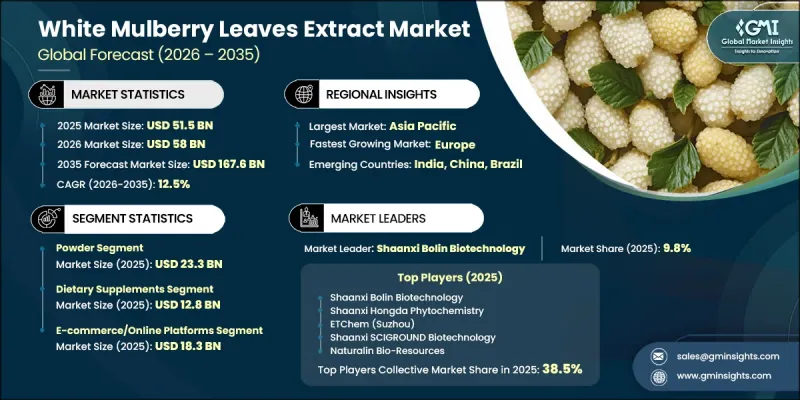
The Global White Mulberry Leaves Extract Market was valued at USD 51.5 billion in 2025 and is estimated to grow at a CAGR of 12.5% to reach USD 167.6 billion by 2035.
White mulberry leaves extract is a natural botanical ingredient derived from the leaves of Morus alba through advanced extraction techniques that concentrate its bioactive compounds. Its rich composition, including flavonoids, alkaloids, and polysaccharides, provides strong antioxidant activity and metabolic health benefits, making it highly valuable for wellness-focused formulations. The ingredient is widely utilized across dietary supplements, cosmetics, and pharmaceutical applications due to its role in supporting blood sugar regulation and overall metabolic balance. It also resists oxidative stress and contributes to UV protection, enhancing its suitability in skincare and therapeutic products. Growing consumer preference for clean-label and naturally derived ingredients is further accelerating adoption. Continuous advancements in extraction technologies are improving purity, potency, and bioavailability, enabling manufacturers to develop more effective and standardized formulations for diverse applications.
| Market Scope | |
|---|---|
| Start Year | 2025 |
| Forecast Year | 2026-2035 |
| Start Value | $51.5 Billion |
| Forecast Value | $167.6 Billion |
| CAGR | 12.5% |
The white mulberry leaves extract market is also benefiting from increasing innovation in extraction and processing techniques that enhance product quality and consistency. Modern technologies are enabling better control over active compound concentration, improving functionality across different applications. The ingredient is gaining wider acceptance due to its adaptability in various formulation types and its compatibility with both food and wellness products. Manufacturers are focusing on improving extraction efficiency and scalability to meet growing industrial demand. As consumer awareness around preventive health continues to rise, demand for plant-based bioactive ingredients is expanding steadily. This is further encouraging research into novel applications across nutraceutical, cosmetic, and pharmaceutical sectors, strengthening long-term market potential.
In terms of product form, the powder-based white mulberry leaves extract segment generated USD 23.3 billion in 2025. This segment continues to grow due to its high versatility and ease of integration into dietary supplements and functional food formulations. Advances in drying and processing techniques have improved concentration levels and product stability, making powder extracts highly efficient for large-scale manufacturing. Their extended shelf life and formulation flexibility further support their widespread use across multiple industries.
By application, the dietary supplements segment reached USD 12.8 billion in 2025. This segment is expanding rapidly due to increasing consumer interest in natural solutions for metabolic health and blood sugar management. Strong demand for antioxidant-rich ingredients is also driving growth in this category. The extract is widely incorporated into wellness-focused products, including fortified beverages and nutritional formulations, due to its functional benefits and compatibility with clean-label requirements.
North America White Mulberry Leaves Extract Market will reach USD 43.2 billion by 2035. Rising demand for natural health management solutions and preventive healthcare practices is driving regional expansion. The growing popularity of clean-label and organic-certified products is further supporting market growth. Increasing cases of lifestyle-related health conditions are encouraging the use of botanical ingredients in nutraceutical and personal care formulations, strengthening overall demand across the region.
Key companies operating in the Global White Mulberry Leaves Extract Market include Shaanxi Bolin Biotechnology, Shaanxi SCIGROUND Biotechnology, Shaanxi Hongda Phytochemistry, ETChem (Suzhou), Naturalin Bio-Resources, Nutra Green Biotechnology, Phytotech Extracts, Tong Rui Bio-Tech, Jeeva Organic, TOKIWA PHYTOCHEMICAL, Nans Products, Xi'an Lanshan Biotechnology, and Undersun Biomedtech. Companies in the white mulberry leaves extract market are focusing on product innovation, quality enhancement, and expansion of production capabilities to strengthen their market presence. They are investing in advanced extraction technologies to improve purity, potency, and bioavailability of active compounds. Strategic partnerships with nutraceutical and cosmetic manufacturers are helping expand application areas and improve market penetration. Firms are also emphasizing sustainable sourcing practices and clean-label certifications to meet evolving consumer expectations.
Table of Contents
Chapter 1 Methodology & Scope
- 1.1 Market scope and definition
- 1.2 Research design
- 1.2.1 Research approach
- 1.2.2 Data collection methods
- 1.3 Data mining sources
- 1.3.1 Global
- 1.3.2 Regional/Country
- 1.4 Base estimates and calculations
- 1.4.1 Base year calculation
- 1.4.2 Key trends for market estimation
- 1.5 Primary research and validation
- 1.5.1 Primary sources
- 1.6 Forecast model
- 1.7 Research assumptions and limitations
Chapter 2 Executive Summary
- 2.1 Industry 360° synopsis
- 2.2 Key market trends
- 2.2.1 Form
- 2.2.2 Application
- 2.2.3 Distribution channel
- 2.2.4 Regional
- 2.3 TAM Analysis, 2026-2035
- 2.4 CXO perspectives: Strategic imperatives
Chapter 3 Industry Insights
- 3.1 Industry ecosystem analysis
- 3.1.1 Supplier landscape
- 3.1.2 Profit margin
- 3.1.3 Value addition at each stage
- 3.1.4 Factor affecting the value chain
- 3.1.5 Disruptions
- 3.2 Industry impact forces
- 3.2.1 Growth drivers
- 3.2.2 Industry pitfalls and challenges
- 3.2.3 Market opportunities
- 3.3 Growth potential analysis
- 3.4 Regulatory landscape
- 3.4.1 North America
- 3.4.2 Europe
- 3.4.3 Asia Pacific
- 3.4.4 Latin America
- 3.4.5 Middle East & Africa
- 3.5 Porter's analysis
- 3.6 PESTEL analysis
- 3.7 Price trends
- 3.7.1 By region
- 3.7.2 By form
- 3.8 Future market trends
- 3.9 Technology and Innovation landscape
- 3.9.1 Current technological trends
- 3.9.2 Emerging technologies
- 3.10 Patent Landscape
- 3.11 Trade statistics (HS code)
- 3.11.1 Major importing countries
- 3.11.2 Major exporting countries
- 3.12 Sustainability and environmental aspects
- 3.12.1 Sustainable practices
- 3.12.2 Waste reduction strategies
- 3.12.3 Energy efficiency in production
- 3.12.4 Eco-friendly initiatives
- 3.13 Carbon footprint consideration
Chapter 4 Competitive Landscape, 2025
- 4.1 Introduction
- 4.2 Company market share analysis
- 4.2.1 By region
- 4.2.1.1 North America
- 4.2.1.2 Europe
- 4.2.1.3 Asia Pacific
- 4.2.1.4 LATAM
- 4.2.1.5 MEA
- 4.2.1 By region
- 4.3 Competitive analysis of major market players
- 4.4 Competitive positioning matrix
- 4.5 Key developments
- 4.5.1 Mergers & acquisitions
- 4.5.2 Partnerships & collaborations
- 4.5.3 New Product Launches
- 4.5.4 Expansion Plans
Chapter 5 Market Estimates and Forecast, By Form, 2022-2035 (USD Billion) (Kilo Tons)
- 5.1 Key trends
- 5.2 Powder
- 5.3 Liquid
- 5.4 Capsule
- 5.5 Other
Chapter 6 Market Estimates and Forecast, By Application, 2022-2035 (USD Billion) (Kilo Tons)
- 6.1 Key trends
- 6.2 Dietary Supplements
- 6.3 Food and Beverage
- 6.4 Cosmetics and Personal Care
- 6.5 Pharmaceuticals
- 6.6 Others
Chapter 7 Market Estimates and Forecast, By Distribution Channel, 2022-2035 (USD Million) (Kilo Tons)
- 7.1 Key trends
- 7.2 Direct Sales
- 7.3 E-commerce/Online Platforms
- 7.4 Offline Retail
- 7.5 Others
Chapter 8 Market Estimates and Forecast, By Region, 2022-2035 (USD Million) (Kilo Tons)
- 8.1 Key trends
- 8.2 North America
- 8.2.1 U.S.
- 8.2.2 Canada
- 8.3 Europe
- 8.3.1 Germany
- 8.3.2 UK
- 8.3.3 France
- 8.3.4 Spain
- 8.3.5 Italy
- 8.3.6 Rest of Europe
- 8.4 Asia Pacific
- 8.4.1 China
- 8.4.2 India
- 8.4.3 Japan
- 8.4.4 Australia
- 8.4.5 South Korea
- 8.4.6 Rest of Asia Pacific
- 8.5 Latin America
- 8.5.1 Brazil
- 8.5.2 Mexico
- 8.5.3 Argentina
- 8.5.4 Rest of Latin America
- 8.6 Middle East and Africa
- 8.6.1 Saudi Arabia
- 8.6.2 South Africa
- 8.6.3 UAE
- 8.6.4 Rest of Middle East and Africa
Chapter 9 Company Profiles
- 9.1 Shaanxi Bolin Biotechnology
- 9.2 Shaanxi Hongda Phytochemistry
- 9.3 ETChem (Suzhou)
- 9.4 Shaanxi SCIGROUND Biotechnology
- 9.5 Naturalin Bio-Resources
- 9.6 Phytotech Extracts
- 9.7 Nutra Green Biotechnology
- 9.8 Tong Rui Bio-Tech
- 9.9 Jeeva Organic
- 9.10 TOKIWA PHYTOCHEMICAL
- 9.11 Nans Products
- 9.12 Xi'an Lanshan Biotechnology
- 9.13 Undersun Biomedtech

