PUBLISHER: Global Market Insights Inc. | PRODUCT CODE: 2038777

PUBLISHER: Global Market Insights Inc. | PRODUCT CODE: 2038777
Liposuction Devices Market Opportunity, Growth Drivers, Industry Trend Analysis, and Forecast 2026 - 2035
The Global Liposuction Devices Market was valued at USD 1 billion in 2025 and is estimated to grow at a CAGR of 9.7% to reach USD 2.6 billion by 2035.
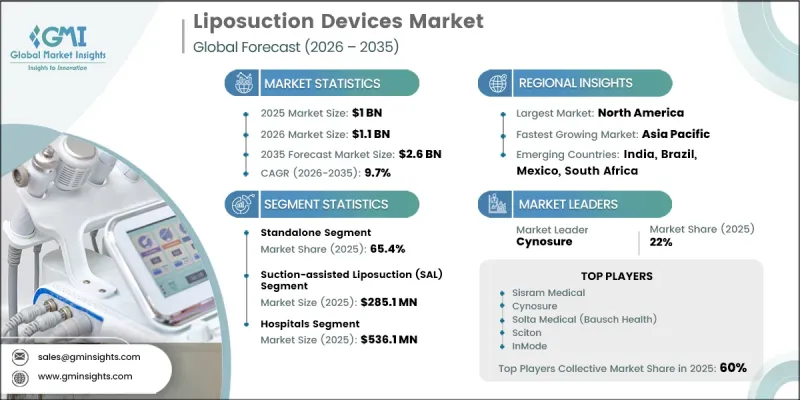
Market expansion is supported by the increasing preference for minimally invasive aesthetic procedures, the rising incidence of chronic lifestyle-related conditions, ongoing advancements in energy-based and suction technologies, and the steady growth of the geriatric population seeking body contouring treatments. In addition, evolving patient expectations for faster recovery, improved safety, and natural-looking results are reshaping the demand landscape. The integration of advanced energy modalities such as laser, ultrasound, and radiofrequency into liposuction systems is enhancing procedural precision and outcomes while reducing tissue trauma and downtime. Growing adoption of body sculpting procedures across hospitals, cosmetic clinics, and ambulatory surgical centers is further reinforcing market penetration. The increasing emphasis on combination procedures that merge fat reduction with skin tightening is also expanding clinical applications. Furthermore, rising awareness regarding aesthetic wellness and improvements in healthcare accessibility are encouraging more individuals to opt for elective body contouring procedures, thereby strengthening overall market growth momentum.
| Market Scope | |
|---|---|
| Start Year | 2025 |
| Forecast Year | 2026-2035 |
| Start Value | $ 1 Billion |
| Forecast Value | $2.6 Billion |
| CAGR | 9.7% |
The standalone systems segment held a 65.4% share in 2025. These systems are widely utilized in hospitals and high-volume cosmetic surgery centers due to their ability to deliver consistent and precise outcomes in complex body contouring procedures. Their adoption is strongly supported by the availability of advanced clinical infrastructure, experienced medical professionals, and high patient throughput in such facilities. Standalone devices offer enhanced procedural control, improved safety features, and better monitoring capabilities, making them suitable for intricate surgical requirements. Continuous technological upgrades have further improved device efficiency, reliability, and overall treatment consistency, reinforcing their strong position in the market.
The suction-assisted liposuction segment generated USD 285.1 million in 2025. This technique remains one of the most widely used methods due to its established clinical reliability, procedural simplicity, and predictable outcomes. It operates through manual fat removal using a cannula connected to a vacuum system, making it a trusted approach in aesthetic fat reduction procedures. Its long-standing use in clinical practice has strengthened surgeon familiarity, reducing training complexity and ensuring consistent results. Cost efficiency and operational ease further contribute to its widespread acceptance across healthcare facilities seeking dependable and economical body contouring solutions.
North America Liposuction Devices Market accounted for a 33.1% share in 2025. Market growth in this region is largely supported by the increasing prevalence of obesity, particularly in the United States, which is driving higher demand for surgical fat reduction procedures. Rising awareness regarding body aesthetics, health risks associated with obesity, and lifestyle improvement trends is further contributing to market expansion. The growing focus on wellness and cosmetic enhancement, combined with strong healthcare infrastructure and access to advanced surgical technologies, continues to support sustained regional demand for liposuction procedures.
Prominent companies operating in the Global Liposuction Devices Market include Johnson & Johnson, InMode, Sciton, Sisram Medical, Cynosure, MicroAire, Euromi, INVAMED, Human Med AG, INTERmedic Arfran, LHbiomed, MOLLER Medical GmbH, Bausch Health Companies, NOUVAG AG, and Vitruvian Partners. Companies in the liposuction devices market are increasingly focusing on product innovation through integration of advanced energy-based technologies such as laser, ultrasound, and radiofrequency to improve precision and patient outcomes. They are expanding their portfolios with minimally invasive and combination treatment solutions that enhance fat removal and skin tightening simultaneously. Strategic collaborations with hospitals and cosmetic clinics are strengthening distribution networks and increasing procedural adoption. Manufacturers are also investing in research and development to improve device safety, efficiency, and recovery time.
Table of Contents
Chapter 1 Research Methodology
- 1.1 Research approach
- 1.2 Quality commitments
- 1.2.1 GMI AI policy & data integrity commitment
- 1.2.1.1 Source consistency protocol
- 1.2.1 GMI AI policy & data integrity commitment
- 1.3 Research trail & confidence scoring
- 1.3.1 Research trail components
- 1.3.2 Scoring components
- 1.4 Data collection
- 1.4.1 Partial list of primary sources
- 1.5 Data mining sources
- 1.5.1 Paid sources
- 1.5.1.1 Sources, by region
- 1.5.1 Paid sources
- 1.6 Base estimates and calculations
- 1.6.1 Base year calculation for any one approach
- 1.7 Forecast model
- 1.7.1 Quantified market impact analysis
- 1.7.1.1 Mathematical impact of growth parameters on forecast
- 1.7.1 Quantified market impact analysis
- 1.8 Research transparency addendum
- 1.8.1 Source attribution framework
- 1.8.2 Quality assurance metrics
- 1.8.3 Our commitment to trust
Chapter 2 Executive Summary
- 2.1 Industry 3600 synopsis
- 2.2 Key market trends
- 2.2.1 Product type trends
- 2.2.2 Technology trends
- 2.2.3 End use trends
- 2.2.4 Regional trends
- 2.3 CXO perspectives: Strategic imperatives
Chapter 3 Industry Insights
- 3.1 Industry ecosystem analysis
- 3.2 Industry impact forces
- 3.2.1 Growth drivers
- 3.2.1.1 Increasing preference for minimally invasive procedures
- 3.2.1.2 Growing prevalence of chronic diseases
- 3.2.1.3 Rapid technological advancements in liposuction devices
- 3.2.1.4 Growing geriatric population
- 3.2.2 Industry pitfalls and challenges
- 3.2.2.1 Low awareness and availability of alternative treatment method
- 3.2.2.2 High treatment cost
- 3.2.3 Market opportunities
- 3.2.3.1 Rising adoption in emerging markets
- 3.2.3.2 Integration of liposuction with skin-tightening and contouring technologies
- 3.2.1 Growth drivers
- 3.3 Growth potential analysis
- 3.4 Regulatory landscape (Driven by primary research)
- 3.4.1 North America
- 3.4.2 Europe
- 3.4.3 Asia Pacific
- 3.5 Technology landscape
- 3.5.1 Current technological trends
- 3.5.1.1 Energy-based, minimally invasive liposuction systems (RF, laser, ultrasound-assisted)
- 3.5.1.2 Power-assisted and ergonomically optimized liposuction platforms
- 3.5.2 Emerging technologies
- 3.5.2.1 AI-enabled treatment planning and real-time procedural monitoring
- 3.5.2.2 Smart, connected, and multifunctional liposuction devices
- 3.5.1 Current technological trends
- 3.6 Future market trends (Driven by primary research)
- 3.7 Impact of AI and Generative AI on the market (Driven by primary research)
- 3.8 Pricing analysis, 2025
- 3.9 Porter's analysis
- 3.10 PESTEL analysis
Chapter 4 Competitive Landscape, 2025
- 4.1 Introduction
- 4.2 Company market share analysis
- 4.2.1 North America
- 4.2.2 Europe
- 4.2.3 Asia Pacific
- 4.3 Company matrix analysis
- 4.4 Competitive analysis of major market players
- 4.5 Competitive positioning matrix
- 4.6 Key developments
- 4.6.1 Mergers and acquisitions
- 4.6.2 Partnerships and collaborations
- 4.6.3 New product launches
- 4.6.4 Expansion plans
Chapter 5 Market Estimates and Forecast, By Product Type, 2022 - 2035 ($ Mn)
- 5.1 Key trends
- 5.2 Standalone
- 5.3 Portable
Chapter 6 Market Estimates and Forecast, By Technology, 2022 - 2035 ($ Mn)
- 6.1 Key trends
- 6.2 Tumescent liposuction
- 6.3 Ultrasound-assisted liposuction (UAL)
- 6.4 Laser-assisted liposuction (LAL)
- 6.5 Power-assisted liposuction (PAL)
- 6.6 BodyJet or water assisted liposuction (WAL)
- 6.7 Suction-assisted liposuction (SAL)
- 6.8 Other technologies
Chapter 7 Market Estimates and Forecast, By End Use, 2022 - 2035 ($ Mn)
- 7.1 Key trends
- 7.2 Hospitals
- 7.3 Clinics
- 7.4 Cosmetic surgical centers
- 7.5 Other end users
Chapter 8 Market Estimates and Forecast, By Region, 2022 - 2035 ($ Mn)
- 8.1 Key trends
- 8.2 North America
- 8.2.1 U.S.
- 8.2.2 Canada
- 8.3 Europe
- 8.3.1 Germany
- 8.3.2 UK
- 8.3.3 France
- 8.3.4 Spain
- 8.3.5 Italy
- 8.3.6 Netherlands
- 8.4 Asia Pacific
- 8.4.1 China
- 8.4.2 Japan
- 8.4.3 India
- 8.4.4 Australia
- 8.4.5 South Korea
- 8.5 Latin America
- 8.5.1 Brazil
- 8.5.2 Mexico
- 8.5.3 Argentina
- 8.6 Middle East and Africa
- 8.6.1 South Africa
- 8.6.2 Saudi Arabia
- 8.6.3 UAE
Chapter 9 Company Profiles
- 9.1 Bausch Health Companies
- 9.2 Cynosure
- 9.3 Euromi
- 9.4 Human Med AG
- 9.5 InMode
- 9.6 INTERmedic Arfran
- 9.7 INVAMED
- 9.8 Johnson & Johnson
- 9.9 LHbiomed
- 9.10 MicroAire
- 9.11 MOLLER Medical GmbH
- 9.12 NOUVAG AG
- 9.13 Sciton
- 9.14 Sisram Medical
- 9.15 Vitruvian Partners

