PUBLISHER: Global Market Insights Inc. | PRODUCT CODE: 2038781

PUBLISHER: Global Market Insights Inc. | PRODUCT CODE: 2038781
Pressure Relief Valve Market Opportunity, Growth Drivers, Industry Trend Analysis, and Forecast 2026 - 2035
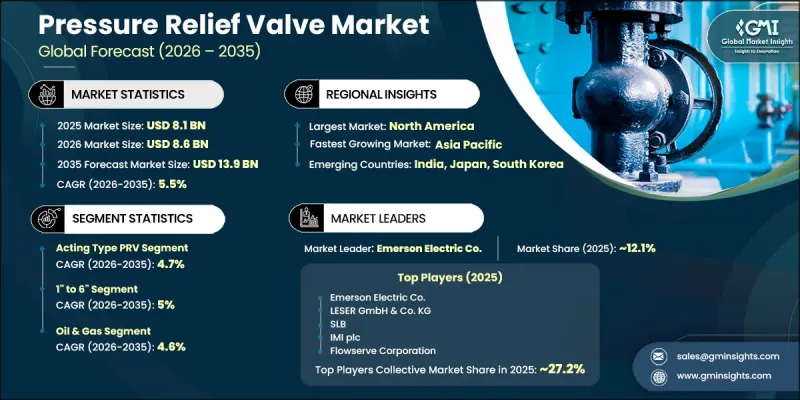
The Global Pressure Relief Valve Market was valued at USD 8.1 billion in 2025 and is estimated to grow at a CAGR of 5.5% to reach USD 13.9 billion by 2035.
Market growth is supported by the rising need for reliable safety and pressure control systems across high-risk industries such as oil & gas, chemicals, and power generation. These sectors operate under extreme pressure conditions where controlled release of excess pressure is essential to ensure operational safety and equipment integrity. Expansion in exploration activities, refinery upgrades, and new industrial facility installations is further increasing the requirement for advanced pressure relief systems.
| Market Scope | |
|---|---|
| Start Year | 2025 |
| Forecast Year | 2026-2035 |
| Start Value | $8.1 Billion |
| Forecast Value | $13.9 Billion |
| CAGR | 5.5% |
Rising industrialization and continuous capacity additions in process industries are significantly boosting demand for durable and high-performance pressure relief valves. Operators are increasingly prioritizing valves that deliver long-term reliability, regulatory compliance, and consistent operational performance under demanding conditions. The tightening of industrial safety regulations across global markets has further accelerated installation rates of pressure relief systems in critical applications. In addition, the growing adoption of industrial automation and smart process control systems is creating new demand for precision-based pressure regulation technologies. Automated production environments require highly accurate pressure management to maintain efficiency and avoid system failures, which is further reinforcing product adoption across multiple end-use industries.
The acting type pressure relief valve segment accounted for USD 4.5 billion in 2025 and is expected to grow at a CAGR of 4.7% from 2026 to 2035. This segment leads the market due to its essential role in maintaining system safety and controlling excess pressure across industrial operations. These valves are designed to automatically activate when pressure exceeds safe limits, ensuring immediate release and preventing equipment damage. Their fast response capability, operational reliability, and adaptability across different pressure ranges make them widely used in industries such as oil & gas, chemical processing, and power generation. Increasing emphasis on safety compliance and operational efficiency continues to strengthen demand for acting type pressure relief valves globally.
The oil & gas segment held a 38% share in 2025 and is projected to grow at a CAGR of 4.6% through 2035. This segment dominates due to the critical need for pressure control in exploration, drilling, refining, and transportation operations. Pressure relief valves play a vital role in maintaining safe operating conditions in high-pressure environments such as pipelines, processing facilities, and offshore installations. Rising upstream and downstream investments, combined with stringent safety regulations, are driving continuous demand. The inherently high operational risk in this sector, along with strict compliance requirements, further reinforces the dominance of oil & gas applications in the global market.
North America Pressure Relief Valve Market accounted for USD 563.8 million in 2025 and is expected to grow at a CAGR of 5.6% from 2026 to 2035. Demand in the country is driven by strict safety standards across oil & gas, chemical processing, and power generation industries. Industrial facilities require highly reliable pressure control systems to ensure safe operations under fluctuating and high-pressure conditions. Strong demand is particularly evident in shale production and refining activities, where equipment must withstand variable pressure loads. Manufacturers in the region focus on advanced materials, precision engineering, and compliance with ASME standards. Additionally, ongoing maintenance and replacement of aging infrastructure significantly contribute to sustained market demand.
The key companies operating in the Global Pressure Relief Valve Market include Emerson Electric Co., Flowserve Corporation, Honeywell International, Parker Hannifin Corporation, IMI plc, Spirax-Sarco Engineering, Crane Co., Pentair plc, SLB, LESER GmbH & Co. KG, Rotork Plc, Burkert Fluid Control Systems, Moog Inc., ValvTechnologies Inc., and Watts Water Technologies. Market players are strengthening their positions through continuous product innovation focused on improving durability, response accuracy, and operational safety. Companies are increasingly investing in smart valve technologies integrated with digital monitoring systems to enable predictive maintenance and real-time pressure tracking. Expansion of manufacturing capabilities and global distribution networks is also a key strategy to enhance market reach. Firms are focusing on compliance with international safety standards while developing customized solutions for specific industrial applications. Strategic partnerships with EPC contractors and industrial operators are helping improve project integration and long-term contracts.
Table of Contents
Chapter 1 Methodology & Scope
- 1.1 Market scope and definition
- 1.2 Research design
- 1.2.1 Research approach
- 1.2.2 Data collection methods
- 1.3 Data mining sources
- 1.3.1 Global
- 1.3.2 Regional/Country
- 1.4 Base estimates and calculations
- 1.4.1 Base year calculation
- 1.4.2 Key trends for market estimation
- 1.5 Primary research and validation
- 1.5.1 Primary sources
- 1.6 Forecast model
- 1.7 Research assumptions and limitations
Chapter 2 Executive Summary
- 2.1 Industry 360° synopsis
- 2.2 Key market trends
- 2.2.1 Regional
- 2.2.2 Type
- 2.2.3 Size
- 2.2.4 Pressure Range
- 2.2.5 End User
- 2.2.6 Distribution channel
Chapter 3 Industry Insights
- 3.1 Industry ecosystem analysis
- 3.1.1 Supplier landscape
- 3.1.2 Profit margin
- 3.1.3 Value addition at each stage
- 3.1.4 Factor affecting the value chain
- 3.2 Industry impact forces
- 3.2.1 Growth drivers
- 3.2.1.1 Increasing demand from oil & gas, chemical, and power generation industries
- 3.2.1.2 Growth in industrial automation and process optimization
- 3.2.1.3 Expansion of water and wastewater treatment infrastructure
- 3.2.2 Pitfalls & Challenges
- 3.2.2.1 High maintenance and periodic inspection requirements
- 3.2.2.2 Volatility in raw material prices such as steel and alloys
- 3.2.3 Opportunities
- 3.2.3.1 Rising adoption of smart valves with real-time monitoring capabilities
- 3.2.3.2 Growth of renewable energy and hydrogen infrastructure
- 3.2.1 Growth drivers
- 3.3 Growth potential analysis
- 3.4 Future market trends
- 3.5 Technology and innovation landscape
- 3.5.1 Current technological trends
- 3.5.2 Emerging technologies
- 3.6 Regulatory landscape
- 3.6.1 Standards and compliance requirements
- 3.6.2 Regional regulatory frameworks
- 3.6.3 Certification standards
- 3.7 Porter's analysis
- 3.8 PESTEL analysis
- 3.9 Pricing analysis (driven by primary research)
- 3.9.1 Historical price trend analysis (driven by primary research)
- 3.9.2 Pricing strategy by player type (premium / value / cost-plus) (driven by primary research)
- 3.9.3 Price differential by material construction
- 3.9.4 Regional price variations & tariff impact
- 3.10 Trade data analysis (HS code 848140) (driven by paid database)
- 3.10.1 Import/export volume and value trends (driven by paid database)
- 3.10.2 Key trade corridors and tariff impact (driven by paid database)
- 3.10.3 Trade balance by region
- 3.10.4 HS code classification and trade policy impact
- 3.11 Impact of AI and generative AI on the market
- 3.11.1 AI-driven disruption of existing business models
- 3.11.2 GenAI use cases and adoption roadmap by segment
- 3.11.3 Risks, limitations and regulatory considerations
- 3.12 Capacity and production landscape (driven by primary research)
- 3.12.1 Installed capacity by region and key producer (driven by primary research)
- 3.12.2 Capacity utilization rates and expansion pipelines (driven by primary research)
Chapter 4 Competitive Landscape, 2025
- 4.1 Introduction
- 4.2 Company market share analysis
- 4.2.1 By Region
- 4.2.1.1 North America
- 4.2.1.2 Europe
- 4.2.1.3 Asia Pacific
- 4.2.1.4 Latin America
- 4.2.1.5 Middle East & Africa
- 4.2.1 By Region
- 4.3 Company matrix analysis
- 4.4 Competitive analysis of major market players
- 4.5 Competitive positioning matrix
- 4.6 Key developments
- 4.6.1 Mergers & acquisitions
- 4.6.2 Partnerships & collaborations
- 4.6.3 New product launches
- 4.6.4 Expansion plans
Chapter 5 Market Estimates & Forecast, By Type, 2022 - 2035, (USD Billion) (Thousand Units)
- 5.1 Key trends
- 5.2 Acting Type PRV
- 5.3 Piston Type PRV
- 5.4 Diaphragm Type PRV
Chapter 6 Market Estimates & Forecast, By Size, 2022 - 2035, (USD Billion) (Thousand Units)
- 6.1 Key trends
- 6.2 Up to 1"
- 6.3 1" to 6"
- 6.4 6" to 25"
- 6.5 25" to 50"
- 6.6 50" and Larger
Chapter 7 Market Estimates & Forecast, By Pressure Range, 2022 - 2035, (USD Billion) (Thousand Units)
- 7.1 Key trends
- 7.2 Low (5 mbar to 3000 mbar)
- 7.3 Medium (Up to 50 bar)
- 7.4 High (Up to 400 bar)
Chapter 8 Market Estimates & Forecast, By End User, 2022 - 2035, (USD Billion) (Thousand Units)
- 8.1 Key trends
- 8.2 Oil & Gas
- 8.3 Water & Wastewater Treatment
- 8.4 Power Industry
- 8.5 Chemical Industry
- 8.6 Others
Chapter 9 Market Estimates & Forecast, By Distribution Channel, 2022 - 2035, (USD Billion) (Thousand Units)
- 9.1 Key trends
- 9.2 Direct Sales
- 9.3 Indirect Sales
Chapter 10 Market Estimates & Forecast, By Region, 2022 - 2035, (USD Billion) (Thousand Units)
- 10.1 Key trends
- 10.2 North America
- 10.2.1 U.S.
- 10.2.2 Canada
- 10.3 Europe
- 10.3.1 Germany
- 10.3.2 UK
- 10.3.3 France
- 10.3.4 Italy
- 10.3.5 Spain
- 10.4 Asia Pacific
- 10.4.1 China
- 10.4.2 India
- 10.4.3 Japan
- 10.4.4 South Korea
- 10.4.5 Australia
- 10.5 Latin America
- 10.5.1 Brazil
- 10.5.2 Mexico
- 10.5.3 Argentina
- 10.6 MEA
- 10.6.1 Saudi Arabia
- 10.6.2 UAE
- 10.6.3 South Africa
Chapter 11 Company Profiles
- 11.1 Burkert Fluid Control Systems
- 11.2 Crane Co
- 11.3 Emerson Electric Co.
- 11.4 Flowserve Corporation
- 11.5 Honeywell International
- 11.6 IMI plc
- 11.7 LESER GmbH & Co. KG
- 11.8 Moog Inc
- 11.9 Parker Hannifin Corporation
- 11.10 Pentair plc
- 11.11 Rotork Plc
- 11.12 SLB
- 11.13 Spirax-Sarco Engineering
- 11.14 ValvTechnologies Inc
- 11.15 Watts Water Technologies

