PUBLISHER: Global Market Insights Inc. | PRODUCT CODE: 2038792

PUBLISHER: Global Market Insights Inc. | PRODUCT CODE: 2038792
Toddler Wear Market Opportunity, Growth Drivers, Industry Trend Analysis, and Forecast 2026 - 2035
The Global Toddler Wear Market was valued at USD 105.6 billion in 2025 and is estimated to grow at a CAGR of 5.1% to reach USD 173.4 billion by 2035.
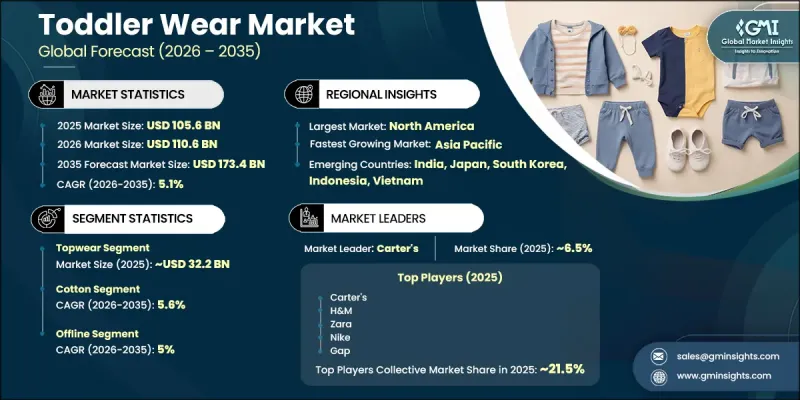
The market is experiencing steady expansion, supported by rising consumer spending on premium, comfortable, and safe clothing for toddlers. Parents are increasingly prioritizing apparel made from soft, breathable, and skin-friendly materials to ensure maximum comfort for children with sensitive skin. Growing awareness regarding fabric safety and product quality has significantly influenced purchasing behavior, especially in urban households. The rising preference for organic and natural textiles is further shaping demand patterns. Frequent wardrobe replacement cycles, driven by rapid growth in toddlers, are also contributing to recurring purchases. In parallel, the expansion of organized retail and digital commerce platforms has enhanced product accessibility and variety. Online channels offer extensive catalog choices, enabling easy comparison of styles, prices, and brands, while offline retail continues to expand dedicated children's apparel sections. Promotional offers, seasonal launches, and bundled pricing strategies are further stimulating consumer spending across distribution channels.
| Market Scope | |
|---|---|
| Start Year | 2025 |
| Forecast Year | 2026-2035 |
| Start Value | $105.6 Billion |
| Forecast Value | $173.4 Billion |
| CAGR | 5.1% |
The toddler wear category includes a wide range of clothing designed specifically for children in early developmental stages, with a strong focus on comfort, safety, and durability. The market has evolved significantly due to changing parental preferences, with greater emphasis placed on fabric quality and non-irritating materials. Product innovation and design diversification have become key factors influencing consumer decisions. Manufacturers are increasingly introducing apparel that balances functionality with aesthetic appeal, catering to both everyday wear and occasion-based requirements. Growing awareness of hygiene standards and skin sensitivity in young children continues to reinforce the demand for high-quality textile solutions across global markets.
The topwear segment accounted for USD 32.2 billion in 2025 and is expected to grow at a CAGR of 5.6% through 2035. This segment maintains a dominant position due to its essential role in daily wardrobe requirements and frequent replacement cycles. It includes a wide range of garments such as t-shirts, shirts, sweaters, and jackets that are widely used across different seasons and occasions. Parents prefer topwear due to its versatility, ease of dressing, and availability in diverse designs and materials. Continuous usage and rapid growth of toddlers drive consistent replacement demand, reinforcing the segment's strong market presence.
The cotton segment held a share of 36.7% in 2025 and is projected to grow at a CAGR of 5.6% during 2026 to 2035. Cotton remains the most preferred fabric due to its softness, breathability, and suitability for sensitive skin. Its natural and hypoallergenic properties make it highly suitable for everyday wear, ensuring comfort and minimizing irritation. Increasing awareness regarding skin-safe and chemical-free textiles has strengthened demand for cotton-based apparel. Rising preference for sustainable and organic fabric options further supports segment expansion. Durability, ease of maintenance, and year-round usability continue to reinforce cotton's leading position in the market.
United States Toddler Wear Market reached USD 22 billion in 2025 and is projected to grow at a CAGR of 5.4% from 2026 to 2035. Market growth in the country is supported by strong consumer spending on children's apparel and increasing preference for high-quality, branded clothing. Parents place significant importance on comfort, durability, and safety, which drives demand for premium and skin-friendly fabrics. Growing awareness of child wellness and clothing standards has further encouraged adoption of organic and sustainable apparel options. The expansion of retail networks and e-commerce platforms has improved product accessibility nationwide. Fashion trends and seasonal collections continue to influence purchasing behavior, while established brands and private labels ensure wide product availability and competitive pricing.
Key companies operating in the Global Toddler Wear Market include Nike, Adidas, Zara, H&M, Gap Inc., Burberry, Ralph Lauren, Carter's, The Children's Place, Marks & Spencer, Gerber Childrenswear, Patagonia, Petit Bateau, Brandix Lanka Limited, and Shenzhou International Group. Companies in the Toddler Wear Market are focusing on product innovation, fabric quality enhancement, and brand differentiation to strengthen their market position. Manufacturers are expanding collections with a strong emphasis on comfort, safety, and skin-friendly materials tailored to toddlers' needs. Increasing investment in sustainable and organic textiles is helping brands align with evolving consumer preferences. Expansion of omnichannel distribution strategies, including both online and offline retail, is improving market reach and accessibility. Companies are also leveraging digital marketing and influencer collaborations to strengthen brand visibility. Seasonal collections, promotional campaigns, and bundled offerings are being used to boost sales volumes. Additionally, firms are focusing on regional expansion and supply chain optimization to ensure cost efficiency and consistent product availability across global markets.
Table of Contents
Chapter 1 Methodology & Scope
- 1.1 Market scope and definition
- 1.2 Research design
- 1.2.1 Research approach
- 1.2.2 Data collection methods
- 1.3 Data mining sources
- 1.3.1 Global
- 1.3.2 Regional/Country
- 1.4 Base estimates and calculations
- 1.4.1 Base year calculation
- 1.4.2 Key trends for market estimation
- 1.5 Primary research and validation
- 1.5.1 Primary sources
- 1.6 Forecast model
- 1.7 Research assumptions and limitations
Chapter 2 Executive Summary
- 2.1 Industry 360° synopsis
- 2.2 Key market trends
- 2.2.1 Regional
- 2.2.2 Product
- 2.2.3 Material
- 2.2.4 Price range
- 2.2.5 Gender
- 2.2.6 Distribution Channel
Chapter 3 Industry Insights
- 3.1 Industry ecosystem analysis
- 3.1.1 Supplier landscape
- 3.1.2 Profit margin
- 3.1.3 Value addition at each stage
- 3.1.4 Factor affecting the value chain
- 3.2 Industry impact forces
- 3.2.1 Growth drivers
- 3.2.1.1 Growing focus on comfort, safety, and skin-friendly materials
- 3.2.1.2 Rising birth rates and increasing toddler population
- 3.2.1.3 Increasing influence of fashion trends and branded apparel
- 3.2.2 Pitfalls & Challenges
- 3.2.2.1 High price sensitivity among consumers in developing regions
- 3.2.2.2 Frequent size changes due to rapid growth of toddlers
- 3.2.3 Opportunities
- 3.2.3.1 Growing demand for organic and sustainable clothing materials
- 3.2.3.2 Expansion of e-commerce and direct-to-consumer brands
- 3.2.1 Growth drivers
- 3.3 Growth potential analysis
- 3.4 Future market trends
- 3.5 Technology and innovation landscape
- 3.5.1 Current technological trends
- 3.5.2 Emerging technologies
- 3.6 Regulatory landscape
- 3.6.1 Standards and compliance requirements
- 3.6.2 Regional regulatory frameworks
- 3.6.3 Certification standards
- 3.7 Porter's analysis
- 3.8 PESTEL analysis
- 3.9 Pricing analysis (driven by primary research)
- 3.9.1 Historical price trend analysis
- 3.9.2 Pricing strategy by player type (premium/value/fast fashion)
- 3.9.3 Price elasticity by product category
- 3.9.4 Regional price variations
- 3.9.5 Impact of material costs on retail pricing
- 3.10 Trade data analysis - HS Code: 6111 (knitted or crocheted) (driven by paid database)
- 3.10.1 Import/export volume & value trends
- 3.10.2 Key trade corridors & tariff impact
- 3.10.3 Major exporting countries
- 3.10.4 Major importing countries
- 3.10.5 HS code classification analysis
- 3.11 Distribution infrastructure & channel penetration landscape (driven by primary research)
- 3.11.1 Channel coverage by region & format (modern vs. traditional trade) (driven by primary research)
- 3.11.2 Last-mile infrastructure gaps & emerging channel shifts (driven by primary research)
- 3.11.3 E-commerce penetration rates by geography
- 3.11.4 Omnichannel strategy adoption
Chapter 4 Competitive Landscape, 2025
- 4.1 Introduction
- 4.2 Company market share analysis
- 4.2.1 By Region
- 4.2.1.1 North America
- 4.2.1.2 Europe
- 4.2.1.3 Asia Pacific
- 4.2.1.4 Latin America
- 4.2.1.5 Middle East & Africa
- 4.2.1 By Region
- 4.3 Company matrix analysis
- 4.4 Competitive analysis of major market players
- 4.5 Competitive positioning matrix
- 4.6 Key developments
- 4.6.1 Mergers & acquisitions
- 4.6.2 Partnerships & collaborations
- 4.6.3 New product launches
- 4.6.4 Expansion plans
Chapter 5 Market Estimates & Forecast, By Product, 2022 - 2035, (USD Billion) (Thousand Units)
- 5.1 Key trends
- 5.2 Topwear
- 5.2.1 T-shirts
- 5.2.2 Shirts
- 5.2.3 Jackets
- 5.2.4 Sweaters
- 5.2.5 Others
- 5.3 Bottomwear
- 5.3.1 Pants
- 5.3.2 Shorts
- 5.3.3 Skirts
- 5.3.4 Others
- 5.4 Sleepwear
- 5.4.1 Onesies
- 5.4.2 Nightgowns
- 5.4.3 Others
- 5.5 Accessories
- 5.5.1 Hats
- 5.5.2 Socks
- 5.5.3 Gloves
- 5.5.4 Others
- 5.6 Footwear
- 5.7 Others
Chapter 6 Market Estimates & Forecast, By Material, 2022 - 2035, (USD Billion) (Thousand Units)
- 6.1 Key trends
- 6.2 Cotton
- 6.3 Nylon
- 6.4 Wool
- 6.5 Others
Chapter 7 Market Estimates & Forecast, By Price range, 2022 - 2035, (USD Billion) (Thousand Units)
- 7.1 Key trends
- 7.2 Low
- 7.3 Medium
- 7.4 High
Chapter 8 Market Estimates & Forecast, By Gender, 2022 - 2035, (USD Billion) (Thousand Units)
- 8.1 Key trends
- 8.2 Boy
- 8.3 Girl
Chapter 9 Market Estimates & Forecast, By Distribution Channel, 2022 - 2035, (USD Billion) (Thousand Units)
- 9.1 Key trends
- 9.2 Online
- 9.2.1 E-commerce
- 9.2.2 Company websites
- 9.3 Offline
- 9.3.1 Mega Retail Stores
- 9.3.2 Specialty stores
- 9.3.3 Others
Chapter 10 Market Estimates & Forecast, By Region, 2022 - 2035, (USD Billion) (Thousand Units)
- 10.1 Key trends
- 10.2 North America
- 10.2.1 U.S.
- 10.2.2 Canada
- 10.3 Europe
- 10.3.1 Germany
- 10.3.2 UK
- 10.3.3 France
- 10.3.4 Italy
- 10.3.5 Spain
- 10.4 Asia Pacific
- 10.4.1 China
- 10.4.2 India
- 10.4.3 Japan
- 10.4.4 South Korea
- 10.4.5 Australia
- 10.5 Latin America
- 10.5.1 Brazil
- 10.5.2 Mexico
- 10.5.3 Argentina
- 10.6 MEA
- 10.6.1 Saudi Arabia
- 10.6.2 UAE
- 10.6.3 South Africa
Chapter 11 Company Profiles
- 11.1 Adidas
- 11.2 Burberry
- 11.3 Carter's
- 11.4 Gap Inc.
- 11.5 Gerber Childrenswear
- 11.6 H&M
- 11.7 Marks & Spencer
- 11.8 Nike
- 11.9 Patagonia
- 11.10 Petit Bateau
- 11.11 Ralph Lauren
- 11.12 The Children's Place
- 11.13 Zara
- 11.14 Brandix Lanka Limited
- 11.15 Shenzhou International Group

