PUBLISHER: Global Market Insights Inc. | PRODUCT CODE: 2038793

PUBLISHER: Global Market Insights Inc. | PRODUCT CODE: 2038793
Food Logistics Market Opportunity, Growth Drivers, Industry Trend Analysis, and Forecast 2026 - 2035
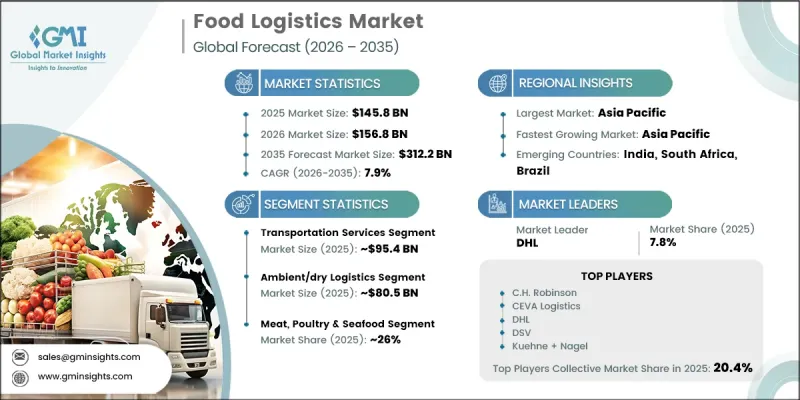
The Global Food Logistics Market was valued at USD 145.8 billion in 2025 and is estimated to grow at a CAGR of 7.9% to reach USD 312.2 billion by 2035.
Market growth is driven by rising global food consumption patterns linked to population expansion and shifting dietary preferences. Increasing urbanization, higher disposable incomes, and evolving lifestyles are intensifying demand for efficient food supply chain systems. The need to maintain food quality across extended and more complex distribution networks is placing greater emphasis on advanced logistics infrastructure. Cold chain logistics is emerging as a critical growth area due to its essential role in preserving temperature-sensitive goods throughout transport and storage. Expanding international trade is further accelerating the requirement for reliable and scalable logistics solutions capable of handling perishable and non-perishable food items. However, infrastructure gaps in developing economies continue to pose challenges, prompting increased investments in modern storage and transportation systems. Governments and industry stakeholders are actively supporting upgrades in logistics capabilities to improve efficiency and reduce waste. As global food demand continues to rise, the importance of integrated, technology-enabled logistics systems is becoming increasingly central to ensuring food safety, availability, and distribution efficiency worldwide.
| Market Scope | |
|---|---|
| Start Year | 2025 |
| Forecast Year | 2026-2035 |
| Start Value | $145.8 Billion |
| Forecast Value | $312.2 Billion |
| CAGR | 7.9% |
The transportation services segment accounted for 65.4% share in 2025, generating USD 95.4 billion. This segment remains the backbone of food logistics due to its critical role in ensuring timely and secure movement of food products across supply chains. It supports the efficient distribution of perishable and non-perishable goods by enabling reliable connectivity between production centers and end markets. The growing need for fast and controlled delivery of food items continues to reinforce the importance of this segment in maintaining product integrity and minimizing losses across the supply chain.
The ambient and dry logistics segment held 55.2% share in 2025, valued at USD 80.5 billion. This segment leads the market due to the large-scale movement of non-perishable food products that do not require temperature-controlled environments. Its cost efficiency, simplified storage requirements, and well-established distribution networks contribute to its widespread adoption. The ability to handle high-volume shipments with minimal infrastructure complexity makes this segment a fundamental part of the global food logistics ecosystem, supporting consistent demand across various food categories.
U.S. Food Logistics Market reached USD 40.8 billion in 2025 and is projected to grow at a CAGR of 7.6% between 2026 and 2035. Market expansion is strongly influenced by stringent food safety, traceability, and transportation standards enforced at the federal level. Regulatory frameworks are designed to enhance transparency and reduce contamination risks throughout the supply chain. These compliance requirements have increased the adoption of advanced logistics practices, particularly for temperature-sensitive and high-risk food categories, ensuring improved safety and operational efficiency across the industry.
Key players operating in the Global Food Logistics Market include DHL, Maersk, C.H. Robinson, CEVA Logistics, DSV, GEODIS, Kuehne + Nagel, Lineage Logistics, Nippon Express, and XPO Logistics. Companies in the Food Logistics Market are focusing on strengthening supply chain efficiency, expanding cold chain capabilities, and adopting advanced digital technologies to improve operational performance. Investments in automation, real-time tracking systems, and data-driven logistics platforms are enhancing visibility and control across distribution networks. Firms are also prioritizing infrastructure development, particularly in temperature-controlled storage and transportation, to support growing demand for perishable goods. Strategic partnerships and global network expansion are enabling companies to improve service coverage and market reach. Additionally, businesses are emphasizing sustainability initiatives and energy-efficient logistics solutions to align with evolving environmental standards while maintaining cost efficiency and service reliability.
Table of Contents
Chapter 1 Methodology
- 1.1 Research approach
- 1.2 Quality Commitments
- 1.2.1 GMI AI policy & data integrity commitment
- 1.3 Research Trail & Confidence Scoring
- 1.3.1 Research Trail Components
- 1.3.2 Scoring Components
- 1.4 Data Collection
- 1.5 Data mining sources
- 1.5.1 Paid sources
- 1.6 Base estimates and calculations
- 1.6.1 Base year calculation for any one approach
- 1.7 Forecast
- 1.7.1 Quantified market impact analysis
- 1.8 Research transparency addendum
- 1.8.1 Source attribution framework
- 1.8.2 Quality assurance metrics
- 1.8.3 Our commitment to trust
Chapter 2 Executive Summary
- 2.1 Industry 360° synopsis
- 2.2 Key market trends
- 2.2.1 Regional
- 2.2.2 Service
- 2.2.3 Temperature Requirement
- 2.2.4 Food Category
- 2.2.5 End Use
- 2.3 TAM analysis, 2026-2035
- 2.4 CXO perspectives: Strategic imperatives
Chapter 3 Industry Insights
- 3.1 Industry ecosystem analysis
- 3.1.1 Supplier landscape
- 3.1.2 Profit margin
- 3.1.3 Cost structure
- 3.1.4 Value addition at each stage
- 3.1.5 Factor affecting the value chain
- 3.1.6 Disruptions
- 3.2 Industry impact forces
- 3.2.1 Growth drivers
- 3.2.1.1 E-commerce & online grocery growth
- 3.2.1.2 Rising food safety & traceability requirements
- 3.2.1.3 Expansion of cold chain infrastructure in emerging markets
- 3.2.1.4 Consumer demand for fresh & perishable products
- 3.2.2 Industry pitfalls and challenges
- 3.2.2.1 Fragmented regulatory landscape
- 3.2.2.2 Energy costs & cold chain operating expenses
- 3.2.3 Market opportunities
- 3.2.3.1 Technology integration (IoT, Blockchain, AI)
- 3.2.3.2 Sustainability-driven logistics solutions
- 3.2.3.3 Emerging market penetration
- 3.2.1 Growth drivers
- 3.3 Growth potential analysis
- 3.4 Regulatory landscape
- 3.4.1 North America
- 3.4.1.1 U.S. - Food and Drug Administration (FDA)
- 3.4.1.2 U.S. - United States Department of Agriculture (USDA)
- 3.4.1.3 Canada - Canadian Food Inspection Agency (CFIA)
- 3.4.2 Europe
- 3.4.2.1 Germany - Federal Office of Consumer Protection and Food Safety (BVL)
- 3.4.2.2 EU - European Food Safety Authority (EFSA)
- 3.4.3 Asia Pacific
- 3.4.3.1 China - Ministry of Agriculture and Rural Affairs (MARA)
- 3.4.3.2 India - FSSAI
- 3.4.4 Latin America
- 3.4.4.1 Mexico - SADER (Secretaria de Agricultura y Desarrollo Rural)
- 3.4.4.2 Mexico - COFEPRIS
- 3.4.5 Middle East & Africa
- 3.4.5.1 UAE - Ministry of Climate Change and Environment (MOCCAE)
- 3.4.5.2 South Africa - Department of Health
- 3.4.1 North America
- 3.5 Porter's analysis
- 3.6 PESTEL analysis
- 3.7 Technology and innovation landscape
- 3.7.1 Current technologies
- 3.7.1.1 Refrigerated Trucks & Containers
- 3.7.1.2 Warehouse Management Systems (WMS)
- 3.7.1.3 Barcode & RFID Tracking
- 3.7.2 Emerging technologies
- 3.7.2.1 Autonomous Delivery Vehicles & Drones
- 3.7.2.2 Digital Twin Technology in Supply Chains
- 3.7.2.3 AI & Predictive Analytics
- 3.7.1 Current technologies
- 3.8 Patent landscape (Driven by Primary Research)
- 3.9 Cost breakdown analysis
- 3.9.1 Transportation costs
- 3.9.2 Storage & warehousing costs
- 3.9.3 Packaging & handling costs
- 3.9.4 Technology & monitoring costs
- 3.9.5 Regulatory compliance & safety costs
- 3.10 Sustainability and environmental aspects
- 3.10.1 Sustainable practices
- 3.10.2 Waste reduction strategies
- 3.10.3 Energy efficiency in production
- 3.10.4 Eco-friendly Initiatives
- 3.10.5 Carbon footprint considerations
- 3.11 Trade Data Analysis (Driven by Paid Database)
- 3.11.1 Import/Export Volume & Value Trends
- 3.11.2 Key Trade Corridors & Tariff Impact
- 3.12 Impact of AI & Generative AI on the Market
- 3.12.1 AI-driven disruption of existing business models
- 3.12.2 GenAI use cases & adoption roadmap by segment
- 3.12.3 Risks, limitations & regulatory considerations
- 3.13 Cross-border operations and international partnerships
- 3.13.1 International trade and customs compliance
- 3.13.2 International partner selection and evaluation
- 3.13.3 Cross-border risk management
- 3.13.4 Multimodal transportation & infrastructure coordination
- 3.14 Infrastructure & cold chain capabilities
- 3.14.1 Global cold storage capacity distribution
- 3.14.2 Refrigerated fleet & transport infrastructure
- 3.14.3 Temperature monitoring & quality control systems
- 3.15 Forecast assumptions & scenario analysis (Driven by Primary Research)
- 3.15.1 Base Case - key macro & industry variables driving CAGR
- 3.15.2 Optimistic Scenarios - Favorable macro and industry tailwinds
- 3.15.3 Pessimistic Scenario - Macroeconomic slowdown or industry headwinds
Chapter 4 Competitive Landscape, 2025
- 4.1 Introduction
- 4.2 Company market share analysis
- 4.2.1 North America
- 4.2.2 Europe
- 4.2.3 Asia Pacific
- 4.2.4 LATAM
- 4.2.5 MEA
- 4.3 Competitive analysis of major market players
- 4.4 Competitive positioning matrix
- 4.5 Key developments
- 4.5.1 Mergers & acquisitions
- 4.5.2 Partnerships & collaborations
- 4.5.3 New product launches
- 4.5.4 Expansion plans and funding
- 4.6 Company tier benchmarking
- 4.6.1 Tier classification criteria & qualifying thresholds
- 4.6.2 Tier positioning matrix by revenue, geography & innovation
Chapter 5 Market Estimates & Forecast, By Service, 2022 - 2035 ($Mn)
- 5.1 Key trends
- 5.2 Transportation services
- 5.2.1 Roadways
- 5.2.1.1 Full truck load (FTL)
- 5.2.1.2 Less than truck load (LTL)
- 5.2.2 Seaways
- 5.2.2.1 Full container load (FCL)
- 5.2.2.2 Less than container load (LCL)
- 5.2.3 Railways
- 5.2.4 Airways
- 5.2.1 Roadways
- 5.3 Warehousing & storage services
- 5.4 Value-added services
- 5.5 Freight forwarding & brokerage
- 5.5.1 Third-Party Logistics (3PL)
- 5.5.2 Fourth-Party Logistics (4PL)
- 5.5.3 In-house / Direct Distribution
Chapter 6 Market Estimates & Forecast, By Temperature Requirement, 2022 - 2035 ($Mn)
- 6.1 Key trends
- 6.2 Frozen/cold chain
- 6.3 Chilled/refrigerated logistics
- 6.4 Ambient/dry logistics
Chapter 7 Market Estimates & Forecast, By Food Category, 2022 - 2035 ($Mn, 000, tons)
- 7.1 Key trends
- 7.2 Fruits & vegetables
- 7.3 Meat, Poultry & Seafood
- 7.4 Dairy Products
- 7.5 Bakery & Confectionery
- 7.6 Frozen Foods
- 7.7 Dry/Packaged Foods
- 7.8 Beverages
Chapter 8 Market Estimates & Forecast, By End Use, 2022 - 2035 ($Mn, 000, tons)
- 8.1 Key trends
- 8.2 Food manufacturers
- 8.3 Food retailers
- 8.3.1 Supermarkets & hypermarkets
- 8.3.2 Convenience stores
- 8.3.3 Specialty food stores
- 8.4 Food service operators
- 8.5 E-commerce & direct-to-consumer
Chapter 9 Market Estimates & Forecast, By Region, 2022 - 2035 ($Mn, 000, tons)
- 9.1 Key trends
- 9.2 North America
- 9.2.1 US
- 9.2.2 Canada
- 9.3 Europe
- 9.3.1 Germany
- 9.3.2 UK
- 9.3.3 France
- 9.3.4 Italy
- 9.3.5 Spain
- 9.3.6 Poland
- 9.3.7 Netherlands
- 9.3.8 Norway
- 9.4 Asia Pacific
- 9.4.1 China
- 9.4.2 India
- 9.4.3 Japan
- 9.4.4 South Korea
- 9.4.5 Australia
- 9.4.6 Singapore
- 9.4.7 Malaysia
- 9.4.8 Indonesia
- 9.4.9 Vietnam
- 9.5 Latin America
- 9.5.1 Brazil
- 9.5.2 Mexico
- 9.5.3 Argentina
- 9.5.4 Colombia
- 9.6 MEA
- 9.6.1 South Africa
- 9.6.2 Saudi Arabia
- 9.6.3 UAE
Chapter 10 Company Profiles
- 10.1 Global players
- 10.1.1 DHL
- 10.1.2 Kuehne + Nagel
- 10.1.3 DSV
- 10.1.4 C.H. Robinson
- 10.1.5 XPO Logistics
- 10.1.6 Nippon Express
- 10.1.7 CEVA Logistics
- 10.1.8 Kerry Logistics
- 10.1.9 Lineage Logistics
- 10.1.10 Maersk
- 10.1.11 FedEx
- 10.1.12 UPS
- 10.1.13 GEODIS
- 10.2 Regional players
- 10.2.1 DACHSER
- 10.2.2 Gist
- 10.2.3 Nichirei Logistics
- 10.2.4 Snowman Logistics
- 10.3 Emerging players
- 10.3.1 Zipline
- 10.3.2 ColdStar Logistics
- 10.3.3 STEF

