PUBLISHER: Global Market Insights Inc. | PRODUCT CODE: 2038798

PUBLISHER: Global Market Insights Inc. | PRODUCT CODE: 2038798
Drinkware Market Opportunity, Growth Drivers, Industry Trend Analysis, and Forecast 2026 - 2035
The Global Drinkware Market was valued at USD 36.6 billion in 2025 and is estimated to grow at a CAGR of 5.9% to reach USD 64.4 billion by 2035.
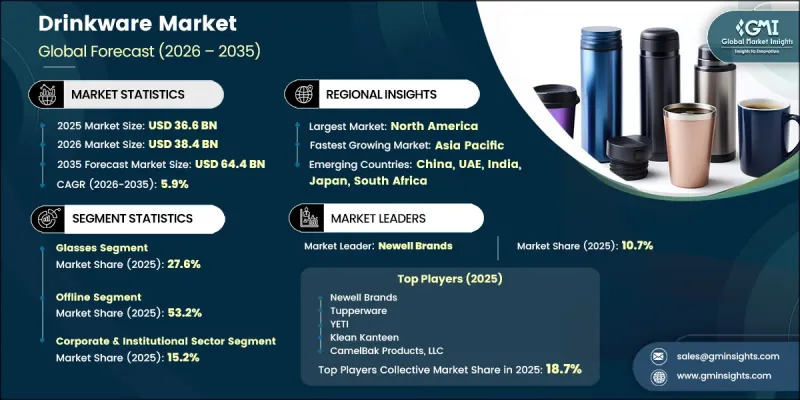
Market growth is supported by rising consumer preference for reusable and sustainable beverage containers, along with the increasing shift toward premium lifestyle-oriented products. Demand is also strengthening across foodservice outlets, coffee chains, and quick-service restaurants as beverage consumption continues to grow in urban environments. Changing consumption habits, particularly the rising demand for on-the-go beverages, are further accelerating market expansion. Continuous innovation in materials such as stainless steel, glass, silicone, and BPA-free plastics is enhancing product durability, safety, and design appeal. The market is also benefiting from growing awareness regarding environmental sustainability and the need to reduce reliance on single-use plastics. Governments across multiple regions are implementing strict regulations and policies aimed at limiting disposable plastic usage and encouraging the adoption of reusable alternatives. Corporate sustainability initiatives and hospitality sector campaigns are also reinforcing demand for eco-friendly drinkware solutions. Together, these factors are driving steady growth across both household and commercial applications globally, while premiumization and product personalization trends are reshaping consumer preferences in the industry.
| Market Scope | |
|---|---|
| Start Year | 2025 |
| Forecast Year | 2026-2035 |
| Start Value | $36.6 Billion |
| Forecast Value | $64.4 Billion |
| CAGR | 5.9% |
The glasses segment held a 27.6% share in 2025. This dominance is primarily attributed to the widespread use of glassware across residential, hospitality, and foodservice settings. Glass remains a preferred material due to its affordability, aesthetic appeal, and versatility for serving both alcoholic and non-alcoholic beverages. Increasing demand for premium-quality tableware in restaurants, cafes, and upscale dining environments is further strengthening the segment's market position.
The offline distribution channel accounted for 53.2% share in 2025, supported by the strong presence of retail stores, including supermarkets, specialty outlets, and department stores. These channels offer consumers the advantage of physically evaluating product quality, durability, and design before purchase. Immediate product availability and in-store promotions also continue to drive consumer preference for offline shopping, particularly in the drinkware category.
North America Drinkware Market held a 29.1% share in 2025, driven by strong demand for durable, functional, and premium beverage containers across the United States and Canada. Rising consumer interest in insulated bottles, tumblers, and stainless-steel products is supported by growing health awareness and increased participation in outdoor and fitness activities. Expanding adoption of sustainable materials, along with strong e-commerce penetration, is further supporting regional growth. Corporate gifting and foodservice applications also contribute significantly to demand, while ongoing trends in premiumization and personalization continue to support long-term market expansion.
Stanley, Hydro Flask, Newell Brands, CamelBak Products, LLC, YETI, Corkcicle, Klean Kanteen, SIGG Switzerland AG, GmbH, S'well, Thermos L.L.C, Tupperware Brands Corporation, Dopper, Mizu, Nalgene, Nomader, LLC., Ocean Glass, Tervis, and Steelite International are among the leading companies operating in the Drinkware Market. Companies in the Drinkware Market are focusing on product innovation, sustainability, and brand differentiation to strengthen their market position. Manufacturers are increasingly investing in eco-friendly materials such as stainless steel and BPA-free alternatives to meet rising environmental concerns. Product customization and premium design offerings are being used to attract lifestyle-oriented consumers. Firms are also expanding their presence across e-commerce platforms while strengthening partnerships with retail and foodservice channels to improve distribution reach. Marketing strategies centered on health awareness and sustainable consumption are further enhancing brand visibility.
Table of Contents
Chapter 1 Methodology and Scope
- 1.1 Market scope and definition
- 1.2 Research design
- 1.2.1 Research approach
- 1.2.2 Data collection methods
- 1.3 Data mining sources
- 1.3.1 Global
- 1.3.2 Regional/Country
- 1.4 Base estimates and calculations
- 1.4.1 Base year calculation
- 1.4.2 Key trends for market estimation
- 1.5 Primary research and validation
- 1.5.1 Primary sources
- 1.6 Forecast model
- 1.7 Research assumptions and limitations
Chapter 2 Executive Summary
- 2.1 Industry 360° synopsis, 2022 - 2035
- 2.2 Key market trends
- 2.2.1 Product trends
- 2.2.2 Material trends
- 2.2.3 Distribution channel trends
- 2.2.4 End-user trends
- 2.2.5 Regional trends
- 2.3 CXO perspectives: Strategic imperatives
Chapter 3 Industry Insights
- 3.1 Industry ecosystem analysis
- 3.1.1 Supplier Landscape
- 3.1.2 Profit Margin
- 3.1.3 Cost structure
- 3.1.4 Value addition at each stage
- 3.1.5 Factor affecting the value chain
- 3.1.6 Disruptions
- 3.2 Industry impact forces
- 3.2.1 Growth drivers
- 3.2.1.1 Rising consumer demand for premium and functional designs
- 3.2.1.2 Growing interest in outdoor and adventure activities
- 3.2.1.3 Health and sustainability consciousness
- 3.2.1.4 Customization and personalization
- 3.2.1.5 Expansion of e-commerce and retail presence
- 3.2.2 Industry pitfalls and challenges
- 3.2.2.1 Intense competition and price pressure
- 3.2.2.2 Rising raw material and manufacturing costs
- 3.2.3 Market opportunities
- 3.2.3.1 Expansion of premium lifestyle and design-led drinkware in gifting and corporate segments
- 3.2.3.2 Integration of smart and subscription-based drinkware ecosystems in urban markets
- 3.2.1 Growth drivers
- 3.3 Growth potential analysis
- 3.4 Regulatory landscape
- 3.4.1 North America
- 3.4.2 Europe
- 3.4.3 Asia Pacific
- 3.4.4 Latin America
- 3.4.5 Middle East & Africa
- 3.5 Porter's analysis
- 3.6 PESTEL analysis
- 3.7 Price trends (Based on paid Database)
- 3.7.1 Historical Price Analysis (2022-2025)
- 3.7.2 Price Trend Drivers
- 3.7.3 Regional Price Variations
- 3.7.4 Price Forecast (2026-2035)
- 3.8 Impact of AI & Generative AI on the Market
- 3.8.1 AI-Driven Disruption of Existing Business Models
- 3.8.2 GenAI Use Cases & Adoption Roadmap by Segment
- 3.8.3 Risks, Limitations & Regulatory Considerations
- 3.9 Capacity & Production Landscape (Driven by Primary Research)
- 3.9.1 Installed Capacity by Region & Key Producer
- 3.9.2 Capacity Utilization Rates & Expansion Pipelines
Chapter 4 Competitive Landscape, 2025
- 4.1 Introduction
- 4.2 Company market share analysis
- 4.2.1 By Region
- 4.2.1.1 North America
- 4.2.1.2 Europe
- 4.2.1.3 Asia-Pacific
- 4.2.1.4 Latin America
- 4.2.1.5 Middle East and Africa
- 4.2.2 Market Concentration Analysis
- 4.2.1 By Region
- 4.3 Competitive analysis of major market players
- 4.4 Competitive positioning matrix
- 4.5 Key developments
- 4.5.1 Mergers & acquisitions
- 4.5.2 Partnerships & collaborations
- 4.5.3 New product launches
- 4.5.4 Expansion plans and funding
- 4.6 Company tier benchmarking
- 4.6.1 Tier classification criteria & qualifying thresholds
- 4.6.2 Tier positioning matrix by revenue, geography & innovation
Chapter 5 Market Estimates and Forecast, By Product, 2022 - 2035 (USD Million & Units)
- 5.1 Key trends
- 5.2 Glasses
- 5.3 Cups and mugs
- 5.4 Bottles
- 5.5 Tumblers
- 5.6 Thermoses and flasks
- 5.7 Others
Chapter 6 Market Estimates and Forecast, By Material, 2022 - 2035 (USD Million & Units)
- 6.1 Key trends
- 6.2 Glass
- 6.3 Ceramic
- 6.4 Plastic
- 6.5 Silicone
- 6.6 Metal
- 6.7 Others
Chapter 7 Market Estimates and Forecast, By End-User, 2022 - 2035 (USD Million & Units)
- 7.1 Key trends
- 7.2 Residential
- 7.3 Foodservice & Hospitality
- 7.3.1 Restaurants & Cafes
- 7.3.2 Hotels & Resorts
- 7.3.3 Bars & Pubs
- 7.3.4 Others
- 7.4 Corporate & Institutional
- 7.4.1 Corporate Offices
- 7.4.2 Educational Institutions
- 7.4.3 Healthcare Facilities
- 7.4.4 Others
- 7.5 Others
Chapter 8 Market Estimates and Forecast, By Distribution Channel, 2022 - 2035 (USD Million & Units)
- 8.1 Key trends
- 8.2 Offline
- 8.3 Online
Chapter 9 Market Estimates and Forecast, By Region, 2022 - 2035 (USD Million & Units)
- 9.1 Key trends
- 9.2 North America
- 9.2.1 U.S.
- 9.2.2 Canada
- 9.3 Europe
- 9.3.1 Germany
- 9.3.2 UK
- 9.3.3 France
- 9.3.4 Spain
- 9.3.5 Italy
- 9.3.6 Netherlands
- 9.4 Asia Pacific
- 9.4.1 China
- 9.4.2 India
- 9.4.3 Japan
- 9.4.4 Australia
- 9.4.5 South Korea
- 9.5 Latin America
- 9.5.1 Brazil
- 9.5.2 Mexico
- 9.5.3 Argentina
- 9.6 Middle East and Africa
- 9.6.1 South Africa
- 9.6.2 Saudi Arabia
- 9.6.3 UAE
Chapter 10 Company Profiles
- 10.1 Global Key Players
- 10.1.1 CamelBak Products, LLC
- 10.1.2 Newell Brands
- 10.1.3 Stanley
- 10.1.4 Thermos L.L.C
- 10.1.5 YETI
- 10.1.6 Klean Kanteen
- 10.1.7 Hydro Flask
- 10.1.8 SIGG Switzerland AG, GmbH
- 10.1.9 Tupperware Brands Corporation
- 10.1.10 Corkcicle
- 10.1.11 S'well
- 10.1.12 Nalgene
- 10.2 Regional Players
- 10.2.1 Dopper
- 10.2.2 Mizu
- 10.2.3 Ocean Glass
- 10.2.4 Tervis
- 10.2.5 Steelite International
- 10.3 Local Players
- 10.3.1 Nomader, LLC.

