
PUBLISHER: Global Market Insights Inc. | PRODUCT CODE: 2045693

PUBLISHER: Global Market Insights Inc. | PRODUCT CODE: 2045693
Robotic Air Purifier Market Opportunity, Growth Drivers, Industry Trend Analysis, and Forecast 2026 - 2035
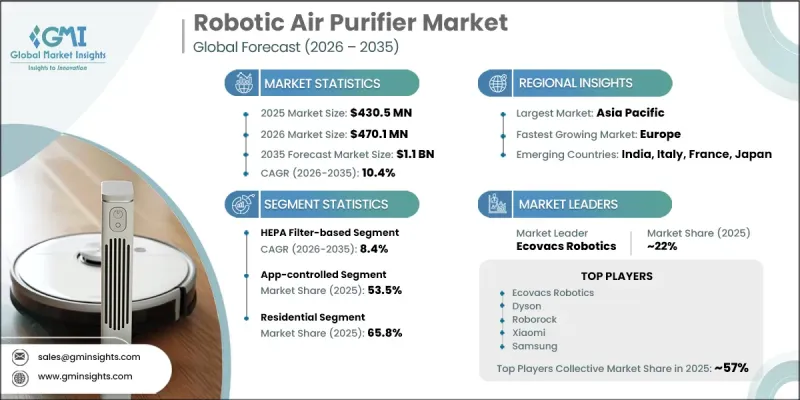
The Global Robotic Air Purifier Market was valued at USD 430.5 million in 2025 and is estimated to grow at a CAGR of 10.4% to reach USD 1.1 billion by 2035.
Increasing awareness regarding indoor air quality and its impact on human health continues to drive strong demand for robotic air purifiers worldwide. Rising levels of indoor pollutants, including airborne particles, allergens, smoke residue, and volatile compounds, are creating growing concerns across residential and commercial environments. As consumers place greater emphasis on healthier indoor living conditions, robotic air purifiers are gaining popularity for their ability to automatically monitor and purify indoor air while improving convenience and operational efficiency. Demand is increasing across homes, commercial offices, healthcare environments, and institutional facilities where maintaining clean indoor air has become a priority. Growing awareness regarding respiratory health and the harmful effect of indoor pollution is further supporting market expansion. In addition, rapid adoption of connected home technologies and smart automation systems is accelerating the integration of robotic air purifiers into broader smart home ecosystems. Consumers increasingly prefer intelligent air purification devices that offer remote monitoring, automated functionality, and seamless connectivity with digital platforms, supporting continued growth across the robotic air purifier market.
| Market Scope | |
|---|---|
| Start Year | 2025 |
| Forecast Year | 2026-2035 |
| Start Value | $430.5 Million |
| Forecast Value | $1.1 Billion |
| CAGR | 10.4% |
The HEPA filter-based segment generated USD 171.9 million in 2025 and is anticipated to grow at a CAGR of 8.4% from 2026 to 2035. This segment continues to dominate the robotic air purifier market because of its strong filtration efficiency and ability to capture fine airborne contaminants that affect indoor air quality. HEPA filtration technology is widely preferred for environments where air cleanliness and respiratory health are major concerns due to its reliable purification performance. Growing consumer focus on healthier indoor spaces and rising concerns related to airborne pollutants continue to strengthen adoption of HEPA filter-based robotic air purifiers across both residential and commercial applications.
The app-controlled segment accounted for a 53.5% share in 2025 and is expected to register a CAGR of 6.5% through 2035. Consumers are increasingly favoring smart connected appliances that can be remotely operated and monitored through digital applications. App-controlled robotic air purifiers enable users to track air quality conditions, customize purification settings, schedule operations, and receive real-time notifications directly through connected mobile devices. The growing expansion of IoT-enabled ecosystems and increasing adoption of smart home technologies continue to strengthen demand for automation-driven air purification solutions, reinforcing the leading position of app-controlled systems within the market.
China Robotic Air Purifier Market reached USD 59.8 million in 2025 and is projected to grow at a CAGR of 10.7% between 2026 and 2035. Market growth across the Asia Pacific region is being supported by increasing urbanization, rising pollution levels, and growing consumer interest in smart home technologies. China continues to lead regional demand due to widespread adoption of robotic air purification systems across residential properties, educational facilities, and commercial buildings. Consumers throughout the region increasingly prefer products equipped with advanced automation capabilities, intelligent monitoring systems, and mobile connectivity features. Manufacturers across Asia Pacific are focusing on delivering technologically advanced, compact, and cost-efficient products that align with evolving consumer preferences for convenience, automation, and enhanced indoor air quality management.
Major companies operating in the Global Robotic Air Purifier Market include 360 (Qihoo 360), Dreame Technology, Dyson, Ecovacs Robotics, Eufy, iLife, LG, Narwal, Philips, Roborock, Samsung, Sharp, TCL, Wyze, and Xiaomi. Companies operating in the robotic air purifier market are implementing various strategic initiatives to strengthen market share and improve competitive positioning. Leading manufacturers are heavily investing in research and development to introduce advanced filtration technologies, AI-powered automation, and intelligent air quality monitoring systems. Product innovation focused on app connectivity, voice-control compatibility, and seamless smart home integration is helping companies enhance user experience and attract technology-focused consumers. Businesses are also expanding product portfolios with compact, energy-efficient, and multifunctional devices tailored for residential and commercial applications. Strategic partnerships with smart home platform providers and expansion through online retail channels are further supporting global market penetration.
Table of Contents
Chapter 1 Methodology & Scope
- 1.1 Market scope and definition
- 1.2 Research design
- 1.2.1 Research approach
- 1.2.2 Data collection methods
- 1.3 Data mining sources
- 1.3.1 Global
- 1.3.2 Regional/Country
- 1.4 Base estimates and calculations
- 1.4.1 Base year calculation
- 1.4.2 Key trends for market estimation
- 1.5 Primary research and validation
- 1.5.1 Primary sources
- 1.6 Forecast model
- 1.7 Research assumptions and limitations
Chapter 2 Executive Summary
- 2.1 Industry 360° synopsis
- 2.2 Key market trends
- 2.2.1 Regional
- 2.2.2 Type
- 2.2.3 Technology
- 2.2.4 Size
- 2.2.5 End Use
- 2.2.6 Distribution channel
Chapter 3 Industry Insights
- 3.1 Industry ecosystem analysis
- 3.1.1 Supplier landscape
- 3.1.2 Profit margin
- 3.1.3 Value addition at each stage
- 3.1.4 Factor affecting the value chain
- 3.2 Industry impact forces
- 3.2.1 Growth drivers
- 3.2.1.1 Rising concerns over indoor air pollution and health impacts
- 3.2.1.2 Growing adoption of smart home and connected devices
- 3.2.1.3 Technological advancements in sensors, navigation, and filtration systems
- 3.2.2 Pitfalls & Challenges
- 3.2.2.1 High cost compared to conventional air purifiers
- 3.2.2.2 Limited awareness and early-stage market penetration
- 3.2.3 Opportunities
- 3.2.3.1 Integration of AI and advanced air quality monitoring systems
- 3.2.3.2 Expansion in emerging markets with rising pollution levels
- 3.2.1 Growth drivers
- 3.3 Growth potential analysis
- 3.4 Future market trends
- 3.5 Technology and innovation landscape
- 3.5.1 Current technological trends
- 3.5.2 Emerging technologies
- 3.6 Regulatory landscape
- 3.6.1 Standards and compliance requirements
- 3.6.2 Regional regulatory frameworks
- 3.6.3 Certification standards
- 3.7 Porter's analysis
- 3.8 PESTEL analysis
- 3.9 Pricing analysis (driven by primary research)
- 3.9.1 Historical price trend analysis (2021-2024) (driven by primary research)
- 3.9.2 Pricing strategy by player type (premium / value / cost-plus) (driven by primary research)
- 3.9.3 Price segmentation by product type & features
- 3.9.4 Regional price variations & parity analysis
- 3.9.5 Impact of raw material costs on pricing
- 3.9.6 Promotional strategies & seasonal discounting patterns
- 3.10 Trade data analysis (driven by paid database)
- 3.10.1 Import/export volume & value trends (2021-2024) (driven by paid database)
- 3.10.2 Key trade corridors & tariff impact (driven by paid database)
- 3.10.3 Trade balance by region
- 3.10.4 HS code classification & customs duty structure
- 3.10.5 Impact of trade agreements & sanctions
- 3.11 Impact of AI and generative AI on the market
- 3.11.1 AI-driven disruption of existing business models
- 3.11.1.1 Predictive air quality management
- 3.11.1.2 Autonomous navigation & room mapping optimization
- 3.11.1.3 Personalized air purification routines
- 3.11.2 GenAI use cases and adoption roadmap by segment
- 3.11.2.1 AI-powered voice assistants & natural language control
- 3.11.2.2 Generative design for filter optimization
- 3.11.2.3 AI-enhanced customer support & troubleshooting
- 3.11.3 Risks, limitations & regulatory considerations
- 3.11.3.1 Data privacy concerns & cybersecurity threats
- 3.11.3.2 Algorithm bias & performance reliability
- 3.11.3.3 Regulatory compliance (AI Act, consumer safety)
- 3.11.1 AI-driven disruption of existing business models
- 3.12 Distribution infrastructure and channel penetration landscape (driven by primary research)
- 3.12.1 Channel coverage by region & format (online vs. offline penetration) (driven by primary research)
- 3.12.2 Last-mile infrastructure gaps & emerging channel shifts (driven by primary research)
- 3.12.3 E-commerce maturity & direct-to-consumer models
- 3.12.4 Specialty retail vs. mass market channel dynamics
Chapter 4 Competitive Landscape, 2025
- 4.1 Introduction
- 4.2 Company market share analysis
- 4.2.1 By Region
- 4.2.1.1 North America
- 4.2.1.2 Europe
- 4.2.1.3 Asia Pacific
- 4.2.1.4 Latin America
- 4.2.1.5 Middle East & Africa
- 4.2.1 By Region
- 4.3 Company matrix analysis
- 4.4 Competitive analysis of major market players
- 4.5 Competitive positioning matrix
- 4.6 Key developments
- 4.6.1 Mergers & acquisitions
- 4.6.2 Partnerships & collaborations
- 4.6.3 New product launches
- 4.6.4 Expansion plans
Chapter 5 Market Estimates & Forecast, By Type, 2022 - 2035, (USD Million) (Thousand Units)
- 5.1 Key trends
- 5.2 HEPA Filter-Based
- 5.3 Activated Carbon
- 5.4 UV-C Light-Based
- 5.5 Ionizer-Based
- 5.6 Others
Chapter 6 Market Estimates & Forecast, By Technology, 2022 - 2035, (USD Million) (Thousand Units)
- 6.1 Key trends
- 6.2 App-Controlled
- 6.3 Voice-Controlled
- 6.4 Smart Integration
Chapter 7 Market Estimates & Forecast, By Size, 2022 - 2035, (USD Million) (Thousand Units)
- 7.1 Key trends
- 7.2 Compact
- 7.3 Medium
- 7.4 Large
Chapter 8 Market Estimates & Forecast, By End Use, 2022 - 2035, (USD Million) (Thousand Units)
- 8.1 Key trends
- 8.2 Residential
- 8.3 Commercial
Chapter 9 Market Estimates & Forecast, By Distribution Channel, 2022 - 2035, (USD Million) (Thousand Units)
- 9.1 Key trends
- 9.2 Offline
- 9.3 Online
Chapter 10 Market Estimates & Forecast, By Region, 2022 - 2035, (USD Million) (Thousand Units)
- 10.1 Key trends
- 10.2 North America
- 10.2.1 U.S.
- 10.2.2 Canada
- 10.3 Europe
- 10.3.1 Germany
- 10.3.2 UK
- 10.3.3 France
- 10.3.4 Italy
- 10.3.5 Spain
- 10.4 Asia Pacific
- 10.4.1 China
- 10.4.2 India
- 10.4.3 Japan
- 10.4.4 South Korea
- 10.4.5 Australia
- 10.5 Latin America
- 10.5.1 Brazil
- 10.5.2 Mexico
- 10.5.3 Argentina
- 10.6 MEA
- 10.6.1 Saudi Arabia
- 10.6.2 UAE
- 10.6.3 South Africa
Chapter 11 Company Profiles
- 11.1 360 (Qihoo 360)
- 11.2 Dreame Technology
- 11.3 Dyson
- 11.4 Ecovacs Robotics
- 11.5 Eufy
- 11.6 iLife
- 11.7 LG
- 11.8 Narwal
- 11.9 Philips
- 11.10 Roborock
- 11.11 Samsung
- 11.12 Sharp
- 11.13 TCL
- 11.14 Wyze
- 11.15 Xiaomi

