
PUBLISHER: Global Market Insights Inc. | PRODUCT CODE: 2045698

PUBLISHER: Global Market Insights Inc. | PRODUCT CODE: 2045698
Biliary Stents Market Opportunity, Growth Drivers, Industry Trend Analysis, and Forecast 2026 - 2035
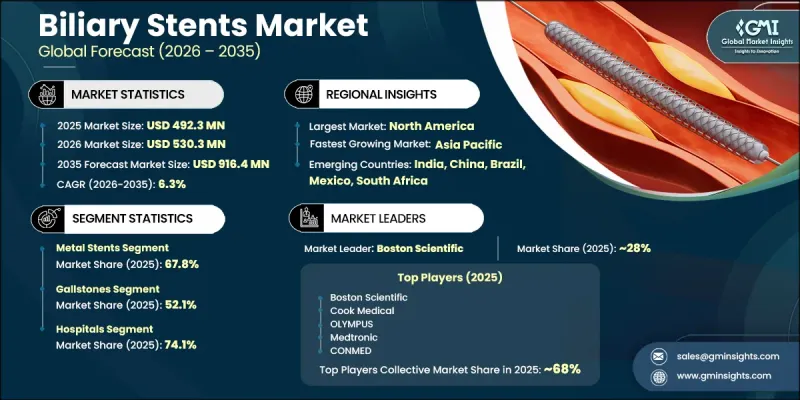
The Global Biliary Stents Market was valued at USD 492.3 million in 2025 and is estimated to grow at a CAGR of 6.3% to reach USD 916.4 million by 2035.
The market is witnessing steady expansion due to the growing occurrence of biliary tract disorders, rising incidence of hepatopancreatic cancers, and increasing preference for minimally invasive treatment procedures. Biliary stents are widely used to manage bile duct blockages and support effective bile drainage in patients suffering from biliary strictures, leaks, and inflammatory conditions linked to liver and pancreatic diseases. The growing use of advanced interventional procedures, combined with ongoing improvements in stent technology and diagnostic imaging systems, is strengthening market growth worldwide. Expanding healthcare infrastructure and rising access to specialized gastroenterology treatments are further supporting adoption across both developed and emerging economies. In addition, the increasing burden of chronic diseases associated with aging populations and changing lifestyle patterns continues to elevate demand for advanced biliary management solutions. Technological progress in stent materials, flexibility, durability, and placement techniques is also improving treatment outcomes and supporting long-term market development.
| Market Scope | |
|---|---|
| Start Year | 2025 |
| Forecast Year | 2026-2035 |
| Start Value | $492.3 Million |
| Forecast Value | $916.4 Million |
| CAGR | 6.3% |
The biliary stents market continues to expand as healthcare providers increasingly adopt minimally invasive procedures for the treatment of bile duct complications. Techniques such as ERCP and PTC have become widely preferred due to their ability to reduce recovery time, minimize surgical risks, and improve patient outcomes. The growing prevalence of pancreatic cancer, liver disorders, biliary infections, and chronic inflammatory conditions is significantly increasing the need for effective stenting procedures. Biliary obstruction caused by malignant and benign conditions frequently requires long-term drainage management, further strengthening product demand. In addition, improvements in stent design, including enhanced flexibility, anti-migration features, and better biocompatibility, are contributing to greater clinical adoption. Rising healthcare spending and broader availability of advanced gastroenterology services are also creating favorable growth opportunities for the industry.
The metal stents segment accounted for 67.8% share in 2025. The segment continues to maintain a leading position due to the superior radial strength, long-term durability, and lower risk of blockage associated with metal-based stents. Self-expandable metal stents are increasingly preferred for managing malignant biliary obstructions because they provide prolonged duct patency and reduce the need for repeated interventions. The growing incidence of bile duct cancers and pancreatic malignancies is further accelerating the adoption of these advanced stenting solutions in palliative care and long-term disease management.
The gallstones segment held a share of 52.1% in 2025 and is anticipated to reach USD 475.8 million during 2026-2035. The rising prevalence of gallstone-related complications is significantly contributing to the demand for biliary stents globally. Factors, including unhealthy dietary habits, obesity, and sedentary lifestyles, are increasing the occurrence of gallstone formation and associated biliary obstructions. Endoscopic treatment approaches involving stent placement continue to play an essential role in restoring bile flow, relieving symptoms, and minimizing complications linked to biliary blockages and inflammatory conditions.
North America Biliary Stents Market held a 35% share in 2025. The region remains a major contributor to industry growth due to the high prevalence of biliary diseases, pancreatic disorders, and hepatobiliary cancers. Increasing rates of obesity, metabolic disorders, and age-related health complications are supporting the rising demand for advanced biliary treatment procedures across the region. North America also benefits from a highly developed healthcare system, strong adoption of advanced interventional technologies, and widespread availability of specialized endoscopic procedures. Growing investments in healthcare innovation and advanced gastroenterology services continue to strengthen regional market expansion.
Prominent companies operating in the Global Biliary Stents Industry include Allium Medical, Becton, Dickinson and Company, Boston Scientific, CONMED, Cook Medical, Cordis, ELLA - CS, ENDO-FLEX, M.I Tech, Medtronic, Merit Medical Systems, MICRO-TECH, OLYMPUS, S&G Biotech, and Taewoong Medical. Companies operating in the biliary stents market are focusing on product innovation, strategic collaborations, and expansion of minimally invasive treatment portfolios to strengthen their market presence. Leading manufacturers are investing heavily in research and development activities to improve stent flexibility, durability, biocompatibility, and anti-migration capabilities. Many organizations are also introducing advanced self-expandable metal stents designed to improve long-term drainage performance and reduce procedure-related complications. In addition, companies are expanding partnerships with hospitals, gastroenterology centers, and healthcare providers to increase product accessibility and strengthen distribution networks. Geographic expansion into emerging healthcare markets, combined with rising investments in training programs for interventional procedures, is further supporting business growth.
Table of Contents
Chapter 1 Research Methodology
- 1.1 Research approach
- 1.2 Quality commitments
- 1.2.1 GMI AI policy & data integrity commitment
- 1.2.1.1 Source consistency protocol
- 1.2.1 GMI AI policy & data integrity commitment
- 1.3 Research trail & confidence scoring
- 1.3.1 Research trail components
- 1.3.2 Scoring components
- 1.4 Data collection
- 1.4.1 Partial list of primary sources
- 1.5 Data mining sources
- 1.5.1 Paid sources
- 1.5.1.1 Sources, by region
- 1.5.1 Paid sources
- 1.6 Base estimates and calculations
- 1.6.1 Base year calculation for any one approach
- 1.7 Forecast model
- 1.7.1 Quantified market impact analysis
- 1.7.1.1 Mathematical impact of growth parameters on forecast
- 1.7.1 Quantified market impact analysis
- 1.8 Research transparency addendum
- 1.8.1 Source attribution framework
- 1.8.2 Quality assurance metrics
- 1.8.3 Our commitment to trust
Chapter 2 Executive Summary
- 2.1 Industry 3600 synopsis
- 2.2 Key market trends
- 2.2.1 Regional trends
- 2.2.2 Type trends
- 2.2.3 Application trends
- 2.2.4 End use trends
- 2.3 CXO perspectives: Strategic imperatives
Chapter 3 Industry Insights
- 3.1 Industry ecosystem analysis
- 3.2 Industry impact forces
- 3.2.1 Growth drivers
- 3.2.1.1 Rising prevalence of biliary disorders and chronic liver diseases
- 3.2.1.2 Growing adoption of minimally invasive procedures
- 3.2.1.3 Technological advancements in stent design
- 3.2.1.4 Expanding clinical applications of endoscopic luminal stenting
- 3.2.2 Industry pitfalls and challenges
- 3.2.2.1 High cost of stents and associated procedures
- 3.2.2.2 Complications and risks related to bile duct stents
- 3.2.3 Market opportunities
- 3.2.3.1 Development of biodegradable and drug-eluting stents
- 3.2.3.2 Expansion in emerging markets
- 3.2.1 Growth drivers
- 3.3 Growth potential analysis
- 3.4 Regulatory landscape (Driven by primary research)
- 3.4.1 North America
- 3.4.2 Europe
- 3.4.3 Asia Pacific
- 3.4.4 Latin America
- 3.4.5 MEA
- 3.5 Technology landscape
- 3.5.1 Current technological trends
- 3.5.2 Emerging technologies
- 3.6 Pricing analysis (Driven by primary research)
- 3.7 Future market trends
- 3.8 Porter's analysis
- 3.9 PESTEL analysis
- 3.10 Impact of AI and Generative AI on the market (Driven by primary research)
- 3.11 Value chain analysis (Driven by primary research)
- 3.12 Investment & funding analysis (Driven by primary research)
- 3.13 Consumer insights (Driven by primary research)
- 3.14 Treatment infrastructure & clinical adoption landscape
- 3.15 Gap analysis
Chapter 4 Competitive Landscape, 2025
- 4.1 Introduction
- 4.2 Company matrix analysis
- 4.3 Company market share analysis (Driven by primary research)
- 4.3.1 Global
- 4.3.2 North America
- 4.3.3 Europe
- 4.3.4 Asia Pacific
- 4.4 Competitive positioning matrix
- 4.5 Competitive analysis of major market players
- 4.6 Key developments
- 4.6.1 Mergers & acquisitions
- 4.6.2 Partnerships & collaborations
- 4.6.3 New product launches
- 4.6.4 Expansion plans
Chapter 5 Market Estimates and Forecast, By Type, 2022 - 2035 ($ Mn)
- 5.1 Key trends
- 5.2 Metal stents
- 5.3 Polymer stents
Chapter 6 Market Estimates and Forecast, By Application, 2022 - 2035 ($ Mn)
- 6.1 Key trends
- 6.2 Gallstones
- 6.3 Pancreatic cancer
- 6.4 Bilio-pancreatic leakages
- 6.5 Benign biliary strictures
- 6.6 Other applications
Chapter 7 Market Estimates and Forecast, By End Use, 2022 - 2035 ($ Mn)
- 7.1 Key trends
- 7.2 Hospitals
- 7.3 Ambulatory surgical centers
- 7.4 Other end users
Chapter 8 Market Estimates and Forecast, By Region, 2022 - 2035 ($ Mn)
- 8.1 Key trends
- 8.2 North America
- 8.2.1 U.S.
- 8.2.2 Canada
- 8.3 Europe
- 8.3.1 Germany
- 8.3.2 UK
- 8.3.3 France
- 8.3.4 Spain
- 8.3.5 Italy
- 8.3.6 Netherlands
- 8.4 Asia Pacific
- 8.4.1 China
- 8.4.2 Japan
- 8.4.3 India
- 8.4.4 Australia
- 8.4.5 South Korea
- 8.5 Latin America
- 8.5.1 Brazil
- 8.5.2 Mexico
- 8.5.3 Argentina
- 8.6 Middle East and Africa
- 8.6.1 South Africa
- 8.6.2 Saudi Arabia
- 8.6.3 UAE
Chapter 9 Company Profiles
- 9.1 Allium Medical
- 9.2 Becton, Dickinson and Company
- 9.3 Boston Scientific
- 9.4 CONMED
- 9.5 Cook Medical
- 9.6 Cordis
- 9.7 ELLA - CS
- 9.8 ENDO-FLEX
- 9.9 M.I Tech
- 9.10 Medtronic
- 9.11 Merit Medical Systems
- 9.12 MICRO-TECH
- 9.13 OLYMPUS
- 9.14 S&G Biotech
- 9.15 Taewoong Medical

