PUBLISHER: Global Market Insights Inc. | PRODUCT CODE: 2045700

PUBLISHER: Global Market Insights Inc. | PRODUCT CODE: 2045700
Hydrogen Aircraft Market Opportunity, Growth Drivers, Industry Trend Analysis, and Forecast 2026 - 2035
The Global Hydrogen Aircraft Market was valued at USD 934.5 million in 2025 and is estimated to grow at a CAGR of 33.6% to reach USD 16.9 billion by 2035.
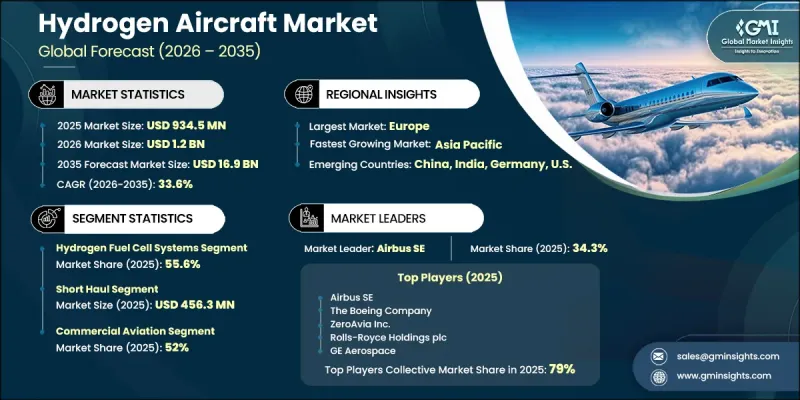
The hydrogen aircraft industry is gaining momentum as aviation stakeholders intensify efforts to decarbonize air transport and reduce reliance on conventional jet fuel. Hydrogen derived from renewable energy sources such as wind and solar is increasingly being viewed as a transformative solution for achieving zero-emission aviation. Growing investments in research and development of fuel cell systems and hydrogen propulsion technologies are accelerating market progress. Early-stage adoption is expected to concentrate on short-haul and regional aviation routes, while long-term advancements are expected to enable scalability into long-haul operations as energy density and storage technologies improve. Expanding collaboration across international aviation stakeholders is further supporting innovation and commercialization pathways. Rising demand for sustainable aviation solutions is also pushing aircraft manufacturers and technology developers to explore next-generation propulsion systems. Continuous technological advancements, particularly in fuel cell efficiency, hybrid propulsion systems, and lightweight aircraft design, are shaping the future of hydrogen-powered aviation and strengthening its role in the global transition toward low-carbon air mobility.
| Market Scope | |
|---|---|
| Start Year | 2025 |
| Forecast Year | 2026-2035 |
| Start Value | $934.5 Million |
| Forecast Value | $16.9 Billion |
| CAGR | 33.6% |
The hydrogen combustion engines segment is projected to grow at a CAGR of 34.4% through 2035. This segment is emerging as a transitional solution for decarbonizing existing aircraft fleets by adapting conventional turbine systems to operate using hydrogen fuel. Development efforts are focused on improving fuel efficiency, enhancing thermal management, and reducing emissions to ensure commercial feasibility for short- and medium-range aircraft applications. Increasing R&D activity is helping refine combustion performance while supporting integration with existing aviation infrastructure, which is expected to accelerate adoption in the coming years.
The medium-haul segment is expected to grow at a CAGR of 34.5% through 2035. Medium-distance aviation routes present strong opportunities for hydrogen adoption through hybrid propulsion configurations that combine fuel cells with conventional engine systems. Aircraft manufacturers are actively developing advanced propulsion architectures that integrate fuel cells and energy storage systems to extend operational range while maintaining payload efficiency. These developments aim to support regulatory compliance and operational efficiency while enabling the gradual expansion of hydrogen-powered aviation beyond short-haul applications.
North America Hydrogen Aircraft Market accounted for 32.7% share in 2025. Regional growth is supported by the presence of leading aerospace manufacturers, strong research and development capabilities, and increasing government support for clean aviation technologies. Expanding investment in hydrogen propulsion systems and growing collaboration between industry participants and public agencies are further accelerating market development. The region continues to benefit from structured funding initiatives and innovation-focused programs that support advanced aerospace technologies and sustainable aviation solutions.
Key companies operating in the Global Hydrogen Aircraft Market include Airbus SE, The Boeing Company, GE Aerospace, Rolls-Royce Holdings plc, Pratt & Whitney, GKN Aerospace, Intelligent Energy, and ElringKlinger AG. Companies operating in the hydrogen aircraft industry are adopting multiple strategic initiatives to strengthen their market position and accelerate commercialization. Leading players are increasing investments in fuel cell research, hydrogen propulsion systems, and lightweight aircraft design technologies to improve efficiency and performance. Strategic collaborations between aircraft manufacturers, energy providers, and technology developers are supporting faster innovation and shared development of hydrogen infrastructure. Firms are also focusing on hybrid propulsion systems that integrate hydrogen fuel cells with conventional engines to enable phased adoption across aviation segments. Expansion of pilot projects, demonstration aircraft programs, and long-term testing initiatives helps validate performance under real operating conditions.
Table of Contents
Chapter 1 Methodology and Scope
- 1.1 Market scope and definition
- 1.2 Research design
- 1.2.1 Research approach
- 1.2.2 Data collection methods
- 1.3 Data mining sources
- 1.3.1 Global
- 1.3.2 Regional/Country
- 1.4 Base estimates and calculations
- 1.4.1 Base year calculation
- 1.4.2 Key trends for market estimation
- 1.5 Primary research and validation
- 1.5.1 Primary sources
- 1.6 Forecast model
- 1.7 Research assumptions and limitations
Chapter 2 Executive Summary
- 2.1 Industry 360° synopsis, 2022 - 2035
- 2.2 Key market trends
- 2.2.1 Propulsion technology trends
- 2.2.2 Aircraft range trends
- 2.2.3 Platform type trends
- 2.2.4 Application trends
- 2.2.5 Regional trends
- 2.3 TAM Analysis, 2026-2035
- 2.4 CXO perspectives: Strategic imperatives
Chapter 3 Industry Insights
- 3.1 Industry ecosystem analysis
- 3.1.1 Supplier Landscape
- 3.1.2 Profit Margin
- 3.1.3 Cost structure
- 3.1.4 Value addition at each stage
- 3.1.5 Factor affecting the value chain
- 3.1.6 Disruptions
- 3.2 Industry impact forces
- 3.2.1 Growth drivers
- 3.2.1.1 Growing demand for sustainable aviation
- 3.2.1.2 Public demand for eco-friendly travel
- 3.2.1.3 Collaboration between companies for manufacturing of hydrogen
- 3.2.1.4 Cost saving over long-term operations
- 3.2.1.5 Support from renewable energy sector
- 3.2.2 Industry pitfalls and challenges
- 3.2.2.1 Compatibility with existing aircrafts
- 3.2.2.2 Insufficient hydrogen supply chain
- 3.2.3 Market opportunities
- 3.2.3.1 Expansion of regional hydrogen infrastructure
- 3.2.3.2 Next-generation fuel-cell development
- 3.2.1 Growth drivers
- 3.3 Growth potential analysis
- 3.4 Regulatory landscape
- 3.4.1 North America
- 3.4.2 Europe
- 3.4.3 Asia Pacific
- 3.4.4 Latin America
- 3.4.5 Middle East & Africa
- 3.5 Porter's analysis
- 3.6 PESTEL analysis
- 3.7 Technology and Innovation landscape
- 3.7.1 Current technological trends
- 3.7.2 Emerging technologies
- 3.8 Emerging business models
- 3.9 Compliance requirements
- 3.10 Defense budget analysis
- 3.11 Global defense spending trends
- 3.12 Regional defense budget allocation
- 3.12.1 North America
- 3.12.2 Europe
- 3.12.3 Asia Pacific
- 3.12.4 Middle East and Africa
- 3.12.5 Latin America
- 3.13 Key defense modernization programs
- 3.14 Budget forecast (2025-2034)
- 3.14.1 Impact on industry growth
- 3.14.2 Defense budgets by country
- 3.14.3 Defense budget allocation by segment
- 3.14.3.1 Personnel
- 3.14.3.2 Operations and maintenance
- 3.14.3.3 Procurement
- 3.14.3.4 Research, development, test and evaluation
- 3.14.3.5 Infrastructure and construction
- 3.14.3.6 Technology and innovation
- 3.15 Supply chain resilience
- 3.16 Geopolitical analysis
- 3.17 Workforce analysis
- 3.18 Digital transformation
- 3.19 Mergers, acquisitions, and strategic partnerships landscape
- 3.20 Risk assessment and management
- 3.21 Major contract awards (2022-2025)
Chapter 4 Competitive Landscape, 2025
- 4.1 Introduction
- 4.2 Company market share analysis
- 4.2.1 By region
- 4.2.1.1 North America
- 4.2.1.2 Europe
- 4.2.1.3 Asia Pacific
- 4.2.1.4 Latin America
- 4.2.1.5 Middle East & Africa
- 4.2.2 Market concentration analysis
- 4.2.1 By region
- 4.3 Competitive benchmarking of key players
- 4.3.1 Financial performance comparison
- 4.3.1.1 Revenue
- 4.3.1.2 Profit margin
- 4.3.1.3 R&D
- 4.3.2 Product portfolio comparison
- 4.3.2.1 Product range breadth
- 4.3.2.2 Technology
- 4.3.2.3 Innovation
- 4.3.3 Geographic presence comparison
- 4.3.3.1 Global footprint analysis
- 4.3.3.2 Service network coverage
- 4.3.3.3 Market penetration by region
- 4.3.4 Competitive positioning matrix
- 4.3.4.1 Leaders
- 4.3.4.2 Challengers
- 4.3.4.3 Followers
- 4.3.4.4 Niche players
- 4.3.5 Strategic outlook matrix
- 4.3.1 Financial performance comparison
- 4.4 Key developments
- 4.4.1 Mergers and acquisitions
- 4.4.2 Partnerships and collaborations
- 4.4.3 Technological advancements
- 4.4.4 Expansion and investment strategies
- 4.4.5 Digital transformation initiatives
- 4.5 Emerging/ startup competitors landscape
Chapter 5 Market Estimates and Forecast, By Propulsion Technology, 2022 - 2035 (USD Million)
- 5.1 Key trends
- 5.2 Hydrogen fuel cell systems
- 5.2.1 Proton exchange membrane fuel cells
- 5.2.2 Solid oxide fuel cells
- 5.3 Hydrogen combustion engines
- 5.3.1 Modified gas turbine engines
- 5.3.2 Hybrid combustion systems
Chapter 6 Market Estimates and Forecast, By Aircraft Range, 2022 - 2035 (USD Million)
- 6.1 Key trends
- 6.2 Short haul
- 6.3 Medium haul
- 6.4 Long haul
Chapter 7 Market Estimates and Forecast, By Platform Type, 2022 - 2035 (USD Million)
- 7.1 Key trends
- 7.2 Regional & narrow body aircraft
- 7.3 Wide body aircraft
- 7.4 Business jets
- 7.5 Urban air mobility & air taxis
- 7.6 Unmanned aerial vehicles
Chapter 8 Market Estimates and Forecast, By Application, 2022 - 2035 (USD Million)
- 8.1 Key trends
- 8.2 Commercial aviation
- 8.2.1 Scheduled passenger airlines
- 8.2.2 Charter services
- 8.3 Cargo & freight aviation
- 8.3.1 Dedicated cargo aircraft
- 8.3.2 Integrated logistics operations
- 8.4 Military & defense aviation
- 8.4.1 Transport & logistics
- 8.4.2 Reconnaissance & surveillance
- 8.5 General & business aviation
- 8.5.1 Business jets
- 8.5.2 Air taxi services
Chapter 9 Market Estimates and Forecast, By Region, 2022 - 2035 (USD Million)
- 9.1 Key trends
- 9.2 North America
- 9.2.1 U.S.
- 9.2.2 Canada
- 9.3 Europe
- 9.3.1 Germany
- 9.3.2 UK
- 9.3.3 France
- 9.3.4 Spain
- 9.3.5 Italy
- 9.3.6 Russia
- 9.3.7 Rest of Europe
- 9.4 Asia Pacific
- 9.4.1 China
- 9.4.2 India
- 9.4.3 Japan
- 9.4.4 Australia
- 9.4.5 South Korea
- 9.4.6 Rest of Asia Pacific
- 9.5 Latin America
- 9.5.1 Brazil
- 9.5.2 Mexico
- 9.5.3 Argentina
- 9.5.4 Rest of Latin America
- 9.6 Middle East and Africa
- 9.6.1 South Africa
- 9.6.2 Saudi Arabia
- 9.6.3 UAE
- 9.6.4 Rest of Middle East & Africa
Chapter 10 Company Profiles
- 10.1 Global Key Players
- 10.1.1 Airbus SE
- 10.1.2 The Boeing Company
- 10.1.3 GE Aerospace
- 10.1.4 Rolls-Royce Holdings plc
- 10.1.5 Pratt & Whitney
- 10.1.6 GKN Aerospace
- 10.1.7 Parker Aerospace
- 10.2 Regional key players
- 10.2.1 ElringKlinger AG
- 10.2.2 PowerCell Sweden AB
- 10.2.3 Intelligent Energy
- 10.2.4 Aeristech Ltd.
- 10.3 Niche Players/Disruptors
- 10.3.1 ZeroAvia Inc.
- 10.3.2 H2FLY GmbH
- 10.3.3 JetZero Inc.
- 10.3.4 Joby Aviation
- 10.3.5 Cranfield Aerospace Solutions Ltd.
- 10.3.6 Stralis Aircraft

