PUBLISHER: Global Market Insights Inc. | PRODUCT CODE: 2045701

PUBLISHER: Global Market Insights Inc. | PRODUCT CODE: 2045701
Tangerine Essential Oil Market Opportunity, Growth Drivers, Industry Trend Analysis, and Forecast 2026 - 2035
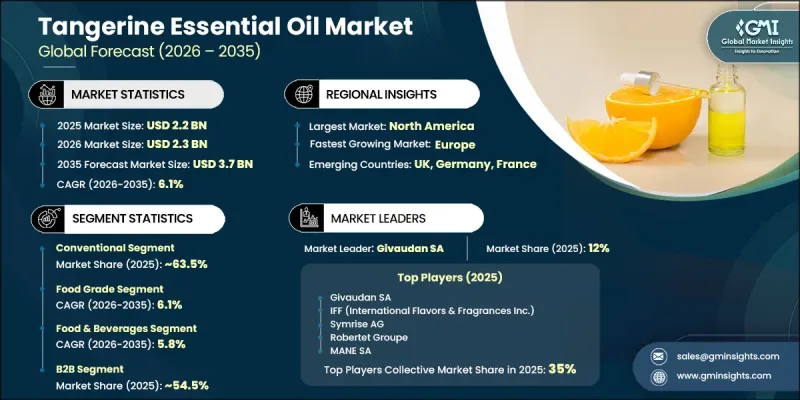
The Global Tangerine Essential Oil Market was valued at USD 2.2 billion in 2025 and is estimated to grow at a CAGR of 6.1% to reach USD 3.7 billion by 2035.
The market is witnessing expansion as consumers increasingly shift toward natural, plant-derived, and organic products across personal care, wellness, and food-related applications. Rising awareness regarding holistic health and preference for clean-label formulations are significantly influencing purchasing behavior. Tangerine essential oil has gained strong traction due to its refreshing aroma and multifunctional use across aromatherapy, skincare formulations, and flavoring applications. Growing focus on preventive wellness and natural therapeutic solutions is further reinforcing its adoption across global consumer segments. However, supply chain volatility remains a key challenge, as oil production depends heavily on citrus fruit availability, which is impacted by climatic variations, seasonal fluctuations, and geographically concentrated cultivation zones. Any disruption in raw material availability can directly affect production stability and pricing consistency, creating supply-side pressure for manufacturers. Despite these constraints, continuous innovation in extraction technologies and expanding applications in wellness-oriented industries are expected to support the steady long-term growth of the market.
| Market Scope | |
|---|---|
| Start Year | 2025 |
| Forecast Year | 2026-2035 |
| Start Value | $2.2 Billion |
| Forecast Value | $3.7 Billion |
| CAGR | 6.1% |
The conventional segment held a share of 63.5% in 2025 and is projected to grow at a CAGR of 5.7% through 2035. This segment remains dominant due to its cost efficiency, easy accessibility, and consistent supply availability, making it highly suitable for large-scale use across flavor, fragrance, and industrial applications. Its ability to maintain stable quality standards supports high-volume manufacturing requirements and ensures continuous supply for global end-use industries.
The food-grade segment held a share of 66% in 2025 and is expected to grow at a CAGR of 6.1% during 2026-2035. This segment leads due to its widespread use in food and beverage flavoring, dietary supplements, and natural ingredient formulations. Its strong compliance with food safety standards, clean-label positioning, and stable sensory profile make it highly preferred among manufacturers focused on natural and health-oriented product development.
North America Tangerine Essential Oil Market accounted for a 38% share in 2025. The region's growth is supported by increasing demand for natural wellness ingredients, expanding personal care industries, and rising consumer preference for aromatherapy-based solutions. Strong manufacturing capabilities, well-established regulatory systems, and increasing adoption of sustainable and natural formulations are further supporting market expansion. Growing investments in health-focused product innovation are also contributing to steady regional demand growth.
Major companies operating in the Global Tangerine Essential Oil Market include Givaudan SA, International Flavors & Fragrances Inc. (IFF), Symrise AG, Robertet Groupe, MANE SA, Young Living Essential Oils, Biolandes, Capua 1880, Florihana, Citrusmade Srl, Shanghai Citrus Import Corporation Ltd., Citrus and Allied Essences Ltd., and Kanta Enterprises Private Limited. Companies operating in the Tangerine Essential Oil Market are focusing on several strategic initiatives to strengthen their market presence and enhance competitiveness. Leading players are investing in advanced extraction technologies to improve oil purity, yield efficiency, and aroma consistency. Expansion of sourcing networks and direct partnerships with citrus growers are helping ensure a stable raw material supply and reduce dependency risks. Product diversification across aromatherapy, cosmetics, and food applications is enabling companies to capture a wider customer base. Manufacturers are also prioritizing clean-label and organic certifications to align with evolving consumer preferences for natural products.
Table of Contents
Chapter 1 Methodology & Scope
- 1.1 Market scope and definition
- 1.2 Research design
- 1.2.1 Research approach
- 1.2.2 Data collection methods
- 1.3 Data mining sources
- 1.3.1 Global
- 1.3.2 Regional/Country
- 1.4 Base estimates and calculations
- 1.4.1 Base year calculation
- 1.4.2 Key trends for market estimation
- 1.5 Primary research and validation
- 1.5.1 Primary sources
- 1.6 Forecast model
- 1.7 Research assumptions and limitations
Chapter 2 Executive Summary
- 2.1 Industry 360° synopsis
- 2.2 Key market trends
- 2.2.1 Regional
- 2.2.2 Nature
- 2.2.3 Grade
- 2.2.4 End-User
- 2.2.5 Distribution Channel
- 2.3 TAM Analysis, 2026-2035
- 2.4 CXO perspectives: Strategic imperatives
- 2.4.1 Executive decision points
- 2.4.2 Critical success factors
- 2.5 Future Outlook and Strategic Recommendations
Chapter 3 Industry Insights
- 3.1 Industry ecosystem analysis
- 3.1.1 Supplier landscape
- 3.1.2 Profit margin
- 3.1.3 Value addition at each stage
- 3.1.4 Factor affecting the value chain
- 3.1.5 Disruptions
- 3.2 Industry impact forces
- 3.2.1 Growth drivers
- 3.2.1.1 Growing demand for natural and organic products
- 3.2.1.2 Expanding applications in various industries
- 3.2.1.3 Rising health and wellness trend
- 3.2.2 Industry pitfalls and challenges
- 3.2.2.1 Supply chain vulnerability
- 3.2.2.2 Quality control and authenticity concerns
- 3.2.3 Market opportunities
- 3.2.3.1 Product innovation in blended essential oil formulations
- 3.2.3.2 Direct-to-consumer e-commerce channel growth
- 3.2.1 Growth drivers
- 3.3 Growth potential analysis
- 3.4 Regulatory landscape
- 3.4.1 North America
- 3.4.2 Europe
- 3.4.3 Asia Pacific
- 3.4.4 Latin America
- 3.4.5 Middle East & Africa
- 3.5 Porter's analysis
- 3.6 PESTEL analysis
- 3.7 Price trends
- 3.7.1 By region
- 3.7.2 By nature
- 3.8 Future market trends
- 3.9 Technology and Innovation landscape
- 3.9.1 Current technological trends
- 3.9.2 Emerging technologies
- 3.10 Patent Landscape
- 3.11 Trade statistics (HS code)
- 3.11.1 Major importing countries
- 3.11.2 Major exporting countries
- 3.12 Sustainability and environmental aspects
- 3.12.1 Sustainable practices
- 3.12.2 Waste reduction strategies
- 3.12.3 Energy efficiency in production
- 3.12.4 Eco-friendly initiatives
- 3.13 Carbon footprint consideration
Chapter 4 Competitive Landscape, 2025
- 4.1 Introduction
- 4.2 Company market share analysis
- 4.2.1 By region
- 4.2.1.1 North America
- 4.2.1.2 Europe
- 4.2.1.3 Asia Pacific
- 4.2.1.4 LATAM
- 4.2.1.5 MEA
- 4.2.1 By region
- 4.3 Company matrix analysis
- 4.4 Competitive analysis of major market players
- 4.5 Competitive positioning matrix
- 4.6 Key developments
- 4.6.1 Mergers & acquisitions
- 4.6.2 Partnerships & collaborations
- 4.6.3 New Product Launches
- 4.6.4 Expansion Plans
Chapter 5 Market Estimates and Forecast, By Nature, 2022-2035 (USD Million) (Kilo Tons)
- 5.1 Key trends
- 5.2 Organic
- 5.3 Conventional
Chapter 6 Market Estimates and Forecast, By Grade, 2022-2035 (USD Million) (Kilo Tons)
- 6.1 Key trends
- 6.2 Food Grade
- 6.3 Industrial Grade
Chapter 7 Market Estimates and Forecast, By End-User, 2022-2035 (USD Million) (Kilo Tons)
- 7.1 Key trends
- 7.2 Food & Beverages
- 7.3 Pharmaceuticals
- 7.4 Aromatherapy
- 7.5 Cosmetics & Personal Care
- 7.6 Others
Chapter 8 Market Estimates and Forecast, By Distribution Channel, 2022-2035 (USD Million) (Kilo Tons)
- 8.1 Key trends
- 8.2 B2B
- 8.3 Hypermarkets/Supermarkets
- 8.4 Specialty Retail
- 8.5 E-commerce
- 8.6 Others
Chapter 9 Market Estimates and Forecast, By Region, 2022-2035 (USD Million) (Kilo Tons)
- 9.1 Key trends
- 9.2 North America
- 9.2.1 U.S.
- 9.2.2 Canada
- 9.3 Europe
- 9.3.1 Germany
- 9.3.2 UK
- 9.3.3 France
- 9.3.4 Spain
- 9.3.5 Italy
- 9.3.6 Rest of Europe
- 9.4 Asia Pacific
- 9.4.1 China
- 9.4.2 India
- 9.4.3 Japan
- 9.4.4 Australia
- 9.4.5 South Korea
- 9.4.6 Rest of Asia Pacific
- 9.5 Latin America
- 9.5.1 Brazil
- 9.5.2 Mexico
- 9.5.3 Argentina
- 9.5.4 Rest of Latin America
- 9.6 Middle East and Africa
- 9.6.1 Saudi Arabia
- 9.6.2 South Africa
- 9.6.3 UAE
- 9.6.4 Rest of Middle East and Africa
Chapter 10 Company Profiles
- 10.1 Young Living Essential Oils
- 10.2 Givaudan SA
- 10.3 IFF (International Flavors & Fragrances Inc.)
- 10.4 Symrise AG
- 10.5 MANE SA
- 10.6 Robertet Groupe
- 10.7 Capua 1880
- 10.8 Citrusmade Srl
- 10.9 Biolandes
- 10.10 Florihana
- 10.11 Shanghai Citrus Import Corporation Ltd.
- 10.12 Citrus and Allied Essences Ltd.
- 10.13 Kanta Enterprises Private Limited

