PUBLISHER: Global Market Insights Inc. | PRODUCT CODE: 2045704

PUBLISHER: Global Market Insights Inc. | PRODUCT CODE: 2045704
Textile Enzyme Market Opportunity, Growth Drivers, Industry Trend Analysis, and Forecast 2026 - 2035
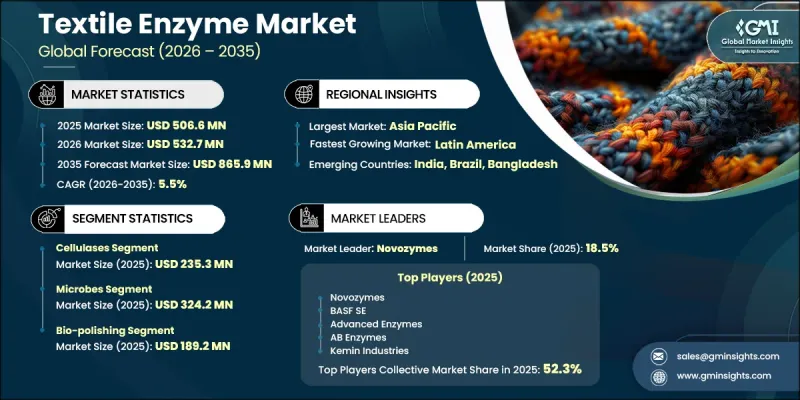
The Global Textile Enzyme Market was valued at USD 506.6 million in 2025 and is estimated to grow at a CAGR of 5.5% to reach USD 865.9 million by 2035.
The textile enzyme industry continues to expand steadily as textile manufacturers increasingly shift toward sustainable and environmentally responsible production methods. Textile enzymes function as specialized biological catalysts sourced from microorganisms, plants, and animal tissues that support efficient textile processing through controlled enzymatic reactions. These enzymes are widely used across multiple textile treatment applications due to their ability to reduce chemical usage, lower energy consumption, and improve processing efficiency. Their compatibility with varying temperature conditions, pH levels, and water quality standards makes them highly suitable for both conventional and modern textile manufacturing operations. Growing preference for biodegradable processing agents and increasing emphasis on reducing toxic industrial waste are further strengthening market demand. Technological advancements in fermentation methods, purification systems, immobilization techniques, and genetic engineering are significantly improving enzyme stability, activity control, and performance efficiency. These developments are enabling manufacturers to produce highly specialized textile enzymes that support precision-based textile finishing and sustainable fabric processing applications across global markets.
| Market Scope | |
|---|---|
| Start Year | 2025 |
| Forecast Year | 2026-2035 |
| Start Value | $506.6 Million |
| Forecast Value | $865.9 Million |
| CAGR | 5.5% |
The cellulases segment accounted for USD 235.3 million in 2025. Demand for cellulase enzymes continues to increase due to their extensive application in fabric finishing and surface enhancement processes for cotton and cellulosic textiles. These enzymes are widely utilized to improve fabric texture, enhance smoothness, and minimize surface imperfections during textile processing. Advancements in cellulase technology have enabled the development of more targeted enzyme variants that provide controlled fabric treatment while preserving fiber integrity. Growing demand for premium-quality textile finishes and efficient fabric processing solutions is further contributing to the expansion of the cellulases segment within the global textile enzyme industry.
The microbial enzyme segment generated USD 324.2 million in 2025. Strong market growth is primarily attributed to the scalability and cost-efficiency associated with microbial enzyme production through advanced fermentation technologies. Enzymes derived from microbial sources offer consistent quality and are available in a wide range of formulations suitable for different textile processing environments. In addition, microbial enzymes demonstrate high stability during storage and transportation, making them more reliable for large-scale industrial applications. Their adaptability to diverse processing conditions continues to support widespread adoption across textile manufacturing facilities worldwide.
North America Textile Enzyme Market is projected to witness notable growth, increasing from USD 147.9 million in 2025 to USD 247.9 million by 2035. Market expansion across the region is being driven by rising demand for sustainable textile processing methods and increasing adoption of environmentally responsible manufacturing practices. Textile manufacturers throughout North America are investing in enzyme-based technologies to align with stricter environmental standards and reduce industrial pollution associated with traditional chemical treatments. Growing focus on green chemistry initiatives and sustainable production systems is further accelerating the deployment of textile enzymes across specialty fabric and technical textile manufacturing operations in the region.
Major companies operating in the Global Textile Enzyme Market include Novozymes, BASF SE, Advanced Enzymes, AB Enzymes, Kemin Industries, Inc, BESTZYME BIO-ENGINEERING CO., LTD., Infinita Biotech Private Limited, Tex Biosciences, Antozyme Biotech Pvt. Ltd., Noor Enzymes, Sunsong Industry Group Co., Ltd., EPYGEN LABS LLC, and DENYKEM. Companies operating in the textile enzyme market are implementing various strategic initiatives to strengthen their market position and expand their global presence. Leading manufacturers are heavily investing in research and development activities to create advanced enzyme formulations with enhanced stability, efficiency, and compatibility for sustainable textile processing. Strategic partnerships and collaborations with textile manufacturers help companies improve product penetration and broaden their customer base across key regions. Businesses are also focusing on expanding production capacities and modernizing fermentation technologies to increase operational efficiency and meet growing global demand. In addition, companies are prioritizing environmentally friendly product development to align with tightening environmental regulations and rising sustainability expectations within the textile industry.
Table of Contents
Chapter 1 Methodology & Scope
- 1.1 Market scope and definition
- 1.2 Research design
- 1.2.1 Research approach
- 1.2.2 Data collection methods
- 1.3 Data mining sources
- 1.3.1 Global
- 1.3.2 Regional/Country
- 1.4 Base estimates and calculations
- 1.4.1 Base year calculation
- 1.4.2 Key trends for market estimation
- 1.5 Primary research and validation
- 1.5.1 Primary sources
- 1.6 Forecast model
- 1.7 Research assumptions and limitations
Chapter 2 Executive Summary
- 2.1 Industry 360° synopsis
- 2.2 Key market trends
- 2.2.1 Type
- 2.2.2 Source
- 2.2.3 Application
- 2.2.4 Regional
- 2.3 TAM Analysis, 2026-2035
- 2.4 CXO perspectives: Strategic imperatives
Chapter 3 Industry Insights
- 3.1 Industry ecosystem analysis
- 3.1.1 Supplier landscape
- 3.1.2 Profit margin
- 3.1.3 Value addition at each stage
- 3.1.4 Factor affecting the value chain
- 3.1.5 Disruptions
- 3.2 Industry impact forces
- 3.2.1 Growth drivers
- 3.2.2 Industry pitfalls and challenges
- 3.2.3 Market opportunities
- 3.3 Growth potential analysis
- 3.4 Regulatory landscape
- 3.4.1 North America
- 3.4.2 Europe
- 3.4.3 Asia Pacific
- 3.4.4 Latin America
- 3.4.5 Middle East & Africa
- 3.5 Porter's analysis
- 3.6 PESTEL analysis
- 3.7 Price trends
- 3.7.1 By region
- 3.7.2 By type
- 3.8 Future market trends
- 3.9 Technology and Innovation landscape
- 3.9.1 Current technological trends
- 3.9.2 Emerging technologies
- 3.10 Patent Landscape
- 3.11 Trade statistics (HS code)
- 3.11.1 Major importing countries
- 3.11.2 Major exporting countries
- 3.12 Sustainability and environmental aspects
- 3.12.1 Sustainable practices
- 3.12.2 Waste reduction strategies
- 3.12.3 Energy efficiency in production
- 3.12.4 Eco-friendly initiatives
- 3.13 Carbon footprint consideration
Chapter 4 Competitive Landscape, 2025
- 4.1 Introduction
- 4.2 Company market share analysis
- 4.2.1 By region
- 4.2.1.1 North America
- 4.2.1.2 Europe
- 4.2.1.3 Asia Pacific
- 4.2.1.4 LATAM
- 4.2.1.5 MEA
- 4.2.1 By region
- 4.3 Competitive analysis of major market players
- 4.4 Competitive positioning matrix
- 4.5 Key developments
- 4.5.1 Mergers & acquisitions
- 4.5.2 Partnerships & collaborations
- 4.5.3 New Product Launches
- 4.5.4 Expansion Plans
Chapter 5 Market Estimates and Forecast, By Type, 2022-2035 (USD Billion) (Kilo Tons)
- 5.1 Key trends
- 5.2 Cellulases
- 5.3 Proteases
- 5.4 Amylases
- 5.5 Lipases
- 5.6 Others (Pectinases, xylanases & laccases etc)
Chapter 6 Market Estimates and Forecast, By Source, 2022-2035 (USD Million) (Kilo Tons)
- 6.1 Key trends
- 6.2 Animal tissue
- 6.3 Plants
- 6.4 Microbes
Chapter 7 Market Estimates and Forecast, By Application, 2022-2035 (USD Million) (Kilo Tons)
- 7.1 Key trends
- 7.2 Bio-polishing
- 7.3 Bio-scouring
- 7.4 Bleaching
- 7.5 Dyeing
- 7.6 Desizing
- 7.7 Others (Washing, finishing etc)
Chapter 8 Market Estimates and Forecast, By Region, 2022-2035 (USD Million) (Kilo Tons)
- 8.1 Key trends
- 8.2 North America
- 8.2.1 U.S.
- 8.2.2 Canada
- 8.3 Europe
- 8.3.1 Germany
- 8.3.2 UK
- 8.3.3 France
- 8.3.4 Spain
- 8.3.5 Italy
- 8.3.6 Rest of Europe
- 8.4 Asia Pacific
- 8.4.1 China
- 8.4.2 India
- 8.4.3 Japan
- 8.4.4 Australia
- 8.4.5 South Korea
- 8.4.6 Rest of Asia Pacific
- 8.5 Latin America
- 8.5.1 Brazil
- 8.5.2 Mexico
- 8.5.3 Argentina
- 8.5.4 Rest of Latin America
- 8.6 Middle East and Africa
- 8.6.1 Saudi Arabia
- 8.6.2 South Africa
- 8.6.3 UAE
- 8.6.4 Rest of Middle East and Africa
Chapter 9 Company Profiles
- 9.1 EPYGEN LABS LLC
- 9.2 Sunsong Industry Group Co., Ltd.
- 9.3 Noor Enzymes
- 9.4 BASF SE
- 9.5 Antozyme Biotech Pvt. Ltd.
- 9.6 Tex Biosciences
- 9.7 Infinita Biotech Private Limited
- 9.8 Novozymes
- 9.9 BESTZYME BIO-ENGINEERING CO., LTD.
- 9.10 AB Enzymes
- 9.11 Advanced Enzymes
- 9.12 Kemin Industries, Inc
- 9.13 DENYKEM

