
PUBLISHER: Global Market Insights Inc. | PRODUCT CODE: 2045707

PUBLISHER: Global Market Insights Inc. | PRODUCT CODE: 2045707
Commercial Coffee Machine Market Opportunity, Growth Drivers, Industry Trend Analysis, and Forecast 2026 - 2035
The Global Commercial Coffee Machine Market was valued at USD 5.9 billion in 2025 and is estimated to grow at a CAGR of 6.4% to reach USD 11 billion by 2035.
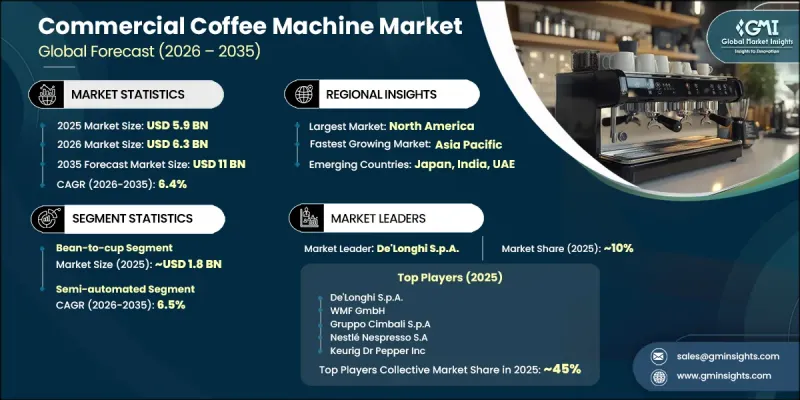
The commercial coffee machine industry is experiencing strong growth due to changing consumer preferences for premium coffee experiences, rapid advancements in automation technologies, and the continuous expansion of foodservice establishments worldwide. Commercial coffee machines have become essential equipment across cafes, hotels, restaurants, offices, and institutional facilities that aim to deliver consistent beverage quality and operational efficiency. The market includes a broad range of machine categories designed to meet varying business requirements, automation preferences, and operational capacities. Increasing demand for specialty coffee beverages and premium cafe-style experiences continues to encourage businesses to upgrade their coffee equipment. Technological innovation is also playing a major role in market expansion, with connected systems, smart monitoring solutions, and automation features improving workflow efficiency and customer service. In addition, growing adoption of digital technologies such as artificial intelligence and IoT-enabled systems is helping businesses optimize maintenance schedules and improve machine performance. Expanding coffee culture in emerging economies and rising investments in modern foodservice infrastructure are further creating significant growth opportunities for the global commercial coffee machine market.
| Market Scope | |
|---|---|
| Start Year | 2025 |
| Forecast Year | 2026-2035 |
| Start Value | $5.9 Billion |
| Forecast Value | $11 Billion |
| CAGR | 6.4% |
The commercial coffee machine industry is also benefiting from the increasing popularity of premium coffee consumption across both developed and emerging markets. Businesses are increasingly prioritizing advanced brewing systems that offer consistency, customization, and operational convenience. Growing demand for high-quality coffee beverages in workplaces, hospitality establishments, and retail foodservice environments continues to accelerate equipment adoption globally. Furthermore, continuous innovation in brewing technologies and the expansion of specialty coffee chains are supporting long-term market growth across multiple regions.
The bean-to-cup segment generated USD 1.8 billion in 2025 and is expected to grow at a CAGR of 4.8% from 2026 to 2035. Bean-to-cup coffee machines continue to gain strong market traction because they combine grinding, brewing, and milk preparation functions within a single automated system. These machines allow businesses to prepare freshly brewed coffee beverages with minimal manual intervention while maintaining product consistency and beverage quality. The ability to grind coffee beans immediately before brewing significantly enhances flavor and freshness, which is increasingly valued by consumers seeking premium coffee experiences. In addition, bean-to-cup systems offer flexible beverage customization options, making them highly suitable for commercial environments focused on delivering cafe-style coffee without requiring extensive barista expertise.
The semi-automated segment accounted for 43.2% share in 2025 and is anticipated to grow at a CAGR of 6.5% through 2035. Semi-automated coffee machines remain highly popular in commercial environments because they provide an effective balance between automation and manual control. These systems are designed to maintain stable extraction pressure and temperature while allowing operators to manage various brewing processes directly. Businesses often prefer semi-automated machines because they support consistent beverage preparation while still enabling skilled operators to influence coffee quality and customization. In addition, these machines offer a favorable balance between cost efficiency and performance compared to fully automated systems, making them a preferred choice for many foodservice operators.
U.S. Commercial Coffee Machine Market generated USD 1.3 billion in 2025 and is projected to grow at a CAGR of 4.4% from 2026 to 2035. Strong coffee consumption patterns, expanding cafe culture, and increasing demand for premium coffee beverages continue to support market leadership across the United States. The country benefits from a highly developed foodservice industry, extensive workplace coffee programs, and strong consumer interest in specialty coffee products. Ongoing equipment modernization, increasing adoption of advanced brewing technologies, and continuous growth of specialty coffee outlets across urban and secondary markets are further contributing to sustained demand for commercial coffee machines throughout the region.
Major companies operating in the Global Commercial Coffee Machine Market include De'Longhi S.p.A., JURA Elektroapparate AG, WMF GmbH, Gruppo Cimbali S.p.A., Nestle Nespresso S.A., Keurig Dr Pepper Inc., Saeco, Gaggia, Bunn-O-Matic Corporation, Melitta Group, Rancilio Group S.p.A., Breville Group Limited, Soro Fresh Coffee Systems, Lucky Coffee Machine Co Ltd, Miele, Thermoplan AG, Eversys AG, Franke Coffee Systems, Fetco LLC, Fracino, and La Marzocco. Companies operating in the commercial coffee machine market are implementing several strategic initiatives to strengthen their market position and expand their global presence. Manufacturers are focusing heavily on technological innovation by integrating automation, smart connectivity, artificial intelligence, and remote monitoring capabilities into commercial coffee systems. Businesses are also investing in energy-efficient designs and customizable brewing technologies to meet evolving customer expectations. Strategic collaborations with hospitality providers, cafe chains, and workplace service operators are helping companies expand their customer base and strengthen distribution networks.
Table of Contents
Chapter 1 Research methodology
- 1.1 Research approach
- 1.2 Quality Commitments
- 1.2.1 GMI AI policy & data integrity commitment
- 1.2.1.1 Source consistency protocol
- 1.2.1 GMI AI policy & data integrity commitment
- 1.3 Research trail & confidence scoring
- 1.3.1 Research trail components
- 1.3.2 Scoring components
- 1.4 Data Collection
- 1.4.1 Partial list of primary sources
- 1.5 Data mining sources
- 1.5.1 Paid sources
- 1.5.1.1 Sources, by region
- 1.5.1 Paid sources
- 1.6 Base estimates and calculations
- 1.6.1 Base year calculation
- 1.7 Forecast model
- 1.7.1 Quantified market impact analysis
- 1.7.1.1 Mathematical impact of growth parameters on forecast
- 1.7.1 Quantified market impact analysis
- 1.8 Research transparency addendum
- 1.8.1 Source attribution framework
- 1.8.2 Quality assurance metrics
- 1.8.3 Our commitment to trust
Chapter 2 Executive Summary
- 2.1 Industry 360° synopsis
- 2.2 Business trends
- 2.3 Regional
- 2.4 Machine type
- 2.5 Technology
- 2.6 Price
- 2.7 End-user
- 2.8 Distribution channel
Chapter 3 Industry Insights
- 3.1 Industry ecosystem analysis
- 3.1.1 Supplier landscape
- 3.1.2 Profit margin analysis
- 3.1.3 Value addition at each stage
- 3.1.4 Factor affecting the value chain
- 3.2 Industry impact forces
- 3.2.1 Growth drivers
- 3.2.1.1 Growing Coffee Culture & Specialty Coffee Consumption
- 3.2.1.2 Rising Office Coffee Subscription Services & Workplace Amenity Expectations
- 3.2.1.3 Expansion of Hotels, Restaurants & Cafes (HoReCa) Sector
- 3.2.1.4 Technological Advancements in Automation & IoT Integration
- 3.2.2 Industry pitfalls & challenges
- 3.2.2.1 High Initial Capital Investment & Maintenance Costs
- 3.2.2.2 Intense Price Competition from Low-Cost Manufacturers
- 3.2.1 Growth drivers
- 3.3 Growth potential analysis
- 3.4 Future market trends
- 3.5 Technology and innovation landscape
- 3.5.1 Current technological trends
- 3.5.2 Emerging technologies
- 3.6 Price trends
- 3.6.1 By region
- 3.6.2 By machine type
- 3.7 Regulatory landscape
- 3.7.1 Standards and compliance requirements
- 3.7.2 Regional regulatory frameworks
- 3.7.3 Certification standards
- 3.8 Porter's analysis
- 3.9 PESTEL analysis
- 3.10 Impact of AI & generative AI on the market
- 3.10.1 AI-driven disruption of existing business models
- 3.10.2 GenAI use cases & adoption roadmap by segment
- 3.10.3 Risks, limitations & regulatory considerations
- 3.11 Consumer behavior analysis
- 3.11.1 Demographic trends
- 3.11.2 Factors affecting buying decision
- 3.11.3 Consumer product adoption
- 3.11.4 Preferred distribution channel
- 3.11.5 Preferred price range
Chapter 4 Competitive Landscape, 2025
- 4.1 Introduction
- 4.2 Company market share analysis
- 4.2.1 By Region
- 4.2.1.1 North America
- 4.2.1.2 Europe
- 4.2.1.3 Asia Pacific
- 4.2.1.4 Latin America
- 4.2.1.5 Middle East & Africa
- 4.2.1 By Region
- 4.3 Company matrix analysis
- 4.4 Competitive analysis of major market players
- 4.5 Competitive positioning matrix
- 4.6 Key developments
- 4.6.1 Mergers & acquisitions
- 4.6.2 Partnerships & collaborations
- 4.6.3 New product launches
- 4.6.4 Expansion plans
Chapter 5 Market Estimates & Forecast, By Machine Type, 2022 - 2035, (USD Billion) (Units)
- 5.1 Key trends
- 5.2 Drip filter
- 5.3 Capsule or pod
- 5.4 Bean-to-cup
- 5.5 Espresso
Chapter 6 Market Estimates & Forecast, By Technology, 2022 - 2035, (USD Billion) (Units)
- 6.1 Key trends
- 6.2 Manual
- 6.3 Semi-automated
- 6.4 Fully automated
Chapter 7 Market Estimates & Forecast, By Price, 2022 - 2035, (USD Billion) (Units)
- 7.1 Key trends
- 7.2 Low
- 7.3 Medium
- 7.4 High
Chapter 8 Market Estimates & Forecast, By End-User, 2022 - 2035, (USD Billion) (Units)
- 8.1 Key trends
- 8.2 Cafes and coffee shops
- 8.2.1 Specialty coffee shops
- 8.2.2 Coffee chains and franchises
- 8.3 Hotels & restaurants
- 8.3.1 Full-service restaurants
- 8.3.2 Quick-service restaurants
- 8.3.3 Hotels & hospitality
- 8.3.4 Others
- 8.4 Convenience stores
- 8.5 Offices and corporate
- 8.6 Others
Chapter 9 Market Estimates & Forecast, By Distribution Channel, 2022 - 2035, (USD Billion) (Units)
- 9.1 Key trends
- 9.2 Online
- 9.2.1 E-commerce website
- 9.2.2 Company website
- 9.3 Offline
Chapter 10 Market Estimates & Forecast, By Region, 2022 - 2035, (USD Billion) (Units)
- 10.1 Key trends
- 10.2 North America
- 10.2.1 U.S.
- 10.2.2 Canada
- 10.3 Europe
- 10.3.1 Germany
- 10.3.2 UK
- 10.3.3 France
- 10.3.4 Italy
- 10.3.5 Spain
- 10.3.6 Sweden
- 10.3.7 Netherlands
- 10.4 Asia Pacific
- 10.4.1 China
- 10.4.2 India
- 10.4.3 Japan
- 10.4.4 South Korea
- 10.4.5 Australia
- 10.4.6 Indonesia
- 10.5 Latin America
- 10.5.1 Brazil
- 10.5.2 Mexico
- 10.5.3 Argentina
- 10.6 MEA
- 10.6.1 Saudi Arabia
- 10.6.2 UAE
- 10.6.3 South Africa
Chapter 11 Company Profiles
- 11.1 Global Players
- 11.1.1 De'Longhi S.p.A.
- 11.1.2 JURA Elektroapparate AG
- 11.1.3 WMF GmbH
- 11.1.4 Gruppo Cimbali S.p.A.
- 11.1.5 Nestle Nespresso S.A.
- 11.1.6 Keurig Dr Pepper Inc.
- 11.1.7 Saeco & Gaggia brands
- 11.2 Regional Players
- 11.2.1 Bunn-O-Matic Corporation
- 11.2.2 Melitta Group
- 11.2.3 Rancilio Group S.p.A.
- 11.2.4 Breville Group Limited
- 11.2.5 Soro Fresh Coffee Systems
- 11.2.6 Lucky Coffee Machine Co Ltd
- 11.2.7 Miele
- 11.3 Emerging Players & Innovators
- 11.3.1 Thermoplan AG
- 11.3.2 Eversys AG
- 11.3.3 Franke Coffee Systems
- 11.3.4 Fetco LLC
- 11.3.5 Fracino
- 11.3.6 La Marzocco

