
PUBLISHER: Global Market Insights Inc. | PRODUCT CODE: 2045726

PUBLISHER: Global Market Insights Inc. | PRODUCT CODE: 2045726
Bike and Scooter Rental Market Opportunity, Growth Drivers, Industry Trend Analysis, and Forecast 2026 - 2035
The Global Bike and Scooter Rental Market was valued at USD 7.1 billion in 2025 and is estimated to grow at a CAGR of 14.1% to reach USD 27.6 billion by 2035.
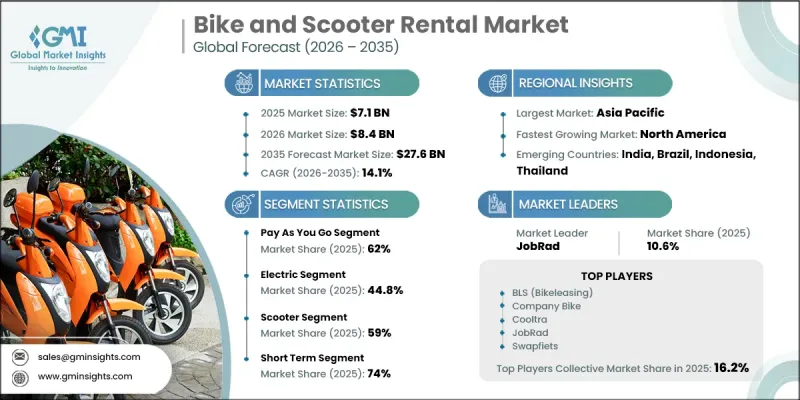
The bike and scooter rental industry is experiencing significant expansion as urban populations continue to rise and transportation congestion becomes a growing challenge across major cities worldwide. Increasing migration toward urban centers has accelerated the demand for convenient, flexible, and cost-efficient shared mobility solutions. Rapid integration of digital technologies into rental operations has further improved customer convenience through app-based vehicle access, digital payments, and real-time fleet tracking. In addition, government initiatives supporting sustainable transportation and low-emission mobility are positively influencing market growth. Many cities are investing heavily in cycling infrastructure, dedicated mobility lanes, and environmentally friendly urban transportation systems to encourage the adoption of shared mobility services. The growing popularity of dockless rental systems is also transforming the industry by providing users with greater flexibility and seamless access to vehicles without requiring fixed docking stations. Rising awareness regarding sustainable transportation and the increasing preference for affordable short-distance travel options are expected to continue driving the growth of the global bike and scooter rental market.
| Market Scope | |
|---|---|
| Start Year | 2025 |
| Forecast Year | 2026-2035 |
| Start Value | $7.1 Billion |
| Forecast Value | $27.6 Billion |
| CAGR | 14.1% |
The pay-as-you-go segment held a 62% share and is expected to grow at a CAGR of 12.6% between 2026 and 2035. Strong consumer preference for flexible and convenient rental options continues to support the growth of this segment. Users increasingly favor short-term rental models that offer immediate access to mobility solutions without requiring long-term commitments or subscription-based agreements. High-demand urban locations and transportation hubs continue to generate significant demand for pay-as-you-go services, encouraging operators to maintain strong fleet availability and dynamic pricing strategies to maximize vehicle utilization and operational efficiency.
The electric segment accounted for 44.8% share in 2025 and is projected to grow at a CAGR of 17.5% during 2026-2035. Increasing demand for environmentally friendly and affordable transportation solutions is accelerating the adoption of electric two-wheelers across urban mobility networks. Electric bikes and scooters are gaining popularity due to their lower operational and maintenance costs compared to traditional fuel-powered alternatives. The growing transition toward sustainable transportation systems and the rising acceptance of electric mobility solutions are further contributing to strong segment growth worldwide.
China Bike and Scooter Rental Market held a 38% share, generating USD 1.1 billion in 2025. The country's bike and scooter rental industry has developed into a highly established urban mobility ecosystem that supports both daily commuting and short-distance transportation requirements. Government authorities continue to play a major role in shaping the market through transportation regulations, urban mobility planning, and data management initiatives. Increasing efforts to reduce traffic congestion and lower carbon emissions are encouraging local administrations to strengthen oversight of shared mobility operations, including parking management systems and fleet optimization measures.
Key companies operating in the Global Bike and Scooter Rental Market include BLS (Bikeleasing), Company Bike, Cooltra, Felyx, JobRad, Lease a Bike, Swapfiets, Yulu, Zoomo, and Zypp Electric. Companies operating in the bike and scooter rental market are implementing several strategic initiatives to strengthen their market presence and improve competitive positioning. Leading operators are investing heavily in expanding electric vehicle fleets to meet rising demand for sustainable urban transportation solutions. Businesses are also focusing on enhancing mobile applications and digital platforms to improve customer experience through seamless booking, navigation, and payment systems. Strategic partnerships with municipalities, transportation authorities, and corporate organizations are helping companies expand operational reach and strengthen infrastructure support. Many market participants are prioritizing fleet optimization technologies, AI-driven route management, and real-time monitoring systems to improve operational efficiency and reduce maintenance costs.
Table of Contents
Chapter 1 Methodology
- 1.1 Research approach
- 1.2 Quality Commitments
- 1.2.1 GMI AI policy & data integrity commitment
- 1.2.1.1 Source consistency protocol
- 1.2.1 GMI AI policy & data integrity commitment
- 1.3 Research Trail & Confidence Scoring
- 1.3.1 Research Trail Components
- 1.3.2 Scoring Components
- 1.4 Data Collection
- 1.4.1 Partial list of primary sources
- 1.5 Data mining sources
- 1.5.1 Paid sources
- 1.5.1.1 Sources, by region
- 1.5.1 Paid sources
- 1.6 Base estimates and calculations
- 1.6.1 Base year calculation for any one approach
- 1.7 Forecast model
- 1.7.1 Quantified market impact analysis
- 1.7.1.1 Mathematical impact of growth parameters on forecast
- 1.7.1 Quantified market impact analysis
- 1.8 Research transparency addendum
- 1.8.1 Source attribution framework
- 1.8.2 Quality assurance metrics
- 1.8.3 Our commitment to trust
Chapter 2 Executive Summary
- 2.1 Industry 360° synopsis, 2022 - 2035
- 2.2 Key market trends
- 2.2.1 Regional
- 2.2.2 Service
- 2.2.3 Propulsion
- 2.2.4 Vehicle
- 2.2.5 Rental Duration
- 2.2.6 End User
- 2.3 TAM Analysis, 2026-2035
- 2.4 CXO perspectives: Strategic imperatives
Chapter 3 Industry Insights
- 3.1 Industry ecosystem analysis
- 3.1.1 Supplier landscape
- 3.1.2 Profit margin analysis
- 3.1.3 Cost structure
- 3.1.4 Value addition at each stage
- 3.1.5 Factor affecting the value chain
- 3.1.6 Disruptions
- 3.2 Industry impact forces
- 3.2.1 Growth drivers
- 3.2.1.1 Growing demand for flexible short-term transportation
- 3.2.1.2 Expansion of tourism and leisure activities
- 3.2.1.3 Corporate and employee leasing programs
- 3.2.1.4 Digital booking and fleet management systems
- 3.2.2 Industry pitfalls and challenges
- 3.2.2.1 High maintenance and fleet management costs
- 3.2.2.2 Seasonal demand fluctuations
- 3.2.3 Market opportunities
- 3.2.3.1 Expansion in corporate leasing segment
- 3.2.3.2 Growth in tourism driven rentals
- 3.2.3.3 Development of subscription based rental plans
- 3.2.1 Growth drivers
- 3.3 Growth potential analysis
- 3.4 Regulatory landscape
- 3.4.1 North America
- 3.4.1.1 United States shared mobility regulations and e-scooter laws
- 3.4.1.2 City-level bike and scooter sharing permits and fleet caps
- 3.4.1.3 Safety standards and helmet regulations
- 3.4.1.4 Canada micromobility regulations and municipal guidelines
- 3.4.2 Europe
- 3.4.2.1 EU micromobility and light electric vehicle regulations
- 3.4.2.2 UNECE vehicle safety and technical standards
- 3.4.2.3 National e-scooter usage laws and speed limits
- 3.4.2.4 Environmental and urban mobility policies
- 3.4.3 Asia Pacific
- 3.4.3.1 China shared bike regulations and fleet management policies
- 3.4.3.2 India e-scooter and bike sharing guidelines
- 3.4.3.3 Japan micromobility and road safety regulations
- 3.4.3.4 Australia e-scooter trial regulations and safety rules
- 3.4.3.5 ASEAN urban mobility and vehicle regulations
- 3.4.4 Latin America
- 3.4.4.1 Brazil shared mobility and safety regulations
- 3.4.4.2 Mexico e-scooter and bike sharing laws
- 3.4.4.3 Argentina micromobility regulations
- 3.4.4.4 Regional urban transport policy frameworks
- 3.4.5 Middle East & Africa
- 3.4.5.1 UAE e-scooter regulations and licensing
- 3.4.5.2 Saudi Arabia micromobility safety regulations
- 3.4.5.3 South Africa shared mobility regulatory framework
- 3.4.1 North America
- 3.5 Porter's analysis
- 3.6 PESTEL analysis
- 3.7 Technology and innovation landscape
- 3.7.1 Current technological trends
- 3.7.2 Emerging technologies
- 3.8 Pricing Analysis (Driven by primary research)
- 3.8.1 Historical Price Trend Analysis
- 3.8.2 Pricing Strategy by Player Type
- 3.9 Cost breakdown analysis
- 3.10 Patent analysis (Driven by primary research)
- 3.11 Sustainability and environmental aspects
- 3.11.1 Sustainable practices
- 3.11.2 Waste reduction strategies
- 3.11.3 Energy efficiency in production
- 3.11.4 Eco-friendly Initiatives
- 3.11.5 Carbon footprint considerations
- 3.12 Impact of AI and Generative AI on the Market
- 3.12.1 AI Driven Disruption of Existing Business Models
- 3.12.2 GenAI Use Cases and Adoption Roadmap by Segment
- 3.12.3 Risks Limitations and Regulatory Considerations
- 3.13 Forecast assumptions & scenario analysis (Driven by Primary Research)
- 3.13.1 Base Case- Key Macro & Industry Variables Driving CAGR
- 3.13.2 Optimistic Scenarios- Favorable macro and industry tailwinds
- 3.13.3 Pessimistic Scenario - Macroeconomic slowdown or industry headwinds
Chapter 4 Competitive Landscape, 2025
- 4.1 Introduction
- 4.2 Company market share analysis
- 4.2.1 North America
- 4.2.2 Europe
- 4.2.3 Asia Pacific
- 4.2.4 LATAM
- 4.2.5 MEA
- 4.3 Competitive analysis of major market players
- 4.4 Competitive positioning matrix
- 4.5 Key developments
- 4.5.1 Mergers & acquisitions
- 4.5.2 Partnerships & collaborations
- 4.5.3 New Product Launches
- 4.5.4 Expansion Plans and funding
Chapter 5 Market Estimates & Forecast, By Service, 2022 - 2035 (USD Mn, Fleet Size)
- 5.1 Key trends
- 5.2 Pay as you go
- 5.3 Subscription-based
Chapter 6 Market Estimates & Forecast, By Propulsion, 2022 - 2035 (USD Mn, Fleet Size)
- 6.1 Key trends
- 6.2 Pedal
- 6.3 Electric
- 6.4 Gasoline
Chapter 7 Market Estimates & Forecast, By Vehicle, 2022 - 2035 (USD Mn, Fleet Size)
- 7.1 Key trends
- 7.2 Bike
- 7.3 Scooter
Chapter 8 Market Estimates & Forecast, By Rental Duration, 2022 - 2035 (USD Mn, Fleet Size)
- 8.1 Key trends
- 8.2 Short term
- 8.3 Long term
Chapter 9 Market Estimates & Forecast, By End User, 2022 - 2035 (USD Mn, Fleet Size)
- 9.1 Key trends
- 9.2 Commuters
- 9.3 Tourists
- 9.4 Students
- 9.5 Corporate Users
- 9.6 Delivery Personnel
Chapter 10 Market Estimates & Forecast, By Region, 2022 - 2035 (USD Mn, Fleet Size)
- 10.1 Key trends
- 10.2 North America
- 10.2.1 US
- 10.2.2 Canada
- 10.3 Europe
- 10.3.1 Germany
- 10.3.2 UK
- 10.3.3 France
- 10.3.4 Italy
- 10.3.5 Spain
- 10.3.6 Russia
- 10.3.7 Norway
- 10.3.8 Netherlands
- 10.3.9 Sweden
- 10.4 Asia Pacific
- 10.4.1 China
- 10.4.2 India
- 10.4.3 Japan
- 10.4.4 Australia
- 10.4.5 South Korea
- 10.4.6 Singapore
- 10.4.7 Thailand
- 10.4.8 Indonesia
- 10.4.9 Vietnam
- 10.5 Latin America
- 10.5.1 Brazil
- 10.5.2 Mexico
- 10.5.3 Argentina
- 10.6 MEA
- 10.6.1 South Africa
- 10.6.2 Saudi Arabia
- 10.6.3 UAE
- 10.6.4 Turkey
Chapter 11 Company Profiles
- 11.1 Global players
- 11.1.1 Bird (Third Lane Mobility)
- 11.1.2 JobRad
- 11.1.3 Lime (Neutron)
- 11.1.4 Swapfiets
- 11.1.5 Vogo
- 11.1.6 Zoomo
- 11.2 Regional players
- 11.2.1 BLS (Bikeleasing)
- 11.2.2 Company Bike
- 11.2.3 Cooltra
- 11.2.4 Donkey Republic
- 11.2.5 Dott
- 11.2.6 Felyx
- 11.2.7 Lease a Bike
- 11.2.8 Voi Technology
- 11.2.9 Yulu
- 11.2.10 Zypp Electric
- 11.3 Emerging players / disruptors
- 11.3.1 CYCLE
- 11.3.2 Dance
- 11.3.3 PLUTO (GIN e-bikes)
- 11.3.4 Upway Flex

