PUBLISHER: Global Market Insights Inc. | PRODUCT CODE: 2045731

PUBLISHER: Global Market Insights Inc. | PRODUCT CODE: 2045731
Gas Fired Boiler Market Opportunity, Growth Drivers, Industry Trend Analysis, and Forecast 2026 - 2035
The Global Gas Fired Boiler Market was valued at USD 65.1 billion in 2025 and is estimated to grow at a CAGR of 6.6% to reach USD 126.8 billion by 2035.
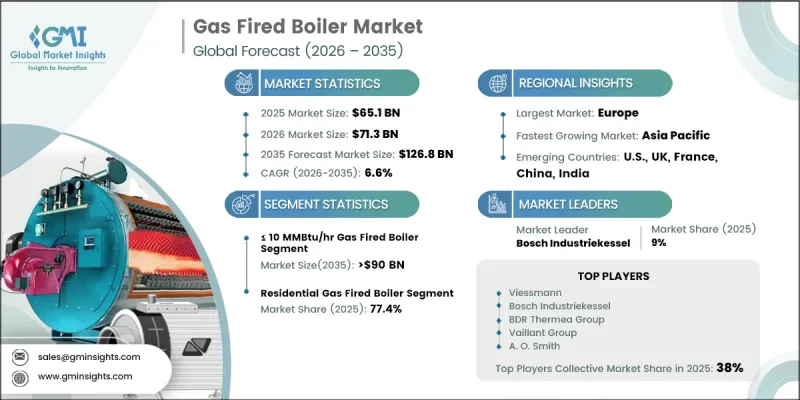
The gas fired boiler industry is witnessing stable expansion due to increasing infrastructure development, rapid urbanization, and the growing requirement for efficient space and water heating systems across residential, commercial, and industrial sectors. Rising demand for advanced heating technologies capable of delivering improved energy efficiency and operational reliability is significantly supporting market growth. Extreme weather conditions across several regions are further encouraging the adoption of modern hot water and steam generation systems. Gas fired boilers operate using natural gas or propane to produce heat, which is then utilized for hot water supply, steam generation, and heating applications in homes, businesses, and industrial facilities. Increasing focus on reducing carbon emissions and improving energy conservation across developed and developing economies is creating strong momentum for high-efficiency boiler installations. Additionally, government regulations promoting cleaner heating solutions, combined with the replacement of aging heating infrastructure, are accelerating product adoption. The growing integration of smart heating controls, automation technologies, and sustainable building practices is also strengthening the long-term outlook of the global gas fired boiler market.
| Market Scope | |
|---|---|
| Start Year | 2025 |
| Forecast Year | 2026-2035 |
| Start Value | $65.1 Billion |
| Forecast Value | $126.8 Billion |
| CAGR | 6.6% |
The <=10 MMBtu/hr gas fired boiler segment is anticipated to reach USD 90 billion by 2035. Rising awareness regarding environmental sustainability and increasing preference for energy-efficient heating systems are major factors contributing to the growth of this segment. Governments and regulatory bodies are actively encouraging the use of advanced and reliable heating technologies that can reduce energy consumption and minimize environmental impact. Expanding industrial activities across developing economies and the positive outlook for manufacturing infrastructure are also driving demand for compact and efficient boiler systems. In addition, businesses are increasingly investing in upgraded heating equipment to improve operational efficiency and reduce long-term energy costs. Favorable funding programs, government incentives, and the growing transition toward low-emission technologies are expected to further accelerate deployment of <=10 MMBtu/hr gas fired boilers.
The residential segment accounted for 77.4% share in 2025. Growing demand for energy-efficient home heating systems across urban and suburban regions continues to support the expansion of residential gas fired boiler installations. Consumers are increasingly replacing outdated heating equipment with advanced boiler systems that offer higher thermal efficiency, reduced emissions, and lower operational expenses. The rising popularity of condensing boiler technologies and smart home heating integration is further driving adoption within residential applications. Increasing residential construction projects, home renovation activities, and the modernization of heating infrastructure are creating additional growth opportunities for manufacturers. Moreover, stricter energy efficiency regulations and government initiatives aimed at reducing residential carbon emissions are encouraging homeowners to invest in environmentally friendly heating systems. Enhanced product designs focused on compact installation, quiet operation, and digital control features are also improving consumer acceptance and contributing to long-term market growth.
North America Gas Fired Boiler Market held a 74% share, generating USD 1.9 billion in 2025. The regional market continues to benefit from rising efforts toward energy conservation, cleaner fuel adoption, and modernization of heating infrastructure. Strong availability of natural gas resources and competitive gas pricing are supporting widespread deployment of gas fired boilers across residential, commercial, and industrial sectors. In addition, the expansion of shale gas production in the United States has strengthened fuel supply stability and improved affordability for end users. Regulatory initiatives promoting energy-efficient appliances and stricter emission reduction targets are further encouraging the adoption of advanced boiler systems. The growing emphasis on sustainable building technologies, combined with increasing demand for efficient heating solutions in colder regions, is expected to continue driving market growth across North America. Continuous investments in smart energy systems and upgraded utility infrastructure are also supporting the regional industry outlook.
Key companies operating in the Global Gas Fired Boiler Market include Carrier, Daikin, Viessmann, Babcock & Wilcox Enterprises, Cleaver-Brooks, Groupe Atlantic, Vaillant Group, Bosch Industriekessel, Forbes Marshall, Fulton, Thermax, Bradford White Corporation, Burnham Commercial Boilers, Lochinvar, Miura America, Rentech Boiler Systems, A.O. Smith, FERROLI, Ariston Holding, Hurst Boiler & Welding, BDR Thermea Group, and WM Technologies. Companies participating in the gas fired boiler market are focusing on several strategic initiatives to strengthen their competitive position and expand their global footprint. Leading manufacturers are investing heavily in research and development to improve energy efficiency, reduce emissions, and integrate advanced smart control technologies into their heating systems. Businesses are also prioritizing the development of compact, high-performance, and environmentally sustainable boiler solutions that comply with evolving regulatory standards. Strategic collaborations with construction firms, utilities, and industrial operators are helping companies increase product adoption across diverse end-use sectors. In addition, market players are expanding their distribution networks and after-sales service capabilities to improve customer reach and strengthen brand loyalty.
Table of Contents
Chapter 1 Methodology & Scope
- 1.1 Research approach
- 1.2 Quality commitments
- 1.2.1 GMI AI policy & data integrity commitment
- 1.2.1.1 Source consistency protocol
- 1.2.1 GMI AI policy & data integrity commitment
- 1.3 Research trail & confidence scoring
- 1.3.1 Research trail components
- 1.3.2 Scoring components
- 1.4 Data collection
- 1.4.1 Partial list of primary sources
- 1.5 Data mining sources
- 1.5.1 Paid sources
- 1.5.1.1 Sources, by region
- 1.5.1 Paid sources
- 1.6 Base estimates and calculations
- 1.6.1 Base year calculation for any one approach
- 1.7 Market estimates & forecasts parameters
- 1.8 Forecast model
- 1.8.1 Quantified market impact analysis
- 1.8.1.1 Mathematical impact of growth parameters on forecast
- 1.8.1 Quantified market impact analysis
- 1.9 Research transparency addendum
- 1.9.1 Source attribution framework
- 1.9.2 Quality assurance metrics
- 1.9.3 Our commitment to trust
- 1.10 Market definitions
Chapter 2 Executive Summary
- 2.1 Industry synopsis, 2022 - 2035
- 2.1.1 Business trends
- 2.1.2 Capacity trends
- 2.1.3 Technology trends
- 2.1.4 Application trends
- 2.1.5 Regional trends
Chapter 3 Industry Insights
- 3.1 Industry ecosystem analysis
- 3.1.1 Raw material availability & sourcing analysis
- 3.1.2 Manufacturing capacity assessment
- 3.1.3 Supply chain resilience & risk factors
- 3.1.4 Distribution network analysis
- 3.2 Industry impact forces
- 3.2.1 Growth drivers
- 3.2.2 Industry pitfalls & challenges
- 3.3 Regulatory landscape
- 3.4 Growth potential analysis
- 3.5 Porter's analysis
- 3.5.1 Bargaining power of suppliers
- 3.5.2 Bargaining power of buyers
- 3.5.3 Threat of new entrants
- 3.5.4 Threat of substitutes
- 3.6 PESTEL analysis
- 3.6.1 Political factors
- 3.6.2 Economic factors
- 3.6.3 Social factors
- 3.6.4 Technological factors
- 3.6.5 Legal factors
- 3.6.6 Environmental factors
- 3.7 Cost structure analysis of gas fired boilers
- 3.8 Emerging opportunities & trends
- 3.9 Growth in untapped markets & applications
- 3.10 Investment analysis & future prospects
- 3.11 Price trend analysis (USD/Unit) (Driven by Primary Research)
- 3.11.1 By region (Driven by Primary Research)
- 3.11.2 By capacity (Driven by Primary Research)
- 3.12 Trade data analysis (Driven by Primary Research)
- 3.12.1 Import/export value trends (Driven by Primary Research)
- 3.12.2 Key trade corridors & tariff impact (Driven by Primary Research)
- 3.13 Capacity & production landscape (Driven by Primary Research)
- 3.13.1 Capacity by region & key producer (Driven by Primary Research)
- 3.13.2 Capacity utilization rates & expansion pipelines (Driven by Primary Research)
- 3.14 Impact of AI & Generative AI on the market (Driven by Primary Research)
- 3.14.1 AI-Driven production optimization (Driven by Primary Research)
- 3.14.2 Predictive maintenance & fault detection (Driven by Primary Research)
Chapter 4 Competitive Landscape, 2026
- 4.1 Introduction
- 4.2 Company market share analysis, by region, 2025
- 4.2.1 North America
- 4.2.2 Europe
- 4.2.3 Asia Pacific
- 4.2.4 Middle East & Africa
- 4.2.5 Latin America
- 4.3 Competitive analysis of major market players
- 4.4 Competitive positioning matrix
- 4.5 Key developments
- 4.5.1 Mergers & acquisitions
- 4.5.2 Partnerships & collaborations
- 4.5.3 New product launches
- 4.5.4 Expansion plans & funding
- 4.6 Company tier benchmarking
- 4.6.1 Tier classification criteria & qualifying thresholds
- 4.6.2 Tier positioning matrix by revenue, geography & innovation
Chapter 5 Market Size and Forecast, By Capacity, 2022 - 2035 (USD Million & Units)
- 5.1 Key trends
- 5.2 ≤ 10 MMBtu/hr
- 5.3 > 10 - 50 MMBtu/hr
- 5.4 > 50 - 100 MMBtu/hr
- 5.5 > 100 - 250 MMBtu/hr
- 5.6 > 250 MMBtu/hr
Chapter 6 Market Size and Forecast, By Technology, 2022 - 2035 (USD Million & Units)
- 6.1 Key trends
- 6.2 Condensing
- 6.3 Non-condensing
Chapter 7 Market Size and Forecast, By Application, 2022 - 2035 (USD Million & Units)
- 7.1 Key trends
- 7.2 Residential
- 7.3 Commercial
- 7.3.1 Offices
- 7.3.2 Healthcare facilities
- 7.3.3 Educational institutions
- 7.3.4 Lodgings
- 7.3.5 Retail stores
- 7.3.6 Others
- 7.4 Industrial
- 7.4.1 Food processing
- 7.4.2 Pulp & paper
- 7.4.3 Chemical
- 7.4.4 Refinery
- 7.4.5 Primary metal
- 7.4.6 Others
Chapter 8 Market Size and Forecast, By Region, 2022 - 2035 (USD Million & Units)
- 8.1 Key trends
- 8.2 North America
- 8.2.1 U.S.
- 8.2.2 Canada
- 8.2.3 Mexico
- 8.3 Europe
- 8.3.1 France
- 8.3.2 UK
- 8.3.3 Poland
- 8.3.4 Italy
- 8.3.5 Spain
- 8.3.6 Austria
- 8.3.7 Germany
- 8.3.8 Sweden
- 8.3.9 Russia
- 8.4 Asia Pacific
- 8.4.1 China
- 8.4.2 India
- 8.4.3 Philippines
- 8.4.4 Japan
- 8.4.5 South Korea
- 8.4.6 Australia
- 8.4.7 Indonesia
- 8.5 Middle East & Africa
- 8.5.1 Saudi Arabia
- 8.5.2 Iran
- 8.5.3 UAE
- 8.5.4 Nigeria
- 8.5.5 South Africa
- 8.6 Latin America
- 8.6.1 Argentina
- 8.6.2 Chile
- 8.6.3 Brazil
Chapter 9 Company Profiles
- 9.1 A.O. Smith
- 9.2 Ariston Holding
- 9.3 Babcock & Wilcox Enterprises
- 9.4 BDR Thermea Group
- 9.5 Bosch Industriekessel
- 9.6 Bradford White Corporation
- 9.7 Burnham Commercial Boilers
- 9.8 Carrier
- 9.9 Cleaver-Brooks
- 9.10 Daikin
- 9.11 FERROLI
- 9.12 Forbes Marshall
- 9.13 Fulton
- 9.14 Groupe Atlantic
- 9.15 Hurst Boiler & Welding
- 9.16 Lochinvar
- 9.17 Miura America
- 9.18 Rentech Boiler Systems
- 9.19 Thermax
- 9.20 Vaillant Group
- 9.21 Viessmann
- 9.22 WM Technologies

