PUBLISHER: Global Market Insights Inc. | PRODUCT CODE: 2045744

PUBLISHER: Global Market Insights Inc. | PRODUCT CODE: 2045744
Aircraft leasing Market Opportunity, Growth Drivers, Industry Trend Analysis, and Forecast 2026 - 2035
The Global Aircraft Leasing Market was valued at USD 207.1 billion in 2025 and is estimated to grow at a CAGR of 12% to reach USD 636.5 billion by 2035.
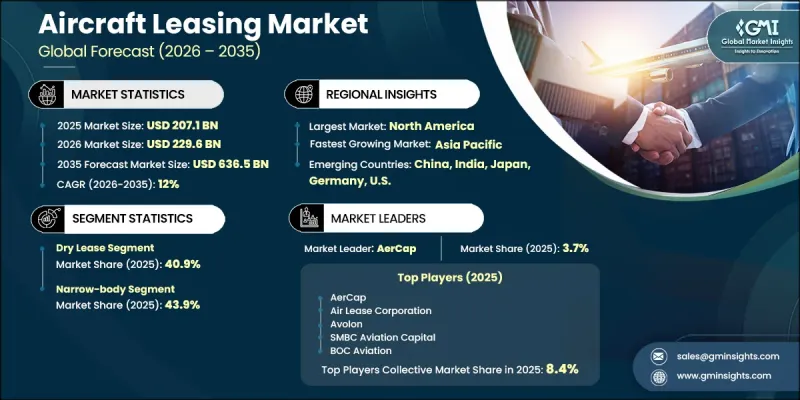
Growth in the market is supported by rising global air passenger traffic, expansion of low-cost carriers, and increasing preference among airlines for flexible and cost-efficient fleet management strategies. Aircraft leasing continues to be an attractive option for airlines as it reduces the need for large upfront capital investments while enabling rapid fleet expansion. Airlines across both emerging and developed markets are increasingly adopting leasing models to support route expansion, fleet modernization, and operational scalability. The ability to adjust fleet size based on demand fluctuations is further strengthening adoption across the aviation industry. In addition, continuous upgrades toward fuel-efficient aircraft and modernization of aging fleets are further contributing to rising leasing activity. The growing emphasis on operational efficiency, capital optimization, and financial flexibility continues to position aircraft leasing as a critical component of global aviation fleet strategy.
| Market Scope | |
|---|---|
| Start Year | 2025 |
| Forecast Year | 2026-2035 |
| Start Value | $207.1 Billion |
| Forecast Value | $636.5 Billion |
| CAGR | 12% |
The dry lease segment accounted for 40.9% share in 2025. Dry leasing remains widely preferred by airlines focused on long-term fleet planning and cost-efficient operational structures. Under this leasing structure, airlines operate aircraft using their own crew and maintenance systems, allowing greater control over operations and internal processes. This model is particularly favored by established carriers seeking to optimize expenses while retaining operational independence. Increasing demand for flexible fleet management solutions continues to support the expansion of dry lease arrangements across the global aviation sector.
The narrow-body aircraft segment held a 43.9% share in 2025, driven by strong demand from both full-service and low-cost carriers. Narrow-body aircraft are extensively used for short-haul and medium-haul routes due to their fuel efficiency and lower operating costs. Their ability to serve a wide range of domestic and regional routes makes them a preferred choice for airlines managing rising passenger volumes. Growing air travel demand and the continued expansion of low-cost airline networks are further strengthening the dominance of narrow-body aircraft within the leasing market.
North America Aircraft Leasing Market accounted for 35.1% share in 2025. The region continues to experience steady growth driven by expanding commercial aviation activity, increasing passenger traffic, and strong demand for fleet modernization across airlines. The presence of major airline operators, advanced aviation infrastructure, and strong adoption of flexible fleet management strategies are further supporting market expansion. Rising investments in fuel-efficient aircraft and growing development of cargo aviation operations are also contributing to increased leasing demand across the region. Additionally, airline network expansion initiatives are reinforcing long-term growth opportunities within the North American aircraft leasing industry.
Major companies operating in the Global Aircraft Leasing Market include AerCap, Avolon, BBAM, Air Lease Corporation, BOC Aviation, SMBC Aviation Capital, CDB Aviation, Jackson Square Aviation, Macquarie AirFinance, TrueNoord, Sky Leasing, Falko, Merx Aviation Finance, ACIA Aero Leasing, Zephyrus Aviation Capital, AviaAM Leasing, and Aircastle Limited. Additional participants in the industry include Nordic Aviation Capital under Dubai Aerospace Enterprise (DAE) Ltd. Companies operating in the aircraft leasing market are implementing a range of strategic initiatives to strengthen their global presence and enhance competitive positioning. Leading lessors are focusing on expanding and modernizing their aircraft portfolios by investing in fuel-efficient, next-generation aircraft to meet evolving airline requirements. Strong emphasis is being placed on portfolio diversification across aircraft types and lease structures to balance risk and improve revenue stability. Companies are also strengthening long-term partnerships with airlines through customized leasing solutions and flexible financing arrangements. In addition, market participants are enhancing asset management capabilities, optimizing fleet utilization, and improving remarketing strategies for used aircraft.
Table of Contents
Chapter 1 Methodology and Scope
- 1.1 Market scope and definition
- 1.2 Research design
- 1.2.1 Research approach
- 1.2.2 Data collection methods
- 1.3 Data mining sources
- 1.3.1 Global
- 1.3.2 Regional/Country
- 1.4 Base estimates and calculations
- 1.4.1 Base year calculation
- 1.4.2 Key trends for market estimation
- 1.5 Primary research and validation
- 1.5.1 Primary sources
- 1.6 Forecast model
- 1.7 Research assumptions and limitations
Chapter 2 Executive Summary
- 2.1 Industry 360° synopsis, 2022 - 2035
- 2.2 Key market trends
- 2.2.1 Leasing trends
- 2.2.2 Aircraft type trends
- 2.2.3 End-user industry trends
- 2.2.4 Regional trends
- 2.3 TAM Analysis, 2026-2035
- 2.4 CXO perspectives: Strategic imperatives
Chapter 3 Industry Insights
- 3.1 Industry ecosystem analysis
- 3.1.1 Supplier Landscape
- 3.1.2 Profit Margin
- 3.1.3 Cost structure
- 3.1.4 Value addition at each stage
- 3.1.5 Factor affecting the value chain
- 3.1.6 Disruptions
- 3.2 Industry impact forces
- 3.2.1 Growth drivers
- 3.2.1.1 Growing global air passenger traffic and airline fleet expansion
- 3.2.1.2 Rising expansion of low-cost carriers (LCCs)
- 3.2.1.3 Increasing focus on fleet modernization and fuel-efficient aircraft
- 3.2.1.4 Growing preference for cost-efficient and flexible fleet management
- 3.2.1.5 Expansion of emerging aviation markets and airport infrastructure development
- 3.2.2 Industry pitfalls and challenges
- 3.2.2.1 High exposure to economic downturns and travel disruptions
- 3.2.2.2 Rising interest rates and aircraft financing costs
- 3.2.3 Market opportunities
- 3.2.3.1 Increasing adoption of sustainable aviation and next-generation aircraft
- 3.2.3.2 Growth of air cargo and e-commerce transportation services
- 3.2.1 Growth drivers
- 3.3 Growth potential analysis
- 3.4 Regulatory landscape
- 3.4.1 North America
- 3.4.2 Europe
- 3.4.3 Asia Pacific
- 3.4.4 Latin America
- 3.4.5 Middle East & Africa
- 3.5 Porter's analysis
- 3.6 PESTEL analysis
- 3.7 Technology and Innovation landscape
- 3.7.1 Current technological trends
- 3.7.2 Emerging technologies
- 3.8 Price trends
- 3.8.1 By region
- 3.8.2 By product
- 3.9 Pricing Strategies
- 3.10 Emerging Business Models
- 3.11 Compliance Requirements
- 3.12 Patent and IP analysis
Chapter 4 Competitive Landscape, 2025
- 4.1 Introduction
- 4.2 Company market share analysis
- 4.2.1 By region
- 4.2.1.1 North America
- 4.2.1.2 Europe
- 4.2.1.3 Asia Pacific
- 4.2.1.4 Latin America
- 4.2.1.5 Middle East & Africa
- 4.2.2 Market concentration analysis
- 4.2.1 By region
- 4.3 Competitive benchmarking of key players
- 4.3.1 Financial performance comparison
- 4.3.1.1 Revenue
- 4.3.1.2 Profit margin
- 4.3.1.3 R&D
- 4.3.2 Product portfolio comparison
- 4.3.2.1 Product range breadth
- 4.3.2.2 Technology
- 4.3.2.3 Innovation
- 4.3.3 Geographic presence comparison
- 4.3.3.1 Global footprint analysis
- 4.3.3.2 Service network coverage
- 4.3.3.3 Market penetration by region
- 4.3.4 Competitive positioning matrix
- 4.3.4.1 Leaders
- 4.3.4.2 Challengers
- 4.3.4.3 Followers
- 4.3.4.4 Niche players
- 4.3.5 Strategic outlook matrix
- 4.3.1 Financial performance comparison
- 4.4 Key developments
- 4.4.1 Mergers and acquisitions
- 4.4.2 Partnerships and collaborations
- 4.4.3 Technological advancements
- 4.4.4 Expansion and investment strategies
- 4.4.5 Digital transformation initiatives
- 4.5 Emerging/ startup competitors landscape
Chapter 5 Market Estimates and Forecast, By Leasing Type, 2022 - 2035 (USD Billion)
- 5.1 Key trends
- 5.2 Wet Lease
- 5.3 Dry Lease
- 5.4 Damp Lease
- 5.5 Others
Chapter 6 Market Estimates and Forecast, By Aircraft Type, 2022 - 2035 (USD Billion)
- 6.1 Key trends
- 6.2 Narrow-body
- 6.3 Wide-body
- 6.4 Regional jets
Chapter 7 Market Estimates and Forecast, By Lease Tenure, 2022 - 2035 (USD Billion)
- 7.1 Key trends
- 7.2 Short-term (<2 years)
- 7.3 Medium-term (2-6 years)
- 7.4 Long-term (>6 years)
- 7.5 Others
Chapter 8 Market Estimates and Forecast, By End-User Industry, 2022 - 2035 (USD Billion)
- 8.1 Key trends
- 8.2 Commercial Airlines
- 8.2.1 Full-Service Carriers
- 8.2.2 Low-Cost Carriers (LCCs)
- 8.3 Cargo Operators
- 8.4 Private & Business Aviation
- 8.5 Others
Chapter 9 Market Estimates and Forecast, By Region, 2022 - 2035 (USD Billion)
- 9.1 Key trends
- 9.2 North America
- 9.2.1 U.S.
- 9.2.2 Canada
- 9.3 Europe
- 9.3.1 Germany
- 9.3.2 UK
- 9.3.3 France
- 9.3.4 Spain
- 9.3.5 Italy
- 9.4 Asia Pacific
- 9.4.1 China
- 9.4.2 India
- 9.4.3 Japan
- 9.4.4 Australia
- 9.4.5 South Korea
- 9.5 Latin America
- 9.5.1 Brazil
- 9.5.2 Mexico
- 9.5.3 Argentina
- 9.6 Middle East and Africa
- 9.6.1 South Africa
- 9.6.2 Saudi Arabia
- 9.6.3 UAE
Chapter 10 Company Profiles
- 10.1 Global Key Players
- 10.1.1 AerCap
- 10.1.2 Avolon
- 10.1.3 SMBC Aviation Capital
- 10.1.4 BOC Aviation
- 10.1.5 Air Lease Corporation
- 10.2 Regional key players
- 10.2.1 North America
- 10.2.1.1 Air Lease Corporation
- 10.2.1.2 Jackson Square Aviation (JSA)
- 10.2.1.3 Macquarie AirFinance
- 10.2.1.4 Aircastle Limited
- 10.2.2 Asia Pacific
- 10.2.2.1 BOC Aviation
- 10.2.2.2 CDB Aviation
- 10.2.2.3 SMBC Aviation Capital
- 10.2.2.4 ALAFCO Aviation Lease and Finance Company K.S.C.P
- 10.2.3 Europe
- 10.2.3.1 AerCap
- 10.2.3.2 Avolon
- 10.2.3.3 BBAM
- 10.2.3.4 TrueNoord
- 10.2.1 North America
- 10.3 Niche Players/Disruptors
- 10.3.1 Falko
- 10.3.2 Merx Aviation Finance
- 10.3.3 ACIA Aero Leasing
- 10.3.4 Zephyrus Aviation Capital

