PUBLISHER: Global Market Insights Inc. | PRODUCT CODE: 2045748

PUBLISHER: Global Market Insights Inc. | PRODUCT CODE: 2045748
Metal Hydride Market Opportunity, Growth Drivers, Industry Trend Analysis, and Forecast 2026 - 2035
The Global Metal Hydride Market was valued at USD 4.4 billion in 2025 and is estimated to grow at a CAGR of 7% to reach USD 9 billion by 2035.
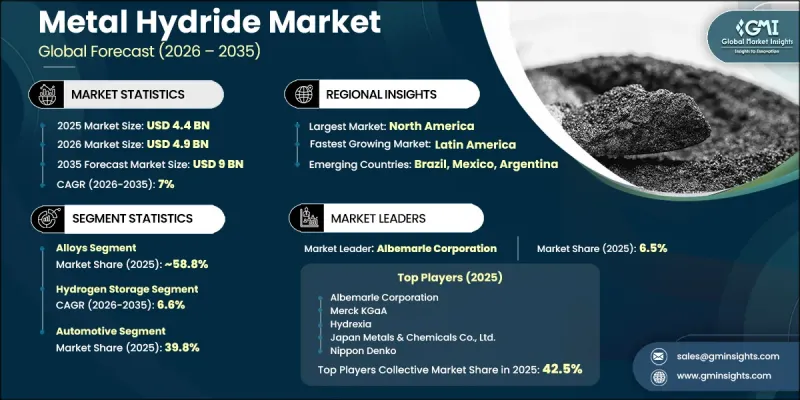
Increasing focus on sustainable energy infrastructure is accelerating the adoption of technologies that enable safe and compact hydrogen storage. Metal hydrides play a critical role by allowing hydrogen to be stored and released under controlled conditions, supporting high storage density and operational safety. Their ability to function across varying temperature and pressure environments makes them highly suitable for modern energy applications. These materials are widely utilized across multiple industries, supporting energy storage, thermal management, and efficient energy transfer. Growing investments in clean energy initiatives and supportive policy frameworks are further strengthening market expansion. As industries continue to prioritize low-emission technologies and renewable energy integration, the global metal hydride market is expected to maintain steady growth driven by innovation, performance efficiency, and increasing adoption across diverse applications.
| Market Scope | |
|---|---|
| Start Year | 2025 |
| Forecast Year | 2026-2035 |
| Start Value | $4.4 Billion |
| Forecast Value | $9 Billion |
| CAGR | 7% |
The alloys segment accounted for 58.8% share in 2025 and is expected to grow at a CAGR of 6.9% through 2035. This segment maintains a leading position due to its strong hydrogen absorption capabilities and reliable performance over repeated usage cycles. These materials are widely preferred for their durability, cost efficiency, and ability to support consistent operation across various applications. Their thermal stability and effective hydrogen storage capacity make them suitable for demanding industrial requirements.
The automotive segment held 39.8% share in 2025 and is projected to grow at a CAGR of 6.8% from 2026 to 2035. This segment leads due to the increasing adoption of hydrogen-based technologies within the transportation sector. Metal hydrides provide a safe and efficient method for storing hydrogen, supporting the development of cleaner mobility solutions. Their integration into advanced systems enhances energy efficiency and supports long-term performance requirements.
North America Metal Hydride Market accounted for 35% share in 2025, reflecting strong regional growth. Expansion in this region is driven by increasing investment in hydrogen infrastructure and supportive government initiatives promoting clean energy technologies. Ongoing research and development activities, supported by both academic institutions and industry players, are contributing to technological advancements and market expansion. Efforts to reduce emissions and enhance renewable energy adoption continue to reinforce demand across the region.
Key companies operating in the Global Metal Hydride Market include Albemarle Corporation, GKN Hydrogen, HBank Technology, Hydrexia, Japan Metals & Chemicals (JMC), Merck KGaA, Mitsui Mining & Smelting, Nippon Denko, Otto Chemie Pvt Ltd, Santa Cruz Biotechnology, and Santoku Corporation. Companies in the Metal Hydride Market are strengthening their position through continuous innovation, strategic partnerships, and expansion initiatives. Organizations are investing in research and development to enhance hydrogen storage efficiency and improve material performance. Many players are focusing on developing advanced alloys and optimized solutions to meet evolving industry requirements. Expansion of production capabilities and global distribution networks is helping companies reach a wider customer base. Strategic collaborations with energy and technology firms are supporting the development of integrated solutions. Additionally, companies are aligning their offerings with sustainability goals, emphasizing efficiency, durability, and cost-effectiveness to maintain competitiveness in a rapidly evolving market landscape.
The Global Metal Hydride Market was valued at USD 4.4 billion in 2025 and is estimated to grow at a CAGR of 7% to reach USD 9 billion by 2035.
Increasing focus on sustainable energy infrastructure is accelerating the adoption of technologies that enable safe and compact hydrogen storage. Metal hydrides play a critical role by allowing hydrogen to be stored and released under controlled conditions, supporting high storage density and operational safety. Their ability to function across varying temperature and pressure environments makes them highly suitable for modern energy applications. These materials are widely utilized across multiple industries, supporting energy storage, thermal management, and efficient energy transfer. Growing investments in clean energy initiatives and supportive policy frameworks are further strengthening market expansion. As industries continue to prioritize low-emission technologies and renewable energy integration, the global metal hydride market is expected to maintain steady growth driven by innovation, performance efficiency, and increasing adoption across diverse applications.
The alloys segment accounted for 58.8% share in 2025 and is expected to grow at a CAGR of 6.9% through 2035. This segment maintains a leading position due to its strong hydrogen absorption capabilities and reliable performance over repeated usage cycles. These materials are widely preferred for their durability, cost efficiency, and ability to support consistent operation across various applications. Their thermal stability and effective hydrogen storage capacity make them suitable for demanding industrial requirements.
The automotive segment held 39.8% share in 2025 and is projected to grow at a CAGR of 6.8% from 2026 to 2035. This segment leads due to the increasing adoption of hydrogen-based technologies within the transportation sector. Metal hydrides provide a safe and efficient method for storing hydrogen, supporting the development of cleaner mobility solutions. Their integration into advanced systems enhances energy efficiency and supports long-term performance requirements.
North America Metal Hydride Market accounted for 35% share in 2025, reflecting strong regional growth. Expansion in this region is driven by increasing investment in hydrogen infrastructure and supportive government initiatives promoting clean energy technologies. Ongoing research and development activities, supported by both academic institutions and industry players, are contributing to technological advancements and market expansion. Efforts to reduce emissions and enhance renewable energy adoption continue to reinforce demand across the region.
Key companies operating in the Global Metal Hydride Market include Albemarle Corporation, GKN Hydrogen, HBank Technology, Hydrexia, Japan Metals & Chemicals (JMC), Merck KGaA, Mitsui Mining & Smelting, Nippon Denko, Otto Chemie Pvt Ltd, Santa Cruz Biotechnology, and Santoku Corporation. Companies in the Metal Hydride Market are strengthening their position through continuous innovation, strategic partnerships, and expansion initiatives. Organizations are investing in research and development to enhance hydrogen storage efficiency and improve material performance. Many players are focusing on developing advanced alloys and optimized solutions to meet evolving industry requirements. Expansion of production capabilities and global distribution networks is helping companies reach a wider customer base. Strategic collaborations with energy and technology firms are supporting the development of integrated solutions. Additionally, companies are aligning their offerings with sustainability goals, emphasizing efficiency, durability, and cost-effectiveness to maintain competitiveness in a rapidly evolving market landscape.
Table of Contents
Chapter 1 Methodology & Scope
- 1.1 Market scope and definition
- 1.2 Research design
- 1.2.1 Research approach
- 1.2.2 Data collection methods
- 1.3 Data mining sources
- 1.3.1 Global
- 1.3.2 Regional/Country
- 1.4 Base estimates and calculations
- 1.4.1 Base year calculation
- 1.4.2 Key trends for market estimation
- 1.5 Primary research and validation
- 1.5.1 Primary sources
- 1.6 Forecast model
- 1.7 Research assumptions and limitations
Chapter 2 Executive Summary
- 2.1 Industry 360° synopsis
- 2.2 Key market trends
- 2.2.1 Type
- 2.2.2 Application
- 2.2.3 End use
- 2.2.4 Regional
- 2.3 TAM Analysis, 2026-2035
- 2.4 CXO perspectives: Strategic imperatives
- 2.4.1 Executive decision points
Chapter 3 Industry Insights
- 3.1 Industry ecosystem analysis
- 3.1.1 Supplier landscape
- 3.1.2 Profit margin
- 3.1.3 Value addition at each stage
- 3.1.4 Factor affecting the value chain
- 3.1.5 Disruptions
- 3.2 Industry impact forces
- 3.2.1 Growth drivers
- 3.2.2 Industry pitfalls and challenges
- 3.2.3 Market opportunities
- 3.3 Growth potential analysis
- 3.4 Regulatory landscape
- 3.4.1 North America
- 3.4.2 Europe
- 3.4.3 Asia Pacific
- 3.4.4 Latin America
- 3.4.5 Middle East & Africa
- 3.5 Porter's analysis
- 3.6 PESTEL analysis
- 3.7 Price trends
- 3.7.1 By region
- 3.7.2 By type
- 3.8 Future market trends
- 3.9 Technology and Innovation landscape
- 3.9.1 Current technological trends
- 3.9.2 Emerging technologies
- 3.10 Patent Landscape
- 3.11 Trade statistics (HS code)
- 3.11.1 Major importing countries
- 3.11.2 Major exporting countries
- 3.12 Sustainability and environmental aspects
- 3.12.1 Sustainable practices
- 3.12.2 Waste reduction strategies
- 3.12.3 Energy efficiency in production
- 3.12.4 Eco-friendly initiatives
- 3.13 Carbon footprint consideration
Chapter 4 Competitive Landscape, 2025
- 4.1 Introduction
- 4.2 Company market share analysis
- 4.2.1 By region
- 4.2.1.1 North America
- 4.2.1.2 Europe
- 4.2.1.3 Asia Pacific
- 4.2.1.4 LATAM
- 4.2.1.5 MEA
- 4.2.1 By region
- 4.3 Company matrix analysis
- 4.4 Competitive analysis of major market players
- 4.5 Competitive positioning matrix
- 4.6 Key developments
- 4.6.1 Mergers & acquisitions
- 4.6.2 Partnerships & collaborations
- 4.6.3 New Product Launches
- 4.6.4 Expansion Plans
Chapter 5 Market Estimates and Forecast, By Type, 2022-2035 (USD Billion) (Kilo Tons)
- 5.1 Key trends
- 5.2 Alloys
- 5.3 Complexes
- 5.4 Others
Chapter 6 Market Estimates and Forecast, By Application, 2022-2035 (USD Billion) (Kilo Tons)
- 6.1 Key trends
- 6.2 Hydrogen storage
- 6.3 NiMH batteries
- 6.4 Fuel cells
- 6.5 Heat pumps
- 6.6 Thermal storage
- 6.7 Hydrogen compressors
- 6.8 Others
Chapter 7 Market Estimates and Forecast, By End User, 2022-2035 (USD Billion) (Kilo Tons)
- 7.1 Key trends
- 7.2 Automotive
- 7.3 Aerospace
- 7.4 Industrial applications
- 7.5 Energy storage
- 7.6 Others
Chapter 8 Market Estimates and Forecast, By Region, 2022-2035 (USD Billion) (Kilo Tons)
- 8.1 Key trends
- 8.2 North America
- 8.2.1 U.S.
- 8.2.2 Canada
- 8.3 Europe
- 8.3.1 Germany
- 8.3.2 UK
- 8.3.3 France
- 8.3.4 Spain
- 8.3.5 Italy
- 8.3.6 Rest of Europe
- 8.4 Asia Pacific
- 8.4.1 China
- 8.4.2 India
- 8.4.3 Japan
- 8.4.4 Australia
- 8.4.5 South Korea
- 8.4.6 Rest of Asia Pacific
- 8.5 Latin America
- 8.5.1 Brazil
- 8.5.2 Mexico
- 8.5.3 Argentina
- 8.5.4 Rest of Latin America
- 8.6 Middle East and Africa
- 8.6.1 Saudi Arabia
- 8.6.2 South Africa
- 8.6.3 UAE
- 8.6.4 Rest of Middle East and Africa
Chapter 9 Company Profiles
- 9.1 Albemarle Corporation
- 9.2 GKN Hydrogen
- 9.3 HBank Technology
- 9.4 Hydrexia
- 9.5 Japan Metals & Chemicals (JMC)
- 9.6 Merck KGaA
- 9.7 Mitsui Mining & Smelting
- 9.8 Nippon Denko
- 9.9 Otto Chemie Pvt Ltd
- 9.10 Santa Cruz Biotechnology
- 9.11 Santoku Corporation

