PUBLISHER: Global Market Insights Inc. | PRODUCT CODE: 2045756

PUBLISHER: Global Market Insights Inc. | PRODUCT CODE: 2045756
Residential Filters Market Opportunity, Growth Drivers, Industry Trend Analysis, and Forecast 2026 - 2035
The Global Residential Filters Market was valued at USD 16 billion in 2025 and is estimated to grow at a CAGR of 4.8% to reach USD 25.5 billion by 2035.
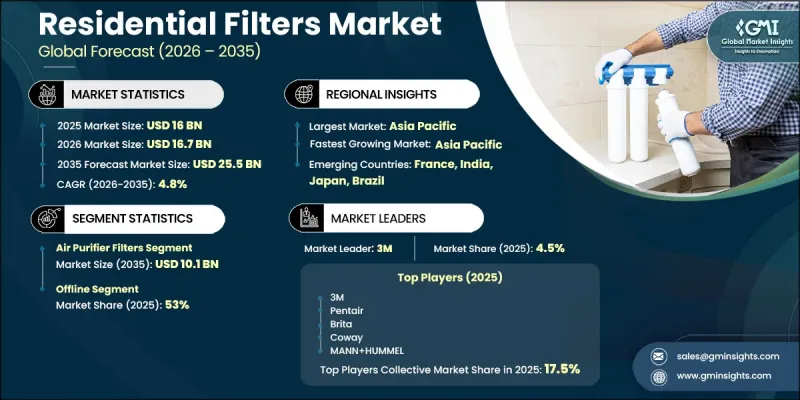
The market is gaining steady traction due to increasing environmental concerns and worsening air quality conditions, particularly in densely populated urban regions across developing economies. Households are increasingly adopting advanced filtration systems as awareness grows around pollution exposure and its long-term impact on indoor living conditions. Rising attention to respiratory health and wellness has further encouraged consumers to prioritize cleaner and safer indoor environments. Regulatory frameworks supporting improved air quality standards and restrictions on harmful substances in consumer products are also accelerating the adoption of high-efficiency filtration solutions. In parallel, rising disposable incomes in developing regions are enabling more households to invest in advanced home appliances, including multi-layer and high-performance filtration systems. This shift is opening new geographic growth opportunities for global manufacturers. Growing consumer preference for healthier lifestyles, combined with technological improvements in filtration efficiency, is strengthening overall market penetration and supporting sustained long-term demand across residential applications.
| Market Scope | |
|---|---|
| Start Year | 2025 |
| Forecast Year | 2026-2035 |
| Start Value | $16 Billion |
| Forecast Value | $25.5 Billion |
| CAGR | 4.8% |
The air purifier filters segment generated USD 6.1 billion in 2025 and is projected to reach USD 10.1 billion by 2035. This segment continues to lead the market as it directly addresses indoor air quality concerns that are increasingly central to household health priorities. Air purifier filters are designed specifically to enhance personal well-being by removing airborne pollutants in sensitive indoor environments, differentiating them from conventional HVAC filtration systems that primarily protect mechanical equipment. The growing popularity of standalone air purification devices has further reinforced segment dominance, as these systems provide flexible, user-focused filtration without requiring structural modifications or large-scale installation. Rising demand for targeted indoor air cleaning solutions continues to support the strong growth trajectory of this category.
The offline distribution channel accounted for a 53% share in 2025. Physical retail channels continue to maintain a leading position as consumers prefer hands-on evaluation and professional consultation before purchasing filtration systems. Buying decisions in this category are highly considered, with customers seeking to physically assess product quality and receive expert guidance. In-store assistance plays a crucial role in simplifying technical specifications such as performance ratings and efficiency metrics, helping consumers make informed choices and strengthening the relevance of traditional retail formats.
U.S. Residential Filters Market held a 77.6% share in 2025 Strong market performance in the country is supported by high awareness of indoor air quality and widespread use of HVAC systems in both single-family and multi-unit housing. Increasing cases of allergies, asthma, and other respiratory conditions have encouraged households to adopt advanced air and water filtration systems as part of routine health management. Strict building regulations, energy-efficient housing upgrades, and consistent replacement demand are further contributing to steady market expansion. Additionally, the presence of established manufacturers, robust distribution networks, and rising integration of smart home technologies continue to reinforce the country's leadership position.
Major players operating in the Global Residential Filters Industry include Culligan, Brita, Camfil, 3M, Coway, Donaldson, Pentair, Daikin, Aquasana, MANN+HUMMEL, A.O. Smith, Parker Hannifin, ZeroWater, Waterdrop, BWT, Berkey, Filterbuy, Clean-Link Filtration, Livpure, Freudenberg Filtration, and FilterTime. Companies in the residential filters market are actively strengthening their competitive position through product innovation focused on higher filtration efficiency and longer service life. Many players are expanding smart filtration solutions integrated with IoT-based monitoring for real-time air and water quality tracking. Strategic partnerships with retail distributors and e-commerce platforms are improving product accessibility and market reach. Manufacturers are also investing in advanced materials and nanotechnology-based filtration media to enhance performance standards. Geographic expansion into high-growth emerging markets is supporting revenue diversification. In addition, firms are focusing on brand differentiation through certifications, sustainability claims, and premium product lines.
Table of Contents
Chapter 1 Methodology & Scope
- 1.1 Research approach
- 1.2 Quality Commitments
- 1.3 GMI AI policy & data integrity commitment
- 1.3.1 Source consistency protocol
- 1.4 Research Trail & Confidence Scoring
- 1.4.1 Research Trail Components
- 1.4.2 Scoring Components
- 1.5 Data Collection
- 1.5.1 Partial list of primary sources
- 1.6 Data mining sources
- 1.7 Paid sources
- 1.7.1 Sources, by region
- 1.8 Base estimates and calculations
- 1.8.1 Base year calculation for any one approach
- 1.9 Forecast model
- 1.9.1 Quantified market impact analysis
- 1.9.1.1 Mathematical impact of growth parameters on forecast
- 1.9.1 Quantified market impact analysis
- 1.10 Research transparency addendum
- 1.10.1 Source attribution framework
- 1.10.2 Quality assurance metrics
- 1.10.3 Our commitment to trust
Chapter 2 Executive Summary
- 2.1 Industry 360° synopsis, 2022 - 2035
- 2.2 Key market trends
- 2.2.1 Regional
- 2.2.2 Type
- 2.2.3 Filter media
- 2.2.4 Efficiency
- 2.2.5 Application
- 2.2.6 Distribution channel
Chapter 3 Industry Insights
- 3.1 Industry ecosystem analysis
- 3.1.1 Supplier landscape
- 3.1.2 Profit margin
- 3.1.3 Value addition at each stage
- 3.1.4 Factor affecting the value chain
- 3.2 Industry impact forces
- 3.2.1 Growth drivers
- 3.2.1.1 Rising awareness of health and environmental concerns
- 3.2.1.2 Urbanization and population growth
- 3.2.1.3 Innovations in filtration technologies
- 3.2.2 Industry pitfalls & challenges
- 3.2.2.1 High initial investment costs
- 3.2.2.2 Maintenance and operational costs
- 3.2.3 Opportunities
- 3.2.3.1 Growing demand for smart and connected filtration solutions
- 3.2.3.2 Rising health and sustainability-driven adoption
- 3.2.1 Growth drivers
- 3.3 Growth potential analysis
- 3.4 Regulatory framework
- 3.5 Major market trends and disruptions
- 3.6 Pricing Analysis (driven by primary research)
- 3.6.1 Historical price trend analysis (driven by primary research)
- 3.6.2 Pricing strategy by player type (premium / value / cost-plus) (driven by primary research)
- 3.7 Future market trends
- 3.8 Trade data analysis (driven by paid database) (HS Code 84212120)
- 3.8.1 Import/export volume & value trends (driven by primary research)
- 3.8.2 Key trade corridors & tariff impact (driven by primary research)
- 3.9 Impact of AI & Generative AI on the Market
- 3.9.1 AI-driven disruption of existing business models
- 3.9.2 Gen-AI use cases & adoption roadmap by segment
- 3.9.3 Risks, limitations & regulatory considerations
- 3.10 Porter's analysis
- 3.11 PESTEL analysis
- 3.12 Capacity & production landscape (driven by primary research)
- 3.12.1 Installed capacity by region & key producer (driven by primary research)
- 3.12.2 Capacity utilization rates & expansion pipelines (driven by primary research)
Chapter 4 Competitive Landscape, 2025
- 4.1 Introduction
- 4.2 Company market share analysis
- 4.2.1 By region
- 4.2.1.1 North America
- 4.2.1.2 Europe
- 4.2.1.3 Asia Pacific
- 4.2.1.4 Latin America
- 4.2.1.5 Middle East and Africa
- 4.2.1 By region
- 4.3 Company matrix analysis
- 4.4 Competitive analysis of major market players
- 4.5 Competitive positioning matrix
- 4.6 Key developments
- 4.6.1 Mergers & acquisitions
- 4.6.2 Partnerships & collaborations
- 4.6.3 New product launches
- 4.6.4 Expansion plans
Chapter 5 Market Estimates & Forecast, By Type, 2022-2035 (USD Billion) (Thousand Units)
- 5.1 Key Trends
- 5.2 HVAC filters
- 5.3 Water filters
- 5.4 Air purifier filters
- 5.5 Furnace filters
- 5.6 Range hood filters
- 5.7 Others
Chapter 6 Market Estimates & Forecast, By Filter Media, 2022 - 2035, (USD Billion) (Thousand Units)
- 6.1 Key trends
- 6.2 Fiberglass
- 6.3 Activated carbon
- 6.4 HEPA
- 6.5 Electrostatic
- 6.6 Pleated paper/polyester
- 6.7 UV
- 6.8 Ceramic
- 6.9 Others (cotton, mesh, etc.)
Chapter 7 Market Estimates & Forecast, By Efficiency, 2022 - 2035, (USD Billion) (Thousand Units)
- 7.1 Key trends
- 7.2 MERV 1-4
- 7.3 MERV 6-10
- 7.4 MERV 10-13
- 7.5 MERV 14-16
- 7.6 MERV 17-20
Chapter 8 Market Estimates & Forecast, By Application, 2022 - 2035, (USD Billion) (Thousand Units)
- 8.1 Key trends
- 8.2 Air filtration
- 8.3 Water filtration
- 8.4 Others (refrigeration, washing machine, etc.)
Chapter 9 Market Estimates & Forecast, By Distribution Channel, 2022 - 2035, (USD Billion) (Thousand Units)
- 9.1 Key trends
- 9.2 Online
- 9.2.1 E-commerce website
- 9.2.2 Company website
- 9.3 Offline
- 9.3.1 Supermarkets/ hypermarkets
- 9.3.2 Specialty stores
- 9.3.3 Others
Chapter 10 Market Estimates & Forecast, By Region, 2022 - 2035, (USD Billion) (Units)
- 10.1 Key trends
- 10.2 North America
- 10.2.1 U.S.
- 10.2.2 Canada
- 10.3 Europe
- 10.3.1 Germany
- 10.3.2 U.K.
- 10.3.3 France
- 10.3.4 Italy
- 10.3.5 Spain
- 10.4 Asia Pacific
- 10.4.1 China
- 10.4.2 India
- 10.4.3 Japan
- 10.4.4 South Korea
- 10.4.5 Australia
- 10.5 Latin America
- 10.5.1 Brazil
- 10.5.2 Mexico
- 10.5.3 Rest of Latin America
- 10.6 MEA
- 10.6.1 UAE
- 10.6.2 Saudi Arabia
- 10.6.3 South Africa
- 10.6.4 Rest of MEA
Chapter 11 Company Profiles (Business Overview, Financial Data, Product Landscape, Strategic Outlook, SWOT Analysis)
- 11.1 Global Companies
- 11.1.1 3M
- 11.1.2 A.O. Smith
- 11.1.3 BWT
- 11.1.4 Culligan
- 11.1.5 Freudenberg Filtration
- 11.1.6 MANN+HUMMEL
- 11.1.7 Pentair
- 11.2 Regional Companies
- 11.2.1 Brita
- 11.2.2 Camfil
- 11.2.3 Coway
- 11.2.4 Daikin
- 11.2.5 Donaldson
- 11.2.6 Livpure
- 11.2.7 Parker Hannifin
- 11.3 Emerging Companies
- 11.3.1 Aquasana
- 11.3.2 Berkey/New Millennium
- 11.3.3 Clean-Link Filtration
- 11.3.4 Filterbuy
- 11.3.5 FilterTime
- 11.3.6 Waterdrop
- 11.3.7 ZeroWater

