PUBLISHER: Global Market Insights Inc. | PRODUCT CODE: 2045761

PUBLISHER: Global Market Insights Inc. | PRODUCT CODE: 2045761
Bicycle Market Opportunity, Growth Drivers, Industry Trend Analysis, and Forecast 2026 - 2035
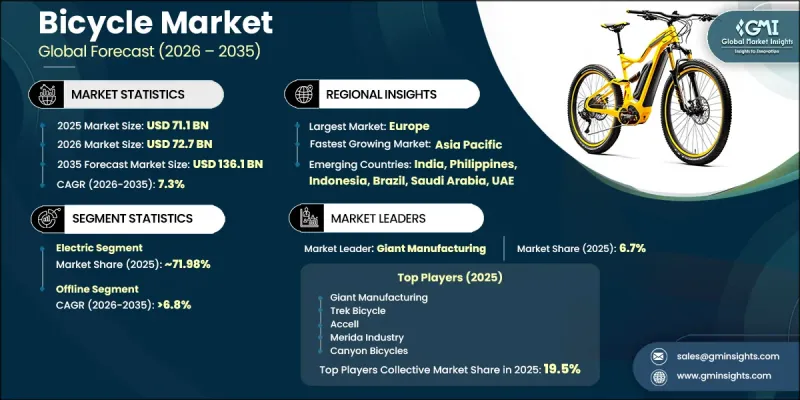
The Global Bicycle Market was valued at USD 71.1 billion in 2025 and is estimated to grow at a CAGR of 7.3% to reach USD 136.1 billion by 2035.
The market is experiencing a major transformation as advancements in smart mobility, digital connectivity, and changing consumer lifestyles continue to reshape the cycling industry. Traditional bicycles are increasingly evolving into connected mobility solutions equipped with advanced technologies such as IoT-enabled sensors, GPS tracking systems, and integrated mobile applications. These innovations improve rider safety, navigation, theft prevention, ride monitoring, and overall user interaction with digital mobility platforms. Rising focus on sustainable transportation and urban mobility planning is also supporting the adoption of technologically advanced bicycles across global markets. Governments and urban authorities are investing in cycling infrastructure and promoting safer transportation alternatives, encouraging manufacturers to develop bicycles with enhanced visibility, tracking, and safety capabilities. In addition, operational efficiency and lifecycle management have become increasingly important for commercial operators involved in bike-sharing services and last-mile transportation networks. The growing use of telematics, predictive maintenance technologies, and data-driven fleet management solutions is further accelerating digital integration across the global bicycle industry.
| Market Scope | |
|---|---|
| Start Year | 2025 |
| Forecast Year | 2026-2035 |
| Start Value | $71.1 Billion |
| Forecast Value | $136.1 Billion |
| CAGR | 7.3% |
The offline distribution segment accounted for 78.7% share in 2025 and is expected to grow at a CAGR of 6.8% from 2026 to 2035. Physical retail channels continue to dominate the industry as consumers prefer in-person product evaluation before making purchasing decisions. Buyers often visit specialty bicycle stores to assess frame dimensions, riding comfort, product quality, and performance characteristics directly. Personalized assistance from retail professionals also plays an important role in helping customers choose suitable bicycle models, accessories, and maintenance solutions, particularly for premium bicycles and electric variants. The ability to experience product features firsthand and receive expert recommendations continues to strengthen the position of offline sales channels across the global bicycle market.
The men segment dominated the bicycle market in 2025 owing to higher participation rates in recreational cycling, professional sports activities, and long-distance commuting applications. Male consumers continue to represent a significant share of demand, particularly for performance-focused bicycles, including road bikes, mountain bikes, and hybrid models. Increased spending on premium and technologically advanced bicycles among male riders is contributing to higher sales volumes across mid-range and premium product categories. Furthermore, growing participation in cycling competitions, outdoor recreational activities, and fitness-oriented lifestyles continues to support sustained product demand within this segment.
China Bicycle Market accounted for 64.2% share and generated USD 14.6 billion in 2025. The country continues to experience strong market growth due to rapid urbanization, increasing traffic congestion, and rising demand for affordable and environmentally sustainable transportation solutions. Bicycles, especially electric models, are widely utilized for daily commuting because they provide operational convenience, low ownership costs, and improved mobility in highly populated urban areas. Government initiatives supporting green transportation, continued expansion of shared mobility services, and advancements in domestic bicycle manufacturing capabilities are further accelerating industry growth across China. Increasing consumer awareness regarding sustainable mobility and fitness-focused transportation alternatives is also contributing to expanding market demand throughout the region.
Major companies operating in the Global Bicycle Market include Giant Manufacturing, Trek Bicycle, Specialized Bicycle, Shimano, Merida Industry, Hero Cycles, Accell, Brompton Bicycle, Canyon Bicycles, and Cube Bikes. Companies operating in the bicycle market are implementing several strategic initiatives to strengthen their market presence and improve competitive positioning. Manufacturers are investing heavily in smart bicycle technologies, lightweight frame materials, and electric mobility solutions to meet evolving consumer preferences and sustainability goals. Many companies are also expanding their electric bicycle portfolios and integrating digital connectivity features such as GPS tracking, mobile applications, and performance monitoring systems. Strategic collaborations with technology providers, mobility platforms, and retail networks are helping brands improve product accessibility and customer engagement. In addition, businesses are focusing on expanding manufacturing capabilities and strengthening distribution channels across emerging markets with rising urban mobility demand.
Table of Contents
Chapter 1 Methodology
- 1.1 Research approach
- 1.2 Quality Commitments
- 1.2.1 GMI AI policy & data integrity commitment
- 1.2.1.1 Source consistency protocol
- 1.2.1 GMI AI policy & data integrity commitment
- 1.3 Research Trail & Confidence Scoring
- 1.3.1 Research Trail Components
- 1.3.2 Scoring Components
- 1.4 Data Collection
- 1.4.1 Partial list of primary sources
- 1.5 Data mining sources
- 1.5.1 Paid sources
- 1.5.1.1 Sources, by region
- 1.5.1 Paid sources
- 1.6 Base estimates and calculations
- 1.6.1 Base year calculation
- 1.7 Forecast Model
- 1.7.1 Quantified market impact analysis
- 1.7.1.1 Mathematical impact of growth parameters on forecast
- 1.7.1 Quantified market impact analysis
- 1.8 Research transparency addendum
- 1.8.1 Source attribution framework
- 1.8.2 Quality assurance metrics
- 1.8.3 Our commitment to trust
Chapter 2 Executive Summary
- 2.1 Industry 360° synopsis, 2022 - 2035
- 2.2 Key market trends
- 2.2.1 Regional
- 2.2.2 Technology
- 2.2.3 Product
- 2.2.4 Design
- 2.2.5 Distribution Channel
- 2.2.6 End Use
- 2.3 TAM Analysis, 2026-2035
- 2.4 CXO perspectives: Strategic imperatives
Chapter 3 Industry Insights
- 3.1 Industry ecosystem analysis
- 3.1.1 Supplier landscape
- 3.1.2 Profit margin analysis
- 3.1.3 Cost structure
- 3.1.4 Value addition at each stage
- 3.1.5 Factor affecting the value chain
- 3.1.6 Disruptions
- 3.2 Industry impact forces
- 3.2.1 Growth drivers
- 3.2.1.1 Rise in government initiatives promoting cycling infrastructure and low-emission transport
- 3.2.1.2 Increase in adoption of electric bicycles for urban commuting
- 3.2.1.3 Surge in demand for bike-sharing and micro-mobility solutions
- 3.2.1.4 Rise in health and fitness awareness encouraging bicycle usage
- 3.2.2 Industry pitfalls and challenges
- 3.2.2.1 High upfront cost of premium and electric bicycles limiting adoption in price-sensitive markets.
- 3.2.2.2 Inadequate cycling infrastructure in several Asia Pacific regions, reducing safety and convenience.
- 3.2.3 Market opportunities
- 3.2.3.1 Growing demand for connected and smart bicycles with GPS, IoT, and app-based services.
- 3.2.3.2 Expansion of last-mile delivery and logistics sectors using bicycles for cost-efficient operations.
- 3.2.3.3 Development of subscription, leasing, and bike-as-a-service models to improve affordability.
- 3.2.3.4 Integration with smart city ecosystems, including digital traffic systems and mobility platforms.
- 3.2.1 Growth drivers
- 3.3 Growth potential analysis
- 3.4 Technology and Innovation landscape
- 3.4.1 Current technological trends
- 3.4.2 Emerging technologies
- 3.5 Pricing Analysis (Driven by Primary Research)
- 3.5.1 Historical Price Trend Analysis
- 3.5.2 Pricing Strategy by Player Type (Premium / Value / Cost-plus)
- 3.6 Regulatory guideline
- 3.6.1 North America
- 3.6.1.1 U.S.: Consumer Product Safety Act (CPSA), CPSC Bicycle Regulations
- 3.6.1.2 Canada: Canada Motor Vehicle Safety Act (CMVSA), Transport Canada Bicycle Safety Standards
- 3.6.2 Europe
- 3.6.2.1 Germany: Straßenverkehrs-Ordnung (StVO), EU General Product Safety Regulation (GPSR)
- 3.6.2.2 UK: Highway Code, Bicycle Lighting Regulations
- 3.6.2.3 France: Code de la Route, Loi d’Orientation des Mobilites (LOM)
- 3.6.2.4 Italy: Codice della Strada, EU Bicycle Safety Standards
- 3.6.3 Asia Pacific
- 3.6.3.1 China: GB Bicycle Safety Standards, Urban Non-Motorized Transport Regulations
- 3.6.3.2 India: Central Motor Vehicles Rules (CMVR), National Urban Transport Policy
- 3.6.3.3 Japan: Road Traffic Act, MLIT Bicycle Safety Guidelines
- 3.6.3.4 Australia: Australian Road Rules, Australian Design Rules (ADR)
- 3.6.4 Latin America
- 3.6.4.1 Brazil: Codigo de Transito Brasileiro (CTB), National Urban Mobility Policy
- 3.6.4.2 Mexico: General Law of Mobility and Road Safety, NOM Standards
- 3.6.4.3 Argentina: Ley Nacional de Transito, ANSV Regulations
- 3.6.5 MEA
- 3.6.5.1 UAE: Federal Traffic Law, Dubai Cycling Regulations
- 3.6.5.2 Saudi Arabia: Saudi Traffic Law, Vision 2030 Mobility Framework
- 3.6.5.3 South Africa: National Road Traffic Act, SABS Standards
- 3.6.1 North America
- 3.7 PESTEL analysis
- 3.8 Patent Landscape (Driven by Primary Research)
- 3.9 Trade Data Analysis (Based on Paid Database)
- 3.9.1 Import/Export Volume & Value Trends
- 3.9.2 Key Trade Corridors & Tariff Impact
- 3.10 Impact of AI & Generative AI on the Market (Driven by Primary Research)
- 3.10.1 AI-Driven Disruption of Existing Business Models
- 3.10.2 GenAI Use Cases & Adoption Roadmap by Segment
- 3.10.3 Risks, Limitations & Regulatory Considerations
- 3.11 Capacity & Production Landscape (Driven by Primary Research)
- 3.11.1 Production Capacity by Region & Key Producer
- 3.11.2 Capacity Utilization Rates & Expansion Pipelines
- 3.12 Sustainability and environmental aspects
- 3.12.1 Sustainable practices
- 3.12.2 Waste reduction strategies
- 3.12.3 Energy efficiency in production
- 3.12.4 Eco-friendly initiatives
- 3.12.5 Carbon footprint considerations
- 3.13 Forecast assumptions & scenario analysis (Driven by Primary Research)
- 3.13.1 Base Case - Key Macro & Industry Variables Driving CAGR
- 3.13.2 Optimistic Scenarios - Favourable macro and industry tailwinds
- 3.13.3 Pessimistic Scenario - Macroeconomic slowdown or industry headwinds
Chapter 4 Competitive Landscape, 2025
- 4.1 Introduction
- 4.2 Company market share analysis
- 4.2.1 North America
- 4.2.2 Europe
- 4.2.3 Asia Pacific
- 4.2.4 Latin America
- 4.2.5 MEA
- 4.3 Competitive analysis of major market players
- 4.4 Competitive positioning matrix
- 4.5 Key developments
- 4.5.1 Mergers & acquisitions
- 4.5.2 Partnerships & collaborations
- 4.5.3 New Product Launches
- 4.5.4 Expansion Plans and funding
- 4.6 Company Tier Benchmarking
- 4.6.1 Tier Classification Criteria & Qualifying Thresholds
- 4.6.2 Tier Positioning Matrix by Revenue, Geography & Innovation
Chapter 5 Market Estimates & Forecast, By Technology, 2022 - 2035 ($Bn, Units)
- 5.1 Key trends
- 5.2 Electric
- 5.3 Conventional
Chapter 6 Market Estimates & Forecast, By Product, 2022 - 2035 ($Bn, Units)
- 6.1 Key trends
- 6.2 Road bicycle
- 6.3 Cargo bicycle
- 6.4 Mountain bicycle
- 6.5 Others
Chapter 7 Market Estimates & Forecast, By Design, 2022 - 2035 ($Bn, Units)
- 7.1 Key trends
- 7.2 Regular
- 7.3 Folding
Chapter 8 Market Estimates & Forecast, By Distribution Channel, 2022 - 2035 ($Bn, Units)
- 8.1 Key trends
- 8.2 Offline
- 8.3 Online
Chapter 9 Market Estimates & Forecast, By End Use, 2022 - 2035 ($Bn, Units)
- 9.1 Key trends
- 9.2 Men
- 9.3 Women
- 9.4 Kids
Chapter 10 Market Estimates & Forecast, By Region, 2022 - 2035 ($Bn, Units)
- 10.1 Key trends
- 10.2 North America
- 10.2.1 US
- 10.2.2 Canada
- 10.3 Europe
- 10.3.1 Germany
- 10.3.2 UK
- 10.3.3 France
- 10.3.4 Italy
- 10.3.5 Spain
- 10.3.6 Russia
- 10.3.7 Netherlands
- 10.3.8 Belgium
- 10.4 Asia Pacific
- 10.4.1 China
- 10.4.2 India
- 10.4.3 Japan
- 10.4.4 Australia
- 10.4.5 South Korea
- 10.4.6 Philippines
- 10.4.7 Indonesia
- 10.5 Latin America
- 10.5.1 Brazil
- 10.5.2 Mexico
- 10.5.3 Argentina
- 10.6 MEA
- 10.6.1 South Africa
- 10.6.2 Saudi Arabia
- 10.6.3 UAE
Chapter 11 Company Profiles
- 11.1 Global players
- 11.1.1 Accell
- 11.1.2 Dorel Industries
- 11.1.3 Giant Manufacturing
- 11.1.4 Hero Cycles
- 11.1.5 Merida Industry
- 11.1.6 Shimano
- 11.1.7 Specialized Bicycle Components
- 11.1.8 Trek Bicycle
- 11.2 Regional players
- 11.2.1 Canyon Bicycles
- 11.2.2 Cube Bikes
- 11.2.3 Derby Cycle
- 11.2.4 Flying Pigeon
- 11.2.5 Focus Bikes
- 11.2.6 Gazelle
- 11.2.7 Riese & Muller
- 11.3 Emerging players
- 11.3.1 Brompton Bicycle
- 11.3.2 Cowboy
- 11.3.3 Rad Power Bikes
- 11.3.4 Stromer
- 11.3.5 VanMoof

