PUBLISHER: Global Market Insights Inc. | PRODUCT CODE: 2045762

PUBLISHER: Global Market Insights Inc. | PRODUCT CODE: 2045762
Immersion Cooling Fluids Market Opportunity, Growth Drivers, Industry Trend Analysis, and Forecast 2026 - 2035
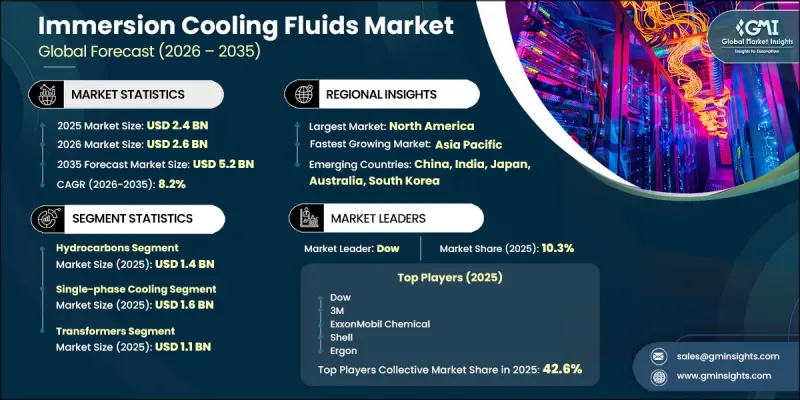
The Global Immersion Cooling Fluids Market was valued at USD 2.4 billion in 2025 and is estimated to grow at a CAGR of 8.2% to reach USD 5.2 billion by 2035.
Immersion cooling fluids play a critical role in dissipating heat by coming into direct contact with electronic components, enabling efficient heat transfer through conduction and convection. These fluids are engineered to deliver high thermal performance while maintaining electrical insulation and chemical stability, ensuring safe and reliable operation of sensitive equipment. Different formulations, including synthetic and engineered dielectric compositions, are designed to perform effectively across varying temperature ranges and extended operational periods. Increasing demand for efficient cooling solutions is being driven by rising energy consumption and the growing complexity of digital infrastructure. As computing systems become more compact and powerful, traditional cooling approaches face limitations in efficiency and energy usage. This shift is encouraging widespread adoption of immersion cooling technologies, positioning the global immersion cooling fluids market for sustained expansion.
| Market Scope | |
|---|---|
| Start Year | 2025 |
| Forecast Year | 2026-2035 |
| Start Value | $2.4 Billion |
| Forecast Value | $5.2 Billion |
| CAGR | 8.2% |
The hydrocarbons segment accounted for USD 1.4 billion in 2025. These fluids are widely adopted due to their cost efficiency and dependable thermal performance. Their compatibility with various materials and long operational lifespan makes them suitable for facilities seeking consistent performance and simplified handling processes. Additionally, these solutions support stable operations while meeting practical requirements for maintenance and disposal.
The transformers segment reached USD 1.1 billion in 2025, reflecting strong adoption of immersion cooling fluids across critical applications. Increasing demand for efficient thermal management is driving the use of these fluids in systems requiring consistent dielectric properties and enhanced operational stability. The need to manage higher thermal loads is encouraging organizations to adopt solutions that improve performance while reducing energy consumption. These systems contribute to extended equipment lifespan and improved operational reliability.
North America Immersion Cooling Fluids Market is projected to grow from USD 811.3 million in 2025 to USD 1.7 billion by 2035. Growth across the region is supported by increasing adoption of advanced cooling solutions in industrial applications. Modernization of digital infrastructure and rising demand for high-density computing are key factors influencing market expansion. The need for thermally stable solutions is increasing as advanced workloads and distributed computing environments continue to expand, reinforcing demand across the region.
Key companies operating in the Global Immersion Cooling Fluids Market include 3M, Cargill, Chemie, Chevron, Dow, Engineered Fluids, Ergon, Inc., ExxonMobil Chemical, Shell, Soltex, and Valvoline. Companies in the Global Immersion Cooling Fluids Market are strengthening their market position through innovation, strategic partnerships, and product development initiatives. Organizations are investing in research and development to enhance fluid performance, improve thermal efficiency, and ensure long-term stability. Many companies are focusing on creating solutions that meet evolving industry standards while addressing sustainability requirements. Expanding production capabilities and strengthening distribution networks are helping businesses reach a broader customer base. Collaboration with technology providers is also supporting the development of advanced cooling systems tailored to modern infrastructure needs.
Table of Contents
Chapter 1 Methodology & Scope
- 1.1 Market scope and definition
- 1.2 Research design
- 1.2.1 Research approach
- 1.2.2 Data collection methods
- 1.3 Data mining sources
- 1.3.1 Global
- 1.3.2 Regional/Country
- 1.4 Base estimates and calculations
- 1.4.1 Base year calculation
- 1.4.2 Key trends for market estimation
- 1.5 Primary research and validation
- 1.5.1 Primary sources
- 1.6 Forecast model
- 1.7 Research assumptions and limitations
Chapter 2 Executive Summary
- 2.1 Industry 360° synopsis
- 2.2 Key market trends
- 2.2.1 Fluid Type
- 2.2.2 Technology
- 2.2.3 Application
- 2.2.4 Regional
- 2.3 TAM Analysis, 2026-2035
- 2.4 CXO perspectives: Strategic imperatives
- 2.5 Future outlook and strategic recommendations
Chapter 3 Industry Insights
- 3.1 Industry ecosystem analysis
- 3.1.1 Supplier landscape
- 3.1.2 Profit margin
- 3.1.3 Value addition at each stage
- 3.1.4 Factor affecting the value chain
- 3.1.5 Disruptions
- 3.2 Industry impact forces
- 3.2.1 Growth drivers
- 3.2.1.1 Rising demand for efficient thermal management
- 3.2.1.2 Increasing data center energy optimization focus
- 3.2.1.3 Expanding use in high-density computing
- 3.2.2 Pitfalls/challenge
- 3.2.2.1 Higher initial setup and transition costs
- 3.2.2.2 Compatibility concerns with older hardware
- 3.2.3 Opportunities
- 3.2.3.1 Development of advanced dielectric fluid chemistries
- 3.2.3.2 Growing interest in sustainable cooling options
- 3.2.1 Growth drivers
- 3.3 Growth potential analysis
- 3.4 Regulatory landscape
- 3.4.1 North America
- 3.4.2 Europe
- 3.4.3 Asia Pacific
- 3.4.4 Latin America
- 3.4.5 Middle East & Africa
- 3.5 Porter's analysis
- 3.6 PESTEL analysis
- 3.7 Technology and innovation landscape
- 3.7.1 Current technological trends
- 3.7.2 Emerging technologies
- 3.8 Price trends
- 3.8.1 By region
- 3.8.2 By fluid type
- 3.9 Future market trends
- 3.10 Patent landscape
- 3.11 Trade statistics (HS code)
- 3.11.1 Major importing countries
- 3.11.2 Major exporting countries
- 3.12 Sustainability and environmental aspects
- 3.12.1 Sustainable practices
- 3.12.2 Waste reduction strategies
- 3.12.3 Energy efficiency in production
- 3.12.4 Eco-friendly initiatives
- 3.13 Carbon footprint consideration
Chapter 4 Competitive Landscape, 2025
- 4.1 Introduction
- 4.2 Company market share analysis
- 4.2.1 By region
- 4.2.1.1 North America
- 4.2.1.2 Europe
- 4.2.1.3 Asia Pacific
- 4.2.1.4 LATAM
- 4.2.1.5 MEA
- 4.2.1 By region
- 4.3 Company matrix analysis
- 4.4 Competitive analysis of major market players
- 4.5 Competitive positioning matrix
- 4.6 Key developments
- 4.6.1 Mergers & acquisitions
- 4.6.2 Partnerships & collaborations
- 4.6.3 New product launches
- 4.6.4 Expansion plans
Chapter 5 Market Estimates and Forecast, By Fluid Type, 2022-2035 (USD Billion) (Kilo Tons)
- 5.1 Key trends
- 5.2 Hydrocarbons
- 5.2.1 Mineral
- 5.2.2 Synthetic
- 5.3 Fluorocarbons
Chapter 6 Market Estimates and Forecast, By Technology, 2022-2035 (USD Billion) (Kilo Tons)
- 6.1 Key trends
- 6.2 Single-phase cooling
- 6.3 Two-phase cooling
Chapter 7 Market Estimates and Forecast, By Application, 2022-2035 (USD Billion) (Kilo Tons)
- 7.1 Key trends
- 7.2 Transformers
- 7.3 Data centre
- 7.4 EV batteries
- 7.5 Others
Chapter 8 Market Estimates and Forecast, By Region, 2022-2035 (USD Billion) (Kilo Tons)
- 8.1 Key trends
- 8.2 North America
- 8.2.1 U.S.
- 8.2.2 Canada
- 8.3 Europe
- 8.3.1 Germany
- 8.3.2 UK
- 8.3.3 France
- 8.3.4 Spain
- 8.3.5 Italy
- 8.3.6 Rest of Europe
- 8.4 Asia Pacific
- 8.4.1 China
- 8.4.2 India
- 8.4.3 Japan
- 8.4.4 Australia
- 8.4.5 South Korea
- 8.4.6 Rest of Asia Pacific
- 8.5 Latin America
- 8.5.1 Brazil
- 8.5.2 Mexico
- 8.5.3 Argentina
- 8.5.4 Rest of Latin America
- 8.6 Middle East and Africa
- 8.6.1 Saudi Arabia
- 8.6.2 South Africa
- 8.6.3 UAE
- 8.6.4 Rest of Middle East and Africa
Chapter 9 Company Profiles
- 9.1 3M
- 9.2 Cargill
- 9.3 Chemie
- 9.4 Chevron
- 9.5 Dow
- 9.6 Engineered Fluids
- 9.7 Ergon,Inc.
- 9.8 ExxonMobil Chemical
- 9.9 Shell
- 9.10 Soltex
- 9.11 Valvoline

