PUBLISHER: Global Market Insights Inc. | PRODUCT CODE: 2045771

PUBLISHER: Global Market Insights Inc. | PRODUCT CODE: 2045771
Spa Market Opportunity, Growth Drivers, Industry Trend Analysis, and Forecast 2026 - 2035
The Global Spa Market was valued at USD 169.5 billion in 2025 and is estimated to grow at a CAGR of 6.9% to reach USD 332.8 billion by 2035.
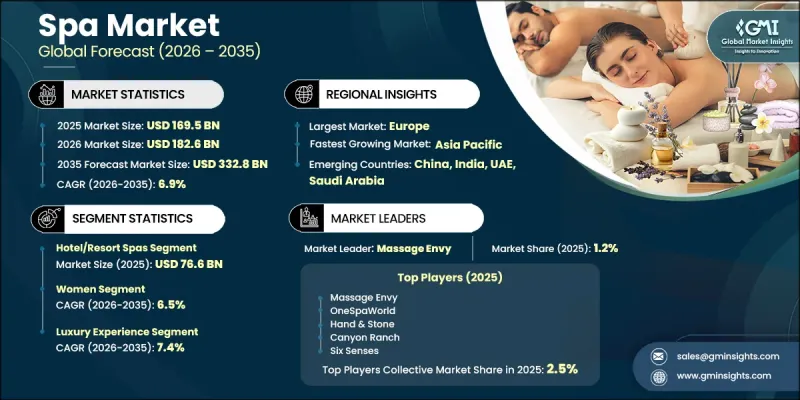
Market expansion is fueled by rising consumer awareness regarding personal wellness, stress management, and preventive healthcare. Increasing prevalence of lifestyle-related conditions, including anxiety, obesity, and hypertension, has encouraged consumers to seek relaxation and wellness therapies, significantly boosting demand for spa services worldwide. Growth in disposable income levels among middle-income populations has also improved accessibility to premium wellness experiences. Rapid urbanization and increasingly demanding work routines are further driving the need for relaxation-focused services. Technological integration across spa facilities, including AI-enabled personalized treatments, immersive wellness experiences, and digitally connected smart spa solutions, is enhancing customer engagement and service efficiency. In addition, the rising popularity of wellness tourism is contributing significantly to industry expansion, as hospitality operators and tourism organizations continue investing in wellness-focused destinations. Growing consumer preference for eco-conscious treatments and natural products is also encouraging spas to adopt sustainable wellness solutions, further strengthening market development globally.
| Market Scope | |
|---|---|
| Start Year | 2025 |
| Forecast Year | 2026-2035 |
| Start Value | $169.5 Billion |
| Forecast Value | $332.8 Billion |
| CAGR | 6.9% |
The hotel and resort spa segment generated USD 76.6 billion in 2025 and is projected to grow at a CAGR of 7.4% during 2026-2035. Rising consumer interest in luxury travel and wellness-centered hospitality experiences is supporting strong growth across this segment. Increasing demand for premium relaxation services and integrated wellness programs within hospitality properties is encouraging hotels and resorts to expand their spa offerings. Higher disposable incomes and changing travel preferences are also contributing to increased adoption of wellness-focused vacation experiences, further accelerating segment growth.
The women segment accounted for 64% share in 2025 and is expected to grow at a CAGR of 6.5% from 2026 to 2035. Women continue to represent the largest consumer group within the spa industry due to increasing focus on beauty, skincare, wellness, and self-care routines. Demand for advanced skincare therapies, anti-aging treatments, and stress-relief services remains particularly strong among female consumers. Growing influence from beauty trends and digital media platforms has further increased interest in innovative and premium wellness experiences. In addition, customer loyalty programs and personalized service offerings targeted toward women are helping spa operators improve customer retention and long-term engagement.
United States Spa Market held a 91% share, generating USD 40.4 billion in 2025. Market growth across the country is being driven by rising consumer spending on wellness and lifestyle enhancement services. Increasing awareness regarding mental health, relaxation therapies, and holistic wellness practices is supporting continued demand for spa treatments. Strong wellness tourism infrastructure, combined with the presence of premium hospitality and luxury wellness facilities, continues to strengthen the country's leadership position within the global spa industry.
Major companies operating in the Global Spa Market include Banyan Tree Spa, Canyon Ranch, Hand & Stone, Mandara Spa, Massage Envy, SHA Wellness Clinic, Six Senses Spas, Blue Lagoon, Chiva-Som, Grand Resort Bad Ragaz, Kamalaya, Lanserhof, Spa Cenvaree, Talise Spa, AIRE Ancient Baths, Bathhouse, Clinique La Prairie, COMO Shambhala, Lefay Resort & SPA, Nimb Spa, and Sojo Spa Club. Companies operating in the spa market are increasingly focusing on service innovation and personalized wellness experiences to strengthen their competitive positioning. Leading players are investing in advanced wellness technologies, including AI-powered treatment customization, digital booking systems, and immersive relaxation therapies to enhance customer satisfaction. Many spa operators are also expanding luxury wellness tourism offerings through partnerships with hospitality and travel providers. Sustainability initiatives, including the use of organic products, eco-friendly infrastructure, and energy-efficient operations, are becoming important strategies to attract environmentally conscious consumers. Businesses are further strengthening brand loyalty through membership programs, customized wellness packages, and premium service experiences.
Table of Contents
Chapter 1 Methodology and scope
- 1.1 Research approach
- 1.2 Quality Commitments
- 1.2.1 GMI AI policy & data integrity commitment
- 1.2.1.1 Source consistency protocol
- 1.2.1 GMI AI policy & data integrity commitment
- 1.3 Research Trail & Confidence Scoring
- 1.3.1 Research Trail Components
- 1.3.2 Scoring Components
- 1.4 Data Collection
- 1.4.1 Partial list of primary sources
- 1.5 Data mining sources
- 1.5.1 Paid sources
- 1.5.1.1 Sources, by region
- 1.5.1 Paid sources
- 1.6 Base estimates and calculations
- 1.6.1 Base year calculation for any one approach
- 1.7 Forecast model
- 1.7.1 Quantified market impact analysis
- 1.7.1.1 Mathematical impact of growth parameters on forecast
- 1.7.1 Quantified market impact analysis
- 1.8 Research transparency addendum
- 1.8.1 Source attribution framework
- 1.8.2 Quality assurance metrics
- 1.8.3 Our commitment to trust
Chapter 2 Executive summary
- 2.1 Industry 360° synopsis
- 2.2 Key market trends
- 2.2.1 Regional
- 2.2.2 Spa type
- 2.2.3 Service type
- 2.2.4 Customer preference
- 2.2.5 Consumer group
- 2.2.6 Age group
Chapter 3 Industry insights
- 3.1 Industry ecosystem analysis
- 3.1.1 Spa service providers
- 3.1.2 Profit margin
- 3.1.3 Value addition at each stage
- 3.1.4 Factor affecting the value chain
- 3.1.5 Disruptions
- 3.2 Industry impact forces
- 3.2.1 Growth drivers
- 3.2.2 Industry pitfalls & challenges
- 3.2.3 Opportunities
- 3.3 Growth potential analysis
- 3.4 Future market trends
- 3.5 Technology and innovation landscape
- 3.5.1 Current technological trends
- 3.5.2 Emerging technologies
- 3.6 Price trends
- 3.6.1 Historical price trend analysis
- 3.6.2 Pricing strategy by player type
- 3.7 Regulatory framework
- 3.7.1 Global Regulatory Overview
- 3.7.2 International Standards & Guidelines
- 3.7.3 Licensing & Certification Requirements
- 3.7.4 Massage Therapy Licensing by Jurisdiction
- 3.7.5 Esthetician Certification Standards
- 3.7.6 Medical Spa Practitioner Requirements
- 3.7.7 FDA Regulations (United States)
- 3.7.8 EU Cosmetics Regulation (Europe)
- 3.8 Service delivery capacity & provider infrastructure
- 3.8.1 Provider network density & coverage by region
- 3.8.2 Capacity gaps & addressable demand mismatch
- 3.9 Porter's five forces analysis
- 3.10 PESTEL analysis
- 3.11 Consumer behavior analysis
- 3.11.1 Service preference analysis
- 3.11.2 Regional variations in consumer behavior
- 3.11.3 Impact of technology on customer decisions
Chapter 4 Competitive landscape, 2025
- 4.1 Introduction
- 4.2 Company market share analysis
- 4.2.1 North America
- 4.2.2 Europe
- 4.2.3 Asia Pacific
- 4.2.4 Latin America
- 4.2.5 MEA
- 4.3 Company matrix analysis
- 4.4 Competitive analysis of major market players
- 4.5 Competitive positioning matrix
- 4.6 Key developments
- 4.6.1 Mergers & acquisitions
- 4.6.2 Partnerships & collaborations
- 4.6.3 New product launches
- 4.6.4 Expansion plans
Chapter 5 Market Estimates & Forecast, By Spa Type, 2022 - 2035 ($Billion)
- 5.1 Key trends
- 5.2 Hotel/resort spas
- 5.3 Day/salon spas
- 5.4 Medical spas
- 5.5 Destination spas
- 5.6 Thermal/mineral springs spas
- 5.7 Other spas (cruise ship spas, mobile spas etc.)
Chapter 6 Market Estimates & Forecast, By Service Type, 2022 - 2035 ($Billion)
- 6.1 Key trends
- 6.2 Massage therapy
- 6.3 Beauty & grooming services
- 6.4 Physical fitness & wellness
- 6.5 Hydrotherapy
- 6.6 Others (body scrubs & wraps etc.)
Chapter 7 Market Estimates & Forecast, By Customer Preference, 2022 - 2035 ($Billion)
- 7.1 Key trends
- 7.2 Luxury experience
- 7.3 Budget-friendly experience
Chapter 8 Market Estimates & Forecast, By Consumer Group, 2022 - 2035 ($Billion)
- 8.1 Key trends
- 8.2 Men
- 8.3 Women
Chapter 9 Market Estimates & Forecast, By Age Group, 2022 - 2035 ($Billion)
- 9.1 Key trends
- 9.2 Below 18
- 9.3 19 to 35
- 9.4 36 to 50
- 9.5 Above 50
Chapter 10 Market Estimates & Forecast, By Region, 2022 - 2035 ($Billion)
- 10.1 Key trends
- 10.2 North America
- 10.2.1 U.S.
- 10.2.2 Canada
- 10.3 Europe
- 10.3.1 Germany
- 10.3.2 UK
- 10.3.3 France
- 10.3.4 Spain
- 10.3.5 Italy
- 10.3.6 Netherlands
- 10.4 Asia Pacific
- 10.4.1 China
- 10.4.2 Japan
- 10.4.3 India
- 10.4.4 Australia
- 10.4.5 South Korea
- 10.5 Latin America
- 10.5.1 Brazil
- 10.5.2 Mexico
- 10.5.3 Argentina
- 10.6 MEA
- 10.6.1 South Africa
- 10.6.2 Saudi Arabia
- 10.6.3 UAE
Chapter 11 Company Profiles
- 11.1 Global Key Players
- 11.1.1 Banyan Tree Spa
- 11.1.2 Canyon Ranch
- 11.1.3 Hand & Stone
- 11.1.4 Mandara Spa
- 11.1.5 Massage Envy
- 11.1.6 SHA Wellness Clinic
- 11.1.7 Six Senses Spas
- 11.2 Regional Players
- 11.2.1 Blue Lagoon
- 11.2.2 Chiva-Som
- 11.2.3 Grand Resort Bad Ragaz
- 11.2.4 Kamalaya
- 11.2.5 Lanserhof
- 11.2.6 Spa Cenvaree
- 11.2.7 Talise Spa
- 11.3 Emerging/Niche Specialists
- 11.3.1 AIRE Ancient Baths
- 11.3.2 Bathhouse
- 11.3.3 Clinique La Prairie
- 11.3.4 COMO Shambhala
- 11.3.5 Lefay Resort & SPA
- 11.3.6 Nimb Spa
- 11.3.7 Sojo Spa Club

