
PUBLISHER: Global Market Insights Inc. | PRODUCT CODE: 2045777

PUBLISHER: Global Market Insights Inc. | PRODUCT CODE: 2045777
Organic Yeast Market Opportunity, Growth Drivers, Industry Trend Analysis, and Forecast 2026 - 2035
The Global Organic Yeast Market was valued at USD 599.2 million in 2025 and is estimated to grow at a CAGR of 10.7% to reach USD 1.6 billion by 2035.
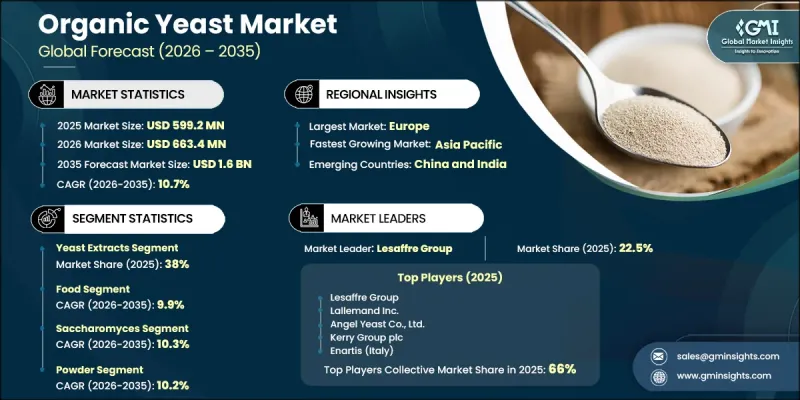
The market is witnessing robust expansion, supported by accelerating consumer preference for clean-label, plant-based, and functionally enriched food ingredients. Demand for nutritional yeast is gaining strong momentum, particularly among vegan consumers, due to its high protein density and naturally occurring B-complex vitamins. Organic yeast derivatives are increasingly utilized in feed formulations and nutraceutical products because of their immune-supporting characteristics, while inactive dry yeast continues to maintain stable adoption in bakery applications. Continuous innovation in strain engineering and rising demand for multifunctional ingredients are driving product diversification across application areas. By species, Saccharomyces cerevisiae leads the market due to its broad applicability across food, beverage, and health-focused formulations, while other species such as Kluyveromyces and Torulaspora are expanding in niche and specialized uses. Powder-based formulations account for more than 54% share owing to their processing convenience and compatibility with large-scale food manufacturing systems. Regionally, North America and Europe remain mature markets supported by strict regulatory standards and high consumer awareness, while Asia Pacific is emerging as the fastest-growing region driven by urbanization and income growth. Latin America along with the Middle East and Africa continues to offer new expansion opportunities.
| Market Scope | |
|---|---|
| Start Year | 2025 |
| Forecast Year | 2026-2035 |
| Start Value | $599.2 Million |
| Forecast Value | $1.6 Billion |
| CAGR | 10.7% |
The food segment accounted for a share of 46.1% in 2025 and is expected to grow at a CAGR of 9.9% from 2026 to 2035. This dominance is supported by increasing integration of clean-label ingredients across baked goods, sauces, and plant-based formulations, where organic yeast plays a key functional role in flavor enhancement and nutritional enrichment.
The Saccharomyces segment reached USD 433.2 million in 2025 and is projected to reach USD 1.1 billion by 2035, growing at a CAGR of 10.3%. Saccharomyces cerevisiae remains the most widely used yeast species globally due to its extensive functionality across food and beverage production as well as nutraceutical applications, making it a core component of multiple industrial processes.
North America Organic Yeast Market is expected to grow at a CAGR of 10.1% throughout 2035. Growth in the region is supported by strong consumer demand for organic and clean-label products, alongside well-established certification frameworks and high awareness levels regarding organic food consumption. The United States leads regional demand due to its mature organic food ecosystem and strong retail penetration.
Key companies operating in the Global Organic Yeast Industry include Kerry Group plc, Angel Yeast Co., Ltd., Lallemand Inc., Lesaffre Group, Agrano GmbH & Co. KG, Brookside Flavors & Ingredients, Levapan S.A., White Labs, Marroquin Organic International, Enartis (Italy), and Deutsche Hefewerke GmbH. Companies in the organic yeast market are focusing on expanding strain innovation programs to develop high-performance yeast variants with enhanced nutritional and functional properties. Strategic investments in fermentation technology and bioprocess optimization are being prioritized to improve yield efficiency and product consistency. Manufacturers are strengthening their clean-label positioning through certified organic sourcing and transparent production practices. Partnerships with food and nutraceutical brands are helping expand application reach across multiple industries. In addition, companies are scaling global distribution networks and enhancing production capacity to meet rising demand.
Table of Contents
Chapter 1 Methodology & Scope
- 1.1 Research approach
- 1.2 Quality Commitments
- 1.2.1 GMI AI policy & data integrity commitment
- 1.2.1.1 Source consistency protocol
- 1.2.1 GMI AI policy & data integrity commitment
- 1.3 Research Trail & Confidence Scoring
- 1.3.1 Research Trail Components
- 1.3.2 Scoring Components
- 1.4 Data Collection
- 1.4.1 Partial list of primary sources
- 1.5 Data mining sources
- 1.5.1 Paid sources
- 1.5.1.1 Sources, by region
- 1.5.1 Paid sources
- 1.6 Base estimates and calculations
- 1.6.1 Base year calculation for any one approach
- 1.7 Forecast model
- 1.7.1 Quantified market impact analysis
- 1.7.1.1 Mathematical impact of growth parameters on forecast
- 1.7.1 Quantified market impact analysis
- 1.8 Research transparency addendum
- 1.8.1 Source attribution framework
- 1.8.2 Quality assurance metrics
- 1.8.3 Our commitment to trust
Chapter 2 Executive Summary
- 2.1 Industry 360° synopsis
- 2.2 Key market trends
- 2.2.1 Regional
- 2.2.2 Product Type
- 2.2.3 Application
- 2.2.4 Species
- 2.2.5 Form
- 2.3 TAM Analysis, 2026-2035
- 2.4 CXO perspectives: Strategic imperatives
Chapter 3 Industry Insights
- 3.1 Industry ecosystem analysis
- 3.1.1 Supplier landscape
- 3.1.2 Profit margin
- 3.1.3 Value addition at each stage
- 3.1.4 Factor affecting the value chain
- 3.1.5 Disruptions
- 3.2 Industry impact forces
- 3.2.1 Growth drivers
- 3.2.2 Industry pitfalls and challenges
- 3.2.3 Market opportunities
- 3.3 Growth potential analysis
- 3.4 Regulatory landscape
- 3.4.1 North America
- 3.4.2 Europe
- 3.4.3 Asia Pacific
- 3.4.4 Latin America
- 3.4.5 Middle East & Africa
- 3.5 Porter's analysis
- 3.6 PESTEL analysis
- 3.7 Price trends
- 3.7.1 By region
- 3.7.2 By product type
- 3.8 Future market trends
- 3.9 Technology and Innovation landscape
- 3.9.1 Current technological trends
- 3.9.2 Emerging technologies
- 3.10 Patent Landscape
- 3.11 Trade statistics (HS code)
- 3.11.1 Major importing countries
- 3.11.2 Major exporting countries
- 3.12 Sustainability and environmental aspects
- 3.12.1 Sustainable practices
- 3.12.2 Waste reduction strategies
- 3.12.3 Energy efficiency in production
- 3.12.4 Eco-friendly initiatives
Chapter 4 Competitive Landscape, 2025
- 4.1 Introduction
- 4.2 Company market share analysis
- 4.2.1 By region
- 4.2.1.1 North America
- 4.2.1.2 Europe
- 4.2.1.3 Asia Pacific
- 4.2.1.4 LATAM
- 4.2.1.5 MEA
- 4.2.1 By region
- 4.3 Company matrix analysis
- 4.4 Competitive analysis of major market players
- 4.5 Competitive positioning matrix
- 4.6 Key developments
- 4.6.1 Mergers & acquisitions
- 4.6.2 Partnerships & collaborations
- 4.6.3 New Product Launches
- 4.6.4 Expansion Plans
Chapter 5 Market Estimates and Forecast, By Product Type, 2022-2035 (USD Million) (Tons)
- 5.1 Key trends
- 5.2 Inactive Dry Yeast
- 5.3 Yeast Extracts
- 5.3.1 Autolysates
- 5.3.2 Hydrolysates
- 5.3.3 Plasmolysates
- 5.4 Yeast Derivatives
- 5.4.1 Beta-Glucans
- 5.4.2 Mannan-Oligosaccharides (MOS)
- 5.5 Nutritional Yeast
- 5.5.1 Fortified Nutritional Yeast
- 5.5.2 Unfortified Nutritional Yeast
Chapter 6 Market Estimates and Forecast, By Application, 2022-2035 (USD Million) (Tons)
- 6.1 Key trends
- 6.2 Food
- 6.2.1 Snacks & Savory Products
- 6.2.2 Soups & Broths
- 6.2.3 Sauces, Seasonings & Dressings
- 6.2.4 Bakery Products
- 6.2.5 Ready Meals
- 6.2.6 Spreads
- 6.2.7 Plant-Based Meat Alternatives
- 6.3 Beverages
- 6.3.1 Functional Beverages
- 6.3.2 Nutritional Drinks
- 6.3.3 Flavor Enhancement Applications
- 6.4 Nutrition
- 6.4.1 Dietary Supplements
- 6.4.2 Protein Supplements
- 6.4.3 Vitamin Fortification (B-Complex, Selenium)
- 6.4.4 Vegan Nutritional Products
- 6.5 Feed
- 6.5.1 Livestock Feed
- 6.5.2 Pet Food
- 6.5.3 Aquaculture Feed
- 6.5.4 Growth Performance & Immunity Enhancement
Chapter 7 Market Estimates and Forecast, By Species, 2022-2035 (USD Million) (Tons)
- 7.1 Key trends
- 7.2 Saccharomyces
- 7.3 Kluyveromyces
- 7.4 Torulaspora
- 7.5 Candida
- 7.6 Others
Chapter 8 Market Estimates and Forecast, By Form, 2022-2035 (USD Million) (Tons)
- 8.1 Key trends
- 8.2 Powder
- 8.3 Flakes
- 8.4 Granules
Chapter 9 Market Estimates and Forecast, By Region, 2022-2035 (USD Million) (Tons)
- 9.1 Key trends
- 9.2 North America
- 9.2.1 U.S.
- 9.2.2 Canada
- 9.3 Europe
- 9.3.1 Germany
- 9.3.2 UK
- 9.3.3 France
- 9.3.4 Spain
- 9.3.5 Italy
- 9.3.6 Rest of Europe
- 9.4 Asia Pacific
- 9.4.1 China
- 9.4.2 India
- 9.4.3 Japan
- 9.4.4 Australia
- 9.4.5 South Korea
- 9.4.6 Rest of Asia Pacific
- 9.5 Latin America
- 9.5.1 Brazil
- 9.5.2 Mexico
- 9.5.3 Argentina
- 9.5.4 Rest of Latin America
- 9.6 Middle East and Africa
- 9.6.1 Saudi Arabia
- 9.6.2 South Africa
- 9.6.3 UAE
- 9.6.4 Rest of Middle East and Africa
Chapter 10 Company Profiles
- 10.1 Lesaffre Group
- 10.2 Lallemand Inc.
- 10.3 Angel Yeast Co., Ltd.
- 10.4 Kerry Group plc
- 10.5 Enartis (Italy)
- 10.6 Agrano GmbH & Co. KG
- 10.7 Deutsche Hefewerke GmbH
- 10.8 Brookside Flavors & Ingredients
- 10.9 White Labs
- 10.10 Levapan S.A.
- 10.11 Marroquin Organic International

