PUBLISHER: Global Market Insights Inc. | PRODUCT CODE: 2045785

PUBLISHER: Global Market Insights Inc. | PRODUCT CODE: 2045785
Wedding Gown Market Opportunity, Growth Drivers, Industry Trend Analysis, and Forecast 2026 - 2035
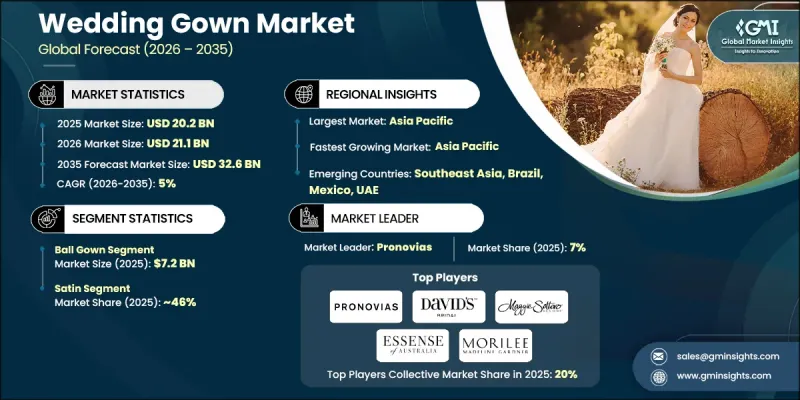
The Global Wedding Gown Market was valued at USD 20.2 billion in 2025 and is estimated to grow at a CAGR of 5% to reach USD 32.6 billion by 2035.
The industry continues to evolve at the intersection of fashion, tradition, and personal identity, with consumer expectations increasingly shaping product innovation and retail experiences. Although ceremonial and formal bridalwear remains deeply rooted in cultural traditions, the market is witnessing strong influence from contemporary fashion trends, premium craftsmanship, and personalized styling preferences. Modern brides are becoming more fashion-conscious and selective, driving demand for gowns that reflect individuality, elegance, and customization. Designers and manufacturers are responding with diverse silhouettes, luxury fabrics, tailored detailing, and enhanced customization services that cater to varying tastes and budgets. Experiential retailing, bespoke consultations, and digitally enabled shopping experiences are also transforming the bridalwear landscape. The growing popularity of personalized wedding aesthetics is encouraging higher spending on exclusive designs and premium-quality garments. As a result, the wedding gown market continues to balance heritage-inspired artistry with modern design innovation, creating strong opportunities for brands that can combine craftsmanship, customization, and evolving fashion sensibilities within a competitive global marketplace.
| Market Scope | |
|---|---|
| Start Year | 2025 |
| Forecast Year | 2026-2035 |
| Start Value | $20.2 Billion |
| Forecast Value | $32.6 Billion |
| CAGR | 5% |
One of the major factors driving growth in the wedding gown market is the increasing consumer preference for individuality and personalized fashion choices. Brides are increasingly selecting wedding attire that reflects their personal style rather than adhering strictly to conventional fashion standards. This shift has accelerated demand for custom-made gowns, modern silhouettes, non-traditional color palettes, and culturally influenced embellishments. To address this trend, designers are expanding bespoke offerings and modular design options that provide greater flexibility and personalization. These strategies enhance perceived product value while helping brands strengthen differentiation within an increasingly competitive bridalwear industry.
The ball gown segment generated USD 7.2 billion in 2025, making it the leading category within the market. Ball gowns continue to maintain strong popularity due to their association with elegance, ceremony, and timeless bridal aesthetics. Their widespread appeal across various age groups and body types continues to support demand, particularly in markets where traditional wedding celebrations remain highly valued. The segment's enduring relevance also reflects consumer preference for dramatic silhouettes and luxurious presentation in formal wedding settings.
The satin segment accounted for 46% share in 2025. Satin remains the preferred fabric choice due to its premium appearance, smooth texture, and structural versatility across multiple gown styles. Its polished finish is strongly associated with sophistication and formal bridalwear, making it highly attractive across both luxury and mass-premium categories. Satin also offers durability and design flexibility, enabling designers to create detailed embellishments and sculpted silhouettes while maintaining fabric integrity. Its visual performance in ceremonial settings and photography further enhances its continued demand across global bridalwear collections.
Asia Pacific Wedding Gown Market held 45% share in 2025 and is anticipated to grow at a CAGR of 5.3% from 2026 to 2035. China continues to lead the regional market due to its large bridal consumer base and rapidly evolving wedding culture. Rising disposable income levels and urbanization trends are increasing demand for premium wedding attire, particularly among consumers seeking customized designs and luxury craftsmanship. Wedding gowns are increasingly viewed as symbols of status, fashion awareness, and personal expression, encouraging greater spending on designer collections and tailored bridal experiences.
Major companies operating in the Global Wedding Gown Industry include Vera Wang, Pronovias, Monique Lhuillier, David's Bridal, Maggie Sottero Designs, Essense of Australia, Rosa Clara, Justin Alexander, Jenny Packham, Enzoani, Morilee, Monica Loretti, Allure Bridals, Azazie, Anomalie, Cocomelody, and Ellebeline. Companies in the wedding gown market are focusing heavily on customization services and personalized bridal experiences to strengthen customer engagement and brand loyalty. Designers are expanding made-to-order collections and incorporating modular gown concepts that offer flexibility in styling and fit. Digital transformation strategies, including virtual consultations and online customization platforms, are improving accessibility and enhancing the consumer purchasing experience. Brands are also investing in premium fabric sourcing, craftsmanship innovation, and exclusive designer collaborations to strengthen product differentiation. Expansion into emerging bridal markets and omnichannel retail strategies is helping companies broaden market reach. In addition, social media marketing, influencer partnerships, and experiential showroom concepts are being widely adopted to increase brand visibility and attract modern, fashion-conscious bridal consumers.
Table of Contents
Chapter 1 Methodology and Scope
- 1.1 Market scope and definition
- 1.2 Research design
- 1.2.1 Research approach
- 1.2.2 Data collection methods
- 1.3 Data mining sources
- 1.3.1 Global
- 1.3.2 Regional/Country
- 1.4 Base estimates and calculations
- 1.4.1 Base year calculation
- 1.4.2 Key trends for market estimation
- 1.5 Primary research and validation
- 1.5.1 Primary sources
- 1.6 Forecast model
- 1.7 Research assumptions and limitations
Chapter 2 Executive Summary
- 2.1 Industry 360° synopsis
- 2.2 Key market trends
- 2.2.1 Regional
- 2.2.2 Style
- 2.2.3 Material
- 2.2.4 End use
- 2.2.5 Distribution channel
Chapter 3 Industry Insights
- 3.1 Industry ecosystem analysis
- 3.1.1 Supplier landscape
- 3.1.2 Profit margin
- 3.1.3 Value addition at each stage
- 3.1.4 Factor affecting the value chain
- 3.2 Industry impact forces
- 3.2.1 Growth drivers
- 3.2.1.1 Cultural and social traditions
- 3.2.1.2 Fashion trends and design innovation
- 3.2.1.3 Celebrity and influencer impact
- 3.2.2 Industry pitfalls & challenges
- 3.2.2.1 Seasonal and event-driven demand
- 3.2.2.2 High customization costs and lead times
- 3.2.3 Opportunities
- 3.2.3.1 Rising demand for sustainable and ethical gowns
- 3.2.3.2 Growth of digital bridal commerce
- 3.2.1 Growth drivers
- 3.3 Growth potential analysis
- 3.4 Future market trends
- 3.5 Technology and innovation landscape
- 3.5.1 Current technological trends
- 3.5.2 Emerging technologies
- 3.6 Pricing Analysis (Driven by Primary Research)
- 3.6.1 Historical price trend analysis
- 3.6.2 Pricing strategy by player type
- 3.6.3 Price positioning by style & material
- 3.6.4 Regional price variations
- 3.6.5 Impact of tariffs on pricing
- 3.7 Regulatory landscape
- 3.7.1 Standards and compliance requirements
- 3.7.2 Regional regulatory frameworks
- 3.7.3 Certification standards
- 3.8 Porter's analysis
- 3.9 PESTEL analysis
- 3.10 Trade data analysis - (HS Code: 62044390: synthetic fiber dresses) (driven by paid database)
- 3.10.1 Import/export volume & value trends
- 3.10.2 Key trade corridors & tariff impact
- 3.10.3 Major importing countries
- 3.10.4 Major exporting countries
- 3.10.5 Trade flow dynamics by region
- 3.11 Impact of AI & Generative AI on the Market
- 3.11.1 AI-driven disruption of existing business models
- 3.11.2 GenAI use cases & adoption roadmap by segment
- 3.11.2.1 Virtual design assistants
- 3.11.2.2 Personalized recommendation engines
- 3.11.2.3 Virtual try-on & fit prediction
- 3.11.2.4 Automated inventory management
- 3.11.3 Risks, limitations & regulatory considerations
- 3.12 Consumer behavior analysis
- 3.12.1 Purchasing patterns
- 3.12.2 Preference analysis
- 3.12.3 Regional variations in consumer behavior
- 3.12.4 Impact of e-commerce on buying decisions
Chapter 4 Competitive Landscape, 2025
- 4.1 Introduction
- 4.2 Company market share analysis
- 4.3 Company market share analysis
- 4.3.1 By region
- 4.3.1.1 North America
- 4.3.1.2 Europe
- 4.3.1.3 Asia Pacific
- 4.3.1.4 Latin America
- 4.3.1.5 Middle East and Africa
- 4.3.1 By region
- 4.4 Competitive analysis of major market players
- 4.5 Competitive positioning matrix
- 4.6 Key developments
- 4.6.1 Mergers & acquisitions
- 4.6.2 Partnerships & collaborations
- 4.6.3 New product launches
- 4.6.4 Expansion plans
Chapter 5 Market Estimates and Forecast, By Style, 2022 - 2035 (USD Billion) (Thousand Units)
- 5.1 Key trends
- 5.2 Ball gown
- 5.3 Mermaid style
- 5.4 Trumpet
- 5.5 A-Line
- 5.6 Sheath
- 5.7 Tea-length
- 5.8 Others (fit and flare, column)
Chapter 6 Market Estimates and Forecast, By Material, 2022 - 2035 (USD Billion) (Thousand Units)
- 6.1 Key trends
- 6.2 Satin
- 6.3 Georgette
- 6.4 Chiffon
- 6.5 Lace
- 6.6 Others (tulle, organza, silk, sustainable fabrics)
Chapter 7 Market Estimates and Forecast, By End Use, 2022 - 2035 (USD Billion) (Thousand Units)
- 7.1 Key trends
- 7.2 Individuals
- 7.3 Commercial
- 7.4 Clothing rental services
- 7.5 Wedding consultant
- 7.6 Photographic studio
- 7.7 Others (religious institutions, social institutions, etc.)
Chapter 8 Market Estimates and Forecast, By Distribution Channel, 2022 - 2035 (USD Billion) (Thousand Units)
- 8.1 Key trends
- 8.2 Online channels
- 8.2.1 E-commerce
- 8.2.2 Company websites
- 8.3 Offline channels
- 8.3.1 Specialty stores
- 8.3.2 Mega retails stores
- 8.3.3 Others (individual stores, departmental stores, etc.)
Chapter 9 Market Estimates and Forecast, By Region, 2022 - 2035 (USD Billion) (Thousand Units)
- 9.1 Key trends
- 9.2 North America
- 9.2.1 U.S.
- 9.2.2 Canada
- 9.3 Europe
- 9.3.1 Germany
- 9.3.2 UK
- 9.3.3 France
- 9.3.4 Italy
- 9.3.5 Spain
- 9.4 Asia Pacific
- 9.4.1 China
- 9.4.2 Japan
- 9.4.3 India
- 9.4.4 Australia
- 9.4.5 South Korea
- 9.5 Latin America
- 9.5.1 Brazil
- 9.5.2 Mexico
- 9.5.3 Argentina
- 9.6 Middle East and Africa
- 9.6.1 South Africa
- 9.6.2 Saudi Arabia
- 9.6.3 UAE
Chapter 10 Company Profiles
- 10.1 Allure Bridals
- 10.2 Anomalie
- 10.3 Azazie
- 10.4 Cocomelody
- 10.5 David's Bridal
- 10.6 Ellebeline
- 10.7 Enzoani
- 10.8 Essense of Australia
- 10.9 Jenny Packham
- 10.10 Justin Alexander
- 10.11 Maggie Sottero Designs
- 10.12 Monica Loretti
- 10.13 Monique Lhuillier
- 10.14 Morilee
- 10.15 Pronovias
- 10.16 Rosa Clara
- 10.17 Vera Wang

