
PUBLISHER: Global Market Insights Inc. | PRODUCT CODE: 2045789

PUBLISHER: Global Market Insights Inc. | PRODUCT CODE: 2045789
Annatto Food Color Market Opportunity, Growth Drivers, Industry Trend Analysis, and Forecast 2026 - 2035
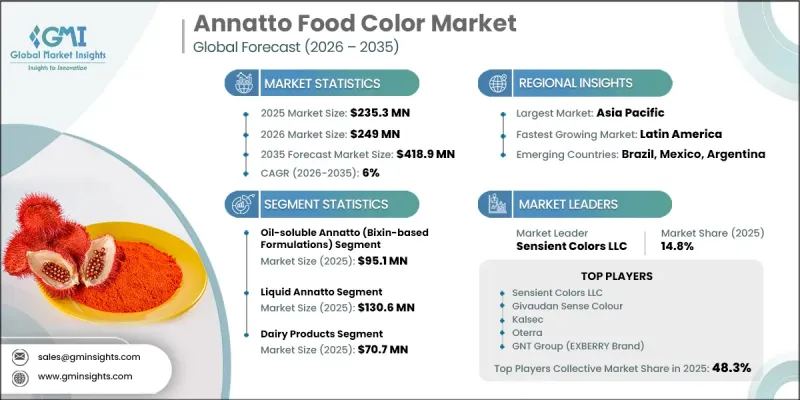
The Global Annatto Food Colors Market was valued at USD 235.3 million in 2025 and is estimated to grow at a CAGR of 6% to reach USD 418.9 million by 2035.
The market is expanding steadily as food and beverage manufacturers increasingly transition toward natural colorants in response to evolving consumer demand for cleaner and more transparent ingredient labels. Annatto, extracted from the seeds of the achiote plant native to tropical regions of the Americas, is widely recognized as a natural pigment containing carotenoids such as bixin and norbixin that deliver yellow to reddish-orange shades. Its stability across heat, light, and pH variations makes it highly suitable for a wide range of food processing conditions. The ingredient is gaining traction as a clean-label solution due to its plant-based origin and absence of synthetic additives, aligning with rising health-conscious purchasing behavior. Technological improvements in extraction and formulation processes have further strengthened its commercial appeal by enabling oil-based, water-based, and emulsified variants that offer improved color consistency and application flexibility. These advancements allow manufacturers to achieve precise hue control while maintaining product stability. Demand is also supported by its growing application across dairy, bakery, beverages, and processed food categories, where natural coloring is increasingly preferred over artificial alternatives. Overall, the market continues to benefit from the global shift toward natural ingredients and enhanced food transparency standards.
| Market Scope | |
|---|---|
| Start Year | 2025 |
| Forecast Year | 2026-2035 |
| Start Value | $235.3 Million |
| Forecast Value | $418.9 Million |
| CAGR | 6% |
The oil-soluble annatto segment accounted for USD 95.1 million in 2025 owing to its strong compatibility with fat-based food systems. Its lipophilic nature enhances dispersion efficiency in products such as dairy and baked goods, making it a preferred choice for manufacturers. Improvements in bixin-based extraction methods have further strengthened formulation stability, enabling consistent color output and broader industrial adoption across processed food applications.
The liquid annatto segment reached USD 130.6 million in 2025 due to its ease of application and uniform blending capabilities. Food manufacturers prefer liquid formulations as they support accurate dosing, smooth integration into production lines, and consistent coloration in large-scale operations. The rising need for convenient natural color solutions in high-volume food manufacturing continues to drive strong demand for this format.
North America Annatto Food Colors Market is projected to rise from USD 57.6 million in 2025 to USD 99.6 million by 2035. Growth in the region is supported by increasing adoption of natural colorants across dairy and packaged food industries, along with a strong shift toward clean-label reformulations. Expanding investments in advanced extraction technologies and sustainable sourcing practices are also contributing to market development. The United States remains a key contributor, driven by rising demand for natural ingredients in cheese production and clean-label snack formulations, alongside growing preference for organic and minimally processed food products.
Major players operating in the Global Annatto Food Colors Industry include Sensient Colors LLC, GNT Group (EXBERRY Brand), Oterra, Kalsec, Givaudan Sense Colour, Aarkay Food Products Ltd., IFC Solutions, AICA Color (Aicacolor S.A.C.), BIOCONCOLORS, Vinayak Ingredients (INDIA) Pvt., Roha Dyechem Pvt Ltd, Food RGB. Companies in the annatto food colors market are focusing on strengthening their competitive position through continuous innovation in extraction technologies that improve pigment stability and color consistency. Many players are investing in research and development to enhance solubility systems and expand application versatility across diverse food categories. Strategic partnerships with food manufacturers are being used to expand product integration and accelerate adoption in clean-label formulations. Firms are also emphasizing sustainable sourcing of raw materials to align with environmental expectations and consumer transparency trends. Expansion of production capacity and optimization of supply chains are supporting cost efficiency and global distribution reach.
Table of Contents
Chapter 1 Methodology & Scope
- 1.1 Market scope and definition
- 1.2 Research design
- 1.2.1 Research approach
- 1.2.2 Data collection methods
- 1.3 Data mining sources
- 1.3.1 Global
- 1.3.2 Regional/Country
- 1.4 Base estimates and calculations
- 1.4.1 Base year calculation
- 1.4.2 Key trends for market estimation
- 1.5 Primary research and validation
- 1.5.1 Primary sources
- 1.6 Forecast model
- 1.7 Research assumptions and limitations
Chapter 2 Executive Summary
- 2.1 Industry 360° synopsis
- 2.2 Key market trends
- 2.2.1 Product type
- 2.2.2 Form
- 2.2.3 Application
- 2.2.4 Regional
- 2.3 TAM Analysis, 2026-2035
- 2.4 CXO perspectives: Strategic imperatives
Chapter 3 Industry Insights
- 3.1 Industry ecosystem analysis
- 3.1.1 Supplier landscape
- 3.1.2 Profit margin
- 3.1.3 Value addition at each stage
- 3.1.4 Factor affecting the value chain
- 3.1.5 Disruptions
- 3.2 Industry impact forces
- 3.2.1 Growth drivers
- 3.2.2 Industry pitfalls and challenges
- 3.2.3 Market opportunities
- 3.3 Growth potential analysis
- 3.4 Regulatory landscape
- 3.4.1 North America
- 3.4.2 Europe
- 3.4.3 Asia Pacific
- 3.4.4 Latin America
- 3.4.5 Middle East & Africa
- 3.5 Porter's analysis
- 3.6 PESTEL analysis
- 3.7 Price trends
- 3.7.1 By region
- 3.7.2 By product type
- 3.8 Future market trends
- 3.9 Technology and Innovation landscape
- 3.9.1 Current technological trends
- 3.9.2 Emerging technologies
- 3.10 Patent Landscape
- 3.11 Trade statistics (HS code)
- 3.11.1 Major importing countries
- 3.11.2 Major exporting countries
- 3.12 Sustainability and environmental aspects
- 3.12.1 Sustainable practices
- 3.12.2 Waste reduction strategies
- 3.12.3 Energy efficiency in production
- 3.12.4 Eco-friendly initiatives
- 3.13 Carbon footprint consideration
Chapter 4 Competitive Landscape, 2025
- 4.1 Introduction
- 4.2 Company market share analysis
- 4.2.1 By region
- 4.2.1.1 North America
- 4.2.1.2 Europe
- 4.2.1.3 Asia Pacific
- 4.2.1.4 LATAM
- 4.2.1.5 MEA
- 4.2.1 By region
- 4.3 Competitive analysis of major market players
- 4.4 Competitive positioning matrix
- 4.5 Key developments
- 4.5.1 Mergers & acquisitions
- 4.5.2 Partnerships & collaborations
- 4.5.3 New Product Launches
- 4.5.4 Expansion Plans
Chapter 5 Market Estimates and Forecast, By Product Type, 2022-2035 (USD Billion) (Kilo Tons)
- 5.1 Key trends
- 5.2 Oil-Soluble Annatto (Bixin-based formulations)
- 5.3 Water-Soluble Annatto (Norbixin-based formulations)
- 5.4 Emulsified Annatto (Dual-phase dispersion systems)
Chapter 6 Market Estimates and Forecast, By Form, 2022-2035 (USD Million) (Kilo Tons)
- 6.1 Key trends
- 6.2 Liquid Annatto
- 6.3 Powder Annatto
Chapter 7 Market Estimates and Forecast, By Application, 2022-2035 (USD Million) (Kilo Tons)
- 7.1 Key trends
- 7.2 Dairy Products
- 7.3 Beverages
- 7.4 Bakery and Confectionery
- 7.5 Snacks and Savory Products
- 7.6 Meat Products
- 7.7 Sauces and Dressings
- 7.8 Others
Chapter 8 Market Estimates and Forecast, By Region, 2022-2035 (USD Million) (Kilo Tons)
- 8.1 Key trends
- 8.2 North America
- 8.2.1 U.S.
- 8.2.2 Canada
- 8.3 Europe
- 8.3.1 Germany
- 8.3.2 UK
- 8.3.3 France
- 8.3.4 Spain
- 8.3.5 Italy
- 8.3.6 Rest of Europe
- 8.4 Asia Pacific
- 8.4.1 China
- 8.4.2 India
- 8.4.3 Japan
- 8.4.4 Australia
- 8.4.5 South Korea
- 8.4.6 Rest of Asia Pacific
- 8.5 Latin America
- 8.5.1 Brazil
- 8.5.2 Mexico
- 8.5.3 Argentina
- 8.5.4 Rest of Latin America
- 8.6 Middle East and Africa
- 8.6.1 Saudi Arabia
- 8.6.2 South Africa
- 8.6.3 UAE
- 8.6.4 Rest of Middle East and Africa
Chapter 9 Company Profiles
- 9.1 Aarkay Food Products Ltd.
- 9.2 Sensient Colors LLC
- 9.3 Givaudan Sense Colour
- 9.4 Kalsec
- 9.5 AICA Color (Aicacolor S.A.C.)
- 9.6 BIOCONCOLORS
- 9.7 Vinayak Ingredients (INDIA) Pvt.
- 9.8 Oterra
- 9.9 Food RGB
- 9.10 GNT Group (EXBERRY Brand)
- 9.11 Roha Dyechem Pvt Ltd
- 9.12 IFC Solutions

