PUBLISHER: Global Market Insights Inc. | PRODUCT CODE: 2045794

PUBLISHER: Global Market Insights Inc. | PRODUCT CODE: 2045794
AI Avatars Market Opportunity, Growth Drivers, Industry Trend Analysis, and Forecast 2026 - 2035
The Global AI Avatars Market was valued at USD 6.3 billion in 2025 and is estimated to grow at a CAGR of 30.6% to reach USD 93.4 billion by 2035.
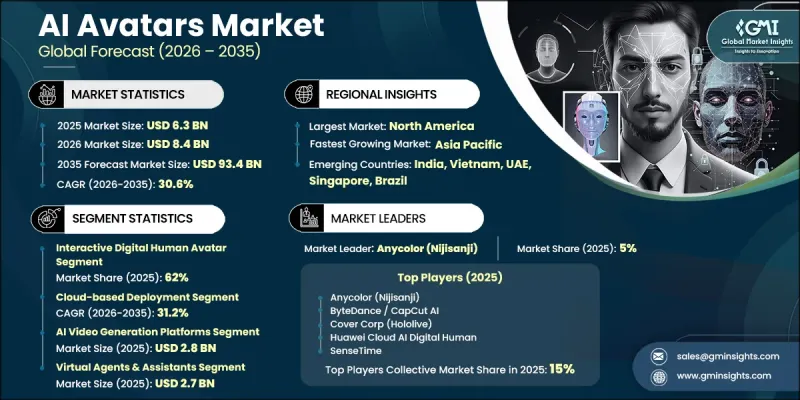
Rapid growth across the AI avatars industry is driven by advancements in generative AI, rising demand for synthetic digital content, and increasing deployment of intelligent virtual agents across enterprise applications. AI avatars are evolving into highly realistic digital representations capable of interacting in human-like ways using natural language processing and conversational AI technologies. Organizations are increasingly integrating these solutions to enhance customer engagement, streamline communication processes, and deliver personalized digital experiences. Growing adoption of remote work models and expansion of online service delivery channels are further accelerating demand. Enterprises are investing heavily in improving customer support systems, digital marketing capabilities, and interactive communication platforms powered by AI avatars. Increasing integration of these systems into enterprise software ecosystems, including CRM, HR, and customer service platforms, is enabling workflow automation and improving operational efficiency. Expanding investments in cloud infrastructure and generative AI technologies are further supporting scalability, performance, and real-time responsiveness, positioning AI avatars as a core component of next-generation digital interaction systems across global industries.
| Market Scope | |
|---|---|
| Start Year | 2025 |
| Forecast Year | 2026-2035 |
| Start Value | $6.3 Billion |
| Forecast Value | $93.4 Billion |
| CAGR | 30.6% |
The interactive digital human avatar segment accounted for 62% share in 2025 and is projected to grow at a CAGR of 30% through 2035. Growth in this segment is driven by increasing demand for real-time, two-way conversational interfaces that deliver personalized and context-aware responses. These avatars are designed to simulate human interaction through dynamic facial expressions, speech synthesis, and adaptive dialogue systems powered by advanced language models. They are widely used across customer engagement, virtual assistance, training, and digital service delivery applications. Continuous improvements in responsiveness, emotional recognition, and conversational accuracy are enhancing user experience and expanding enterprise adoption across multiple industries.
The cloud-based deployment segment held 54% share in 2025 and is expected to grow at a CAGR of 31.2% between 2026 and 2035. Cloud deployment is increasingly preferred due to its ability to support scalable computing resources, reduce upfront infrastructure costs, and enable continuous platform updates. It also provides global accessibility, allowing organizations to deploy AI avatar solutions across distributed work environments and customer bases. The high computational demand of real-time avatar rendering and AI-driven interaction is further reinforcing reliance on cloud infrastructure. Advancements in GPU-accelerated cloud services and distributed computing frameworks are enhancing performance efficiency and supporting large-scale enterprise adoption.
North America AI Avatars Market is projected to account for 42.5% share in 2025. The region benefits from strong technological infrastructure, early adoption of artificial intelligence solutions, and substantial enterprise investment in digital transformation initiatives. Widespread deployment across industries such as financial services, healthcare, and retail is contributing to sustained market growth. The presence of major technology companies and advanced cloud ecosystems is further accelerating the innovation and commercialization of AI avatar solutions. Increasing acceptance of AI-driven customer engagement tools is strengthening regional demand and supporting continued market expansion.
Key companies operating in the Global AI Avatars Industry include Google, IBM, Synthesia, Baidu Digital Human, ByteDance / CapCut AI, Huawei Cloud AI Digital Human, SenseTime (SenseAvatar), Anycolor (Nijisanji), Cover Corp (Hololive), and HeyGen. Companies operating in the AI avatars market are focusing on multiple strategic initiatives to strengthen their competitive positioning and expand global reach. Leading players are investing heavily in generative AI research, natural language processing, and real-time rendering technologies to enhance avatar realism and responsiveness. Strategic partnerships with cloud service providers and enterprise software companies are enabling wider integration of AI avatars into business ecosystems. Firms are also expanding product capabilities across customer service, digital marketing, and virtual training applications to diversify use cases. Continuous improvements in emotional intelligence, speech synthesis, and personalization features are helping companies improve user engagement. In addition, organizations are leveraging cloud-native architectures to improve scalability and reduce operational costs.
Table of Contents
Chapter 1 Methodology & Scope
- 1.1 Research approach
- 1.2 Quality Commitments
- 1.2.1 GMI AI policy & data integrity commitment
- 1.2.1.1 Source consistency protocol
- 1.2.1 GMI AI policy & data integrity commitment
- 1.3 Research Trail & Confidence Scoring
- 1.3.1 Research Trail Components
- 1.3.2 Scoring Components
- 1.4 Data Collection
- 1.4.1 Partial list of primary sources
- 1.5 Data mining sources
- 1.5.1 Paid sources
- 1.5.1.1 Sources, by region
- 1.5.1 Paid sources
- 1.6 Base estimates and calculations
- 1.6.1 Base year calculation for any one approach
- 1.7 Forecast
- 1.7.1 Quantified market impact analysis
- 1.7.1.1 Mathematical impact of growth parameters on forecast
- 1.7.1 Quantified market impact analysis
- 1.8 Research transparency addendum
- 1.8.1 Source attribution framework
- 1.8.2 Quality assurance metrics
- 1.8.3 Our commitment to trust
Chapter 2 Executive Summary
- 2.1 Industry 360° synopsis
- 2.2 Key market trends
- 2.2.1 Avatar
- 2.2.2 Platform
- 2.2.3 Deployment
- 2.2.4 Technology
- 2.2.5 Application
- 2.2.6 Industry Vertical
- 2.2.7 Regional
- 2.3 TAM Analysis, 2026-2035
- 2.4 CXO perspectives: Strategic imperatives
Chapter 3 Industry Insights
- 3.1 Industry ecosystem analysis
- 3.1.1 Supplier landscape
- 3.1.1.1 Solution providers & platform vendors
- 3.1.1.2 Implementation partners & system integrators
- 3.1.1.3 Technology enablers & infrastructure providers
- 3.1.1.4 Managed service providers
- 3.1.1.5 End-use organizations
- 3.1.2 Cost structure
- 3.1.3 Profit margin
- 3.1.4 Value addition at each stage
- 3.1.5 Vertical integration trends
- 3.1.6 Disruptors
- 3.1.1 Supplier landscape
- 3.2 Impact on forces
- 3.2.1 Growth drivers
- 3.2.1.1 Rising enterprise adoption of AI-powered customer engagement solutions
- 3.2.1.2 Rapid advancements in generative AI and multimodal technologies
- 3.2.1.3 Growing demand for scalable digital content creation
- 3.2.1.4 Expansion of metaverse, gaming, and virtual identity ecosystems
- 3.2.2 Industry pitfalls & challenges
- 3.2.2.1 Legal and regulatory concerns surrounding deepfakes and synthetic media
- 3.2.2.2 High computational and infrastructure requirements
- 3.2.3 Market opportunities
- 3.2.3.1 Shift toward real-time conversational AI avatars
- 3.2.3.2 Increasing integration with enterprise software ecosystems
- 3.2.3.3 Rising popularity of AI influencers and virtual companions
- 3.2.3.4 Growing adoption of hyper-personalized and multilingual avatars
- 3.2.1 Growth drivers
- 3.3 Technology trends & innovation ecosystem
- 3.3.1 Current technologies
- 3.3.2 Emerging technologies
- 3.4 Growth potential analysis
- 3.5 Regulatory landscape
- 3.5.1 North America
- 3.5.1.1 U.S. Americans with Disabilities Act (ADA)
- 3.5.1.2 Cybersecurity and Infrastructure Security Agency (CISA)
- 3.5.2 Europe
- 3.5.2.1 General Data Protection Regulation (GDPR)
- 3.5.2.2 NIS2 Directive
- 3.5.3 Asia-Pacific
- 3.5.3.1 China Cybersecurity Law
- 3.5.3.2 Digital India & Smart City/Event Infrastructure Policies
- 3.5.4 Latin America
- 3.5.4.1 Brazil National Infrastructure Modernization Program
- 3.5.4.2 Mexico Energy & Industrial Compliance Standards (NOM Framework)
- 3.5.5 Middle East & Africa
- 3.5.5.1 UAE Net Zero 2050 Strategy
- 3.5.5.2 Saudi Vision 2030 Industrial Digitalization Program
- 3.5.1 North America
- 3.6 Porter's analysis
- 3.7 PESTEL analysis
- 3.8 Patent analysis (Driven by Primary Research)
- 3.9 Pricing Analysis (Driven by Primary Research)
- 3.9.1 Historical Price Trend Analysis
- 3.9.2 Pricing Strategy by Player Type
- 3.10 Base case scenarios
- 3.11 Use cases
- 3.12 Sustainability and environmental aspects
- 3.12.1 Sustainable practices
- 3.12.2 Waste reduction strategies
- 3.12.3 Energy efficiency in production
- 3.12.4 Eco-friendly initiatives
- 3.12.5 Carbon footprint considerations
- 3.13 Impact of AI & generative AI on the market
- 3.13.1 AI-driven disruption of existing business models
- 3.13.2 GenAI use cases & adoption roadmap by segment
- 3.13.3 Risks, limitations & regulatory considerations
- 3.14 Forecast assumptions & scenario analysis (Driven by Primary Research)
- 3.14.1 Base Case - key macro & industry variables driving CAGR
- 3.14.2 Optimistic Scenarios - Favorable Macro and Industry Tailwinds
- 3.14.3 Pessimistic Scenario - Macroeconomic slowdown or industry headwinds
Chapter 4 Competitive Landscape, 2025
- 4.1 Introduction
- 4.2 Company market share analysis
- 4.2.1 North America
- 4.2.2 Europe
- 4.2.3 Asia Pacific
- 4.2.4 Latin America
- 4.2.5 MEA
- 4.3 Competitive analysis of major market players
- 4.4 Competitive positioning matrix
- 4.5 Company Tier Benchmarking
- 4.5.1 Tier Classification Criteria & Qualifying Thresholds
- 4.5.2 Tier Positioning Matrix by Revenue, Geography & Innovation
- 4.6 Key developments
- 4.6.1 Mergers & acquisitions
- 4.6.2 Partnerships & collaborations
- 4.6.3 New product launches
- 4.6.4 Expansion plans and funding
Chapter 5 Market Estimates & Forecast, By Avatar, 2022 - 2035 ($Bn)
- 5.1 Key trends
- 5.2 Interactive digital human avatar
- 5.3 Non-interactive digital human avatar
Chapter 6 Market Estimates & Forecast, By Platform, 2022 - 2035 ($Bn)
- 6.1 Key trends
- 6.2 AI Video Generation Platforms
- 6.3 Interactive Digital Human Platforms
- 6.4 3D & Metaverse Avatars
- 6.5 Stylized Avatar & Social Media Tools
Chapter 7 Market Estimates & Forecast, By Deployment, 2022 - 2035 ($Bn)
- 7.1 Key trends
- 7.2 Cloud-based
- 7.3 On-premises
Chapter 8 Market Estimates & Forecast, By Technology, 2022 - 2035 ($Bn)
- 8.1 Key trends
- 8.2 Natural Language Processing (NLP)
- 8.3 Computer Vision
- 8.4 Machine Learning
- 8.5 Artificial Intelligence (AI)
- 8.6 Others
Chapter 9 Market Estimates & Forecast, By Application, 2022 - 2035 ($Bn)
- 9.1 Key trends
- 9.2 Virtual agents & assistant
- 9.3 Virtual influencers
- 9.4 Virtual characters
- 9.5 Virtual companions
Chapter 10 Market Estimates & Forecast, By Industry Vertical, 2022 - 2035 ($Bn)
- 10.1 Key trends
- 10.2 Retail and E-commerce
- 10.3 Healthcare
- 10.4 Education
- 10.5 Banking, Financial Services, and Insurance (BFSI)
- 10.6 Gaming and Entertainment
- 10.7 Automotive
- 10.8 Telecommunications
- 10.9 Others
Chapter 11 Market Estimates & Forecast, By Region, 2022 - 2035 ($Bn)
- 11.1 Key trends
- 11.2 North America
- 11.2.1 US
- 11.2.2 Canada
- 11.3 Europe
- 11.3.1 UK
- 11.3.2 Germany
- 11.3.3 France
- 11.3.4 Italy
- 11.3.5 Spain
- 11.3.6 Belgium
- 11.3.7 Netherlands
- 11.3.8 Sweden
- 11.3.9 Russia
- 11.4 Asia Pacific
- 11.4.1 China
- 11.4.2 India
- 11.4.3 Japan
- 11.4.4 Australia
- 11.4.5 Singapore
- 11.4.6 South Korea
- 11.4.7 Vietnam
- 11.4.8 Indonesia
- 11.5 Latin America
- 11.5.1 Brazil
- 11.5.2 Mexico
- 11.5.3 Argentina
- 11.6 MEA
- 11.6.1 South Africa
- 11.6.2 Saudi Arabia
- 11.6.3 UAE
Chapter 12 Company Profiles
- 12.1 Global players
- 12.1.1 D-ID
- 12.1.2 Google
- 12.1.3 HeyGen
- 12.1.4 IBM
- 12.1.5 Meta
- 12.1.6 Microsoft
- 12.1.7 NVIDIA
- 12.1.8 Synthesia
- 12.2 Regional players
- 12.2.1 Colossyan
- 12.2.2 DeepBrain AI
- 12.2.3 Elai.io
- 12.2.4 Hour One
- 12.2.5 Invideo AI
- 12.2.6 Inworld AI
- 12.2.7 Soul Machines
- 12.2.8 UneeQ
- 12.3 Emerging players
- 12.3.1 Ready Player Me
- 12.3.2 Rephrase.ai
- 12.3.3 Synthflow
- 12.3.4 Tavus

