PUBLISHER: Global Market Insights Inc. | PRODUCT CODE: 2045804

PUBLISHER: Global Market Insights Inc. | PRODUCT CODE: 2045804
Crane Rental Market Opportunity, Growth Drivers, Industry Trend Analysis, and Forecast 2026 - 2035
The Global Crane Rental Market was valued at USD 19.7 billion in 2025 and is estimated to grow at a CAGR of 8.7% to reach USD 44.4 billion by 2035.
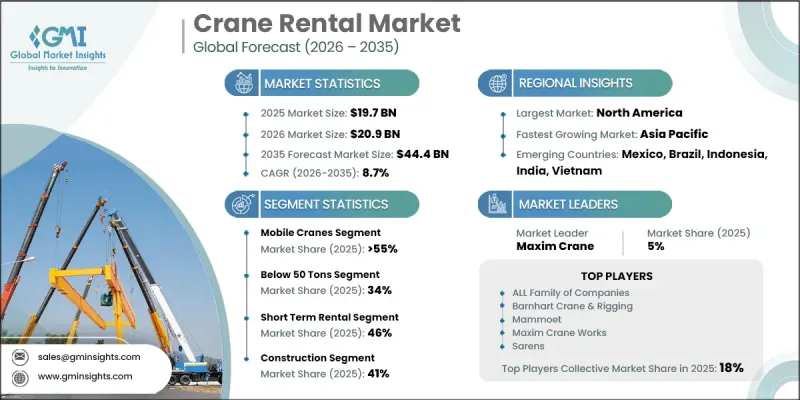
Rapid growth in large-scale infrastructure development projects is significantly driving demand for crane rental services across the world. Increasing construction activities involving highways, rail corridors, ports, commercial buildings, and industrial facilities are creating strong requirements for heavy lifting equipment without the burden of high capital investment. Governments and private developers are increasingly opting for rental crane solutions to improve operational efficiency, reduce equipment ownership costs, and accelerate project completion timelines. Rising urbanization and expansion of smart city developments are also contributing to higher deployment of mobile and tower cranes across densely populated urban environments, where flexibility and quick mobility are essential. In addition, expansion across the energy, mining, and industrial sectors is strengthening demand for specialized lifting equipment used in refinery upgrades, equipment installation, and large-scale industrial projects. Technological advancements, including telematics, remote diagnostics, fuel-efficient systems, and hybrid-powered cranes, are further improving operational productivity and supporting market growth globally.
| Market Scope | |
|---|---|
| Start Year | 2025 |
| Forecast Year | 2026-2035 |
| Start Value | $19.7 Billion |
| Forecast Value | $44.4 Billion |
| CAGR | 8.7% |
The mobile cranes segment accounted for 55% share in 2025 and is expected to grow at a CAGR of 8.3% from 2026 to 2035. Demand for mobile cranes continues to increase due to ongoing urban redevelopment and infrastructure modernization projects worldwide. Advanced technologies such as telematics integration, hybrid propulsion systems, and remote monitoring capabilities are improving crane efficiency, operational safety, and sustainability. Compact crane designs are also enabling easier deployment across congested urban construction sites with limited operational space, further accelerating segment growth across rapidly developing regions.
The below 50 tons segment held a 34% share in 2025 and is anticipated to grow at a CAGR of 7.7% through 2035. Cranes within this lifting capacity range are gaining significant traction across utility work, maintenance activities, and urban construction projects due to their maneuverability and suitability for confined job sites. Increasing preference for electric and hybrid lifting equipment to meet tightening emission standards is further supporting demand across this segment. Rental availability is particularly benefiting small and mid-sized contractors handling short-duration infrastructure repair and construction projects in highly populated metropolitan areas.
U.S. Crane Rental Market reached USD 6 billion in 2025. Market growth in the country is being supported by rising investments in transportation infrastructure modernization projects, including highways, bridges, and public utility upgrades. Growing adoption of telematics-enabled cranes and automated lifting systems is improving operational efficiency across construction sites. Contractors are increasingly relying on rental fleets to maintain flexibility and reduce equipment ownership costs. In addition, renewable energy projects involving wind and utility-scale solar installations are generating substantial demand for heavy-lift crane solutions required for equipment assembly and energy infrastructure deployment.
Major companies operating in the Global Crane Rental Market include Sanghvi Movers, Barnhart Crane & Rigging, Liebherr Rental, Sarens, Tat Hong, Maxim Crane Works, ALL Family of Companies, TNT Crane & Rigging, and Mammoet. Companies in the crane rental market are focusing on fleet modernization, geographic expansion, and technology integration to strengthen their competitive position. Leading providers are investing in advanced cranes equipped with telematics, remote diagnostics, hybrid power systems, and automated safety features to improve operational efficiency and reduce downtime. Businesses are also expanding rental fleets with high-capacity and compact cranes to meet growing demand from infrastructure, energy, and urban construction projects. Strategic partnerships with construction firms and industrial operators are helping rental companies secure long-term contracts and improve market penetration. In addition, companies are emphasizing digital fleet management platforms, predictive maintenance solutions, and operator training programs to enhance customer satisfaction and operational reliability.
Table of Contents
Chapter 1 Methodology
- 1.1 Research approach
- 1.2 Quality commitments
- 1.3 GMI AI policy & data integrity commitment
- 1.4 Research trail & confidence scoring
- 1.4.1 Research trail components
- 1.4.2 Scoring components
- 1.5 Data collection
- 1.5.1 Partial list of primary sources
- 1.6 Data mining sources
- 1.6.1 Paid sources
- 1.7 Base estimates and calculations
- 1.7.1 Base year calculation
- 1.8 Forecast model
- 1.9 Research transparency addendum
Chapter 2 Executive Summary
- 2.1 Industry 360° synopsis
- 2.2 Key market trends
- 2.2.1 Regional
- 2.2.2 Type
- 2.2.3 Load capacity
- 2.2.4 Rental duration
- 2.2.5 End use
- 2.3 TAM analysis, 2026-2035
- 2.4 CXO perspectives: Strategic imperatives
Chapter 3 Industry Insights
- 3.1 Industry ecosystem analysis
- 3.1.1 Supplier landscape
- 3.1.2 Profit margin
- 3.1.3 Cost structure
- 3.1.4 Value addition at each stage
- 3.1.5 Factor affecting the value chain
- 3.1.6 Disruptions
- 3.2 Industry impact forces
- 3.2.1 Growth drivers
- 3.2.1.1 Infrastructure development investments
- 3.2.1.2 Urbanization and smart city projects
- 3.2.1.3 Growth in oil & gas and mining activities
- 3.2.1.4 Expansion of renewable energy projects
- 3.2.2 Industry pitfalls and challenges
- 3.2.2.1 Economic and currency volatility
- 3.2.2.2 Regulatory and political uncertainty
- 3.2.3 Market opportunities
- 3.2.3.1 Rising demand for equipment leasing over ownership
- 3.2.3.2 Technological integration in crane operations
- 3.2.3.3 Growth in public-private partnership (PPP) projects
- 3.2.3.4 Expansion in secondary and emerging cities
- 3.2.1 Growth drivers
- 3.3 Growth potential analysis
- 3.4 Technology and innovation landscape
- 3.4.1 Current technological trends
- 3.4.2 Emerging technologies
- 3.5 Pricing analysis (Driven by Primary Research)
- 3.5.1 Historical price trend analysis
- 3.5.2 Pricing strategy by player type (premium / value / cost-plus)
- 3.6 Regulatory landscape
- 3.6.1 North America
- 3.6.2 Europe
- 3.6.3 Asia Pacific
- 3.6.4 Latin America
- 3.6.5 Middle East & Africa
- 3.7 Porter's analysis
- 3.8 PESTEL analysis
- 3.9 Cost breakdown analysis
- 3.10 Patent analysis (Driven by Primary Research)
- 3.11 Trade data analysis (Driven by paid database)
- 3.11.1 Import/export volume & value trends
- 3.11.2 Key trade corridors & tariff impact
- 3.12 Impact of AI & Generative AI on the Market
- 3.12.1 AI-driven disruption of existing business models
- 3.12.2 Gen AI use cases & adoption roadmap by segment
- 3.12.3 Risks, limitations & regulatory considerations
- 3.13 Sustainability and environmental aspects
- 3.13.1 Sustainable practices
- 3.13.2 Waste reduction strategies
- 3.13.3 Energy efficiency in production
- 3.13.4 Eco-friendly initiatives
- 3.13.5 Carbon footprint considerations
- 3.14 Forecast assumptions & scenario analysis (Driven by primary research)
- 3.14.1 Base Case - key macro & industry variables driving CAGR
- 3.14.2 Optimistic Scenarios - Favorable macro and industry tailwinds
- 3.14.3 Pessimistic Scenario - Macroeconomic slowdown or industry headwinds
Chapter 4 Competitive Landscape, 2025
- 4.1 Introduction
- 4.2 Company market share analysis
- 4.2.1 North America
- 4.2.2 Europe
- 4.2.3 Asia Pacific
- 4.2.4 LATAM
- 4.2.5 MEA
- 4.3 Competitive analysis of major market players
- 4.4 Competitive positioning matrix
- 4.5 Key developments
- 4.5.1 Mergers & acquisitions
- 4.5.2 Partnerships & collaborations
- 4.5.3 New product launches
- 4.5.4 Expansion plans and funding
Chapter 5 Market Estimates & Forecast, By Type, 2022 - 2035 ($Mn, Units)
- 5.1 Key trends
- 5.2 Mobile cranes
- 5.2.1 Truck-mounted cranes
- 5.2.2 Rough terrain cranes
- 5.2.3 All-terrain cranes
- 5.2.4 Floating cranes
- 5.2.5 Carry deck cranes
- 5.3 Fixed cranes
- 5.3.1 Tower cranes
- 5.3.2 Level luffing cranes
- 5.3.3 Hammerhead cranes
- 5.3.4 Gantry cranes
- 5.3.5 Bridge/overhead cranes
- 5.3.6 Jib cranes
- 5.4 Crawler cranes
- 5.5 Marine and offshore cranes
Chapter 6 Market Estimates & Forecast, By Load capacity, 2022 - 2035 ($Mn, Units)
- 6.1 Key trends
- 6.2 Below 50 tons
- 6.3 50-150 tons
- 6.4 150-300 tons
- 6.5 Above 300 tons
Chapter 7 Market Estimates & Forecast, By Rental duration, 2022 - 2035 ($Mn)
- 7.1 Key trends
- 7.2 Short term rental
- 7.3 Long-term rental
- 7.4 Project-based rental
Chapter 8 Market Estimates & Forecast, By End Use, 2022 - 2035 ($Mn, Units)
- 8.1 Key trends
- 8.2 Construction
- 8.3 Mining and excavation
- 8.4 Oil & gas
- 8.5 Power & energy
- 8.6 Manufacturing
- 8.7 Transportation & infrastructure
- 8.8 Utilities
- 8.9 Others
Chapter 9 Market Estimates & Forecast, By Region, 2022 - 2035 ($Mn, Units)
- 9.1 Key trends
- 9.2 North America
- 9.2.1 U.S.
- 9.2.2 Canada
- 9.3 Europe
- 9.3.1 Germany
- 9.3.2 UK
- 9.3.3 France
- 9.3.4 Italy
- 9.3.5 Spain
- 9.3.6 Nordics
- 9.3.7 Russia
- 9.3.8 Poland
- 9.3.9 Romania
- 9.4 Asia Pacific
- 9.4.1 China
- 9.4.2 India
- 9.4.3 Japan
- 9.4.4 South Korea
- 9.4.5 ANZ
- 9.4.6 Vietnam
- 9.4.7 Indonesia
- 9.4.8 Philippines
- 9.5 Latin America
- 9.5.1 Brazil
- 9.5.2 Mexico
- 9.5.3 Argentina
- 9.6 MEA
- 9.6.1 South Africa
- 9.6.2 Saudi Arabia
- 9.6.3 UAE
Chapter 10 Company Profiles
- 10.1 Global players
- 10.1.1 ALL Family of Companies
- 10.1.2 Barnhart
- 10.1.3 Liebherr
- 10.1.4 Mammoet
- 10.1.5 Maxim
- 10.1.6 Sarens
- 10.1.7 Tadano
- 10.1.8 TNT Crane & Rigging
- 10.1.9 XCMG Group
- 10.1.10 Zoomlion Heavy Industry
- 10.2 Regional players
- 10.2.1 Ainscough Crane Hire
- 10.2.2 Al Faris Group
- 10.2.3 ALL Erection & Crane Rental
- 10.2.4 Bigge Crane and Rigging
- 10.2.5 Maxim Crane Works
- 10.2.6 Tat Hong
- 10.3 Emerging players
- 10.3.1 Lampson International
- 10.3.2 Palfinger AG
- 10.3.3 Sanghvi Movers
- 10.3.4 Sany Heavy Industry

