PUBLISHER: Global Market Insights Inc. | PRODUCT CODE: 2045813

PUBLISHER: Global Market Insights Inc. | PRODUCT CODE: 2045813
Clinical Communication and Collaboration Market Opportunity, Growth Drivers, Industry Trend Analysis, and Forecast 2026 - 2035
The Global Clinical Communication & Collaboration Market was valued at USD 2.8 billion in 2025 and is estimated to grow at a CAGR of 13.5% to reach USD 9.9 billion by 2035.
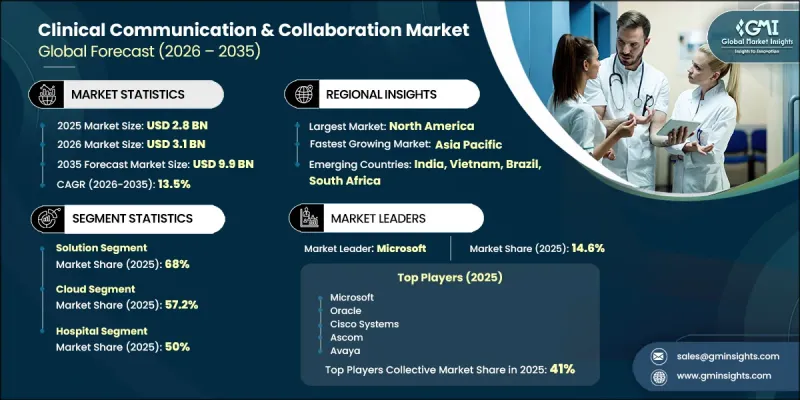
The market is gaining strong momentum as healthcare systems prioritize faster coordination, real-time information exchange, and improved workflow efficiency across clinical environments. Healthcare providers are rapidly replacing outdated communication methods with secure, integrated digital platforms that support seamless collaboration among care teams. Growing emphasis on data security and regulatory compliance is a major growth catalyst, particularly as healthcare organizations adopt HIPAA-compliant communication systems. Government-led healthcare digitalization programs are also accelerating adoption, alongside efforts in multiple regions to strengthen interoperability and expand electronic health record integration.
| Market Scope | |
|---|---|
| Start Year | 2025 |
| Forecast Year | 2026-2035 |
| Start Value | $2.8 Billion |
| Forecast Value | $9.9 Billion |
| CAGR | 13.5% |
Advancements in artificial intelligence and analytics are significantly enhancing clinical communication platforms by enabling smarter workflows and improved decision support. AI-driven alert management systems are helping healthcare professionals reduce notification overload by directing urgent updates to the right personnel based on priority and availability. These capabilities improve response time and reduce delays in patient care delivery. At the same time, the expansion of telehealth services and mobile-enabled healthcare solutions is extending clinical communication beyond traditional hospital environments, increasing accessibility and continuity of care across care settings.
The solution segment accounted for a 68% share in 2025 and is expected to grow at a CAGR of 12.9% through 2035. This segment leads the market due to widespread adoption of secure messaging systems that enable real-time communication, care coordination, and alert management across clinical teams. Hospitals are increasingly implementing integrated communication tools to replace legacy systems and fragmented workflows. Workflow optimization and alarm management solutions witness strong uptake as healthcare facilities aim to reduce clinician workload and improve response accuracy. These platforms are further enhanced by integration with hospital information systems, enabling streamlined escalation and coordinated care delivery across departments.
The cloud-based segment held a 57.2% share in 2025 and is forecast to grow at a CAGR of 15.8% through 2035. Cloud deployment is becoming the preferred model for clinical communication systems due to its scalability, cost efficiency, and ability to support real-time collaboration across distributed healthcare networks. Cloud-native platforms enable seamless messaging, alert distribution, and coordination between care teams while supporting integration with clinical data systems. Healthcare providers are increasingly shifting to cloud-based solutions to reduce infrastructure costs, accelerate deployment cycles, and enable continuous updates. The integration of artificial intelligence and cross-facility communication capabilities further strengthens the adoption of cloud-based systems across modern healthcare ecosystems.
China Clinical Communication & Collaboration Market held a 40% share in 2025, generating USD 258.8 million. Market growth in the country is strongly supported by large-scale healthcare digitalization and rising demand for efficient communication across high-volume hospital environments. Major urban healthcare institutions are increasingly adopting advanced communication systems to enhance coordination between emergency care units, intensive care departments, and specialized treatment teams. Domestic technology providers are also contributing to market expansion by supporting healthcare IT infrastructure and enabling secure data exchange across hospital networks.
Major players operating in the Global Clinical Communication & Collaboration Industry include Cisco Systems, Epic Systems, Imprivata, Microsoft, Oracle, Avaya, Ascom, Spok, PerfectServe, and TigerConnect. Healthcare companies are focusing on strengthening their market position through integration of artificial intelligence and automation into communication platforms to improve workflow efficiency and clinical decision support. They are also investing in cloud-based architectures to ensure scalability, interoperability, and cost efficiency across healthcare networks. Strategic partnerships with hospitals and health systems are helping expand deployment across large care ecosystems. Vendors are enhancing cybersecurity capabilities to meet strict regulatory requirements and build trust among healthcare providers. Continuous product innovation is also a key focus, particularly in developing advanced alert management and real-time messaging features. Additionally, companies are expanding globally through acquisitions and collaborations, while improving interoperability with electronic health record systems to create unified digital healthcare environments.
Table of Contents
Chapter 1 Methodology
- 1.1 Research approach
- 1.2 Quality Commitments
- 1.2.1 GMI AI policy & data integrity commitment
- 1.2.1.1 Source consistency protocol
- 1.2.1 GMI AI policy & data integrity commitment
- 1.3 Research Trail & Confidence Scoring
- 1.3.1 Research Trail Components
- 1.3.2 Scoring Components
- 1.4 Data Collection
- 1.4.1 Partial list of primary sources
- 1.5 Data mining sources
- 1.5.1 Paid sources
- 1.5.1.1 Sources, by region
- 1.5.1 Paid sources
- 1.6 Base estimates and calculations
- 1.6.1 Base year calculation for any one approach
- 1.7 Forecast model
- 1.7.1 Quantified market impact analysis
- 1.7.1.1 Mathematical impact of growth parameters on forecast
- 1.7.1 Quantified market impact analysis
- 1.8 Research transparency addendum
- 1.8.1 Source attribution framework
- 1.8.2 Quality assurance metrics
- 1.8.3 Our commitment to trust
Chapter 2 Executive Summary
- 2.1 Industry 360° synopsis, 2022 - 2035
- 2.2 Key market trends
- 2.2.1 Regional
- 2.2.2 Component
- 2.2.3 Deployment
- 2.2.4 End-use
- 2.3 TAM Analysis, 2026-2035
- 2.4 CXO perspectives: Strategic imperatives
Chapter 3 Industry Insights
- 3.1 Industry ecosystem analysis
- 3.1.1 Supplier landscape
- 3.1.2 Profit margin analysis
- 3.1.3 Cost structure
- 3.1.4 Value addition at each stage
- 3.1.5 Factor affecting the value chain
- 3.1.6 Disruptions
- 3.2 Industry impact forces
- 3.2.1 Growth drivers
- 3.2.1.1 Increased emphasis on enhanced patient care and safety
- 3.2.1.2 Rise in technology advancements
- 3.2.1.3 Rising demand for real-time communication
- 3.2.1.4 Rising demand for secure messaging
- 3.2.2 Industry pitfalls and challenges
- 3.2.2.1 Regulatory compliance complexity
- 3.2.2.2 Lack of standardized communication protocols and interoperability
- 3.2.3 Market opportunities
- 3.2.3.1 Expansion of telehealth and remote patient monitoring
- 3.2.3.2 Growing adoption of cloud-based solutions
- 3.2.3.3 Emergence of AI-driven clinical communication tools
- 3.2.1 Growth drivers
- 3.3 Growth potential analysis
- 3.4 Technology and innovation landscape
- 3.4.1 Current technological trends
- 3.4.2 Emerging technologies
- 3.5 Pricing Analysis (Driven by primary research)
- 3.5.1 Historical Price Trend Analysis
- 3.5.2 Pricing Strategy by Player Type
- 3.6 Regulatory landscape
- 3.6.1 North America
- 3.6.1.1 HIPAA and HITECH Act (Privacy and Security)
- 3.6.1.2 FDA Medical Device Regulation (SaMD - Software as a Medical Device)
- 3.6.1.3 ONC Interoperability and Cures Act Final Rule
- 3.6.1.4 Canada Health Information Acts (PIPEDA and PHIPA)
- 3.6.2 Europe
- 3.6.2.1 EU Medical Device Regulation (MDR)
- 3.6.2.2 GDPR Health Data and Biometric Compliance
- 3.6.2.3 European Health Data Space (EHDS) Interoperability Standards
- 3.6.2.4 Germany Hospital Future Act (KHZG) and DiGA Framework
- 3.6.3 Asia Pacific
- 3.6.3.1 China Personal Information Protection Law (PIPL)
- 3.6.3.2 China Cybersecurity Law (CSL) and Data Security Law (DSL)
- 3.6.3.3 India Digital Information Security in Healthcare Act (DISHA)
- 3.6.3.4 Japan Next-Generation Medical Care Act
- 3.6.3.5 South Korea Personal Information Protection Act (PIPA)
- 3.6.4 Latin America
- 3.6.4.1 Brazil General Personal Data Protection Act (LGPD)
- 3.6.4.2 Mexico Federal Law on Protection of Personal Data (LFPDPPP)
- 3.6.4.3 Argentina Personal Data Protection Act (Law 25.326)
- 3.6.4.4 Regional Health Information Standards and Interoperability (RACSEL)
- 3.6.5 Middle East & Africa
- 3.6.5.1 UAE Federal Law No. 2 of 2019 (Health Data Law)
- 3.6.5.2 Saudi Arabia Data Healthcare Privacy and Governance (SDAIA)
- 3.6.5.3 South Africa Protection of Personal Information Act (POPIA)
- 3.6.1 North America
- 3.7 Porter's analysis
- 3.8 PESTEL analysis
- 3.9 Patent analysis (Driven by primary research)
- 3.10 Cost breakdown analysis
- 3.11 Impact of AI & Generative AI on the Market
- 3.11.1 AI-driven disruption of existing business models
- 3.11.2 Gen AI use cases & adoption roadmap by segment
- 3.11.3 Risks, limitations & regulatory considerations
- 3.12 Sustainability and environmental aspects
- 3.12.1 Sustainable practices
- 3.12.2 Waste reduction strategies
- 3.12.3 Energy efficiency in production
- 3.12.4 Eco-friendly Initiatives
- 3.12.5 Carbon footprint considerations
- 3.13 Forecast assumptions & scenario analysis (Driven by Primary Research)
- 3.13.1 Base Case- Key Macro & Industry Variables Driving CAGR
- 3.13.2 Optimistic Scenarios- Favorable macro and industry tailwinds
- 3.13.3 Pessimistic Scenario - Macroeconomic slowdown or industry headwinds
Chapter 4 Competitive Landscape, 2025
- 4.1 Introduction
- 4.2 Company market share analysis
- 4.2.1 North America
- 4.2.2 Europe
- 4.2.3 Asia Pacific
- 4.2.4 LATAM
- 4.2.5 MEA
- 4.3 Competitive analysis of major market players
- 4.4 Competitive positioning matrix
- 4.5 Key developments
- 4.5.1 Mergers & acquisitions
- 4.5.2 Partnerships & collaborations
- 4.5.3 New Product Launches
- 4.5.4 Expansion Plans and funding
- 4.6 Company tier benchmarking
- 4.6.1 Tier classification criteria & qualifying thresholds
- 4.6.2 Tier positioning matrix by revenue, geography & innovation
Chapter 5 Market Estimates & Forecast, By Component, 2022 - 2035 (USD Mn)
- 5.1 Key trends
- 5.2 Solution
- 5.2.1 Secure Messaging Platform
- 5.2.2 Electronic Health Record (EHR) Systems
- 5.2.3 Telehealth Platform
- 5.2.4 Collaborative Care Platforms
- 5.2.5 Others
- 5.3 Services
- 5.3.1 Professional service
- 5.3.2 Managed service
Chapter 6 Market Estimates & Forecast, By Deployment, 2022 - 2035 (USD Mn)
- 6.1 Key trends
- 6.2 Cloud
- 6.3 On-premise
Chapter 7 Market Estimates & Forecast, By End-use, 2022 - 2035 (USD Mn)
- 7.1 Key trends
- 7.2 Hospital
- 7.2.1 Small Hospitals
- 7.2.2 Medium Hospitals
- 7.2.3 Large Hospitals
- 7.3 Clinical Labs
- 7.4 Physicians
- 7.5 Others
Chapter 8 Market Estimates & Forecast, By Region, 2022 - 2035 (USD Mn)
- 8.1 Key trends
- 8.2 North America
- 8.2.1 US
- 8.2.2 Canada
- 8.3 Europe
- 8.3.1 Germany
- 8.3.2 UK
- 8.3.3 France
- 8.3.4 Italy
- 8.3.5 Spain
- 8.3.6 Russia
- 8.3.7 Norway
- 8.3.8 Netherlands
- 8.3.9 Sweden
- 8.4 Asia Pacific
- 8.4.1 China
- 8.4.2 India
- 8.4.3 Japan
- 8.4.4 Australia
- 8.4.5 South Korea
- 8.4.6 Singapore
- 8.4.7 Thailand
- 8.4.8 Indonesia
- 8.4.9 Vietnam
- 8.5 Latin America
- 8.5.1 Brazil
- 8.5.2 Mexico
- 8.5.3 Argentina
- 8.6 MEA
- 8.6.1 South Africa
- 8.6.2 Saudi Arabia
- 8.6.3 UAE
- 8.6.4 Turkey
Chapter 9 Company Profiles
- 9.1 Global Players
- 9.1.1 Microsoft
- 9.1.2 Oracle
- 9.1.3 Cisco Systems
- 9.1.4 IBM
- 9.1.5 Google Cloud
- 9.1.6 NEC
- 9.1.7 Avaya
- 9.1.8 Ascom
- 9.1.9 Epic Systems
- 9.1.10 TigerConnect
- 9.2 Regional Players
- 9.2.1 PerfectServe
- 9.2.2 Imprivata
- 9.2.3 Pulsara
- 9.2.4 Spok
- 9.2.5 OnPage
- 9.2.6 Medsphere Systems
- 9.2.7 Halo Health Systems (symplr)
- 9.2.8 Vocera Communications (Stryker)
- 9.2.9 Hillrom & Welch Allyn (Baxter)
- 9.2.10 Voalte (Baxter)
- 9.2.11 TNS (AGNITY)
- 9.3 Emerging Players / Disruptors
- 9.3.1 Baidu
- 9.3.2 Huawei Technologies
- 9.3.3 HiRain Technologies
- 9.3.4 Horizon Robotics
- 9.3.5 Joyson Electronics
- 9.3.6 NavInfo
- 9.3.7 Neusoft
- 9.3.8 ThunderSoft
- 9.3.9 Visteon

