PUBLISHER: Global Market Insights Inc. | PRODUCT CODE: 2045814

PUBLISHER: Global Market Insights Inc. | PRODUCT CODE: 2045814
Floor Cleaning Equipment Market Opportunity, Growth Drivers, Industry Trend Analysis, and Forecast 2026 - 2035
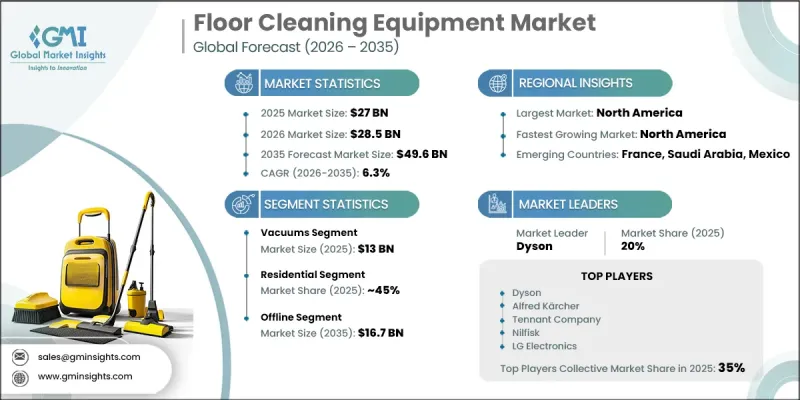
The Global Floor Cleaning Equipment Market was valued at USD 27 billion in 2025 and is estimated to grow at a CAGR of 6.3% to reach USD 49.6 billion by 2035.
Growing attention toward hygiene and sanitation across residential, commercial, and public environments continues to accelerate market expansion. Consumers are placing greater emphasis on maintaining cleaner living and working spaces, leading to increased adoption of advanced floor-cleaning technologies. Businesses are prioritizing sanitation standards to improve workplace safety, operational quality, and customer perception, thereby encouraging the transition from labor-intensive cleaning practices to equipment-based cleaning systems. At the household level, evolving lifestyles, rising health awareness, and the need for cleaner indoor environments are driving demand for efficient and easy-to-use cleaning equipment. Consumers are increasingly investing in modern floor care products that minimize allergens, improve hygiene, and reduce manual effort. This growing preference for automated and high-performance cleaning systems is reshaping cleaning habits worldwide and supporting sustained demand across the floor cleaning equipment industry.
| Market Scope | |
|---|---|
| Start Year | 2025 |
| Forecast Year | 2026-2035 |
| Start Value | $27 Billion |
| Forecast Value | $49.6 Billion |
| CAGR | 6.3% |
The vacuum cleaners segment accounted for USD 13 billion in 2025. These products remain an essential part of routine floor maintenance due to their ability to efficiently eliminate dirt, dust particles, and allergens from multiple flooring surfaces. Compared to conventional cleaning methods, vacuum systems provide stronger particle containment through sealed filtration and suction-based collection mechanisms. Their effectiveness in maintaining cleaner indoor environments has strengthened their position in both residential and commercial applications. The growing preference for convenient, fast, and highly efficient cleaning solutions has further increased the popularity of vacuum cleaners. Their capability to clean hard-to-reach spaces and support improved indoor cleanliness continues to drive widespread product adoption across global markets.
The residential sector held a 45% share in 2025. Rising urbanization levels, higher disposable income, and stronger awareness regarding household cleanliness are major factors supporting segment growth. Consumers are increasingly purchasing floor cleaning equipment such as vacuum cleaners, steam cleaning systems, mops, and compact floor scrubbers to simplify cleaning activities and improve efficiency. Urban housing trends and increasingly busy lifestyles are also encouraging demand for space-saving, lightweight, and multifunctional cleaning products. Technological innovations have significantly transformed the residential cleaning landscape, with cordless operation, lithium-ion battery technology, robotic cleaning systems, and smart navigation capabilities becoming highly attractive among consumers. Robotic vacuum and mop combinations are particularly gaining traction among middle- and upper-income households because they offer automated cleaning convenience and integration with connected home technologies.
North America Floor Cleaning Equipment Market held a 78.5% share, generating USD 6.5 billion in 2025. The country continues to experience strong demand for floor cleaning machinery due to its extensive commercial infrastructure and strict expectations surrounding cleanliness standards. Commercial establishments across multiple industries continue to invest heavily in advanced floor maintenance equipment to maintain hygienic environments and improve operational efficiency. The growing focus on automation, labor optimization, and consistent cleaning performance has accelerated the adoption of technologically advanced floor cleaning systems throughout the U.S. market. The country's strong investment culture in facility maintenance solutions and widespread presence of large-scale commercial spaces continue to reinforce its leadership position within the North American floor cleaning equipment industry.
Key companies operating in the Global Floor Cleaning Equipment Market include Alfred Karcher, Tennant Company, Nilfisk, Dyson, BSH Home Appliances, LG Electronics, and Panasonic. Prominent regional participants include Hako GmbH, Comac S.p.A., Fimap S.p.A., Tacony Corporation, Solenis, RCM S.p.A., and Dulevo Fayat Group. Emerging companies participating in the market include Factory Cat, Minuteman International, Cleanfix AG, Ghibli, Adiatek S.r.l., Haier, and Midea America Corp. Companies operating in the floor cleaning equipment market are actively implementing several growth strategies to strengthen their market position and expand customer reach. Manufacturers are focusing heavily on product innovation by introducing robotic cleaning systems, cordless technologies, energy-efficient machines, and smart-enabled devices with automated navigation capabilities. Many companies are increasing investments in research and development to improve cleaning performance, battery life, and user convenience. Strategic partnerships, mergers, and acquisitions are also being used to broaden product portfolios and strengthen regional distribution networks. In addition, manufacturers are expanding their presence in emerging economies through local partnerships and targeted marketing initiatives.
Table of Contents
Chapter 1 Methodology and Scope
- 1.1 Market scope and definition
- 1.2 Research design
- 1.2.1 Research approach
- 1.2.2 Data collection methods
- 1.3 Data mining sources
- 1.3.1 Global
- 1.3.2 Regional/Country
- 1.4 Base estimates and calculations
- 1.4.1 Base year calculation
- 1.4.2 Key trends for market estimation
- 1.5 Primary research and validation
- 1.5.1 Primary sources
- 1.6 Forecast model
- 1.7 Research assumptions and limitations
Chapter 2 Executive Summary
- 2.1 Industry 360° synopsis
- 2.2 Key market trends
- 2.2.1 Regional
- 2.2.2 Equipment type
- 2.2.3 Technology
- 2.2.4 Application
- 2.2.5 Price
- 2.2.6 Distribution channel
Chapter 3 Industry Insights
- 3.1 Industry ecosystem analysis
- 3.1.1 Supplier landscape
- 3.1.2 Profit margin
- 3.1.3 Value addition at each stage
- 3.1.4 Factor affecting the value chain
- 3.2 Industry impact forces
- 3.2.1 Growth drivers
- 3.2.1.1 Rising focus on hygiene & cleanliness
- 3.2.1.2 Technological advancements
- 3.2.1.3 Shift from manual to mechanized cleaning
- 3.2.2 Industry pitfalls & challenges
- 3.2.2.1 High maintenance & operational costs
- 3.2.2.2 Competition with traditional cleaning methods
- 3.2.3 Opportunities
- 3.2.3.1 Rapid adoption of robotic & automated systems
- 3.2.3.2 Growing demand in healthcare & institutional sectors
- 3.2.1 Growth drivers
- 3.3 Growth potential analysis
- 3.4 Future market trends
- 3.5 Technology and innovation landscape
- 3.5.1 Current technological trends
- 3.5.2 Emerging technologies
- 3.6 Price trends
- 3.6.1 By region
- 3.6.2 By equipment type
- 3.7 Regulatory framework
- 3.7.1 Standards & compliance requirements
- 3.7.2 Regional regulatory frameworks
- 3.7.2.1 North america (osha, epa standards)
- 3.7.2.2 Europe (ce marking, eu directives)
- 3.7.2.3 Asia pacific (regional variations)
- 3.7.2.4 Emerging markets
- 3.7.3 Certification standards (iso, leed, breeam)
- 3.7.4 Environmental & sustainability regulations
- 3.7.5 Safety & ergonomics standards
- 3.8 Pricing analysis
- 3.8.1 Historical price trend analysis (driven by primary research)
- 3.8.2 Pricing strategy by player type (premium / value / cost-plus)
- 3.8.3 Price variation by equipment type
- 3.8.4 Regional price differentials
- 3.8.5 Total cost of ownership (tco) modeling [solution core]
- 3.8.5.1 Upfront capital investment analysis
- 3.8.5.2 Operational & energy costs
- 3.8.5.3 Maintenance & parts replacement costs
- 3.8.5.4 Labor efficiency impact on tco
- 3.8.5.5 5-year tco comparison: manual vs automated vs robotic
- 3.9 Trade data analysis (driven by paid data base) (84798999)
- 3.9.1 Import/export volume & value trends
- 3.9.2 Key trade corridors & tariff impact
- 3.9.3 Trade flow by equipment type
- 3.9.4 Regional trade balance analysis
- 3.10 Impact of AI & generative AI on the market
- 3.10.1 AI-driven disruption of existing business models
- 3.10.2 GenAI use cases & adoption roadmap by segment
- 3.10.2.1 Predictive maintenance & downtime reduction
- 3.10.2.2 Autonomous navigation & route optimization
- 3.10.2.3 Real-time performance monitoring & analytics
- 3.10.2.4 Smart chemical dispensing & resource optimization
- 3.10.3 Risks, limitations & regulatory considerations
- 3.11 Infrastructure & deployment landscape (driven by primary research)
- 3.11.1 Deployment penetration by region & buyer segment
- 3.11.2 Scalability constraints & infrastructure investment trends
Chapter 4 Competitive Landscape, 2025
- 4.1 Introduction
- 4.2 Company market share analysis
- 4.2.1 By region
- 4.2.1.1 North America
- 4.2.1.2 Europe
- 4.2.1.3 Asia Pacific
- 4.2.1.4 Latin America
- 4.2.1.5 Middle East and Africa
- 4.2.1 By region
- 4.3 Company matrix analysis
- 4.4 Competitive analysis of major market players
- 4.5 Competitive positioning matrix
- 4.6 Key developments
- 4.6.1 Mergers & acquisitions
- 4.6.2 Partnerships & collaborations
- 4.6.3 New product launches
- 4.6.4 Expansion plans
Chapter 5 Market Estimates and Forecast, By Equipment Type, 2022 - 2035 (USD Billion) (Thousand Units)
- 5.1 Key trends
- 5.2 Scrubbers
- 5.2.1 Ride-on scrubbers
- 5.2.2 Walk-behind scrubbers
- 5.3 Sweepers
- 5.4 Vacuums
- 5.4.1 Upright vacuums
- 5.4.2 Canister vacuums
- 5.4.3 Backpack vacuums
- 5.4.4 Robotic vacuums
- 5.5 Burnishers
- 5.6 Polishers
- 5.7 Extractors
- 5.8 Others (Floor Dryers)
Chapter 6 Market Estimates and Forecast, By Technology, 2022 - 2035 (USD Billion) (Thousand Units)
- 6.1 Key trends
- 6.2 Manual/traditional
- 6.3 Automated/robotic
- 6.4 IoT-enabled smart equipment
Chapter 7 Market Estimates and Forecast, By Application, 2022 - 2035 (USD Billion) (Thousand Units)
- 7.1 Key trends
- 7.2 Residential
- 7.3 Commercial
- 7.3.1 Hotels & hospitality
- 7.3.2 Offices
- 7.3.3 Others
- 7.4 Industrial
Chapter 8 Market Estimates and Forecast, By Price, 2022 - 2035 (USD Billion) (Thousand Units)
- 8.1 Key trends
- 8.2 Low
- 8.3 Medium
- 8.4 High
Chapter 9 Market Estimates and Forecast, By Distribution Channel, 2022 - 2035 (USD Billion) (Thousand Units)
- 9.1 Key trends
- 9.2 Online
- 9.2.1 E-commerce
- 9.2.2 Brand websites
- 9.3 Offline
- 9.3.1 Supermarkets
- 9.3.2 Specialty stores
- 9.3.3 Others (Departmental stores, etc.)
Chapter 10 Market Estimates and Forecast, By Region, 2022 - 2035 (USD Billion) (Thousand Units)
- 10.1 Key trends
- 10.2 North America
- 10.2.1 U.S.
- 10.2.2 Canada
- 10.3 Europe
- 10.3.1 Germany
- 10.3.2 UK
- 10.3.3 France
- 10.3.4 Italy
- 10.3.5 Spain
- 10.4 Asia Pacific
- 10.4.1 China
- 10.4.2 Japan
- 10.4.3 India
- 10.4.4 Australia
- 10.4.5 South Korea
- 10.5 Latin America
- 10.5.1 Brazil
- 10.5.2 Mexico
- 10.5.3 Argentina
- 10.6 Middle East and Africa
- 10.6.1 South Africa
- 10.6.2 Saudi Arabia
- 10.6.3 UAE
Chapter 11 Company Profiles
- 11.1 Global players
- 11.1.1 Alfred Karcher
- 11.1.2 Tennant Company
- 11.1.3 Nilfisk
- 11.1.4 Dyson
- 11.1.5 BSH Home Appliances
- 11.1.6 LG Electronics
- 11.1.7 Panasonic
- 11.2 Regional players
- 11.2.1 Hako GmbH
- 11.2.2 Comac S.p.A.
- 11.2.3 Fimap S.p.A.
- 11.2.4 Tacony Corporation
- 11.2.5 Solenis
- 11.2.6 RCM S.p.A.
- 11.2.7 Dulevo Fayat Group
- 11.3 Emerging players
- 11.3.1 Factory Cat
- 11.3.2 Minuteman International
- 11.3.3 Cleanfix AG
- 11.3.4 Ghibli
- 11.3.5 Adiatek S.r.l.
- 11.3.6 Haier
- 11.3.7 Midea America Corp.

