
PUBLISHER: Global Market Insights Inc. | PRODUCT CODE: 2045828

PUBLISHER: Global Market Insights Inc. | PRODUCT CODE: 2045828
AI Sensor Market Opportunity, Growth Drivers, Industry Trend Analysis, and Forecast 2026 - 2035
The Global AI Sensor Market was valued at USD 6.8 billion in 2025 and is estimated to grow at a CAGR of 42.2% to reach USD 229.5 billion by 2035.
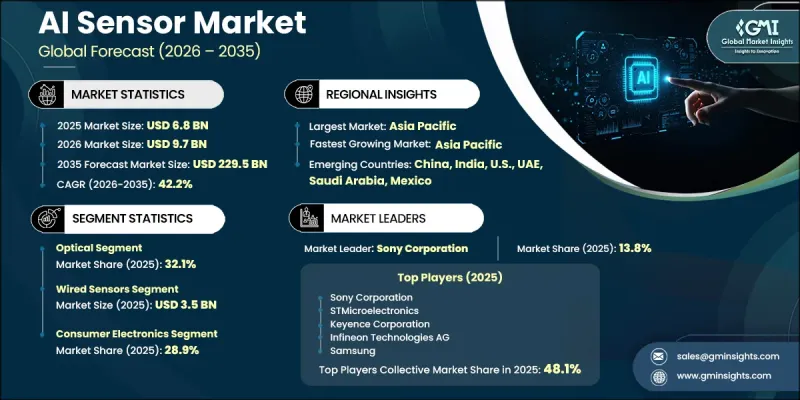
Rapid expansion of the AI sensor industry is fueled by the growing incorporation of intelligent sensing technologies across multiple sectors, including consumer electronics, healthcare, industrial automation, automotive systems, and smart infrastructure. Increasing demand for connected devices capable of processing information with greater speed and efficiency is significantly accelerating market growth. The rising adoption of automation technologies in residential and commercial environments is also contributing to higher deployment of AI-enabled sensors. In addition, the growing dependence on robotics and intelligent monitoring systems is creating strong opportunities for advanced sensing technologies worldwide. AI-powered sensing solutions are increasingly utilized to improve operational accuracy, strengthen system responsiveness, and support real-time data analysis across several end-use industries. Continuous advancements in semiconductor technologies and the increasing shift toward edge computing are further enhancing the performance capabilities of AI sensors, supporting widespread adoption across global markets.
| Market Scope | |
|---|---|
| Start Year | 2025 |
| Forecast Year | 2026-2035 |
| Start Value | $6.8 Billion |
| Forecast Value | $229.5 Billion |
| CAGR | 42.2% |
The AI sensor market continues to gain momentum due to the increasing integration of advanced image, depth, and motion sensing technologies into connected consumer devices. Manufacturers are focusing on incorporating intelligent sensing capabilities directly into devices to improve operational efficiency, data processing speed, and privacy protection. The growing transition toward on-device processing is reducing dependence on cloud-based infrastructure while improving response times and overall system reliability. Market growth is also supported by the rising adoption of smart home and building automation technologies that rely heavily on AI-enabled sensors for environmental monitoring and intelligent system management. AI sensors are increasingly being used to optimize building operations, improve energy efficiency, and support automated control systems based on real-time environmental conditions and occupancy analysis.
Among technology segments, the optical category segment held a 32.1% share in 2025. Strong adoption across industrial automation, consumer electronics, automotive technologies, and surveillance systems contributed significantly to segment leadership. Optical AI sensors are widely preferred for applications requiring advanced visual sensing capabilities, high detection accuracy, and efficient monitoring performance. Ongoing technological improvements, increasing deployment across intelligent systems, and declining component costs continue to support the expansion of the optical segment within the global AI sensor industry.
The wired sensors segment generated USD 3.5 billion in 2025. Growth within this category is largely attributed to the strong reliability, consistent data transfer, and low-latency performance offered by wired AI sensing systems. These sensors are extensively utilized across healthcare facilities, industrial operations, and automotive environments where uninterrupted connectivity and stable performance are essential. Their ability to support continuous high-bandwidth communication and seamless integration with existing infrastructure continues to strengthen the demand for wired AI sensor technologies worldwide.
North America AI Sensor Market accounted for 31.6% share in 2025. Market growth across the region is being supported by the early adoption of advanced intelligent technologies in industries such as healthcare, consumer electronics, automotive manufacturing, and industrial automation. The strong presence of leading technology companies and the increasing commercialization of AI-powered products are accelerating the demand for innovative sensing solutions across North America. In addition, ongoing investments in digital transformation initiatives, smart infrastructure development, and artificial intelligence technologies are further reinforcing regional market expansion.
Major companies operating in the Global AI Sensor Market include ams-OSRAM AG, Analog Devices, Inc., Bosch Sensortec GmbH, Goertek Inc., Infineon Technologies AG, Keyence Corporation, Murata Manufacturing, OMNIVISION, PixArt Imaging Inc., Prophesee, Quanergy Solutions, Inc., Renesas Electronics Corporation, RESONIKS, Samsung, Sensirion AG, SICK AG, Sony Corporation, STMicroelectronics, Teledyne FLIR LLC, and Texas Instruments. Companies participating in the AI Sensor Market are implementing several strategic initiatives to strengthen their market presence and improve competitive positioning. Leading manufacturers are increasing investments in research and development activities to introduce advanced AI-enabled sensing technologies with improved accuracy, speed, and energy efficiency. Many organizations are also focusing on partnerships, acquisitions, and collaborations to expand their technological capabilities and accelerate product innovation. Expansion of manufacturing facilities and supply chain networks is helping companies address rising global demand while improving operational efficiency. Businesses are further emphasizing the integration of edge AI, machine learning, and intelligent processing technologies into sensor platforms to enhance product functionality.
Table of Contents
Chapter 1 Methodology and Scope
- 1.1 Market scope and definition
- 1.2 Research design
- 1.2.1 Research approach
- 1.2.2 Data collection methods
- 1.3 Data mining sources
- 1.3.1 Global
- 1.3.2 Regional/Country
- 1.4 Base estimates and calculations
- 1.4.1 Base year calculation
- 1.4.2 Key trends for market estimation
- 1.5 Primary research and validation
- 1.5.1 Primary sources
- 1.6 Forecast model
- 1.7 Research assumptions and limitations
Chapter 2 Executive Summary
- 2.1 Industry 360° synopsis, 2022 - 2035
- 2.2 Key market trends
- 2.2.1 Sensor type trends
- 2.2.2 Connectivity trends
- 2.2.3 Application trends
- 2.2.4 Regional trends
- 2.3 TAM Analysis, 2026-2035
- 2.4 CXO perspectives: Strategic imperatives
Chapter 3 Industry Insights
- 3.1 Industry ecosystem analysis
- 3.1.1 Supplier Landscape
- 3.1.2 Profit Margin
- 3.1.3 Cost structure
- 3.1.4 Value addition at each stage
- 3.1.5 Factor affecting the value chain
- 3.1.6 Disruptions
- 3.2 Industry impact forces
- 3.2.1 Growth drivers
- 3.2.1.1 Increased integration of intelligent sensing in consumer devices
- 3.2.1.2 Rising deployment of AI-driven sensing in vehicle intelligence systems
- 3.2.1.3 Wider adoption of intelligent automation in residential and commercial buildings
- 3.2.1.4 Growing dependence on AI sensor for robotic awareness and control
- 3.2.1.5 Expanding role of AI sensor in medical and health monitoring applications
- 3.2.2 Industry pitfalls and challenges
- 3.2.2.1 High cost and complexity of AI sensor integration
- 3.2.2.2 Data privacy, security, and regulatory concerns
- 3.2.3 Market opportunities
- 3.2.3.1 Standardization of edge AI sensor platforms and interoperability frameworks
- 3.2.3.2 Expansion of AI sensor in industrial inspection and asset monitoring
- 3.2.1 Growth drivers
- 3.3 Growth potential analysis
- 3.4 Regulatory landscape
- 3.4.1 North America
- 3.4.2 Europe
- 3.4.3 Asia Pacific
- 3.4.4 Latin America
- 3.4.5 Middle East & Africa
- 3.5 Porter's analysis
- 3.6 PESTEL analysis
- 3.7 Technology and Innovation landscape
- 3.7.1 Current technological trends
- 3.7.2 Emerging technologies
- 3.8 Price trends
- 3.8.1 By region
- 3.8.2 By product
- 3.9 Pricing Strategies
- 3.10 Emerging Business Models
- 3.11 Compliance Requirements
- 3.12 Patent and IP analysis
Chapter 4 Competitive Landscape, 2025
- 4.1 Introduction
- 4.2 Company market share analysis
- 4.2.1 By region
- 4.2.1.1 North America
- 4.2.1.2 Europe
- 4.2.1.3 Asia Pacific
- 4.2.1.4 Latin America
- 4.2.1.5 Middle East & Africa
- 4.2.2 Market concentration analysis
- 4.2.1 By region
- 4.3 Competitive benchmarking of key players
- 4.3.1 Financial performance comparison
- 4.3.1.1 Revenue
- 4.3.1.2 Profit margin
- 4.3.1.3 R&D
- 4.3.2 Product portfolio comparison
- 4.3.2.1 Product range breadth
- 4.3.2.2 Technology
- 4.3.2.3 Innovation
- 4.3.3 Geographic presence comparison
- 4.3.3.1 Global footprint analysis
- 4.3.3.2 Service network coverage
- 4.3.3.3 Market penetration by region
- 4.3.4 Competitive positioning matrix
- 4.3.4.1 Leaders
- 4.3.4.2 Challengers
- 4.3.4.3 Followers
- 4.3.4.4 Niche players
- 4.3.5 Strategic outlook matrix
- 4.3.1 Financial performance comparison
- 4.4 Key developments
- 4.4.1 Mergers and acquisitions
- 4.4.2 Partnerships and collaborations
- 4.4.3 Technological advancements
- 4.4.4 Expansion and investment strategies
- 4.4.5 Digital transformation initiatives
- 4.5 Emerging/ startup competitors landscape
Chapter 5 Market Estimates and Forecast, By Sensor Type, 2022 - 2035 (USD Million & Units)
- 5.1 Key trends
- 5.2 Pressure
- 5.3 Temperature
- 5.4 Optical
- 5.5 Position
- 5.6 Ultrasonic
- 5.7 Motion
- 5.8 Navigation
- 5.9 Others
Chapter 6 Market Estimates and Forecast, By Connectivity, 2022 - 2035 (USD Million & Units)
- 6.1 Key trends
- 6.2 Wired sensor
- 6.3 Wireless sensor
- 6.3.1 Wi-Fi
- 6.3.2 Bluetooth
- 6.3.3 Zigbee
- 6.3.4 Others
Chapter 7 Market Estimates and Forecast, By Application, 2022 - 2035 (USD Million & Units)
- 7.1 Key trends
- 7.2 Automotive
- 7.2.1 ADAS & autonomous driving
- 7.2.2 Driver monitoring
- 7.2.3 In-cabin sensing
- 7.2.4 Vehicle navigation & V2X
- 7.2.5 Others
- 7.3 Consumer Electronics
- 7.3.1 Smartphones & tablets
- 7.3.2 Wearables & smartwatches
- 7.3.3 AR/VR headsets
- 7.3.4 Smart cameras
- 7.3.5 Others
- 7.4 Manufacturing / Industrial
- 7.4.1 Factory automation & machine vision
- 7.4.2 Predictive maintenance systems
- 7.4.3 Process monitoring & control sensor
- 7.4.4 Industrial asset tracking
- 7.4.5 Others
- 7.5 Aerospace & Defense
- 7.5.1 Avionics and navigation systems
- 7.5.2 Target detection & tracking
- 7.5.3 Structural health monitoring
- 7.5.4 Unmanned aerial vehicles (UAVs)
- 7.5.5 Others
- 7.6 Smart Home & Building Automation
- 7.6.1 Smart thermostats & HVAC control
- 7.6.2 Voice-controlled assistants
- 7.6.3 Energy monitoring and management systems
- 7.6.4 Others
- 7.7 Healthcare
- 7.7.1 Patient monitoring devices
- 7.7.2 Medical imaging sensor
- 7.7.3 Surgical assistance systems
- 7.7.4 Others
- 7.8 Others
Chapter 8 Market Estimates and Forecast, By Region, 2022 - 2035 (USD Million)
- 8.1 Key trends
- 8.2 North America
- 8.2.1 U.S.
- 8.2.2 Canada
- 8.3 Europe
- 8.3.1 Germany
- 8.3.2 UK
- 8.3.3 France
- 8.3.4 Spain
- 8.3.5 Italy
- 8.3.6 Russia
- 8.4 Asia Pacific
- 8.4.1 China
- 8.4.2 India
- 8.4.3 Japan
- 8.4.4 Australia
- 8.4.5 South Korea
- 8.5 Latin America
- 8.5.1 Brazil
- 8.5.2 Mexico
- 8.5.3 Argentina
- 8.6 Middle East and Africa
- 8.6.1 South Africa
- 8.6.2 Saudi Arabia
- 8.6.3 UAE
Chapter 9 Company Profiles
- 9.1 Global Key Players
- 9.1.1 Sony Corporation
- 9.1.2 STMicroelectronics
- 9.1.3 Keyence Corporation
- 9.1.4 Infineon Technologies AG
- 9.1.5 Samsung
- 9.2 Regional key players
- 9.2.1 North America
- 9.2.1.1 Analog Devices, Inc.
- 9.2.1.2 Texas Instruments
- 9.2.1.3 Teledyne FLIR LLC
- 9.2.2 Asia Pacific
- 9.2.2.1 Goertek Inc.
- 9.2.2.2 Murata Manufacturing
- 9.2.2.3 OMNIVISION
- 9.2.2.4 PixArt Imaging Inc.
- 9.2.2.5 Renesas Electronics Corporation
- 9.2.3 Europe
- 9.2.3.1 ams-OSRAM AG
- 9.2.3.2 Bosch Sensortec GmbH
- 9.2.3.3 Sensirion AG
- 9.2.3.4 SICK AG
- 9.2.1 North America
- 9.3 Niche Players/Disruptors
- 9.3.1 Prophesee
- 9.3.2 Quanergy Solutions, Inc.
- 9.3.3 RESONIKS

