PUBLISHER: Global Market Insights Inc. | PRODUCT CODE: 2045829

PUBLISHER: Global Market Insights Inc. | PRODUCT CODE: 2045829
Hotel Franchise Market Opportunity, Growth Drivers, Industry Trend Analysis, and Forecast 2026 - 2035
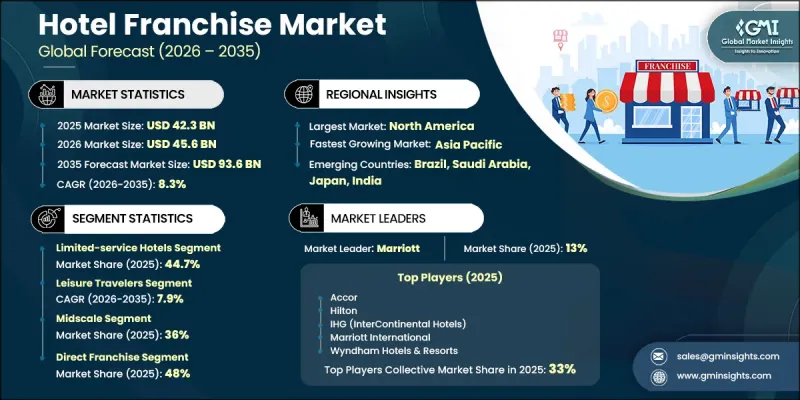
The Global Hotel Franchise Market was valued at USD 42.3 billion in 2025 and is estimated to grow at a CAGR of 8.3% to reach USD 93.6 billion by 2035.
Rising domestic tourism activity and the growing popularity of short leisure travel are creating strong momentum for the hotel franchise industry worldwide. Increasing demand for affordable accommodations among cost-conscious travelers is encouraging rapid expansion of economy and midscale hotel franchise models. At the same time, the steady recovery of business travel and corporate events is contributing significantly to occupancy rates and franchise revenues, particularly across metropolitan and commercial destinations. Hotel operators are increasingly adopting advanced technologies such as AI-enabled revenue management systems and digital guest engagement platforms to improve pricing strategies, customer experiences, and operational efficiency. The market is also witnessing a strong transition toward asset-light business models, where hospitality brands focus more on franchise agreements and management contracts instead of direct property ownership. In addition, sustainability initiatives are becoming a major competitive advantage, with hospitality brands investing heavily in energy-efficient infrastructure, environmentally responsible operations, and green-certified hotel developments to strengthen customer appeal and long-term profitability.
| Market Scope | |
|---|---|
| Start Year | 2025 |
| Forecast Year | 2026-2035 |
| Start Value | $42.3 Billion |
| Forecast Value | $93.6 Billion |
| CAGR | 8.3% |
The limited-service hotels segment accounted for 44.7% share in 2025 and is projected to grow at a CAGR of 8.1% between 2026 and 2035. These hotels primarily focus on offering affordable accommodations with essential amenities and simplified services for travelers seeking short-term stays. Limited-service properties generally provide streamlined room offerings and minimal dining options while avoiding extensive recreational or conference facilities. Their cost-effective business structure and ability to cater to budget-conscious travelers continue to support strong segment expansion across domestic and international markets.
The leisure travelers segment held a 52% share in 2025 and is anticipated to grow at a CAGR of 7.9% through 2035. Leisure travelers continue to play a crucial role in driving demand across tourism destinations, resort locations, and vacation-focused hospitality markets. Families, couples, and solo travelers are increasingly seeking comfortable yet affordable accommodation options that combine convenience with enhanced travel experiences. To strengthen occupancy levels, hotel franchise operators are introducing personalized travel packages, seasonal promotions, loyalty rewards, and experience-focused hospitality services that align with changing consumer expectations for recreational travel and holiday stays.
U.S. Hotel Franchise Market generated USD 14.7 billion in 2025 and is expected to witness a CAGR of 7.3% from 2026 to 2035. The country remains the leading contributor to the North American hotel franchise industry due to its strong concentration of branded hotel properties, consistent domestic tourism activity, and stable corporate travel demand. Expansion opportunities remain particularly strong within the economy, midscale, and select-service hotel categories, while upscale and luxury brands continue focusing on premium urban centers and resort destinations. Additionally, growing demand for extended-stay accommodations, supported by remote working trends and long-duration business assignments, is encouraging hotel franchise operators to prioritize flexible lodging concepts that combine affordability with enhanced guest convenience.
Key companies operating in the Global Hotel Franchise Market include Accor, Hyatt Hotels, Wyndham Hotels & Resorts, Marriott, Hilton, Choice Hotels, H World, InterContinental Hotels (IHG), Best Western Hotels & Resorts, Radisson Hotels, NH Hotel, and Melia Hotels. Companies operating in the hotel franchise market are focusing on multiple growth strategies to strengthen their market presence and competitive positioning. Major hospitality brands are expanding their franchise portfolios across economy, midscale, luxury, and extended-stay categories to target diverse traveler preferences. Companies are increasingly investing in digital transformation, including AI-powered pricing systems, mobile booking platforms, smart room technologies, and personalized customer engagement tools to improve operational efficiency and guest satisfaction. Strategic partnerships, franchise agreements, and global expansion initiatives are helping brands increase their geographical reach and accelerate property development. Sustainability initiatives such as green building certifications, energy-efficient operations, and eco-friendly hospitality solutions are also becoming key priorities.
Table of Contents
Chapter 1 Methodology
- 1.1 Research approach
- 1.2 Quality Commitments
- 1.2.1 GMI AI policy & data integrity commitment
- 1.2.1.1 Source consistency protocol
- 1.2.1 GMI AI policy & data integrity commitment
- 1.3 Research Trail & Confidence Scoring
- 1.3.1 Research Trail Components
- 1.3.2 Scoring Components
- 1.4 Data Collection
- 1.4.1 Partial list of primary sources
- 1.5 Data mining sources
- 1.5.1 Paid sources
- 1.5.1.1 Sources, by region
- 1.5.1 Paid sources
- 1.6 Base estimates and calculations
- 1.6.1 Base year calculation
- 1.7 Forecast model
- 1.7.1 Quantified market impact analysis
- 1.7.1.1 Mathematical impact of growth parameters on forecast
- 1.7.1 Quantified market impact analysis
- 1.8 Research transparency addendum
- 1.8.1 Source attribution framework
- 1.8.2 Quality assurance metrics
- 1.8.3 Our commitment to trust
Chapter 2 Executive Summary
- 2.1 Industry 360° synopsis
- 2.2 Key market trends
- 2.2.1 Regional
- 2.2.2 Property type
- 2.2.3 Customer
- 2.2.4 Chain value
- 2.2.5 Franchise model
- 2.3 TAM analysis, 2026-2035
- 2.4 CXO perspectives: Strategic imperatives
Chapter 3 Industry Insights
- 3.1 Industry ecosystem analysis
- 3.1.1 Supplier landscape
- 3.1.2 Profit margin
- 3.1.3 Cost structure
- 3.1.4 Value addition at each stage
- 3.1.5 Factor affecting the value chain
- 3.1.6 Disruptions
- 3.2 Industry impact forces
- 3.2.1 Growth drivers
- 3.2.1.1 Rising domestic tourism demand
- 3.2.1.2 Growth in budget travel
- 3.2.1.3 Expansion of international hotel brands
- 3.2.1.4 Increasing business travel activities
- 3.2.2 Industry pitfalls and challenges
- 3.2.2.1 Regulatory licensing complexities
- 3.2.2.2 Intense pricing competition
- 3.2.3 Market opportunities
- 3.2.3.1 Growth in secondary cities
- 3.2.3.2 Expansion of lifestyle hotel brands
- 3.2.3.3 Rising digital booking adoption
- 3.2.3.4 Increasing extended-stay demand
- 3.2.1 Growth drivers
- 3.3 Growth potential analysis
- 3.4 Technology and innovation landscape
- 3.4.1 Current technological trends
- 3.4.2 Emerging technologies
- 3.5 Cost breakdown analysis
- 3.6 Regulatory landscape
- 3.6.1 North America
- 3.6.1.1 Federal Trade Commission (FTC)
- 3.6.1.2 U.S. Department of Justice (DOJ) - Antitrust Division
- 3.6.2 Europe
- 3.6.2.1 European Commission (DG GROW)
- 3.6.2.2 European Travel Commission (ETC)
- 3.6.3 Asia Pacific
- 3.6.3.1 Ministry of Culture and Tourism (China) / National Tourism Administration equivalents
- 3.6.3.2 Ministry of Tourism (India)
- 3.6.4 Latin America
- 3.6.4.1 Brazilian Ministry of Tourism (Ministerio do Turismo)
- 3.6.4.2 Secretaria de Turismo (SECTUR - Mexico)
- 3.6.5 Middle East & Africa
- 3.6.5.1 Dubai Department of Economy and Tourism (DET)
- 3.6.5.2 Saudi Ministry of Tourism
- 3.6.1 North America
- 3.7 Porter's analysis
- 3.8 PESTEL analysis
- 3.9 Pricing analysis (Driven by Primary Research)
- 3.9.1 Historical price trend analysis
- 3.9.2 Pricing strategy by player type (premium / value / cost-plus)
- 3.10 Patent analysis (Driven by Primary Research)
- 3.11 Impact of AI & Generative AI on the Market
- 3.11.1 AI-driven disruption of existing business models
- 3.11.2 Gen AI use cases & adoption roadmap by segment
- 3.11.3 Risks, limitations & regulatory considerations
- 3.12 Sustainability and environmental aspects
- 3.12.1 Sustainable practices
- 3.12.2 Waste reduction strategies
- 3.12.3 Energy efficiency in production
- 3.12.4 Eco-friendly initiatives
- 3.12.5 Carbon footprint considerations
- 3.13 Forecast assumptions & scenario analysis (Driven by primary research)
- 3.13.1 Base Case - key macro & industry variables driving CAGR
- 3.13.2 Optimistic Scenarios - Favorable macro and industry tailwinds
- 3.13.3 Pessimistic Scenario - Macroeconomic slowdown or industry headwinds
Chapter 4 Competitive Landscape, 2025
- 4.1 Introduction
- 4.2 Company market share analysis
- 4.2.1 North America
- 4.2.2 Europe
- 4.2.3 Asia Pacific
- 4.2.4 LATAM
- 4.2.5 MEA
- 4.3 Competitive analysis of major market players
- 4.4 Competitive positioning matrix
- 4.5 Key developments
- 4.5.1 Mergers & acquisitions
- 4.5.2 Partnerships & collaborations
- 4.5.3 New product launches
- 4.5.4 Expansion plans and funding
Chapter 5 Market Estimates & Forecast, By Property Type, 2022 - 2035 ($Mn)
- 5.1 Key trends
- 5.2 Full-service hotels
- 5.3 Limited-service hotels
- 5.4 Extended-stay hotels
- 5.5 Select-service hotels
Chapter 6 Market Estimates & Forecast, By Chain Value, 2022 - 2035 ($Mn)
- 6.1 Key trends
- 6.2 Luxury
- 6.3 Upper Upscale
- 6.4 Upscale
- 6.5 Upper Midscale
- 6.6 Midscale
- 6.7 Economy
Chapter 7 Market Estimates & Forecast, By Customer, 2022 - 2035 ($Mn)
- 7.1 Key trends
- 7.2 Business travelers
- 7.3 Leisure travelers
- 7.4 Group/Convention
- 7.5 Extended-stay guests
Chapter 8 Market Estimates & Forecast, By Franchise Model, 2022 - 2035 ($Mn)
- 8.1 Key trends
- 8.2 Direct franchise
- 8.3 Management franchise
- 8.4 Conversion franchise
- 8.5 Master franchise / Area development franchise
Chapter 9 Market Estimates & Forecast, By Region, 2022 - 2035 ($Mn)
- 9.1 Key trends
- 9.2 North America
- 9.2.1 U.S.
- 9.2.2 Canada
- 9.3 Europe
- 9.3.1 Germany
- 9.3.2 UK
- 9.3.3 France
- 9.3.4 Italy
- 9.3.5 Spain
- 9.3.6 Russia
- 9.3.7 Netherlands
- 9.4 Asia Pacific
- 9.4.1 China
- 9.4.2 India
- 9.4.3 Japan
- 9.4.4 South Korea
- 9.4.5 Australia
- 9.4.6 Vietnam
- 9.4.7 Indonesia
- 9.5 Latin America
- 9.5.1 Brazil
- 9.5.2 Mexico
- 9.5.3 Argentina
- 9.6 MEA
- 9.6.1 South Africa
- 9.6.2 Saudi Arabia
- 9.6.3 UAE
Chapter 10 Company Profiles
- 10.1 Global players
- 10.1.1 Accor
- 10.1.2 Choice Hotels
- 10.1.3 Hilton
- 10.1.4 Hyatt Hotels
- 10.1.5 IHG (InterContinental Hotels)
- 10.1.6 Jin Jiang
- 10.1.7 Marriott
- 10.1.8 Wyndham
- 10.2 Regional players
- 10.2.1 Best Western Hotels & Resorts
- 10.2.2 H World (Huazhu)
- 10.2.3 Louvre Hotels
- 10.2.4 Melia Hotels
- 10.2.5 Minor Hotels
- 10.2.6 Radisson Hotel
- 10.2.7 Shangri-La Hotels and Resorts
- 10.2.8 Whitbread (Premier Inn)
- 10.3 Emerging players
- 10.3.1 Banyan Tree
- 10.3.2 Magnuson Hotels
- 10.3.3 OYO Hotels & Homes
- 10.3.4 Sonesta International Hotels

