
PUBLISHER: Global Market Insights Inc. | PRODUCT CODE: 2045837

PUBLISHER: Global Market Insights Inc. | PRODUCT CODE: 2045837
Feed Premixes Market Opportunity, Growth Drivers, Industry Trend Analysis, and Forecast 2026 - 2035
The Global Feed Premixes Market was valued at USD 21.6 billion in 2025 and is estimated to grow at a CAGR of 5.2% to reach USD 36.1 billion by 2035.
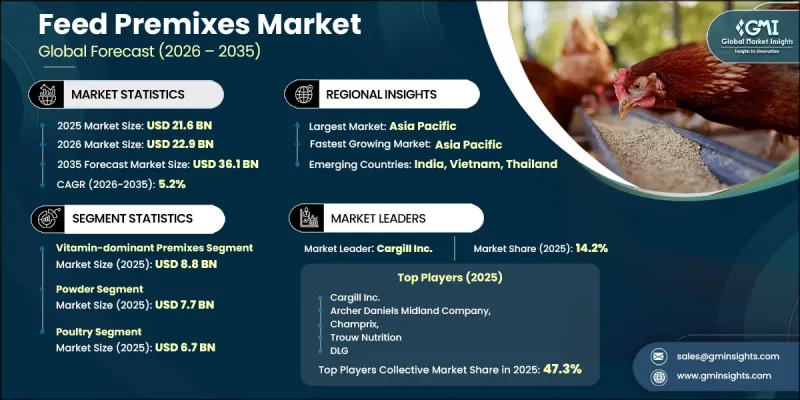
The market is expanding due to the rising emphasis on animal nutrition optimization and improved livestock productivity across global farming systems. Feed premixes are specialized nutritional blends created by combining vitamins, minerals, amino acids, and other essential micronutrients into concentrated formulations designed to enhance feed quality. Their balanced composition supports improved animal health, growth performance, and feed efficiency, making them a critical component in modern livestock nutrition programs. These formulations are widely used across poultry, swine, cattle, and aquaculture industries due to their ability to improve nutrient absorption and overall production efficiency. Feed premixes are also valued for their stability against oxidation, moisture exposure, and environmental degradation, enabling reliable performance in diverse farming conditions ranging from industrial operations to small-scale farms. Growing demand for sustainable livestock production is further driving adoption, as premixes enable precise nutritional control while reducing the use of harmful additives. Continuous technological advancements in microencapsulation, spray drying, and granulation processes are improving nutrient stability, bioavailability, and dosing accuracy. The integration of precision nutrition approaches is further enhancing feed conversion efficiency, disease resistance, and overall livestock productivity across global agricultural systems.
| Market Scope | |
|---|---|
| Start Year | 2025 |
| Forecast Year | 2026-2035 |
| Start Value | $21.6 Billion |
| Forecast Value | $36.1 Billion |
| CAGR | 5.2% |
The vitamin-dominant premixes segment accounted for USD 8.8 billion in 2025 owing to its essential role in supporting metabolic functions and strengthening immunity in livestock. This segment is widely used in poultry and animal health applications where vitamin enrichment is critical for growth performance and disease resistance. Advancements in vitamin stabilization techniques, including microencapsulation, are improving heat resistance and extending product shelf life, which supports broader adoption in feed manufacturing systems.
The powder form segment reached USD 7.7 billion in 2025. This segment leads the market due to its superior mixing uniformity, ease of handling, and cost-effectiveness in large-scale feed production. Powdered premixes are widely preferred in automated feed mill operations because of their free-flowing properties and consistent distribution capabilities. Liquid premixes are also gaining traction as they offer precise dosing and uniform nutrient dispersion, supporting improved formulation stability in compound feed applications.
North America Feed Premixes Market is projected to grow from USD 6.6 billion in 2025 to USD 11.3 billion by 2035. Market growth in the region is driven by rising demand for advanced nutritional solutions in poultry and swine production, along with increasing adoption of precision livestock farming techniques. The expansion of research facilities and the integration of advanced formulation technologies are further supporting industry development. Strong focus on productivity enhancement and efficiency continues to reinforce regional market growth.
Major companies operating in the Global Feed Premixes Market include Archer Daniels Midland Company, Cargill Inc., DSM, De Heus Livestock Nutrition, Kemin Industries, Trouw Nutrition, Glanbia Nutritionals, Corbion, DLG, Champrix, Koudijs, Farbest Brands, and SweesyFeed. Companies in the feed premixes market are adopting multiple strategic initiatives to strengthen their market position and expand global presence. Leading manufacturers are heavily investing in research and development to enhance nutrient formulation efficiency, improve bioavailability, and increase stability under varying environmental conditions. Expansion of production facilities and strengthening of supply chain networks are helping companies meet rising global demand more effectively. Strategic collaborations with livestock producers, feed manufacturers, and agricultural research institutions are supporting innovation in precision nutrition solutions. Many players are also focusing on developing customized premix formulations tailored to specific animal species and growth stages. Integration of advanced processing technologies such as microencapsulation and automated blending systems is further improving product quality and consistency.
Table of Contents
Chapter 1 Methodology & Scope
- 1.1 Market scope and definition
- 1.2 Research design
- 1.2.1 Research approach
- 1.2.2 Data collection methods
- 1.3 Data mining sources
- 1.3.1 Global
- 1.3.2 Regional/Country
- 1.4 Base estimates and calculations
- 1.4.1 Base year calculation
- 1.4.2 Key trends for market estimation
- 1.5 Primary research and validation
- 1.5.1 Primary sources
- 1.6 Forecast model
- 1.7 Research assumptions and limitations
Chapter 2 Executive Summary
- 2.1 Industry 360° synopsis
- 2.2 Key market trends
- 2.2.1 Type
- 2.2.2 Form
- 2.2.3 Livestock
- 2.2.4 Regional
- 2.3 TAM Analysis, 2026-2035
- 2.4 CXO perspectives: Strategic imperatives
Chapter 3 Industry Insights
- 3.1 Industry ecosystem analysis
- 3.1.1 Supplier landscape
- 3.1.2 Profit margin
- 3.1.3 Value addition at each stage
- 3.1.4 Factor affecting the value chain
- 3.1.5 Disruptions
- 3.2 Industry impact forces
- 3.2.1 Growth drivers
- 3.2.2 Industry pitfalls and challenges
- 3.2.3 Market opportunities
- 3.3 Growth potential analysis
- 3.4 Regulatory landscape
- 3.4.1 North America
- 3.4.2 Europe
- 3.4.3 Asia Pacific
- 3.4.4 Latin America
- 3.4.5 Middle East & Africa
- 3.5 Porter's analysis
- 3.6 PESTEL analysis
- 3.7 Price trends
- 3.7.1 By region
- 3.7.2 By type
- 3.8 Future market trends
- 3.9 Technology and Innovation landscape
- 3.9.1 Current technological trends
- 3.9.2 Emerging technologies
- 3.10 Patent Landscape
- 3.11 Trade statistics (HS code)
- 3.11.1 Major importing countries
- 3.11.2 Major exporting countries
- 3.12 Sustainability and environmental aspects
- 3.12.1 Sustainable practices
- 3.12.2 Waste reduction strategies
- 3.12.3 Energy efficiency in production
- 3.12.4 Eco-friendly initiatives
- 3.13 Carbon footprint consideration
Chapter 4 Competitive Landscape, 2025
- 4.1 Introduction
- 4.2 Company market share analysis
- 4.2.1 By region
- 4.2.1.1 North America
- 4.2.1.2 Europe
- 4.2.1.3 Asia Pacific
- 4.2.1.4 LATAM
- 4.2.1.5 MEA
- 4.2.1 By region
- 4.3 Competitive analysis of major market players
- 4.4 Competitive positioning matrix
- 4.5 Key developments
- 4.5.1 Mergers & acquisitions
- 4.5.2 Partnerships & collaborations
- 4.5.3 New Product Launches
- 4.5.4 Expansion Plans
Chapter 5 Market Estimates and Forecast, By Type, 2022-2035 (USD Billion) (Kilo Tons)
- 5.1 Key trends
- 5.2 Vitamin-Dominant Premixes
- 5.3 Mineral-Dominant Premixes
- 5.4 Amino Acid-Dominant Premixes
- 5.5 Multi-Component Premixes
Chapter 6 Market Estimates and Forecast, By Form, 2022-2035 (USD Billion) (Kilo Tons)
- 6.1 Key trends
- 6.2 Powder
- 6.3 Granular
- 6.4 Liquid
- 6.5 Pellet
Chapter 7 Market Estimates and Forecast, By Livestock, 2022-2035 (USD Million) (Kilo Tons)
- 7.1 Key trends
- 7.2 Poultry
- 7.3 Swine
- 7.4 Cattle
- 7.5 Aquaculture
- 7.6 Pet Food
- 7.7 Others
Chapter 8 Market Estimates and Forecast, By Region, 2022-2035 (USD Million) (Kilo Tons)
- 8.1 Key trends
- 8.2 North America
- 8.2.1 U.S.
- 8.2.2 Canada
- 8.3 Europe
- 8.3.1 Germany
- 8.3.2 UK
- 8.3.3 France
- 8.3.4 Spain
- 8.3.5 Italy
- 8.3.6 Rest of Europe
- 8.4 Asia Pacific
- 8.4.1 China
- 8.4.2 India
- 8.4.3 Japan
- 8.4.4 Australia
- 8.4.5 South Korea
- 8.4.6 Rest of Asia Pacific
- 8.5 Latin America
- 8.5.1 Brazil
- 8.5.2 Mexico
- 8.5.3 Argentina
- 8.5.4 Rest of Latin America
- 8.6 Middle East and Africa
- 8.6.1 Saudi Arabia
- 8.6.2 South Africa
- 8.6.3 UAE
- 8.6.4 Rest of Middle East and Africa
Chapter 9 Company Profiles
- 9.1 Cargill Inc.
- 9.2 Archer Daniels Midland Company
- 9.3 Champrix
- 9.4 Trouw Nutrition
- 9.5 DLG
- 9.6 Corbion
- 9.7 Glanbia Nutritionals
- 9.8 Farbest Brands
- 9.9 Sweesyfeed
- 9.10 Koudijs
- 9.11 Kemin Industries
- 9.12 De Heus Animal Nutrition
- 9.13 DSM

