PUBLISHER: Global Market Insights Inc. | PRODUCT CODE: 2045841

PUBLISHER: Global Market Insights Inc. | PRODUCT CODE: 2045841
Atherectomy Devices Market Opportunity, Growth Drivers, Industry Trend Analysis, and Forecast 2026 - 2035
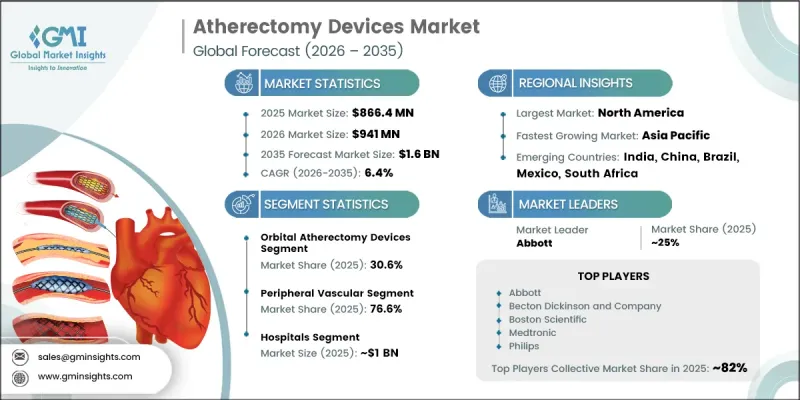
The Global Atherectomy Devices Market was valued at USD 866.4 million in 2025 and is estimated to grow at a CAGR of 6.4% to reach USD 1.6 billion by 2035.
Market expansion is fueled by the increasing incidence of peripheral artery disease and coronary artery disease, along with the rising global elderly population and growing cases of obesity and diabetes. Changing lifestyles, including reduced physical activity and unhealthy dietary patterns, are also contributing to the increasing burden of cardiovascular disorders, thereby strengthening demand for minimally invasive vascular treatment solutions. Atherectomy devices are gaining wider acceptance because they support effective plaque removal while minimizing the need for invasive surgical procedures. Continuous technological advancements in interventional cardiology, combined with increasing physician preference for precision-based vascular treatments, are further supporting product adoption. In addition, healthcare providers are increasingly focusing on patient-centered procedures that reduce hospital stays and recovery time. Rising clinical evidence validating the safety and performance of advanced atherectomy systems, along with a growing number of product approvals, continues to reinforce the positive outlook for the global atherectomy devices industry.
| Market Scope | |
|---|---|
| Start Year | 2025 |
| Forecast Year | 2026-2035 |
| Start Value | $866.4 Million |
| Forecast Value | $1.6 Billion |
| CAGR | 6.4% |
Atherectomy devices are specialized medical instruments designed to eliminate plaque accumulation from arteries and restore healthy blood circulation in patients diagnosed with vascular disorders. These systems operate through several advanced mechanisms, including sanding, shaving, cutting, and laser-based plaque removal technologies, allowing physicians to address blocked vessels without open surgery. Growing preference for minimally invasive cardiovascular interventions is accelerating demand for these devices across hospitals and specialty care facilities. Increasing investments in healthcare infrastructure and innovation in catheter-based technologies are also encouraging broader adoption. Furthermore, healthcare systems are prioritizing early diagnosis and timely treatment of vascular diseases, which is expected to create long-term growth opportunities for the atherectomy devices market. Enhanced procedural efficiency, reduced patient complications, and improved treatment outcomes continue to position atherectomy solutions as a critical component of modern cardiovascular care.
The orbital atherectomy devices segment accounted for a share of 30.6% in 2025 and is anticipated to reach USD 495.8 million by 2035, expanding at a CAGR of 6.3% over the forecast period. Strong growth within this category is largely linked to the ability of orbital atherectomy systems to deliver controlled and uniform plaque modification, particularly in complex calcified lesions. These devices utilize advanced rotating crown technology that carefully sands hardened plaque while preserving the surrounding arterial structure, making them highly effective in both coronary and peripheral vascular procedures. Increasing preference among clinicians for precision-driven plaque removal techniques is further supporting segment growth. Technological improvements in device flexibility, navigation accuracy, and procedural safety are also encouraging adoption across healthcare facilities.
The peripheral vascular segment captured a share of 76.6% in 2025, maintaining its leading position within the atherectomy devices market. The growing global burden of peripheral artery disease continues to create significant demand for effective vessel preparation and plaque management technologies. Increasing rates of smoking, diabetes, obesity, and aging-related vascular complications are contributing to the rising prevalence of PAD, thereby supporting market expansion. Atherectomy procedures are becoming increasingly important in peripheral vascular treatments due to their ability to improve blood flow and reduce the severity of arterial blockages. Physicians are also favoring these devices because they offer minimally invasive treatment options with shorter recovery periods and improved patient outcomes.
North America Atherectomy Devices Market held a share of 58.8% in 2025. The region continues to experience strong demand for advanced cardiovascular treatment technologies, particularly in the United States, where cases of peripheral artery disease and coronary artery disease remain high. The increasing prevalence of obesity, diabetes, and sedentary lifestyles has contributed to the growing patient population requiring vascular interventions. The region benefits from a highly developed healthcare infrastructure, strong reimbursement systems, and rapid adoption of innovative medical technologies. Healthcare providers across North America are increasingly utilizing minimally invasive procedures to improve treatment efficiency and patient recovery outcomes. In addition, growing investments in cardiovascular research, expanding access to advanced interventional care, and rising awareness regarding vascular disease management continue to reinforce regional market growth.
Key companies operating in the Global Atherectomy Devices Market include Abbott, Medtronic, Boston Scientific, Philips, Becton Dickinson and Company, AVINGER, MicroPort, Nipro, Angiodynamics, Ra Medical Systems, Rex Medical, and Cardio Flow. These companies are actively focusing on product innovation, strategic partnerships, and expansion of their cardiovascular treatment portfolios to strengthen their market presence and improve competitive positioning within the global atherectomy devices industry. Companies operating in the atherectomy devices market are increasingly adopting strategic initiatives focused on innovation, geographic expansion, and portfolio diversification to strengthen their competitive position. Major industry participants are investing heavily in research and development activities to introduce technologically advanced devices with improved precision, safety, and procedural efficiency. Partnerships with hospitals, cardiovascular centers, and healthcare providers are helping companies expand product accessibility and improve physician adoption rates. Many manufacturers are also focusing on regulatory approvals and clinical trials to validate product performance and accelerate commercialization opportunities. In addition, businesses are expanding their distribution networks across emerging economies to capture growing demand for minimally invasive vascular treatments.
Table of Contents
Chapter 1 Research Methodology
- 1.1 Research approach
- 1.2 Quality commitments
- 1.2.1 GMI AI policy & data integrity commitment
- 1.2.1.1 Source consistency protocol
- 1.2.1 GMI AI policy & data integrity commitment
- 1.3 Research trail & confidence scoring
- 1.3.1 Research trail components
- 1.3.2 Scoring components
- 1.4 Data collection
- 1.4.1 Partial list of primary sources
- 1.5 Data mining sources
- 1.5.1 Paid sources
- 1.5.1.1 Sources, by region
- 1.5.1 Paid sources
- 1.6 Base estimates and calculations
- 1.6.1 Base year calculation for any one approach
- 1.7 Forecast model
- 1.7.1 Quantified market impact analysis
- 1.7.1.1 Mathematical impact of growth parameters on forecast
- 1.7.1 Quantified market impact analysis
- 1.8 Research transparency addendum
- 1.8.1 Source attribution framework
- 1.8.2 Quality assurance metrics
- 1.8.3 Our commitment to trust
Chapter 2 Executive Summary
- 2.1 Industry 3600 synopsis
- 2.2 Key market trends
- 2.2.1 Regional trends
- 2.2.2 Product trends
- 2.2.3 Application trends
- 2.2.4 End use trends
- 2.3 CXO perspectives: Strategic imperatives
Chapter 3 Industry Insights
- 3.1 Industry ecosystem analysis
- 3.2 Industry impact forces
- 3.2.1 Growth drivers
- 3.2.1.1 Increase in preference for minimally invasive procedures
- 3.2.1.2 Growing target patient population
- 3.2.1.3 Technological advancements in atherectomy devices
- 3.2.1.4 Rising prevalence of peripheral arterial diseases (PAD)
- 3.2.2 Industry pitfalls and challenges
- 3.2.2.1 High cost of devices and associated procedures
- 3.2.2.2 Steep learning curve and operator dependency
- 3.2.3 Market opportunities
- 3.2.3.1 Geographic expansion in emerging markets
- 3.2.1 Growth drivers
- 3.3 Growth potential analysis
- 3.4 Regulatory landscape (Driven by primary research)
- 3.4.1 North America
- 3.4.2 Europe
- 3.4.3 Asia Pacific
- 3.4.4 Latin America
- 3.4.5 MEA
- 3.5 Technology landscape
- 3.5.1 Current technological trends
- 3.5.2 Emerging technologies
- 3.6 Pricing analysis (Driven by primary research)
- 3.7 Future market trends
- 3.8 Porter's analysis
- 3.9 PESTEL analysis
- 3.10 Impact of AI and Generative AI on the market (Driven by primary research)
- 3.11 Value chain analysis
- 3.12 Customer insights (Driven by primary research)
- 3.13 Start-up scenarios
- 3.14 Investment & funding analysis (Driven by primary research)
Chapter 4 Competitive Landscape, 2025
- 4.1 Introduction
- 4.2 Company matrix analysis
- 4.3 Company market share analysis (Driven by primary research)
- 4.3.1 Global
- 4.3.2 North America
- 4.3.3 Europe
- 4.3.4 Asia Pacific
- 4.4 Competitive positioning matrix
- 4.5 Competitive analysis of major market players
- 4.6 Key developments
- 4.6.1 Mergers & acquisitions
- 4.6.2 Partnerships & collaborations
- 4.6.3 New product launches
- 4.6.4 Expansion plans
Chapter 5 Market Estimates and Forecast, By Products, 2022 - 2035 ($ Mn)
- 5.1 Key trends
- 5.2 Orbital atherectomy devices
- 5.3 Laser atherectomy devices
- 5.4 Directional atherectomy devices
- 5.5 Rotational atherectomy devices
Chapter 6 Market Estimates and Forecast, By Application, 2022 - 2035 ($ Mn)
- 6.1 Key trends
- 6.2 Peripheral vascular applications
- 6.3 Coronary applications
Chapter 7 Market Estimates and Forecast, By End Use, 2022 - 2035 ($ Mn)
- 7.1 Key trends
- 7.2 Hospitals
- 7.3 Ambulatory surgical centers
- 7.4 Other end users
Chapter 8 Market Estimates and Forecast, By Region, 2022 - 2035 ($ Mn)
- 8.1 Key trends
- 8.2 North America
- 8.2.1 U.S.
- 8.2.2 Canada
- 8.3 Europe
- 8.3.1 Germany
- 8.3.2 UK
- 8.3.3 France
- 8.3.4 Spain
- 8.3.5 Italy
- 8.3.6 Netherlands
- 8.4 Asia Pacific
- 8.4.1 China
- 8.4.2 Japan
- 8.4.3 India
- 8.4.4 Australia
- 8.4.5 South Korea
- 8.5 Latin America
- 8.5.1 Brazil
- 8.5.2 Mexico
- 8.5.3 Argentina
- 8.6 Middle East and Africa
- 8.6.1 South Africa
- 8.6.2 Saudi Arabia
- 8.6.3 UAE
Chapter 9 Company Profiles
- 9.1 Abbott
- 9.2 angiodynamics
- 9.3 AVINGER
- 9.4 Becton Dickinson and Company
- 9.5 Boston Scientific
- 9.6 Cardio Flow
- 9.7 Medtronic
- 9.8 MicroPort
- 9.9 Nipro
- 9.10 Philips
- 9.11 Ra Medical Systems
- 9.12 Rex Medical

