PUBLISHER: Global Market Insights Inc. | PRODUCT CODE: 2045842

PUBLISHER: Global Market Insights Inc. | PRODUCT CODE: 2045842
Optical Switches Market Opportunity, Growth Drivers, Industry Trend Analysis, and Forecast 2026 - 2035
The Global Optical Switches Market was valued at USD 7.6 billion in 2025 and is estimated to grow at a CAGR of 12.6% to reach USD 24.5 billion by 2035.
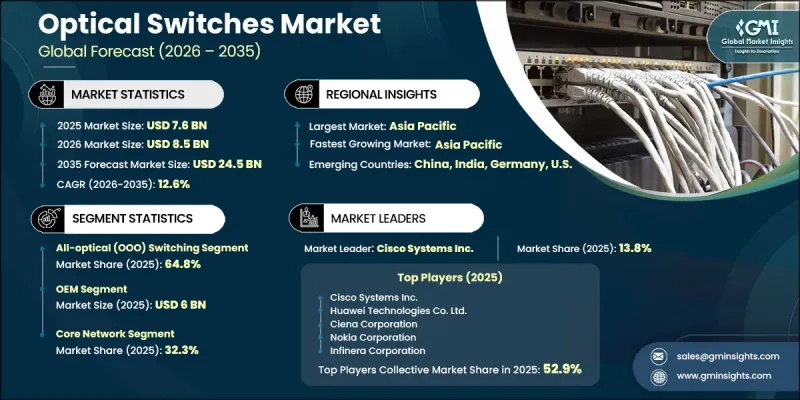
The market is experiencing substantial growth due to the increasing volume of internal data traffic across hyperscale facilities, rising deployment of high-capacity fiber optic infrastructure, and the ongoing transition toward software-defined and flexible networking architectures. Growing demand for faster data transmission, reduced latency, and improved network scalability is encouraging telecom operators and data center providers to adopt advanced optical switching technologies. The rapid rise in AI-driven computing, cloud-based services, and large-scale digital workloads is significantly increasing data movement within network environments, accelerating the need for efficient bandwidth management solutions. In addition, the industry is increasingly prioritizing energy-efficient networking systems, which is driving the shift from conventional electronic switching technologies toward optical alternatives. Optical switches are gaining strong traction due to their ability to support high-speed communication while reducing power consumption and improving network performance. Expanding investments in next-generation telecom infrastructure and advanced data center networking systems are further contributing to the continued growth of the global optical switches market.
| Market Scope | |
|---|---|
| Start Year | 2025 |
| Forecast Year | 2026-2035 |
| Start Value | $7.6 Billion |
| Forecast Value | $24.5 Billion |
| CAGR | 12.6% |
The optical switches industry is witnessing rising demand as hyperscale data centers continue to experience significant growth in internal traffic generated by cloud computing, artificial intelligence, and advanced processing applications. Increasing east-west data transfer requirements are encouraging operators to deploy optical switching systems capable of supporting high bandwidth capacity while maintaining low latency and scalable network performance. The market is also benefiting from the rapid migration toward high-speed optical interconnect technologies across metro and data center networks. As communication infrastructure evolves to accommodate higher line rates and increasing traffic volumes, network providers are modernizing optical systems to improve operational efficiency and support future connectivity requirements.
The all-optical switching segment accounted for 64.8% share in 2025, driven by its capability to enable ultra-fast data transmission without requiring optical-electrical-optical conversion processes. This technology is increasingly utilized in hyperscale data centers and long-distance communication networks due to its ability to support growing bandwidth demands while minimizing latency and power usage. Its efficiency and scalability continue to strengthen adoption across high-capacity optical communication infrastructure.
The core network segment held a 32.3% share in 2025. Strong deployment of high-capacity optical switching technologies across backbone and long-haul network infrastructure continues to drive segment growth. Core network systems require ultra-low latency communication, stable bandwidth performance, and efficient traffic handling capabilities, making advanced optical switches essential for supporting large-scale national and international data transmission networks.
North America Optical Switches Market accounted for 37.4% share in 2025. Market expansion across the region is being supported by rapid growth in hyperscale data centers, cloud computing infrastructure, and AI-driven networking systems, particularly across the United States and Canada. Major technology companies are continuously expanding interconnected data center environments, increasing the need for optical switching technologies capable of managing high-bandwidth, low-latency traffic between facilities. Rising investments from both government and private organizations in broadband development, fiber optic infrastructure, and advanced networking technologies are further strengthening market growth throughout North America.
Leading companies operating in the Global Optical Switches Market include Lumentum Holdings Inc., II-VI Incorporated (Coherent), Molex LLC (Koch Industries), Cisco Systems Inc., Ciena Corporation, Infinera Corporation, Nokia Corporation, NTT Advanced Technology Corporation, ADVA Optical Networking (Adtran), Fujitsu Optical Components, Huawei Technologies Co. Ltd., ZTE Corporation, HUBER+SUHNER Polatis, Thorlabs Inc., Sercalo Microtechnology Ltd., GLSUN Technologies, DiCon Fiberoptics Inc., and Agiltron Inc. Companies operating in the optical switches market are focusing on multiple strategic initiatives to strengthen their market position and expand technological capabilities. Leading players are investing heavily in research and development to improve switching speed, bandwidth capacity, and energy efficiency across optical networking solutions. Strategic collaborations with telecom operators, cloud service providers, and hyperscale data center companies are helping businesses accelerate product deployment and strengthen long-term customer relationships. Companies are also expanding manufacturing capabilities and enhancing supply chain operations to support rising global demand for advanced optical communication infrastructure.
Table of Contents
Chapter 1 Methodology and Scope
- 1.1 Market scope and definition
- 1.2 Research design
- 1.2.1 Research approach
- 1.2.2 Data collection methods
- 1.3 Data mining sources
- 1.3.1 Global
- 1.3.2 Regional/Country
- 1.4 Base estimates and calculations
- 1.4.1 Base year calculation
- 1.4.2 Key trends for market estimation
- 1.5 Primary research and validation
- 1.5.1 Primary sources
- 1.6 Forecast model
- 1.7 Research assumptions and limitations
Chapter 2 Executive Summary
- 2.1 Industry 360° synopsis, 2022 - 2035
- 2.2 Key market trends
- 2.2.1 Switches type trends
- 2.2.2 Switching mechanism trends
- 2.2.3 Network layer trends
- 2.2.4 Enterprise size trends
- 2.2.5 End-Use industry trends
- 2.2.6 Sales channel trends
- 2.2.7 Regional trends
- 2.3 TAM Analysis, 2026-2035
- 2.4 CXO perspectives: Strategic imperatives
Chapter 3 Industry Insights
- 3.1 Industry ecosystem analysis
- 3.1.1 Supplier Landscape
- 3.1.2 Profit Margin
- 3.1.3 Cost structure
- 3.1.4 Value addition at each stage
- 3.1.5 Factor affecting the value chain
- 3.1.6 Disruptions
- 3.2 Industry impact forces
- 3.2.1 Growth drivers
- 3.2.1.1 Hyperscale data center traffic switching requirements
- 3.2.1.2 Migration to high-speed optical interconnects (100G/400G/800G)
- 3.2.1.3 Optical layer reconfiguration in 5G and fiber-rich telecom networks
- 3.2.1.4 Adoption of software-defined and disaggregated optical networks
- 3.2.1.5 Shift toward power-efficient and low-latency network architectures
- 3.2.2 Industry pitfalls and challenges
- 3.2.2.1 High capital cost and complex integration of optical switches
- 3.2.2.2 Interoperability and standardization challenges across multi-vendor networks
- 3.2.3 Market opportunities
- 3.2.3.1 Adoption of optical Switching in AI cluster and high-performance computing interconnects
- 3.2.3.2 Expansion of optical switching in disaster-resilient and mission-critical networks
- 3.2.1 Growth drivers
- 3.3 Growth potential analysis
- 3.4 Regulatory landscape
- 3.4.1 North America
- 3.4.2 Europe
- 3.4.3 Asia Pacific
- 3.4.4 Latin America
- 3.4.5 Middle East & Africa
- 3.5 Porter's analysis
- 3.6 PESTEL analysis
- 3.7 Technology and Innovation landscape
- 3.7.1 Current technological trends
- 3.7.2 Emerging technologies
- 3.8 Price trends
- 3.8.1 By region
- 3.8.2 By product
- 3.9 Pricing Strategies
- 3.10 Emerging Business Models
- 3.11 Compliance Requirements
- 3.12 Patent and IP analysis
Chapter 4 Competitive Landscape, 2025
- 4.1 Introduction
- 4.2 Company market share analysis
- 4.2.1 By region
- 4.2.1.1 North America
- 4.2.1.2 Europe
- 4.2.1.3 Asia Pacific
- 4.2.1.4 Latin America
- 4.2.1.5 Middle East & Africa
- 4.2.2 Market concentration analysis
- 4.2.1 By region
- 4.3 Competitive benchmarking of key players
- 4.3.1 Financial performance comparison
- 4.3.1.1 Revenue
- 4.3.1.2 Profit margin
- 4.3.1.3 R&D
- 4.3.2 Product portfolio comparison
- 4.3.2.1 Product range breadth
- 4.3.2.2 Technology
- 4.3.2.3 Innovation
- 4.3.3 Geographic presence comparison
- 4.3.3.1 Global footprint analysis
- 4.3.3.2 Service network coverage
- 4.3.3.3 Market penetration by region
- 4.3.4 Competitive positioning matrix
- 4.3.4.1 Leaders
- 4.3.4.2 Challengers
- 4.3.4.3 Followers
- 4.3.4.4 Niche players
- 4.3.5 Strategic outlook matrix
- 4.3.1 Financial performance comparison
- 4.4 Key developments
- 4.4.1 Mergers and acquisitions
- 4.4.2 Partnerships and collaborations
- 4.4.3 Technological advancements
- 4.4.4 Expansion and investment strategies
- 4.4.5 Digital transformation initiatives
- 4.5 Emerging/ startup competitors landscape
Chapter 5 Market Estimates and Forecast, By Switches Type, 2022 - 2035 (USD Million)
- 5.1 Key trends
- 5.2 MEMS-based switches
- 5.2.1 2D MEMS
- 5.2.2 3D MEMS
- 5.3 Electro-optic switches
- 5.3.1 Lithium niobate (LiNbO3) based
- 5.3.2 Semiconductor-based (InP, GaAs)
- 5.4 Thermo-optic switches
- 5.5 Liquid crystal switches
- 5.6 Acousto-optic switches
- 5.7 Magneto-optic switches
- 5.8 Silicon photonics-based switches
- 5.9 Others
Chapter 6 Market Estimates and Forecast, By Switching Mechanism, 2022 - 2035 (USD Million)
- 6.1 Key trends
- 6.2 All-optical (OOO) switching
- 6.3 Opto-electronic (OEO) switching
Chapter 7 Market Estimates and Forecast, By Network Layer, 2022 - 2035 (USD Million)
- 7.1 Key trends
- 7.2 Core network
- 7.2.1 Long-haul backbone
- 7.2.2 Inter-regional core
- 7.3 Metro/aggregation network
- 7.4 Access network
- 7.5 Data center networks
- 7.6 others
Chapter 8 Market Estimates and Forecast, By Enterprise Size, 2022 - 2035 (USD Million)
- 8.1 Key trends
- 8.2 Large enterprises
- 8.3 Small & medium enterprises (SMEs)
Chapter 9 Market Estimates and Forecast, By End-Use Industry, 2022 - 2035 (USD Million)
- 9.1 Key trends
- 9.2 Telecommunications
- 9.2.1 Carriers & service providers
- 9.2.2 Internet service providers (ISPs)
- 9.3 Data centers & cloud providers
- 9.3.1 Hyperscale data centers
- 9.3.2 Colocation & enterprise data centers
- 9.4 IT & networking
- 9.5 BFSI
- 9.6 Defense & aerospace
- 9.7 Healthcare & medical systems
- 9.8 Industrial & manufacturing
- 9.9 Retail
- 9.10 Others
Chapter 10 Market Estimates and Forecast, By Sales Channel, 2022 - 2035 (USD Million)
- 10.1 Key trends
- 10.2 OEM
- 10.3 Aftermarket
Chapter 11 Market Estimates and Forecast, By Region, 2022 - 2035 (USD Million)
- 11.1 Key trends
- 11.2 North America
- 11.2.1 U.S.
- 11.2.2 Canada
- 11.3 Europe
- 11.3.1 Germany
- 11.3.2 UK
- 11.3.3 France
- 11.3.4 Spain
- 11.3.5 Italy
- 11.3.6 Russia
- 11.4 Asia Pacific
- 11.4.1 China
- 11.4.2 India
- 11.4.3 Japan
- 11.4.4 Australia
- 11.4.5 South Korea
- 11.5 Latin America
- 11.5.1 Brazil
- 11.5.2 Mexico
- 11.5.3 Argentina
- 11.6 Middle East and Africa
- 11.6.1 South Africa
- 11.6.2 Saudi Arabia
- 11.6.3 UAE
Chapter 12 Company Profiles
- 12.1 Global Key Players
- 12.1.1 Cisco Systems Inc.
- 12.1.2 Huawei Technologies Co. Ltd.
- 12.1.3 Ciena Corporation
- 12.1.4 Nokia Corporation
- 12.1.5 Infinera Corporation
- 12.2 Regional key players
- 12.2.1 North America
- 12.2.1.1 Lumentum Holdings Inc.
- 12.2.1.2 Molex LLC (Koch Industries)
- 12.2.1.3 Thorlabs Inc.
- 12.2.1.4 DiCon Fiberoptics Inc.
- 12.2.1.5 Agiltron Inc.
- 12.2.2 Asia Pacific
- 12.2.2.1 NTT Advanced Technology Corporation
- 12.2.2.2 Fujitsu Optical Components
- 12.2.2.3 ZTE Corporation
- 12.2.2.4 GLSUN Technologies
- 12.2.3 Europe
- 12.2.3.1 II-VI Incorporated (Coherent)
- 12.2.3.2 ADVA Optical Networking (Adtran)
- 12.2.3.3 HUBER+SUHNER Polatis
- 12.2.3.4 Sercalo Microtechnology Ltd.
- 12.2.1 North America

