PUBLISHER: Global Market Insights Inc. | PRODUCT CODE: 2045843

PUBLISHER: Global Market Insights Inc. | PRODUCT CODE: 2045843
Cricket Equipment Market Opportunity, Growth Drivers, Industry Trend Analysis, and Forecast 2026 - 2035
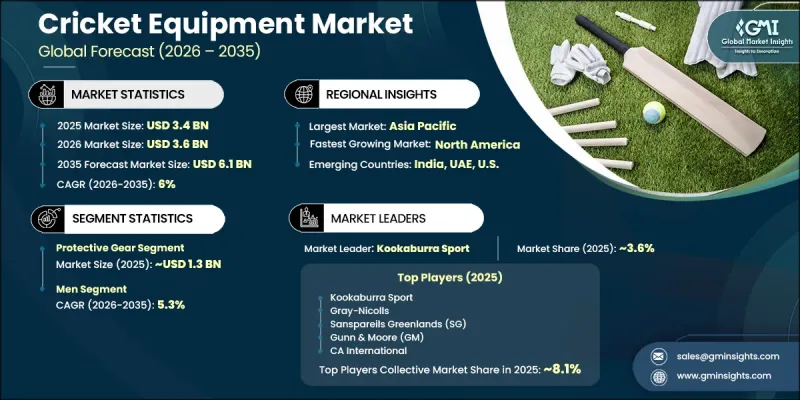
The Global Cricket Equipment Market was valued at USD 3.4 billion in 2025 and is estimated to grow at a CAGR of 6% to reach USD 6.1 billion by 2035.
Market expansion is driven by the rising global popularity of cricket and increasing participation across professional, amateur, and grassroots levels. The growing number of international leagues, school sports programs, and structured training academies is steadily boosting demand for bats, balls, protective gear, stumps, and training accessories. Rising investments in sports infrastructure and increasing consumer expenditure on advanced sporting goods are further strengthening market growth worldwide. Expansion of franchise-based tournaments and rising media exposure are also contributing to stronger engagement across all age groups. At the same time, manufacturers are focusing on product innovation through lightweight materials, enhanced durability, and improved impact protection technologies. Ergonomic design improvements are also helping athletes achieve better comfort and performance. Growing participation among youth and women is widening the consumer base, while the expansion of e-commerce platforms and branded retail networks is improving product accessibility across developed and emerging markets.
| Market Scope | |
|---|---|
| Start Year | 2025 |
| Forecast Year | 2026-2035 |
| Start Value | $3.4 Billion |
| Forecast Value | $6.1 Billion |
| CAGR | 6% |
The protective gear segment accounted for USD 1.3 billion in 2025 and is projected to grow at a CAGR of 6.2% from 2026 to 2035. This segment leads the market due to increasing emphasis on player safety across professional leagues, domestic tournaments, and recreational cricket activities. Equipment such as helmets, gloves, batting pads, and abdominal protection gear is widely adopted to reduce injury risks during high-intensity play. Strengthened safety regulations introduced by sports governing bodies and cricket organizations are further supporting consistent demand for protective equipment globally.
The men's segment held 66.2% share in 2025 and is expected to grow at a CAGR of 5.3% through 2035. This dominance is attributed to high participation levels in professional leagues, club-level competitions, and recreational cricket across major cricket-playing nations. The segment benefits from strong engagement in competitive sports activities and increasing participation among working-age populations. Rising investments in domestic tournaments, along with the growing popularity of franchise-based leagues, continue to support steady demand for bats, balls, protective gear, and training equipment.
India Cricket Equipment Market reached USD 1.5 billion in 2025 and is projected to grow at a CAGR of 5.3% from 2026 to 2035. The country's dominance is driven by its strong cricketing culture, extensive participation across all playing levels, and continuous expansion of domestic leagues. Increasing investments in training academies, school-level competitions, and grassroots development programs are driving strong demand for bats, protective gear, balls, and training equipment across urban and semi-urban regions. The growing popularity of franchise tournaments and rising digital and broadcast coverage are further supporting market growth. Manufacturers are increasingly focusing on premium-grade bats, lightweight protective gear, and cost-effective entry-level products to cater to a wide range of consumers.
Major players operating in the Global Cricket Equipment Industry include Gunn & Moore Limited, Gray-Nicolls, Kookaburra Sport Pty Ltd, Newbery Cricket, Ihsan Sports, CA International, Stanford Cricket Industries, Sareen Sports Industries (SS), Sanspareils Greenlands (SG), Delux Sports Company (DSC), Madras Rubber Factory (MRF), BAS Vampire (Beat All Sports), Salix Cricket Bats, RNS Larsons, Masuri, Spartan Sports International, Millichamp & Hall (M&H), DKP Cricket, Shrinika Sports, Koxtons Sports Equipments Pvt. Ltd., and TON Cricket. Companies in the cricket equipment market are focusing on continuous product innovation to enhance performance, durability, and player safety. Manufacturers are increasingly investing in advanced materials such as carbon composites and lightweight alloys to improve strength while reducing weight. Strategic collaborations with professional players, teams, and leagues are being used to strengthen brand visibility and product endorsement value. Firms are also expanding their distribution networks through e-commerce platforms and specialized sports retail outlets to improve accessibility across global markets. Investment in grassroots development programs, academies, and sponsorships is helping companies build long-term consumer engagement.
Table of Contents
Chapter 1 Methodology & Scope
- 1.1 Market scope and definition
- 1.2 Research design
- 1.2.1 Research approach
- 1.2.2 Data collection methods
- 1.3 Data mining sources
- 1.3.1 Global
- 1.3.2 Regional/Country
- 1.4 Base estimates and calculations
- 1.4.1 Base year calculation
- 1.4.2 Key trends for market estimation
- 1.5 Primary research and validation
- 1.5.1 Primary sources
- 1.6 Forecast model
- 1.7 Research assumptions and limitations
Chapter 2 Executive Summary
- 2.1 Industry 360° synopsis
- 2.2 Key market trends
- 2.2.1 Regional
- 2.2.2 Product Type
- 2.2.3 Price Range
- 2.2.4 End User
- 2.2.5 Distribution Channel
Chapter 3 Industry Insights
- 3.1 Industry ecosystem analysis
- 3.1.1 Supplier landscape
- 3.1.2 Profit margin
- 3.1.3 Value addition at each stage
- 3.1.4 Factor affecting the value chain
- 3.2 Industry impact forces
- 3.2.1 Growth drivers
- 3.2.1.1 Rising popularity of cricket and expansion of international leagues
- 3.2.1.2 Growing participation in youth, school, and women's cricket
- 3.2.1.3 Increasing investments in sports infrastructure and training academies
- 3.2.2 Pitfalls & Challenges
- 3.2.2.1 High pricing of premium branded cricket equipment
- 3.2.2.2 Presence of counterfeit and low-quality sporting goods
- 3.2.3 Opportunities
- 3.2.3.1 Expansion of e-commerce and direct-to-consumer sports retail channels
- 3.2.3.2 Rising demand for lightweight and technologically advanced protective gear
- 3.2.1 Growth drivers
- 3.3 Growth potential analysis
- 3.4 Future market trends
- 3.5 Technology and innovation landscape
- 3.5.1 Current technological trends
- 3.5.2 Emerging technologies
- 3.6 Regulatory landscape
- 3.6.1 Standards and compliance requirements
- 3.6.2 Regional regulatory frameworks
- 3.6.3 Certification standards
- 3.7 Porter's analysis
- 3.8 PESTEL analysis
- 3.9 Pricing analysis (driven by primary research)
- 3.9.1 Historical price trend analysis (2019-2024) (driven by primary research)
- 3.9.2 Pricing strategy by player type (premium / value / entry-level) (driven by primary research)
- 3.9.3 Price positioning by product category
- 3.9.4 Regional price variations and determinants
- 3.10 Trade data analysis (driven by paid data base)
- 3.10.1 Import/export volume and value trends (HS code level) (driven by paid data base)
- 3.10.2 Key trade corridors and bilateral trade flows (driven by paid data base)
- 3.10.3 Tariff impact analysis by region
- 3.10.4 Export competitiveness by country
- 3.10.5 Import dependency analysis
- 3.11 Impact of AI and generative AI on the market
- 3.11.1 AI-driven disruption of existing business models
- 3.11.2 GenAI use cases and adoption roadmap by segment
- 3.11.3 Smart ball technology (real-time spin analytics)
- 3.11.4 Sensor-embedded bats and gloves (performance tracking)
- 3.11.5 AI-powered training aids and VR integration
- 3.11.6 Predictive maintenance and equipment lifecycle optimization
- 3.11.7 Risks, limitations and regulatory considerations
- 3.12 Distribution infrastructure and channel penetration landscape (driven by primary research)
- 3.12.1 Channel coverage by region and format (modern vs. traditional trade) (driven by primary research)
- 3.12.2 Last-mile infrastructure gaps and emerging channel shifts (driven by primary research)
- 3.12.3 E-commerce penetration and digital channel maturity
- 3.12.4 Exclusive retail footprint by major brands
Chapter 4 Competitive Landscape, 2025
- 4.1 Introduction
- 4.2 Company market share analysis
- 4.2.1 By Region
- 4.2.1.1 North America
- 4.2.1.2 Europe
- 4.2.1.3 Asia Pacific
- 4.2.1.4 Latin America
- 4.2.1.5 Middle East & Africa
- 4.2.1 By Region
- 4.3 Company matrix analysis
- 4.4 Competitive analysis of major market players
- 4.5 Competitive positioning matrix
- 4.6 Key developments
- 4.6.1 Mergers & acquisitions
- 4.6.2 Partnerships & collaborations
- 4.6.3 New product launches
- 4.6.4 Expansion plans
Chapter 5 Market Estimates & Forecast, By Product Type, 2022 - 2035, (USD Billion) (Thousand Units)
- 5.1 Key trends
- 5.2 Protective Gear
- 5.2.1 Helmet
- 5.2.2 Pads
- 5.2.3 Gloves
- 5.2.4 Abdominal guards
- 5.3 Bats
- 5.4 Balls
- 5.5 Stumps & Bails
- 5.6 Others
Chapter 6 Market Estimates & Forecast, By Price Range, 2022 - 2035, (USD Billion) (Thousand Units)
- 6.1 Key trends
- 6.2 Below USD 100
- 6.3 USD 100 - USD 200
- 6.4 Above USD 200
Chapter 7 Market Estimates & Forecast, By End User, 2022 - 2035, (USD Billion) (Thousand Units)
- 7.1 Key trends
- 7.2 Men
- 7.3 Women
- 7.4 Kids
Chapter 8 Market Estimates & Forecast, By Distribution Channel, 2022 - 2035, (USD Billion) (Thousand Units)
- 8.1 Key trends
- 8.2 Online
- 8.3 Sports Retail Stores
- 8.4 Branded Outlets
- 8.5 Hypermarkets & Supermarkets
- 8.6 Others
Chapter 9 Market Estimates & Forecast, By Region, 2022 - 2035, (USD Billion) (Thousand Units)
- 9.1 Key trends
- 9.2 North America
- 9.2.1 U.S.
- 9.2.2 Canada
- 9.3 Europe
- 9.3.1 Germany
- 9.3.2 UK
- 9.3.3 France
- 9.3.4 Italy
- 9.3.5 Spain
- 9.4 Asia Pacific
- 9.4.1 China
- 9.4.2 India
- 9.4.3 Japan
- 9.4.4 South Korea
- 9.4.5 Australia
- 9.5 Latin America
- 9.5.1 Brazil
- 9.5.2 Mexico
- 9.5.3 Argentina
- 9.6 MEA
- 9.6.1 Saudi Arabia
- 9.6.2 UAE
- 9.6.3 South Africa
Chapter 10 Company Profiles
- 10.1 Top Global Players
- 10.1.1 Kookaburra Sport Pty Ltd
- 10.1.2 Gray-Nicolls
- 10.1.3 Gunn & Moore Limited
- 10.1.4 CA International
- 10.1.5 Ihsan Sports
- 10.1.6 Stanford Cricket Industries
- 10.1.7 Newbery Cricket
- 10.2 Regional Champions
- 10.2.1 Sanspareils Greenlands (SG)
- 10.2.2 Sareen Sports Industries (SS)
- 10.2.3 Madras Rubber Factory (MRF)
- 10.2.4 Delux Sports Company (DSC)
- 10.2.5 BAS Vampire (Beat All Sports)
- 10.2.6 Salix Cricket Bats
- 10.2.7 RNS Larsons
- 10.3 Emerging & Specialized Players
- 10.3.1 Masuri
- 10.3.2 Spartan Sports International
- 10.3.3 Millichamp & Hall (M&H)
- 10.3.4 DKP Cricket
- 10.3.5 Shrinika Sports
- 10.3.6 Koxtons Sports Equipments Pvt. Ltd.
- 10.3.7 TON Cricket

