PUBLISHER: Global Market Insights Inc. | PRODUCT CODE: 2045851

PUBLISHER: Global Market Insights Inc. | PRODUCT CODE: 2045851
Nail Salon Market Opportunity, Growth Drivers, Industry Trend Analysis, and Forecast 2026 - 2035
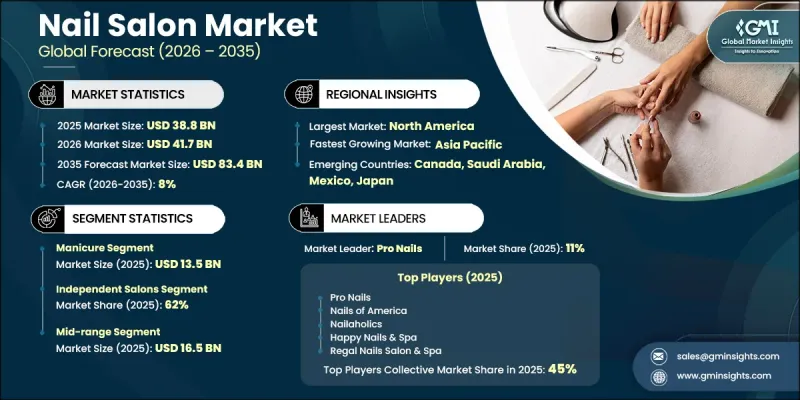
The Global Nail Salon Market was valued at USD 38.8 billion in 2025 and is estimated to grow at a CAGR of 8% to reach USD 83.4 billion by 2035.
The industry is witnessing growth driven by rising consumer expenditure on beauty, grooming, and personal care services. Nail care has increasingly become part of everyday self-maintenance routines as consumers place greater importance on appearance across professional and social settings. Growing disposable incomes, urban lifestyles, and higher participation in workplace and social activities are further reinforcing demand across all age groups. Nail services are widely perceived as an affordable and accessible enhancement option, encouraging frequent visits and repeat consumption patterns. In addition, nail care is increasingly associated with self-expression, confidence, and overall wellness, which is strengthening its positioning beyond basic grooming. The shift toward viewing personal care as a form of self-care is also supporting sustained service demand. As grooming standards continue to rise globally, well-maintained nails are becoming an expected part of personal presentation rather than an occasional luxury, contributing to consistent and predictable market expansion.
| Market Scope | |
|---|---|
| Start Year | 2025 |
| Forecast Year | 2026-2035 |
| Start Value | $38.8 Billion |
| Forecast Value | $83.4 Billion |
| CAGR | 8% |
The manicure services segment accounted for USD 13.5 billion in 2025. These services focus on comprehensive nail and hand care, including cuticle maintenance, nail shaping, exfoliation, hydration, and polishing, all aimed at improving both appearance and nail health. Manicures have evolved into an essential part of personal grooming routines, reflecting cleanliness, style, and professional presentation. Their growing popularity is driven by increasing awareness of nail hygiene and aesthetic grooming standards among consumers.
The independent salons segment held a 62% share in 2025. These establishments typically operate as single-location or small-scale businesses managed by individual owners. Their growth is strongly supported by localized customer relationships, repeat visitation, and strong word-of-mouth recommendations. Independent salons benefit from lower operating costs, allowing them to offer competitive pricing and attract a broad consumer base. Their flexible business models also enable them to cater effectively to neighborhood demand, strengthening their overall market presence.
United States Nail Salon Market accounted for 77.9% share in 2025, generating USD 6.1 billion. The country represents one of the most advanced nail salon markets globally, supported by high consumer spending on grooming and strong cultural emphasis on nail care maintenance. Demand remains consistently strong due to frequent service usage, growing preference for advanced nail treatments such as gel and acrylic applications, and the rising influence of digital platforms that promote nail art trends and styles.
Major companies operating in the Global Nail Salon Market include N.Bar, Happy Nails & Spa, Pro Nails, Nails of America, Regal Nails Salon & Spa, Townhouse, Nailaholics, Bellacures, PROSE Nails, MiniLuxe, Anthony Vince' Nail Spa, Posh Spa & Nails, Polished Nail Bar (iPolished), Milano Nail Spa the Heights, JINsoon, Tenoverten, Paintbox, Vanity Projects, WAH Nails, Lotus Nailbar & Spa, and Images Luxury Nail Lounge. Companies in the nail salon market are focusing on several strategic approaches to strengthen their market position and enhance customer loyalty. Leading players are expanding service portfolios by introducing advanced nail treatments, premium nail art designs, and personalized grooming experiences to attract diverse consumer groups. Many salons are investing in digital booking platforms and customer management systems to improve convenience and streamline service delivery. Brand differentiation through luxury experiences, hygienic service environments, and high-quality product usage is also becoming a key competitive strategy. Franchise expansion and multi-location growth are helping established brands scale their presence across urban and suburban markets.
Table of Contents
Chapter 1 Methodology and Scope
- 1.1 Market scope and definition
- 1.2 Research design
- 1.2.1 Research approach
- 1.2.2 Data collection methods
- 1.3 Data mining sources
- 1.3.1 Global
- 1.3.2 Regional/Country
- 1.4 Base estimates and calculations
- 1.4.1 Base year calculation
- 1.4.2 Key trends for market estimation
- 1.5 Primary research and validation
- 1.5.1 Primary sources
- 1.6 Forecast model
- 1.7 Research assumptions and limitations
Chapter 2 Executive Summary
- 2.1 Industry 360° synopsis
- 2.2 Key market trends
- 2.2.1 Regional
- 2.2.2 Service type
- 2.2.3 Business model
- 2.2.4 Price range
- 2.2.5 End use
Chapter 3 Industry Insights
- 3.1 Industry ecosystem analysis
- 3.1.1 Supplier landscape
- 3.1.2 Profit margin
- 3.1.3 Value addition at each stage
- 3.1.4 Factor affecting the value chain
- 3.2 Industry impact forces
- 3.2.1 Growth drivers
- 3.2.1.1 Rising beauty & personal grooming spend
- 3.2.1.2 Expansion of professional nail services
- 3.2.1.3 Growing male & gender-neutral demand
- 3.2.2 Industry pitfalls & challenges
- 3.2.2.1 Labor dependence & skill shortages
- 3.2.2.2 Price sensitivity & fragmented competition
- 3.2.3 Opportunities
- 3.2.3.1 Clean, vegan & health-focused nail services
- 3.2.3.2 Home services & hybrid models
- 3.2.1 Growth drivers
- 3.3 Growth potential analysis
- 3.4 Technology and innovation landscape
- 3.4.1 Current technological trends
- 3.4.2 Emerging technologies
- 3.5 Regulatory framework
- 3.5.1 Health & safety compliance standards (North America)
- 3.5.2 Sanitation & sterilization requirements (EU)
- 3.5.3 Chemical exposure & ventilation regulations
- 3.5.4 Labor & licensing requirements by region
- 3.5.5 Insurance & liability mandates
- 3.6 Trade data analysis (driven by paid database) (3304.3)
- 3.6.1 Import/export volume & value trends
- 3.6.2 Key trade corridors & tariff impact
- 3.7 Impact of AI & generative AI on the market
- 3.7.1 AI-driven disruption of existing business models
- 3.7.2 GenAI use cases & adoption roadmap by segment
- 3.7.3 Risks, limitations & regulatory considerations
- 3.8 Service delivery capacity & provider infrastructure (driven by primary research)
- 3.8.1 Provider network density & coverage by region
- 3.8.2 Capacity gaps & addressable demand mismatch
Chapter 4 Competitive Landscape, 2025
- 4.1 Introduction
- 4.2 Company market share analysis
- 4.2.1 By region
- 4.2.1.1 North America
- 4.2.1.2 Europe
- 4.2.1.3 Asia Pacific
- 4.2.1.4 Latin America
- 4.2.1.5 Middle East and Africa
- 4.2.1 By region
- 4.3 Company matrix analysis
- 4.4 Competitive analysis of major market players
- 4.5 Competitive positioning matrix
- 4.6 Key developments
- 4.6.1 Mergers & acquisitions
- 4.6.2 Partnerships & collaborations
- 4.6.3 New product launches
- 4.6.4 Expansion plans
Chapter 5 Market Estimates and Forecast, By Service Type, 2022 - 2035 (USD Billion)
- 5.1 Key trends
- 5.2 Manicure
- 5.3 Pedicure
- 5.4 Nail art & design
- 5.5 Nail extensions
- 5.6 Others
Chapter 6 Market Estimates and Forecast, By Business Model, 2022 - 2035 (USD Billion)
- 6.1 Key trends
- 6.2 Independent salons
- 6.3 Franchise salons
- 6.4 Mobile nail services
Chapter 7 Market Estimates and Forecast, By Price Range, 2022 - 2035 (USD Billion)
- 7.1 Key trends
- 7.2 Premium/luxury experience
- 7.3 Mid-range
- 7.4 Budget-friendly/economical
Chapter 8 Market Estimates and Forecast, By End Use, 2022 - 2035 (USD Billion)
- 8.1 Key trends
- 8.2 Women
- 8.3 Men
- 8.4 Unisex
Chapter 9 Market Estimates and Forecast, By Region, 2022 - 2035 (USD Billion)
- 9.1 Key trends
- 9.2 North America
- 9.2.1 U.S.
- 9.2.2 Canada
- 9.3 Europe
- 9.3.1 Germany
- 9.3.2 UK
- 9.3.3 France
- 9.3.4 Italy
- 9.3.5 Spain
- 9.4 Asia Pacific
- 9.4.1 China
- 9.4.2 Japan
- 9.4.3 India
- 9.4.4 Australia
- 9.4.5 South Korea
- 9.5 Latin America
- 9.5.1 Brazil
- 9.5.2 Mexico
- 9.5.3 Argentina
- 9.6 Middle East and Africa
- 9.6.1 South Africa
- 9.6.2 Saudi Arabia
- 9.6.3 UAE
Chapter 10 Company Profiles
- 10.1 Global players
- 10.1.1 Pro Nails
- 10.1.2 Nails of America
- 10.1.3 Nailaholics
- 10.1.4 Happy Nails & Spa
- 10.1.5 Regal Nails Salon & Spa
- 10.1.6 Townhouse
- 10.1.7 N.Bar
- 10.2 Regional players
- 10.2.1 MiniLuxe
- 10.2.2 Bellacures
- 10.2.3 Polished Nail Bar (iPolished)
- 10.2.4 Anthony Vince' Nail Spa
- 10.2.5 PROSE Nails
- 10.2.6 Posh Spa & Nails
- 10.2.7 Milano Nail Spa The Heights
- 10.3 Emerging players
- 10.3.1 JINsoon
- 10.3.2 Tenoverten
- 10.3.3 Paintbox
- 10.3.4 Vanity Projects
- 10.3.5 WAH Nails
- 10.3.6 Lotus Nailbar & Spa
- 10.3.7 Images Luxury Nail Lounge

