PUBLISHER: Global Market Insights Inc. | PRODUCT CODE: 2045869

PUBLISHER: Global Market Insights Inc. | PRODUCT CODE: 2045869
Biohacking Market Opportunity, Growth Drivers, Industry Trend Analysis, and Forecast 2026 - 2035
The Global Biohacking Market was valued at USD 28.2 billion in 2025 and is estimated to grow at a CAGR of 16.8% to reach USD 131.5 billion by 2035.
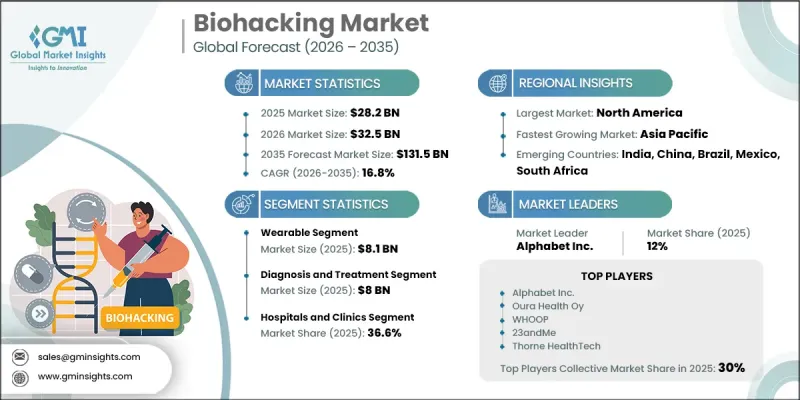
Rapid growth across the biohacking industry is driven by the increasing prevalence of chronic health conditions, rising consumer interest in preventive healthcare, and continuous advancements in wearable and monitoring technologies. Consumers are becoming more focused on improving physical performance, mental wellness, and long-term health management through personalized and data-driven solutions. The growing burden of chronic illnesses, including metabolic, cardiovascular, and neurological disorders, continues to encourage individuals to adopt advanced wellness technologies that support real-time health tracking and lifestyle optimization. In addition, significant developments in biosensors, artificial intelligence, mobile connectivity, and digital health platforms are enhancing the accuracy and accessibility of biohacking solutions. Wearable technologies are becoming increasingly popular among consumers seeking continuous monitoring of health indicators and personalized wellness insights. Rising smartphone adoption and growing awareness regarding self-managed healthcare are also contributing to strong market expansion. As consumers continue prioritizing personalized wellness and performance enhancement, demand for innovative biohacking tools and connected health solutions is expected to accelerate substantially throughout the forecast period.
| Market Scope | |
|---|---|
| Start Year | 2025 |
| Forecast Year | 2026-2035 |
| Start Value | $28.2 Billion |
| Forecast Value | $131.5 Billion |
| CAGR | 16.8% |
The wearable segment generated USD 8.1 billion in 2025. Wearable devices have become essential components of biohacking practices due to their ability to continuously monitor key physiological and wellness indicators. These technologies provide users with real-time access to health-related data, supporting more personalized approaches to fitness, recovery, cognitive performance, and overall well-being. Continuous monitoring capabilities allow users to evaluate lifestyle patterns, measure physical responses, and make informed decisions regarding health optimization strategies. Advancements in wearable technology are also improving user experience through enhanced data precision, long-term tracking capabilities, and integration with mobile health applications, further driving adoption across the biohacking industry.
The hospitals and clinics segment accounted for 36.6% share in 2025. Expansion within this segment is being supported by the growing ability of healthcare facilities to provide advanced biohacking services aimed at preventive care, wellness enhancement, and chronic disease management. Hospitals and specialized healthcare centers are increasingly integrating personalized health technologies, biomarker monitoring systems, and advanced diagnostic solutions into patient care programs. Rising consumer demand for early health assessment, individualized wellness plans, and proactive disease management strategies continues to increase patient visits to healthcare facilities offering biohacking-related services. The integration of advanced monitoring tools and personalized treatment approaches is further strengthening the role of hospitals and clinics within the expanding biohacking industry.
North America Biohacking Market represented 40.2% share in 2025. The region's market growth is largely supported by the high prevalence of chronic conditions and increasing consumer interest in self-directed health management solutions. Consumers throughout North America are actively adopting wearable technologies, biosensors, and personalized wellness programs to monitor health indicators and improve long-term well-being. Growing awareness regarding preventive healthcare and lifestyle optimization is encouraging widespread adoption of connected health devices capable of tracking vital physiological metrics in real time. In addition, rising healthcare expenditures, technological innovation, and strong digital health infrastructure are contributing to continued market development across the region.
Key companies operating in the Global Biohacking Market include Alphabet Inc., 23andMe, BioAge Diagnostics, Cronometer, HF Concepts, Muse, Neuralink, Nuanic, Oralgenix, Oura Health Oy, Senseonics, Synbiota, Thorne HealthTech, Viome Life Science, and WHOOP. Companies operating in the biohacking industry are implementing a range of strategic initiatives to strengthen their market position and expand customer engagement. Leading players are investing heavily in research and development activities focused on advanced biosensors, artificial intelligence integration, and personalized health analytics to improve product performance and user experience. Businesses are also introducing innovative wearable devices and connected wellness platforms designed to deliver real-time health insights and customized recommendations. Strategic partnerships with healthcare providers, fitness organizations, and digital wellness platforms are helping companies broaden market reach and strengthen brand visibility.
Table of Contents
Chapter 1 Research Methodology
- 1.1 Research approach
- 1.2 Quality commitments
- 1.2.1 GMI AI policy & data integrity commitment
- 1.2.1.1 Source consistency protocol
- 1.2.1 GMI AI policy & data integrity commitment
- 1.3 Research trail & confidence scoring
- 1.3.1 Research trail components
- 1.3.2 Scoring components
- 1.4 Data collection
- 1.4.1 Partial list of primary sources
- 1.5 Data mining sources
- 1.5.1 Paid sources
- 1.5.1.1 Sources, by region
- 1.5.1 Paid sources
- 1.6 Base estimates and calculations
- 1.6.1 Base year calculation for any one approach
- 1.7 Forecast model
- 1.7.1 Quantified market impact analysis
- 1.7.1.1 Mathematical impact of growth parameters on forecast
- 1.7.1 Quantified market impact analysis
- 1.8 Research transparency addendum
- 1.8.1 Source attribution framework
- 1.8.2 Quality assurance metrics
- 1.8.3 Our commitment to trust
Chapter 2 Executive Summary
- 2.1 Industry 3600 synopsis
- 2.2 Key market trends
- 2.2.1 Product trends
- 2.2.2 Application trends
- 2.2.3 End Use trends
- 2.2.4 Regional trends
- 2.3 CXO perspectives: Strategic imperatives
Chapter 3 Industry Insights
- 3.1 Industry ecosystem analysis
- 3.2 Industry impact forces
- 3.2.1 Growth drivers
- 3.2.1.1 Rising prevalence of chronic diseases
- 3.2.1.2 Technological advancements in biohacking
- 3.2.1.3 Growing demand for wearable devices
- 3.2.1.4 Increasing health optimization and longevity awareness
- 3.2.2 Industry pitfalls and challenges
- 3.2.2.1 High costs of advanced devices
- 3.2.2.2 Strict regulatory and compliance requirements
- 3.2.3 Market opportunities
- 3.2.3.1 Growth of AI-driven personalized health platforms
- 3.2.3.2 Expansion of at-home diagnostics and self-testing kits
- 3.2.1 Growth drivers
- 3.3 Growth potential analysis
- 3.4 Regulatory landscape (Driven by primary research)
- 3.4.1 North America
- 3.4.2 Europe
- 3.4.3 Asia Pacific
- 3.4.4 Latin America
- 3.4.5 Middle East and Africa
- 3.5 Technology landscape (Driven by primary research)
- 3.5.1 Current technological trends
- 3.5.1.1 Advanced wearable biosensors
- 3.5.1.2 AI-driven health analytics platforms
- 3.5.2 Emerging technologies
- 3.5.2.1 Implantable and Injectable Biosensors
- 3.5.2.2 Brain-Computer Interfaces (BCIs) for Cognitive Enhancement
- 3.5.1 Current technological trends
- 3.6 Future market trends (Driven by primary research)
- 3.7 Impact of AI and Generative AI on the market (Driven by primary research)
- 3.8 Pricing trend analysis (Driven by primary research)
- 3.9 Patent analysis
- 3.10 Porter's analysis
- 3.11 PESTEL analysis
Chapter 4 Competitive Landscape, 2025
- 4.1 Introduction
- 4.2 Company market share analysis
- 4.2.1 Global
- 4.2.2 North America
- 4.2.3 Europe
- 4.2.4 Asia Pacific
- 4.3 Company matrix analysis
- 4.4 Competitive analysis of major market players
- 4.5 Competitive positioning matrix
- 4.6 Key developments
- 4.6.1 Mergers and acquisitions
- 4.6.2 Partnerships and collaborations
- 4.6.3 New product launches
- 4.6.4 Expansion plans
Chapter 5 Market Estimates and Forecast, By Product, 2022 - 2035 ($ Mn)
- 5.1 Key trends
- 5.2 Wearable
- 5.2.1 Fitness trackers and biosensors
- 5.2.2 Smart rings
- 5.2.3 Other wearables
- 5.3 Implants
- 5.3.1 Biomonitoring chips
- 5.3.2 RFID/NFC tags
- 5.3.3 Other implantable devices
- 5.4 Diagnostic kits & testing
- 5.5 Genetic testing kits
- 5.6 Microbiome testing kits
- 5.6.1 Gut microbiome tests
- 5.6.2 Oral microbiome tests
- 5.6.3 Other microbiome tests
- 5.7 Other kits and testing
- 5.8 Smart drugs
- 5.9 Supplements
- 5.10 Mobile apps
- 5.11 Other products
Chapter 6 Market Estimates and Forecast, By Application, 2022 - 2035 ($ Mn)
- 6.1 Key trends
- 6.2 Synthetic biology
- 6.3 Genetic engineering
- 6.4 Forensic science
- 6.5 Diagnosis & treatment
- 6.6 Drug testing
- 6.7 Other applications
Chapter 7 Market Estimates and Forecast, By End Use, 2022 - 2035 ($ Mn)
- 7.1 Key trends
- 7.2 Hospitals and clinics
- 7.3 Pharmaceutical and biotechnology companies
- 7.4 Forensic laboratories
- 7.5 Academic and research institutes
Chapter 8 Market Estimates and Forecast, By Region, 2022 - 2035 ($ Mn)
- 8.1 Key trends
- 8.2 North America
- 8.2.1 U.S.
- 8.2.2 Canada
- 8.3 Europe
- 8.3.1 Germany
- 8.3.2 UK
- 8.3.3 France
- 8.3.4 Spain
- 8.3.5 Italy
- 8.3.6 Netherlands
- 8.4 Asia Pacific
- 8.4.1 China
- 8.4.2 Japan
- 8.4.3 India
- 8.4.4 Australia
- 8.4.5 South Korea
- 8.5 Latin America
- 8.5.1 Brazil
- 8.5.2 Mexico
- 8.5.3 Argentina
- 8.6 Middle East and Africa
- 8.6.1 South Africa
- 8.6.2 Saudi Arabia
- 8.6.3 UAE
Chapter 9 Company Profiles
- 9.1 23andMe
- 9.2 Alphabet Inc.
- 9.3 BioAge Diagnostics
- 9.4 Cronometer
- 9.5 HF Concepts
- 9.6 Muse
- 9.7 Neuralink
- 9.8 Nuanic
- 9.9 Oralgenix
- 9.10 Oura Health Oy
- 9.11 Senseonics
- 9.12 Synbiota
- 9.13 Thorne HealthTech
- 9.14 Viome Life Science
- 9.15 WHOOP

