
PUBLISHER: Global Market Insights Inc. | PRODUCT CODE: 2045875

PUBLISHER: Global Market Insights Inc. | PRODUCT CODE: 2045875
Oxytocin Market Opportunity, Growth Drivers, Industry Trend Analysis, and Forecast 2026 - 2035
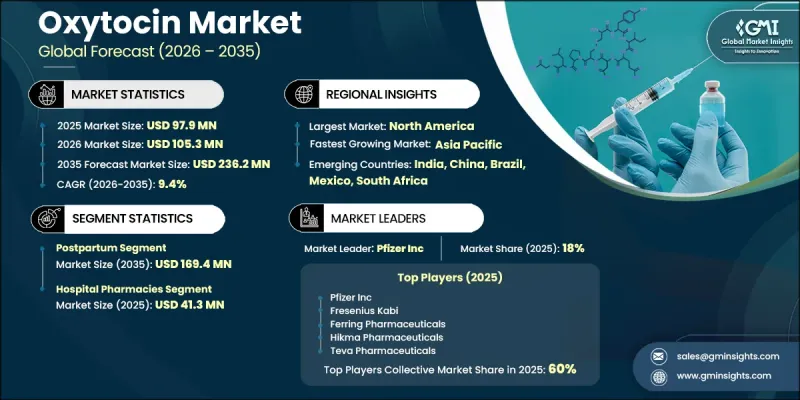
The Global Oxytocin Market was valued at USD 97.9 million in 2025 and is estimated to grow at a CAGR of 9.4% to reach USD 236.2 million by 2035.
Market expansion is supported by a steady rise in pregnancy-related complications, increasing childbirth volumes, and growing clinical awareness regarding induced labor and breastfeeding support. Rising maternal health challenges, including prolonged labor, postpartum hemorrhage, uterine atony, preeclampsia, and obstructed labor, are becoming more frequent due to advanced maternal age, higher rates of cesarean deliveries, obesity, diabetes prevalence, and limited prenatal care access in some regions. This has strengthened the role of oxytocin as an essential obstetric drug in modern healthcare systems. Growing birth rates across multiple regions are also reinforcing demand, particularly in emerging economies across Asia, Africa, and Latin America, where expanding healthcare access and government-led maternal care initiatives are increasing institutional deliveries. As hospital-based childbirth becomes more common, oxytocin usage continues to rise across labor induction, augmentation, and postpartum hemorrhage prevention, supporting its position as a core medication in maternal healthcare protocols worldwide.
| Market Scope | |
|---|---|
| Start Year | 2025 |
| Forecast Year | 2026-2035 |
| Start Value | $97.9 Million |
| Forecast Value | $236.2 Million |
| CAGR | 9.4% |
The postpartum segment is projected to reach USD 169.4 million by 2035, supported by strong and sustained demand for oxytocin in preventing and treating postpartum hemorrhage, which remains a leading contributor to maternal mortality globally. This segment holds a dominant position due to the routine administration of oxytocin immediately after delivery as a first-line uterotonic agent. Widespread adoption of standardized clinical guidelines, combined with increasing institutional childbirth rates, has reinforced consistent usage in maternity care environments. The prophylactic use of oxytocin after childbirth ensures high-volume demand, further strengthening the segment's growth outlook.
The hospital pharmacies segment accounted for USD 41.3 million in 2025. This segment leads distribution channels as hospitals remain the primary settings for childbirth, surgical procedures, and emergency obstetric care, where oxytocin is routinely administered. High patient inflow in institutional delivery settings, along with strict adherence to obstetric treatment protocols, supports consistent procurement through hospital pharmacies. The availability of trained healthcare professionals and controlled clinical environments further enhances the reliability and standardized use of oxytocin in hospital-based care.
North America Oxytocin Market held a 40.4% share in 2025. Market growth in this region is driven by a rising incidence of pregnancy-related complications, including uterine atony, prolonged labor, gestational diabetes, and preeclampsia. Delayed pregnancies, lifestyle-related risk factors, and higher obesity rates have increased the need for labor induction and postpartum hemorrhage management. Oxytocin remains widely used as a first-line therapy across hospitals and obstetric centers. Strong healthcare infrastructure, well-established clinical protocols, and high rates of institutional deliveries further support consistent demand and reinforce its critical role in maternal healthcare across the region.
Major players operating in the Global Oxytocin Industry include Pfizer Inc., Hikma Pharmaceuticals, Fresenius Kabi, Sun Pharmaceutical Industries, Ferring Pharmaceuticals, Teva Pharmaceuticals, Gland Pharma, AdvaCare Pharma, Aspen Pharmacare, Laborate Pharmaceuticals, and Taj Pharmaceuticals. Companies in the oxytocin market are prioritizing expansion of manufacturing capacity and strengthening supply chain reliability to ensure consistent availability of injectable formulations. Many players are investing in compliance with stringent regulatory standards and quality assurance systems to maintain trust in hospital procurement channels. Strategic collaborations with hospitals and government healthcare programs are being used to secure long-term supply contracts. Firms are also focusing on geographic expansion into emerging regions with rising birth rates and improving healthcare access. Product portfolio diversification, including ready-to-use formulations and improved packaging stability, is enhancing usability in clinical environments.
Table of Contents
Chapter 1 Research Methodology
- 1.1 Research approach
- 1.2 Quality commitments
- 1.2.1 GMI AI policy & data integrity commitment
- 1.2.1.1 Source consistency protocol
- 1.2.1 GMI AI policy & data integrity commitment
- 1.3 Research trail & confidence scoring
- 1.3.1 Research trail components
- 1.3.2 Scoring components
- 1.4 Data collection
- 1.4.1 Partial list of primary sources
- 1.5 Data mining sources
- 1.5.1 Paid sources
- 1.5.1.1 Sources, by region
- 1.5.1 Paid sources
- 1.6 Base estimates and calculations
- 1.6.1 Base year calculation for any one approach
- 1.7 Forecast model
- 1.7.1 Quantified market impact analysis
- 1.7.1.1 Mathematical impact of growth parameters on forecast
- 1.7.1 Quantified market impact analysis
- 1.8 Research transparency addendum
- 1.8.1 Source attribution framework
- 1.8.2 Quality assurance metrics
- 1.8.3 Our commitment to trust
Chapter 2 Executive Summary
- 2.1 Industry 3600 synopsis
- 2.2 Key market trends
- 2.2.1 Indication trends
- 2.2.2 Distribution Channel trends
- 2.2.3 Regional trends
- 2.3 CXO perspectives: Strategic imperatives
Chapter 3 Industry Insights
- 3.1 Industry ecosystem analysis
- 3.2 Industry impact forces
- 3.2.1 Growth drivers
- 3.2.1.1 Rising incidence of pregnancy complications
- 3.2.1.2 Increase in childbirth rates
- 3.2.1.3 Growing awareness of induced labor and breastfeeding
- 3.2.1.4 Increasing research & development activities
- 3.2.2 Industry pitfalls and challenges
- 3.2.2.1 Stringent regulatory requirements
- 3.2.2.2 High cost of drug
- 3.2.3 Market opportunities
- 3.2.3.1 Intranasal & oromucosal delivery systems for non-invasive administration
- 3.2.1 Growth drivers
- 3.3 Growth potential analysis
- 3.4 Regulatory landscape (Driven by primary research)
- 3.4.1 North America
- 3.4.2 Europe
- 3.4.3 Asia Pacific
- 3.4.4 Latin America
- 3.4.5 Middle East and Africa
- 3.5 Technology landscape (Driven by primary research)
- 3.5.1 Current technological trends
- 3.5.1.1 Cold-Chain monitoring and temperature-controlled packaging
- 3.5.2 Emerging technologies
- 3.5.2.1 Alternative Delivery Systems
- 3.5.2.2 Integration with Maternal Health Digital Platforms
- 3.5.1 Current technological trends
- 3.6 Future market trends (Driven by primary research)
- 3.7 Impact of AI and Generative AI on the market (Driven by primary research)
- 3.8 Price trend analysis (Driven by primary research)
- 3.9 Patent analysis
- 3.10 Porter's analysis
- 3.11 PESTEL analysis
Chapter 4 Competitive Landscape, 2025
- 4.1 Introduction
- 4.2 Company market share analysis
- 4.2.1 Global
- 4.2.2 North America
- 4.2.3 Europe
- 4.2.4 Asia Pacific
- 4.3 Company matrix analysis
- 4.4 Competitive analysis of major market players
- 4.5 Competitive positioning matrix
- 4.6 Key developments
- 4.6.1 Mergers and acquisitions
- 4.6.2 Partnerships and collaborations
- 4.6.3 New product launches
- 4.6.4 Expansion plans
Chapter 5 Market Estimates and Forecast, By Indication, 2022 - 2035 ($ Mn)
- 5.1 Key trends
- 5.2 Antepartum
- 5.3 Postpartum
Chapter 6 Market Estimates and Forecast, By Distribution Channel, 2022 - 2035 ($ Mn)
- 6.1 Key trends
- 6.2 Hospital pharmacies
- 6.3 Retail pharmacies
- 6.4 Online pharmacies
Chapter 7 Market Estimates and Forecast, By Region, 2022 - 2035 ($ Mn)
- 7.1 Key trends
- 7.2 North America
- 7.2.1 U.S.
- 7.2.2 Canada
- 7.3 Europe
- 7.3.1 Germany
- 7.3.2 UK
- 7.3.3 France
- 7.3.4 Spain
- 7.3.5 Italy
- 7.3.6 Netherlands
- 7.4 Asia Pacific
- 7.4.1 China
- 7.4.2 Japan
- 7.4.3 India
- 7.4.4 Australia
- 7.4.5 South Korea
- 7.5 Latin America
- 7.5.1 Brazil
- 7.5.2 Mexico
- 7.5.3 Argentina
- 7.6 Middle East and Africa
- 7.6.1 South Africa
- 7.6.2 Saudi Arabia
- 7.6.3 UAE
Chapter 8 Company Profiles
- 8.1 AdvaCare Pharma
- 8.2 Aspen Pharmacare
- 8.3 Ferring Pharmaceuticals
- 8.4 Fresenius Kabi
- 8.5 Gland Pharma
- 8.6 Hikma Pharmaceuticals
- 8.7 Laborate Pharmaceuticals
- 8.8 Pfizer Inc.
- 8.9 Sun Pharmaceutical Industries
- 8.10 Taj Pharmaceuticals
- 8.11 Teva Pharmaceuticals

