PUBLISHER: Global Market Insights Inc. | PRODUCT CODE: 2061296

PUBLISHER: Global Market Insights Inc. | PRODUCT CODE: 2061296
Europe Soundbars Market Opportunity, Growth Drivers, Industry Trend Analysis, and Forecast 2026 - 2035
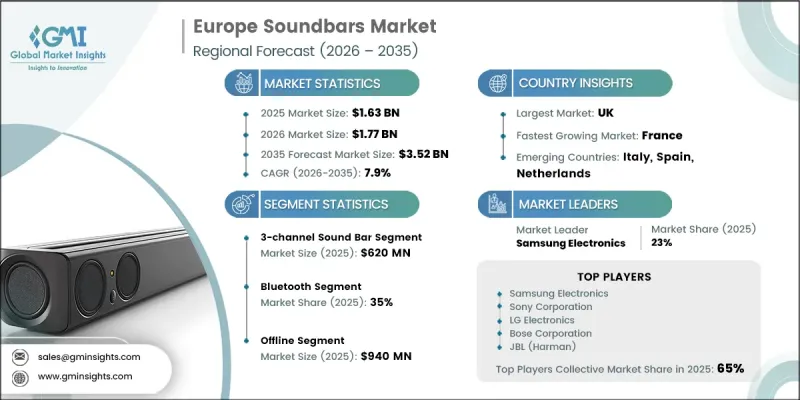
Europe Soundbars Market was valued at USD 1.63 billion in 2025 and is estimated to grow at a CAGR of 7.9% to reach USD 3.52 billion by 2035.
Rising adoption of advanced home entertainment systems across European households is significantly contributing to the growth of the Europe soundbars industry. Consumers are increasingly upgrading to high-resolution smart televisions, creating stronger demand for external audio solutions capable of delivering enhanced sound quality and immersive listening experiences. Built-in television speakers are often unable to provide premium audio performance, encouraging households to invest in soundbars that improve entertainment quality for movies, sports broadcasts, and digital content streaming. In addition, the increasing popularity of streaming platforms has transformed media consumption patterns throughout the region, leading consumers to spend more time on home entertainment activities. This shift has accelerated interest in compact yet high-performance audio systems that can recreate a cinematic experience without requiring large and complex home theater installations. Growing consumer preference for wireless connectivity, advanced surround sound technologies, and aesthetically compact devices is further strengthening market demand. Technological advancements in premium sound formats and smart home integration are also supporting long-term expansion across the Europe soundbars market.
| Market Scope | |
|---|---|
| Start Year | 2025 |
| Forecast Year | 2026-2035 |
| Start Value | $1.63 Billion |
| Forecast Value | $3.52 Billion |
| CAGR | 7.9% |
The 3-channel soundbar segment accounted for USD 620 million in 2025. These soundbars continue to gain strong consumer preference because they provide balanced audio output and improved voice clarity through dedicated left, center, and right audio channels. Enhanced dialogue performance makes these systems particularly attractive for consumers who prioritize clearer sound quality while watching television programs, movies, and other spoken-content entertainment. The segment is also benefiting from rising consumer demand for simplified audio solutions that deliver superior sound performance without the complexity associated with larger multi-speaker entertainment systems.
The bluetooth connectivity segment held 35% share in 2025. Bluetooth-enabled soundbars remain highly popular because consumers increasingly prefer wireless and convenient device connectivity for home entertainment systems. These products allow users to connect multiple devices seamlessly without relying on wired installations, improving flexibility and ease of use. The growing preference for wireless streaming and multi-device compatibility is encouraging consumers to adopt Bluetooth-enabled soundbars for music streaming and digital entertainment purposes. Convenience, portability, and simplified setup processes continue to support strong adoption of Bluetooth-integrated sound systems across the European market.
UK Soundbars Market held a 21.6% share, generating USD 350 million in 2025. The country remains one of the most developed soundbar markets in Europe due to widespread adoption of smart televisions and strong consumer demand for enhanced home entertainment experiences. Increasing spending on subscription-based digital entertainment services has also strengthened interest in premium audio products capable of complementing high-definition viewing experiences. Consumers across the UK are increasingly prioritizing sound quality and immersive entertainment setups, driving sustained demand across both mid-range and premium soundbar categories.
Major companies operating in the Europe soundbars market include global brands such as Samsung Electronics, LG Electronics, Sony Corporation, Sonos, Bose Corporation, JBL (Harman), and Yamaha Corporation. Regional market participants include Bang & Olufsen, Teufel, Sennheiser, Philips (TP Vision), Denon (Sound United), Loewe, and Cambridge Audio. Emerging companies shaping the Europe soundbars industry include Devialet, Bluesound, Bowers & Wilkins, Majority, Hisense, Magnat, and Nubert. Companies operating in the Europe soundbars industry are adopting multiple strategic initiatives to strengthen their market position and expand customer reach. Manufacturers are increasingly investing in advanced audio technologies, including immersive surround sound systems, wireless connectivity solutions, and smart home compatibility features to improve product appeal. Many brands are also focusing on sleek and compact product designs that complement modern home interiors while maintaining premium audio performance. Strategic collaborations with streaming platforms, television manufacturers, and digital retailers are helping companies enhance brand visibility and distribution capabilities. In addition, businesses are expanding their online sales presence and implementing digital marketing campaigns to strengthen consumer engagement across European markets.
Table of Contents
Chapter 1 Methodology and Scope
- 1.1 Market scope & definitions
- 1.2 Research design
- 1.2.1 Research approach
- 1.2.2 Data collection methods
- 1.3 Base estimates and calculations
- 1.3.1 Base year calculation
- 1.3.2 Market estimates & forecasts parameters
- 1.4 Forecast Model
- 1.4.1 Key trends for market estimates
- 1.4.2 Quantified market impact analysis
- 1.4.2.1 Mathematical impact of growth parameters on forecast
- 1.4.3 Scenario analysis framework
- 1.5 Primary research and validation
- 1.5.1 Some of the primary sources (but not limited to)
- 1.6 Data mining sources
- 1.6.1 Paid Sources
- 1.7 Primary research and validation
- 1.7.1 Primary sources
- 1.8 Research Trail & confidence scoring
- 1.8.1 Research trail components
- 1.8.2 Scoring components
- 1.9 Research transparency addendum
- 1.9.1 Source attribution framework
- 1.9.2 Quality assurance metrics
- 1.9.3 Our commitment to trust
- 1.10 Market Definitions
Chapter 2 Executive Summary
- 2.1 Industry 360° synopsis
- 2.2 Key market trends
- 2.2.1 Country trends
- 2.2.2 Product type trends
- 2.2.3 Connectivity trends
- 2.2.4 Installation type trends
- 2.2.5 Speaker wattage trends
- 2.2.6 Price range trends
- 2.2.7 Size trends
- 2.2.8 Application trends
- 2.2.9 Distribution channel trends
Chapter 3 Industry Insights
- 3.1 Soundbars industry ecosystem analysis
- 3.1.1 Raw material suppliers
- 3.1.2 Soundbars manufacturers
- 3.1.3 Value addition at each stage
- 3.1.4 Factor affecting the value chain
- 3.2 Industry impact forces
- 3.2.1 Growth drivers
- 3.2.1.1 Rising adoption of smart TVs and home entertainment systems
- 3.2.1.2 Consumer preference for compact audio solutions
- 3.2.1.3 Technological advancements
- 3.2.2 Industry pitfalls & challenges
- 3.2.2.1 Substitution from alternative audio devices
- 3.2.2.2 Installation and compatibility issues
- 3.2.3 Market opportunities
- 3.2.3.1 Smart home integration
- 3.2.3.2 Premiumization and high-end soundbars
- 3.2.1 Growth drivers
- 3.3 Growth potential analysis
- 3.4 Regulatory framework
- 3.4.1 Standards & compliance requirements
- 3.4.2 Europe regulatory landscape (CE, ROHS, REACH, Ecodesign)
- 3.4.3 Certification standards (THX, Dolby, DTS)
- 3.4.4 Acoustic performance standards (EN ISO 3382)
- 3.5 Technological and innovation landscape
- 3.5.1 Current technological trends
- 3.5.1.1 Wireless connectivity and multi-room audio ecosystems
- 3.5.1.2 Immersive audio technologies (Dolby Atmos and spatial sound)
- 3.5.1.3 Compact design with enhanced acoustic engineering
- 3.5.1.4 Streaming integration and content ecosystem compatibility
- 3.5.2 Emerging technologies
- 3.5.2.1 AI-driven sound optimization and adaptive audio processing
- 3.5.2.2 Smart home integration and voice assistant compatibility
- 3.5.2.3 Modular expansion and surround system scalability
- 3.5.2.4 Sustainability and energy-efficient product development
- 3.5.1 Current technological trends
- 3.6 Pricing analysis, 2025 (driven by primary research)
- 3.6.1 Historical price trend analysis (2022-2025)
- 3.6.2 Pricing strategy by player type (premium/value/cost-plus)
- 3.6.3 Price elasticity by segment
- 3.6.4 Country pricing variations
- 3.7 Trade data analysis (driven by paid database) (851822)
- 3.7.1 Import/export volume & value trends (2022-2025)
- 3.7.2 Top 10 import countries
- 3.7.3 Top 10 export countries
- 3.7.4 Key trade corridors & tariff impact
- 3.8 Impact of AI & generative AI on the market
- 3.8.1 AI-driven disruption of existing business models
- 3.8.2 GenAI use cases & adoption roadmap by segment
- 3.8.2.1 Adaptive sound optimization & room calibration
- 3.8.2.2 Voice control & natural language processing
- 3.8.2.3 Personalized audio profiles & user behavior learning
- 3.8.2.4 Predictive maintenance & firmware updates
- 3.8.3 Risks, limitations & regulatory considerations
- 3.9 Distribution infrastructure & channel penetration landscape (driven by primary research)
- 3.9.1 Channel coverage by country & format (modern vs. Traditional trade)
- 3.9.2 Last-mile infrastructure gaps & emerging channel shifts
- 3.9.3 E-commerce penetration & direct-to-consumer models
Chapter 4 Competitive Landscape, 2025
- 4.1 Company market share analysis
- 4.1.1 By country
- 4.1.1.1 UK
- 4.1.1.2 Germany
- 4.1.1.3 France
- 4.1.1.4 Italy
- 4.1.1.5 Spain
- 4.1.1.6 Switzerland
- 4.1.1.7 Belgium
- 4.1.1.8 Netherlands
- 4.1.1.9 Nordics
- 4.1.2 Company matrix analysis
- 4.1.3 Competitive analysis of major market players
- 4.1.4 Competitive positioning matrix
- 4.1.5 Key developments
- 4.1.5.1 Mergers & acquisitions
- 4.1.5.2 Partnerships & collaborations
- 4.1.5.3 New product launches
- 4.1.5.4 Expansion plan
- 4.1.1 By country
Chapter 5 Market Estimates and Forecast, By Product Type, 2022 - 2035 (USD Billion) (Million Units)
- 5.1 Key trends
- 5.2 2 channel soundbars
- 5.3 3 channel soundbars
- 5.4 5 channel soundbars
- 5.5 7 channel soundbars
Chapter 6 Market Estimates and Forecast, By Connectivity, 2022 - 2035 (USD Billion) (Million Units)
- 6.1 Key trends
- 6.2 Bluetooth
- 6.3 Auxiliary
- 6.4 Wi-Fi
- 6.5 Others (HDMI, optical, etc.)
Chapter 7 Market Estimates and Forecast, By Installation Type, 2022 - 2035 (USD Billion) (Million Units)
- 7.1 Key trends
- 7.2 Wall mounted
- 7.3 Tabletop
- 7.4 Free standing
Chapter 8 Market Estimates and Forecast, By Speaker Wattage, 2022 - 2035 (USD Billion) (Million Units)
- 8.1 Key trends
- 8.2 Up to 200 Watts
- 8.3 200-400 Watts
- 8.4 400-600 Watts
- 8.5 600+ Watts
Chapter 9 Market Estimates and Forecast, By Price Range, 2022 - 2035 (USD Billion) (Million Units)
- 9.1 Key trends
- 9.2 Budget/Economy (Under $200)
- 9.3 Mid-Range ($200-$500)
- 9.4 Premium ($500-$1,000)
- 9.5 Ultra-Premium ($1,000+)
Chapter 10 Market Estimates and Forecast, By Size, 2022 - 2035 (USD Billion) (Million Units)
- 10.1 Key trends
- 10.2 Under 30 Inches
- 10.3 30-40 Inches
- 10.4 40-50 Inches
- 10.5 50+ Inches
Chapter 11 Market Estimates and Forecast, By Application, 2022 - 2035 (USD Billion) (Million Units)
- 11.1 Key trends
- 11.2 Residential
- 11.3 Commercial
- 11.3.1 Hospitality (hotels, restaurants)
- 11.3.2 Retail stores
- 11.3.3 Offices/conference rooms
- 11.3.4 Educational institutions
- 11.3.5 Entertainment venues (cinemas, theatres)
Chapter 12 Market Estimates and Forecast, By Distribution Channel, 2022 - 2035 (USD Billion) (Million Units)
- 12.1 Key trends
- 12.2 Online
- 12.2.1 E-commerce websites
- 12.2.2 Company websites
- 12.3 Offline
- 12.3.1 Hypermarkets/supermarkets
- 12.3.2 Specialty stores
- 12.3.3 Brand outlets
- 12.3.4 Other retail stores (department stores, local electronic shops)
Chapter 13 Market Estimates and Forecast, By Country, 2022 - 2035 (USD Billion) (Million Units)
- 13.1 Key trends
- 13.2 UK
- 13.3 Germany
- 13.4 France
- 13.5 Italy
- 13.6 Spain
- 13.7 Switzerland
- 13.8 Belgium
- 13.9 Netherlands
- 13.10 Nordics
Chapter 14 Company Profiles
- 14.1 Global players
- 14.1.1 Samsung Electronics
- 14.1.2 LG Electronics
- 14.1.3 Sony Corporation
- 14.1.4 Sonos
- 14.1.5 Bose Corporation
- 14.1.6 JBL (Harman)
- 14.1.7 Yamaha Corporation
- 14.2 Regional players
- 14.2.1 Bang & Olufsen
- 14.2.2 Teufel
- 14.2.3 Sennheiser
- 14.2.4 Philips (TP Vision)
- 14.2.5 Denon (Sound United)
- 14.2.6 Loewe
- 14.2.7 Cambridge Audio
- 14.3 Emerging players
- 14.3.1 Devialet
- 14.3.2 Bluesound
- 14.3.3 Bowers & Wilkins
- 14.3.4 Majority
- 14.3.5 Hisense
- 14.3.6 Magnat
- 14.3.7 Nubert

