PUBLISHER: Global Market Insights Inc. | PRODUCT CODE: 2061302

PUBLISHER: Global Market Insights Inc. | PRODUCT CODE: 2061302
Asia Pacific Insulated Products Market Opportunity, Growth Drivers, Industry Trend Analysis, and Forecast 2026 - 2035
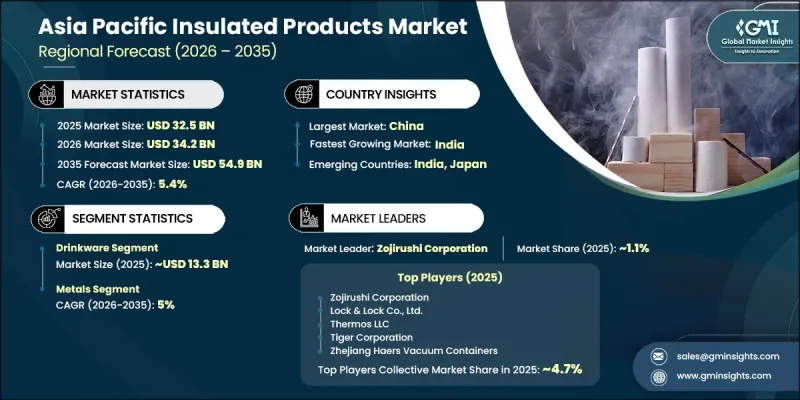
Asia Pacific Insulated Products Market was valued at USD 32.5 billion in 2025 and is estimated to grow at a CAGR of 5.4% to reach USD 54.9 billion by 2035.
Rising consumption of food and beverages within urban households is significantly contributing to the growth of the Asia Pacific insulated products industry. Consumers across metropolitan regions are increasingly preferring home-based meal preparation and consumption due to convenience, changing lifestyles, and cost efficiency. This shift has accelerated demand for products associated with food storage, beverage preservation, and daily household utility. Growing interest in convenient dining solutions and evolving eating patterns are further supporting market expansion. At the same time, the rapid development of organized retail networks and digital commerce platforms is improving product accessibility across urban and semi-urban markets. Modern retail channels are increasing consumer exposure to a wider range of insulated products, while online platforms are encouraging frequent purchases through convenience, flexible payment methods, and promotional campaigns. Manufacturers are also strengthening their digital presence to reach broader customer groups and improve brand visibility. The steady growth of retail infrastructure and e-commerce penetration continues to create favorable conditions for long-term market expansion across the Asia Pacific region.
| Market Scope | |
|---|---|
| Start Year | 2025 |
| Forecast Year | 2026-2035 |
| Start Value | $32.5 Billion |
| Forecast Value | $54.9 Billion |
| CAGR | 5.4% |
The drinkware segment generated USD 13.3 billion in 2025 and is expected to witness a CAGR of 5.4% between 2026 and 2035. This segment continues to hold a substantial share of the Asia Pacific insulated products market due to its widespread use across everyday consumer activities, including hydration, commuting, travel, workplace usage, and fitness routines. Demand for insulated drinkware products remains consistently strong because of regular replacement cycles, increasing consumer interest in customized designs, seasonal purchasing behavior, and changing lifestyle preferences. Continuous product innovation and expanding consumer awareness regarding reusable beverage containers are also supporting segment growth throughout the region.
The metals segment accounted for 64.2% share in 2025 and is projected to grow at a CAGR of 5% through 2035. Metal-based insulated products, particularly those manufactured using stainless steel, continue to dominate the market because of their durability, corrosion resistance, safety standards, and superior insulation efficiency. Stainless steel materials are highly preferred for insulated storage and beverage products as they effectively maintain temperature retention while supporting advanced insulation technologies. Growing consumer concerns regarding product safety and the limitations associated with alternative materials are further accelerating demand for metal-based insulated products across residential and commercial applications.
China Insulated Products Market reached USD 20.6 billion in 2025, and is forecast to grow at a CAGR of 5% from 2026 to 2035. Market growth in China is being driven by rapid industrialization, expanding infrastructure development, and strong government emphasis on energy-efficient construction practices. Insulated products are increasingly utilized across residential buildings, commercial infrastructure, industrial systems, and temperature-control applications to improve energy conservation and operational efficiency. Demand remains particularly high in urban construction projects, where stricter building efficiency regulations continue to encourage the adoption of advanced insulation solutions and related products.
Major companies operating in the Asia Pacific insulated products market include leading global participants such as Thermos LLC, Zojirushi Corporation, Tiger Corporation, Stanley 1913 (PMI Worldwide), Newell Brands (Contigo), CamelBak Products LLC, and Hydro Flask (Helen of Troy Limited). Regional market participants include Klean Kanteen, SIGG, Lock & Lock Co., Ltd., Zhejiang Haers Vacuum Containers Co., Ltd., Takeya USA, KINTO, and Peacock Vacuum Bottle Co., Ltd. Emerging and specialized companies in the industry include YETI Holdings Inc., S'well Bottle, Corkcicle, Aladdin (PMI Worldwide), Cello World Limited, Owala, and Frank Green. Companies operating in the Asia Pacific insulated products industry are implementing multiple strategies to strengthen their market position and improve customer engagement. Manufacturers are focusing heavily on product innovation, including advanced insulation technologies, lightweight materials, and premium design enhancements to attract a wider consumer base. Many companies are also expanding their online retail presence and investing in digital marketing campaigns to improve brand awareness across urban and semi-urban markets. Strategic collaborations with retail chains and e-commerce platforms are helping brands increase distribution efficiency and customer accessibility. Businesses are additionally prioritizing sustainable manufacturing practices and environmentally friendly materials to align with rising consumer preference for reusable and eco-conscious products.
Table of Contents
Chapter 1 Methodology & Scope
- 1.1 Market scope and definition
- 1.2 Research design
- 1.2.1 Research approach
- 1.2.2 Data collection methods
- 1.3 Data mining sources
- 1.3.1 Global
- 1.3.2 Regional/Country
- 1.4 Base estimates and calculations
- 1.4.1 Base year calculation
- 1.4.2 Key trends for market estimation
- 1.5 Primary research and validation
- 1.5.1 Primary sources
- 1.6 Forecast model
- 1.7 Research assumptions and limitations
Chapter 2 Executive Summary
- 2.1 Industry 360° synopsis
- 2.2 Key market trends
- 2.2.1 Country
- 2.2.2 Type
- 2.2.3 Material
- 2.2.4 Usage
- 2.2.5 Insulation technology
- 2.2.6 Capacity
- 2.2.7 Temperature retention
- 2.2.8 Price range
- 2.2.9 Distribution channel
Chapter 3 Industry Insights
- 3.1 Industry ecosystem analysis
- 3.1.1 Supplier landscape
- 3.1.2 Profit margin
- 3.1.3 Value addition at each stage
- 3.1.4 Factor affecting the value chain
- 3.2 Industry impact forces
- 3.2.1 Growth drivers
- 3.2.1.1 Rising home consumption of food and beverages across urban households
- 3.2.1.2 Growth of organized retail and e-commerce platforms
- 3.2.1.3 Shift toward sustainable and reusable alternatives to single-use plastics
- 3.2.2 Pitfalls & Challenges
- 3.2.2.1 Intense competition from low-cost and unbranded products
- 3.2.2.2 Product fragmentation with low differentiation in basic kitchenware items
- 3.2.3 Opportunities
- 3.2.3.1 Rising demand for smart, multifunctional, and insulated kitchenware products
- 3.2.3.2 Growth of eco-friendly materials such as bamboo, stainless steel, and glass alternatives
- 3.2.1 Growth drivers
- 3.3 Growth potential analysis
- 3.4 Future market trends
- 3.5 Technology and innovation landscape
- 3.5.1 Current technological trends
- 3.5.2 Emerging technologies
- 3.6 Regulatory landscape
- 3.6.1 Standards and compliance requirements
- 3.6.2 Regional regulatory frameworks
- 3.6.3 Certification standards
- 3.7 Porter’s analysis
- 3.8 PESTEL analysis
- 3.9 Pricing analysis (driven by primary research)
- 3.9.1 Historical price trend analysis (2019-2024) (driven by primary research)
- 3.9.2 Pricing strategy by player type (premium/value/cost-plus) (driven by primary research)
- 3.9.3 Price elasticity of demand
- 3.9.4 Regional price variations
- 3.9.5 Material cost impact on pricing
- 3.10 Trade data analysis (HS code 392410) (driven by paid database)
- 3.10.1 Import/export volume and value trends (2019-2024) (driven by paid database)
- 3.10.2 Key trade corridors and tariff impact (driven by paid database)
- 3.10.3 Major exporting countries
- 3.10.4 Major importing countries
- 3.10.5 Trade balance analysis by region
- 3.11 Impact of AI and generative AI on the market
- 3.11.1 AI-driven disruption of existing business models
- 3.11.2 Manufacturing optimization and quality control
- 3.11.3 Demand forecasting and inventory management
- 3.11.4 Personalization and mass customization
- 3.11.5 Customer service automation
- 3.11.6 GenAI use cases and adoption roadmap by segment
- 3.11.7 Design generation and product development
- 3.11.8 Marketing content creation
- 3.11.9 Supply chain optimization
- 3.11.10 Consumer insights and sentiment analysis
- 3.11.11 Risks, limitations and regulatory considerations
- 3.11.12 Data privacy and security
- 3.11.13 Quality control challenges
- 3.11.14 Ethical AI use in marketing
- 3.12 Distribution infrastructure and channel penetration landscape (driven by primary research)
- 3.12.1 Channel coverage by region and format (modern vs traditional trade) (driven by primary research)
- 3.12.2 Last-mile infrastructure gaps and emerging channel shifts (driven by primary research)
- 3.12.3 E-commerce fulfillment network analysis
- 3.12.4 Retail store density and geographic penetration
- 3.12.5 Direct-to-consumer (D2C) channel evolution
Chapter 4 Competitive Landscape, 2025
- 4.1 Introduction
- 4.2 Company market share analysis
- 4.2.1 By Country
- 4.2.1.1 China
- 4.2.1.2 Japan
- 4.2.1.3 India
- 4.2.1.4 South Korea
- 4.2.1.5 Australia
- 4.2.1 By Country
- 4.3 Company matrix analysis
- 4.4 Competitive analysis of major market players
- 4.5 Competitive positioning matrix
- 4.6 Key developments
- 4.6.1 Mergers & acquisitions
- 4.6.2 Partnerships & collaborations
- 4.6.3 New product launches
- 4.6.4 Expansion plans
Chapter 5 Market Estimates & Forecast, By Type, 2022 - 2035, (USD Billion) (Thousand Units)
- 5.1 Key trends
- 5.2 Drinkware
- 5.2.1 Tumblers
- 5.2.2 Water bottles
- 5.2.3 Travel mugs
- 5.2.4 Thermoses
- 5.2.5 Beer/wine glasses
- 5.3 Food Storage
- 5.3.1 Lunch boxes
- 5.3.2 Food containers
- 5.3.3 Coolers/ice chests
- 5.4 Pitchers and Jugs
- 5.5 Insulated Serving Bowls
Chapter 6 Market Estimates & Forecast, By Material, 2022 - 2035, (USD Billion) (Thousand Units)
- 6.1 Key trends
- 6.2 Glass
- 6.2.1 Tempered glass
- 6.2.2 Borosilicate glass
- 6.2.3 Others
- 6.3 Metals
- 6.3.1 Stainless steel
- 6.3.2 Aluminum
- 6.3.3 Titanium
- 6.4 Composite Material
- 6.5 Glass-lined steel
Chapter 7 Market Estimates & Forecast, By Usage, 2022 - 2035, (USD Billion) (Thousand Units)
- 7.1 Key trends
- 7.2 Everyday use
- 7.3 Outdoor/camping
- 7.4 Sports and fitness
- 7.5 Travel
- 7.6 Office/work
Chapter 8 Market Estimates & Forecast, By Design, 2022 - 2035, (USD Billion) (Thousand Units)
- 8.1 Key trends
- 8.2 Sweat-proof exterior
- 8.3 Non-slip base
- 8.4 Ergonomic grip
- 8.5 Wide-mouth opening
- 8.6 Collapsible
- 8.7 Built-in strainers/infusers
Chapter 9 Market Estimates & Forecast, By Insulation Technology, 2022 - 2035, (USD Billion) (Thousand Units)
- 9.1 Key trends
- 9.2 Vacuum insulation
- 9.3 Double-wall insulation
- 9.4 Foam insulation
- 9.5 Reflective insulation
Chapter 10 Market Estimates & Forecast, By Capacity, 2022 - 2035, (USD Billion) (Thousand Units)
- 10.1 Key trends
- 10.2 Small (under 16 oz)
- 10.3 Medium (16-32 oz)
- 10.4 Large (32-64 oz)
- 10.5 Extra large (over 64 oz)
Chapter 11 Market Estimates & Forecast, By Temperature Retention, 2022 - 2035, (USD Billion) (Thousand Units)
- 11.1 Key trends
- 11.2 Cold retention
- 11.3 Heat retention
- 11.4 Dual temperature (hot and cold)
Chapter 12 Market Estimates & Forecast, By Price Range, 2022 - 2035, (USD Billion) (Thousand Units)
- 12.1 Key trends
- 12.2 Economy
- 12.3 Mid-range
- 12.4 Premium
- 12.5 Luxury
Chapter 13 Market Estimates & Forecast, By Distribution Channel, 2022 - 2035, (USD Billion) (Thousand Units)
- 13.1 Key trends
- 13.2 Online
- 13.2.1 Ecommerce website
- 13.2.2 Company owned website
- 13.3 Offline
- 13.3.1 Specialty stores
- 13.3.2 Department stores
- 13.3.3 Home improvement stores
- 13.3.4 Others
Chapter 14 Market Estimates & Forecast, By Country, 2022 - 2035, (USD Billion) (Thousand Units)
- 14.1 Key trends
- 14.2 China
- 14.3 Japan
- 14.4 India
- 14.5 South Korea
- 14.6 Thailand
- 14.7 Philippines
- 14.8 Vietnam
- 14.9 Australia
Chapter 15 Company Profiles
- 15.1 Top Global Companies
- 15.1.1 Thermos LLC
- 15.1.2 Zojirushi Corporation
- 15.1.3 Tiger Corporation
- 15.1.4 Stanley 1913 (PMI Worldwide)
- 15.1.5 Newell Brands (Contigo)
- 15.1.6 CamelBak Products LLC
- 15.1.7 Hydro Flask (Helen of Troy Limited)
- 15.2 Regional Champions
- 15.2.1 Klean Kanteen
- 15.2.2 SIGG
- 15.2.3 Lock & Lock Co., Ltd.
- 15.2.4 Zhejiang Haers Vacuum Containers Co., Ltd.
- 15.2.5 Takeya USA
- 15.2.6 KINTO
- 15.2.7 Peacock Vacuum Bottle Co., Ltd.
- 15.3 Emerging and Specialized Players
- 15.3.1 YETI Holdings Inc.
- 15.3.2 S'well Bottle
- 15.3.3 Corkcicle
- 15.3.4 Aladdin (PMI Worldwide)
- 15.3.5 Cello World Limited
- 15.3.6 Owala
- 15.3.7 Frank Green

