
PUBLISHER: Global Market Insights Inc. | PRODUCT CODE: 2061311

PUBLISHER: Global Market Insights Inc. | PRODUCT CODE: 2061311
Aerospace Additive Manufacturing Market Opportunity, Growth Drivers, Industry Trend Analysis, and Forecast 2026 - 2035
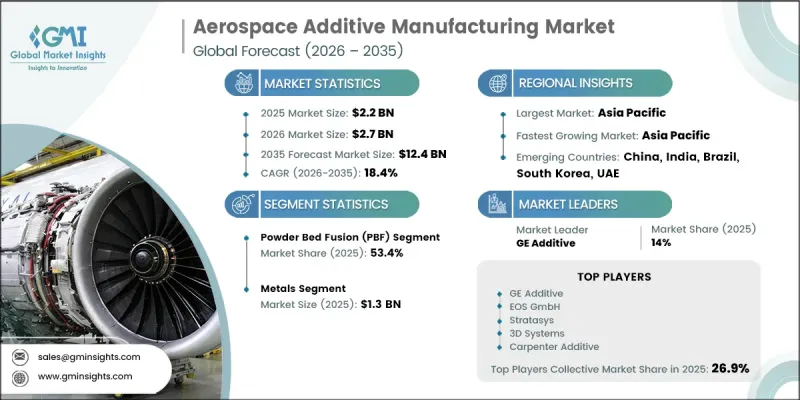
The Global Aerospace Additive Manufacturing Market was valued at USD 2.2 billion in 2025 and is estimated to grow at a CAGR of 18.4% to reach USD 12.4 billion by 2035.
Growth across the global aerospace additive manufacturing industry is being driven by the increasing focus on lightweight aircraft components, improved fuel efficiency, and advanced manufacturing techniques capable of producing highly complex aerospace parts. Rising demand for faster production cycles and rapid availability of replacement components for maintenance and repair operations is further accelerating adoption of additive manufacturing technologies throughout the aerospace sector. Continuous investments in aerospace-grade materials, including advanced metal alloys and high-performance composites, are also strengthening market expansion. Aerospace manufacturers are increasingly integrating additive manufacturing into production workflows to improve operational flexibility, reduce material waste, and enhance component performance while lowering dependence on traditional manufacturing methods. Ongoing support from defense organizations and government-backed advanced manufacturing initiatives is further contributing to industrial-scale adoption. In addition, advancements in material science, precision engineering, and digital manufacturing systems are enabling broader commercialization of additive manufacturing technologies across critical aerospace applications, supporting long-term growth opportunities for the aerospace additive manufacturing market.
| Market Scope | |
|---|---|
| Start Year | 2025 |
| Forecast Year | 2026-2035 |
| Start Value | $2.2 Billion |
| Forecast Value | $12.4 Billion |
| CAGR | 18.4% |
The global aerospace additive manufacturing market is experiencing strong momentum due to rising demand for lightweight and fuel-efficient aerospace systems. Reduced aircraft weight contributes significantly to fuel savings and supports broader sustainability and emissions reduction objectives, encouraging increased adoption of additive manufacturing solutions. Market growth is also being reinforced by rising investments from government agencies and defense organizations focused on strengthening advanced manufacturing capabilities. Aerospace manufacturers are prioritizing improved production efficiency, enhanced part performance, and greater supply chain resilience through the integration of additive manufacturing technologies. Simultaneously, ongoing developments in aerospace-grade materials and increasing industrial deployment of advanced manufacturing systems are accelerating adoption across commercial and defense aerospace applications.
The powder bed fusion (PBF) segment held a 53.4% share in 2025. Strong segment growth is attributed to widespread utilization of PBF technologies for manufacturing highly precise and geometrically complex aerospace metal components. These systems deliver exceptional material characteristics, high dimensional accuracy, and compatibility with aerospace-grade metallic materials, making them highly suitable for mission-critical applications. Their ability to support production-scale manufacturing continues to strengthen adoption across the aerospace industry.
The metals segment captured USD 1.3 billion in 2025. Market dominance is driven by extensive use of metal-based additive manufacturing technologies in high-performance aerospace applications requiring superior strength, durability, and reliability. Aerospace-grade metal materials are increasingly preferred for structural and propulsion-related components due to their ability to withstand demanding operational conditions. These performance advantages continue to reinforce strong market leadership for the metals segment within the aerospace additive manufacturing industry.
North America Aerospace Additive Manufacturing Market accounted for 35.6% share in 2025. Regional market expansion is supported by strong defense expenditures and early integration of advanced manufacturing technologies across aerospace programs. Presence of established aerospace manufacturers and defense organizations is accelerating adoption of additive manufacturing technologies within both production and maintenance operations. Continuous demand for high-performance aerospace components and mission-critical systems is further strengthening market growth across the region.
Major companies operating in the Global Aerospace Additive Manufacturing Market include EOS GmbH, 3D Systems, TRUMPF, Renishaw, DMG MORI, AddUp, Farsoon Technologies, Titomic, Optomec, Sciaky, AML3D, Desktop Metal, Carpenter Additive, Oerlikon AM, GE Additive, and Stratasys. Companies active in the aerospace additive manufacturing industry are focusing on technological innovation, strategic partnerships, and advanced material development to strengthen their market position. Industry participants are increasing investments in next-generation printing systems, aerospace-grade metal powders, and high-precision manufacturing technologies to improve production efficiency and component performance. Many manufacturers are also expanding collaborations with aerospace companies, defense organizations, and research institutions to accelerate commercialization and broaden application capabilities. Continuous investments in automation, digital manufacturing platforms, and large-scale production facilities are helping companies improve scalability and reduce production timelines. In addition, businesses are prioritizing research and development initiatives focused on lightweight materials, process optimization, and sustainable manufacturing solutions to strengthen competitive differentiation and expand their long-term presence within the global aerospace additive manufacturing market.
Table of Contents
Chapter 1 Methodology and Scope
- 1.1 Market scope and definition
- 1.2 Research design
- 1.2.1 Research approach
- 1.2.2 Data collection methods
- 1.3 Data mining sources
- 1.3.1 Global
- 1.3.2 Regional/Country
- 1.4 Base estimates and calculations
- 1.4.1 Base year calculation
- 1.4.2 Key trends for market estimation
- 1.5 Primary research and validation
- 1.5.1 Primary sources
- 1.6 Forecast model
- 1.7 Research assumptions and limitations
Chapter 2 Executive Summary
- 2.1 Industry 360° synopsis, 2022 - 2035
- 2.2 Key market trends
- 2.2.1 Product form trends
- 2.2.2 Material type trends
- 2.2.3 Application trends
- 2.2.4 Technology type trends
- 2.2.5 Material type trends
- 2.2.6 End-User trends
- 2.2.7 Component type trends
- 2.2.8 Regional trends
- 2.3 TAM Analysis, 2026-2035
- 2.4 CXO perspectives: Strategic imperatives
Chapter 3 Industry Insights
- 3.1 Industry ecosystem analysis
- 3.1.1 Supplier Landscape
- 3.1.2 Profit Margin
- 3.1.3 Cost structure
- 3.1.4 Value addition at each stage
- 3.1.5 Factor affecting the value chain
- 3.1.6 Disruptions
- 3.2 Industry impact forces
- 3.2.1 Growth drivers
- 3.2.1.1 Rising demand for lightweight and fuel-efficient aerospace components
- 3.2.1.2 Need for efficient production of complex and high-performance geometries
- 3.2.1.3 Increasing adoption in maintenance, repair, and overhaul (MRO) operations
- 3.2.1.4 Growing investments by OEMs and defense agencies in advanced manufacturing
- 3.2.1.5 Advancements in aerospace-grade materials and certification capabilities
- 3.2.2 Industry pitfalls and challenges
- 3.2.2.1 High qualification and certification complexity for aerospace components
- 3.2.2.2 Limited scalability and high production cost for large-volume manufacturing
- 3.2.3 Market opportunities
- 3.2.3.1 Adoption of additive manufacturing in space and launch vehicle applications
- 3.2.3.2 Development of hybrid manufacturing combining additive and conventional processes
- 3.2.1 Growth drivers
- 3.3 Growth potential analysis
- 3.4 Regulatory landscape
- 3.4.1 North America
- 3.4.2 Europe
- 3.4.3 Asia Pacific
- 3.4.4 Latin America
- 3.4.5 Middle East & Africa
- 3.5 Porter’s analysis
- 3.6 PESTEL analysis
- 3.7 Technology and Innovation landscape
- 3.7.1 Current technological trends
- 3.7.2 Emerging technologies
- 3.8 Price trends
- 3.8.1 By region
- 3.8.2 By product
- 3.9 Pricing Strategies
- 3.10 Emerging Business Models
- 3.11 Compliance Requirements
- 3.12 Patent and IP analysis
Chapter 4 Competitive Landscape, 2025
- 4.1 Introduction
- 4.2 Company market share analysis
- 4.2.1 By region
- 4.2.1.1 North America
- 4.2.1.2 Europe
- 4.2.1.3 Asia Pacific
- 4.2.1.4 Latin America
- 4.2.1.5 Middle East & Africa
- 4.2.2 Market concentration analysis
- 4.2.1 By region
- 4.3 Competitive benchmarking of key players
- 4.3.1 Financial performance comparison
- 4.3.1.1 Revenue
- 4.3.1.2 Profit margin
- 4.3.1.3 R&D
- 4.3.2 Product portfolio comparison
- 4.3.2.1 Product range breadth
- 4.3.2.2 Technology
- 4.3.2.3 Innovation
- 4.3.3 Geographic presence comparison
- 4.3.3.1 Global footprint analysis
- 4.3.3.2 Service network coverage
- 4.3.3.3 Market penetration by region
- 4.3.4 Competitive positioning matrix
- 4.3.4.1 Leaders
- 4.3.4.2 Challengers
- 4.3.4.3 Followers
- 4.3.4.4 Niche players
- 4.3.5 Strategic outlook matrix
- 4.3.1 Financial performance comparison
- 4.4 Key developments
- 4.4.1 Mergers and acquisitions
- 4.4.2 Partnerships and collaborations
- 4.4.3 Technological advancements
- 4.4.4 Expansion and investment strategies
- 4.4.5 Digital transformation initiatives
- 4.5 Emerging/ startup competitors landscape
Chapter 5 Market Estimates and Forecast, By Technology Type, 2022 - 2035 (USD Million)
- 5.1 Key trends
- 5.2 Powder bed fusion (PBF)
- 5.3 Directed energy deposition (DED)
- 5.4 Binder jetting
- 5.5 Material extrusion
- 5.6 Material jetting
- 5.7 Vat photopolymerization
- 5.8 Others
Chapter 6 Market Estimates and Forecast, By Material Type, 2022 - 2035 (USD Million)
- 6.1 Key trends
- 6.2 Metals
- 6.3 Polymers
- 6.4 Ceramics
- 6.5 Composites
- 6.6 Others
Chapter 7 Market Estimates and Forecast, By End-User, 2022 - 2035 (USD Million)
- 7.1 Key trends
- 7.2 Commercial aviation
- 7.3 Military & defense
- 7.4 Space
- 7.5 Unmanned aerial vehicles (UAVs)
Chapter 8 Market Estimates and Forecast, By Component Type, 2022 - 2035 (USD Million)
- 8.1 Key trends
- 8.2 Engine components
- 8.3 Structural components
- 8.4 Avionics & electronics components
- 8.5 Interior components
- 8.6 Landing gear components
- 8.7 Others
Chapter 9 Market Estimates and Forecast, By Region, 2022 - 2035 (USD Million)
- 9.1 Key trends
- 9.2 North America
- 9.2.1 U.S.
- 9.2.2 Canada
- 9.3 Europe
- 9.3.1 Germany
- 9.3.2 UK
- 9.3.3 France
- 9.3.4 Spain
- 9.3.5 Italy
- 9.3.6 Russia
- 9.4 Asia Pacific
- 9.4.1 China
- 9.4.2 India
- 9.4.3 Japan
- 9.4.4 Australia
- 9.4.5 South Korea
- 9.5 Latin America
- 9.5.1 Brazil
- 9.5.2 Mexico
- 9.5.3 Argentina
- 9.6 Middle East and Africa
- 9.6.1 South Africa
- 9.6.2 Saudi Arabia
- 9.6.3 UAE
Chapter 10 Company Profiles
- 10.1 Global Key Players
- 10.1.1 GE Additive
- 10.1.2 EOS GmbH
- 10.1.3 Stratasys
- 10.1.4 3D Systems
- 10.1.5 Carpenter Additive
- 10.2 Regional key players
- 10.2.1 North America
- 10.2.1.1 TRUMPF
- 10.2.1.2 Renishaw
- 10.2.1.3 DMG MORI
- 10.2.2 Asia Pacific
- 10.2.2.1 Farsoon Technologies
- 10.2.3 Europe
- 10.2.3.1 AddUp
- 10.2.3.2 Oerlikon AM
- 10.2.1 North America
- 10.3 Niche Players/Disruptors
- 10.3.1 Titomic
- 10.3.2 Optomec
- 10.3.3 Sciaky
- 10.3.4 AML3D
- 10.3.5 Desktop Metal

