PUBLISHER: Global Market Insights Inc. | PRODUCT CODE: 2061319

PUBLISHER: Global Market Insights Inc. | PRODUCT CODE: 2061319
Electric Vehicle HVAC Service Market Opportunity, Growth Drivers, Industry Trend Analysis, and Forecast 2026 - 2035
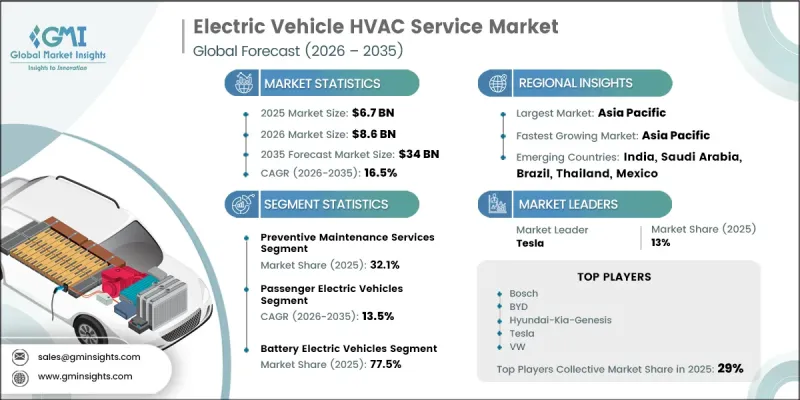
The Global Electric Vehicle HVAC Service Market was valued at USD 6.7 billion in 2025 and is estimated to grow at a CAGR of 16.5% to reach USD 34 billion by 2035.
The rising global adoption of electric vehicles continues to create substantial demand for HVAC maintenance, diagnostics, and repair services. As EV manufacturers increasingly integrate advanced thermal management technologies and heat pump systems into modern vehicles, the requirement for system calibration, sensor testing, and energy-efficiency optimization services is accelerating. The growing shift toward software-driven HVAC operations is also contributing to the need for periodic inspections and technical servicing. Automotive companies and fleet operators are placing stronger emphasis on battery efficiency, driving range optimization, and vehicle energy management, further increasing the importance of HVAC system upkeep. Since thermal management systems directly influence battery temperature stability and power consumption, preventive servicing has become a critical operational priority. The rapid deployment of electric commercial fleets is also supporting higher demand for HVAC servicing solutions across the broader electric mobility ecosystem.
| Market Scope | |
|---|---|
| Start Year | 2025 |
| Forecast Year | 2026-2035 |
| Start Value | $6.7 Billion |
| Forecast Value | $34 Billion |
| CAGR | 16.5% |
The preventive maintenance services segment accounted for 32.1% share in 2025 and are anticipated to witness a CAGR of 14.5% between 2026 and 2035. The segment continues to maintain a leading position due to the growing focus on scheduled inspections, refrigerant monitoring, filter replacements, and ongoing thermal system maintenance. Vehicle owners and fleet management companies increasingly rely on proactive servicing strategies to improve HVAC system efficiency, reduce long-term repair costs, and maintain overall vehicle performance. The expansion of connected vehicle technologies and predictive maintenance platforms is also contributing to higher adoption of routine HVAC service programs across the EV industry.
The passenger electric vehicles segment held a 77.7% share in 2025 and is forecast to grow at a CAGR of 13.5% through 2035. The increasing integration of sophisticated HVAC technologies, including advanced heat pumps and battery thermal management systems, is driving the need for specialized servicing and software calibration support. Automakers are heavily focused on enhancing cabin comfort, maintaining battery cooling efficiency, and maximizing vehicle driving range, which continues to strengthen demand for professional HVAC maintenance services in passenger EVs. In addition, rising consumer expectations for vehicle performance and energy optimization are encouraging regular servicing of thermal management systems.
China Electric Vehicle HVAC Service Market held a 61% share and generated USD 2.2 billion in 2025. The country continues to lead the regional industry due to its massive electric vehicle population, robust domestic EV manufacturing network, and rapidly expanding electric mobility infrastructure. Strong adoption of electric passenger vehicles, public transportation fleets, and commercial EVs has significantly increased the requirement for HVAC diagnostics, repair, maintenance, and software calibration services. The ongoing expansion of electric transportation within logistics and transit sectors is also accelerating the need for commercial EV HVAC servicing solutions throughout the country.
Key participants operating in the Global Electric Vehicle HVAC Service Market include BMW, Bosch, BYD, Geely, Hyundai-Kia-Genesis, Mercedes-Benz, NIO Service, Stellantis, Tesla, and Volkswagen. Companies operating in the electric vehicle HVAC service market are actively implementing several strategic initiatives to strengthen their market presence and improve long-term competitiveness. Major industry participants are investing heavily in advanced diagnostic technologies, AI-driven predictive maintenance platforms, and software-based HVAC calibration systems to improve service efficiency and vehicle performance. Many companies are expanding their authorized service networks and strengthening partnerships with EV manufacturers and fleet operators to increase customer reach and aftermarket support capabilities. Businesses are also prioritizing technician training programs focused on advanced thermal management systems and next-generation heat pump technologies. In addition, market players are increasing investments in digital service platforms, remote diagnostics, and connected vehicle solutions to enhance customer experience, reduce downtime, and support the growing demand for efficient electric vehicle HVAC maintenance services across global markets.
Table of Contents
Chapter 1 Research Methodology
- 1.1 Research approach
- 1.2 Quality Commitments
- 1.2.1 GMI AI policy & data integrity commitment
- 1.2.1.1 Source consistency protocol
- 1.2.1 GMI AI policy & data integrity commitment
- 1.3 Research Trail & Confidence Scoring
- 1.3.1 Research Trail Components
- 1.3.2 Scoring Components
- 1.4 Data Collection
- 1.4.1 Partial list of primary sources
- 1.5 Data mining sources
- 1.5.1 Paid sources
- 1.5.1.1 Sources, by region
- 1.5.1 Paid sources
- 1.6 Base estimates and calculations
- 1.6.1 Base year calculation for any one approach
- 1.7 Forecast model
- 1.7.1 Quantified market impact analysis
- 1.7.1.1 Mathematical impact of growth parameters on forecast
- 1.7.1 Quantified market impact analysis
- 1.8 Research transparency addendum
- 1.8.1 Source attribution framework
- 1.8.2 Quality assurance metrics
- 1.8.3 Our commitment to trust
Chapter 2 Executive Summary
- 2.1 Industry 360° synopsis, 2022 - 2035
- 2.2 Key market trends
- 2.2.1 Regional
- 2.2.2 Service
- 2.2.3 Vehicle
- 2.2.4 Propulsion
- 2.2.5 End User
- 2.3 TAM Analysis, 2026-2035
- 2.4 CXO perspectives: Strategic imperatives
Chapter 3 Industry Insights
- 3.1 Industry ecosystem analysis
- 3.1.1 Supplier landscape
- 3.1.2 Profit margin analysis
- 3.1.3 Cost structure
- 3.1.4 Value addition at each stage
- 3.1.5 Factor affecting the value chain
- 3.1.6 Disruptions
- 3.2 Industry impact forces
- 3.2.1 Growth drivers
- 3.2.1.1 Rising electric vehicle adoption
- 3.2.1.2 Growth in advanced thermal management systems
- 3.2.1.3 Expansion of commercial electric vehicle fleets
- 3.2.1.4 Increasing software integration in HVAC systems
- 3.2.2 Industry pitfalls and challenges
- 3.2.2.1 High servicing complexity
- 3.2.2.2 Limited skilled workforce
- 3.2.3 Market opportunities
- 3.2.3.1 Expansion of EV aftermarket service networks
- 3.2.3.2 Increasing heat pump adoption
- 3.2.3.3 Growth in fleet maintenance contracts
- 3.2.1 Growth drivers
- 3.3 Growth potential analysis
- 3.4 Technology and innovation landscape
- 3.4.1 Current technological trends
- 3.4.2 Emerging technologies
- 3.5 Pricing Analysis (Driven by primary research)
- 3.5.1 Historical Price Trend Analysis
- 3.5.2 Pricing Strategy by Player Type
- 3.6 Regulatory landscape
- 3.6.1 North America
- 3.6.1.1 U.S. EPA MVAC Servicing Regulations
- 3.6.1.2 U.S. EPA Technician Certification Standards
- 3.6.1.3 U.S. EPA Refrigerant Handling Standards
- 3.6.1.4 Canada Federal Halocarbon Regulations
- 3.6.2 Europe
- 3.6.2.1 EU Fluorinated Gas Regulation
- 3.6.2.2 EU Mobile Air Conditioning Directive
- 3.6.2.3 Germany Climate Protection Chemical Regulation
- 3.6.3 Asia Pacific
- 3.6.3.1 Japan Fluorocarbon Management Act
- 3.6.3.2 Japan Vehicle Recycling Act
- 3.6.3.3 Australia Ozone Protection Act
- 3.6.3.4 India Cooling Action Plan
- 3.6.3.5 India HCFC Phase Out Management Plan
- 3.6.4 Latin America
- 3.6.4.1 Brazil HCFC Phase Out Regulations
- 3.6.4.2 Brazil Refrigerant Management Standards
- 3.6.4.3 Mexico Vehicle Emission Standards
- 3.6.5 Middle East & Africa
- 3.6.5.1 UAE Green Mobility Regulations
- 3.6.5.2 UAE Refrigerant Management Standards
- 3.6.5.3 South Africa Air Quality Act
- 3.6.5.4 South Africa Ozone Depleting Substance Regulations
- 3.6.1 North America
- 3.7 Porter's analysis
- 3.8 PESTEL analysis
- 3.9 Patent analysis (Driven by primary research)
- 3.10 Cost breakdown analysis
- 3.11 Impact of AI and Generative AI on the Market
- 3.11.1 AI Driven Disruption of Existing Business Models
- 3.11.2 GenAI Use Cases and Adoption Roadmap by Segment
- 3.11.3 Risks Limitations and Regulatory Considerations
- 3.12 Sustainability and environmental aspects
- 3.12.1 Sustainable practices
- 3.12.2 Waste reduction strategies
- 3.12.3 Energy efficiency in production
- 3.12.4 Eco-friendly Initiatives
- 3.12.5 Carbon footprint considerations
- 3.13 Forecast assumptions & scenario analysis (Driven by Primary Research)
- 3.13.1 Base Case- Key Macro & Industry Variables Driving CAGR
- 3.13.2 Optimistic Scenarios- Favorable macro and industry tailwinds
- 3.13.3 Pessimistic Scenario - Macroeconomic slowdown or industry headwinds
Chapter 4 Competitive Landscape, 2025
- 4.1 Introduction
- 4.2 Company market share analysis
- 4.2.1 North America
- 4.2.2 Europe
- 4.2.3 Asia Pacific
- 4.2.4 LATAM
- 4.2.5 MEA
- 4.3 Competitive analysis of major market players
- 4.4 Competitive positioning matrix
- 4.5 Key developments
- 4.5.1 Mergers & acquisitions
- 4.5.2 Partnerships & collaborations
- 4.5.3 New Product Launches
- 4.5.4 Expansion Plans and funding
- 4.6 Company tier benchmarking
- 4.6.1 Tier classification criteria & qualifying thresholds
- 4.6.2 Tier positioning matrix by revenue, geography & innovation
Chapter 5 Market Estimates & Forecast, By Service, 2022 - 2035 (USD Mn)
- 5.1 Key trends
- 5.2 Preventive Maintenance Services
- 5.3 Diagnostic Services
- 5.4 Repair & Replacement Services
- 5.5 Installation & Retrofit Services
- 5.6 Software & Calibration Services
Chapter 6 Market Estimates & Forecast, By Vehicle, 2022 - 2035 (USD Mn)
- 6.1 Key trends
- 6.2 Passenger Electric Vehicles
- 6.2.1 Hatchbacks
- 6.2.2 Sedans
- 6.2.3 SUVs & Crossovers
- 6.3 Commercial Electric Vehicles
- 6.3.1 Light Commercial Vehicles (LCVs)
- 6.3.2 Medium & Heavy Commercial Vehicles (M&HCVs)
- 6.3.3 Electric Buses
Chapter 7 Market Estimates & Forecast, By Propulsion, 2022 - 2035 (USD Mn)
- 7.1 Key trends
- 7.2 Battery Electric Vehicles (BEVs)
- 7.3 Plug-in Hybrid Electric Vehicles (PHEVs)
- 7.4 Hybrid Electric Vehicles (HEVs)
Chapter 8 Market Estimates & Forecast, By End User, 2022 - 2035 (USD Mn)
- 8.1 Key trends
- 8.2 Individual Vehicle Owners
- 8.3 Fleet Operators
- 8.4 Ride-Hailing & Mobility Companies
- 8.5 Public Transport Authorities
- 8.6 Logistics & Delivery Operators
Chapter 9 Market Estimates & Forecast, By Region, 2022 - 2035 (USD Mn)
- 9.1 Key trends
- 9.2 North America
- 9.2.1 US
- 9.2.2 Canada
- 9.3 Europe
- 9.3.1 Germany
- 9.3.2 UK
- 9.3.3 France
- 9.3.4 Italy
- 9.3.5 Spain
- 9.3.6 Russia
- 9.3.7 Norway
- 9.3.8 Netherlands
- 9.3.9 Sweden
- 9.4 Asia Pacific
- 9.4.1 China
- 9.4.2 India
- 9.4.3 Japan
- 9.4.4 Australia
- 9.4.5 South Korea
- 9.4.6 Singapore
- 9.4.7 Thailand
- 9.4.8 Indonesia
- 9.4.9 Vietnam
- 9.5 Latin America
- 9.5.1 Brazil
- 9.5.2 Mexico
- 9.5.3 Argentina
- 9.6 MEA
- 9.6.1 South Africa
- 9.6.2 Saudi Arabia
- 9.6.3 UAE
- 9.6.4 Turkey
Chapter 10 Company Profiles
- 10.1 Global Players
- 10.1.1 BMW
- 10.1.2 Bosch
- 10.1.3 BYD
- 10.1.4 DENSO
- 10.1.5 Hyundai Motor
- 10.1.6 Mercedes-Benz
- 10.1.7 Stellantis
- 10.1.8 Tesla
- 10.1.9 Valeo
- 10.1.10 Volkswagen
- 10.2 Regional Players
- 10.2.1 NIO
- 10.2.2 Geely Auto
- 10.2.3 Mahindra Electric Automobile
- 10.2.4 Rivian
- 10.2.5 SAIC Motor
- 10.2.6 Tata Motors
- 10.3 Emerging Players
- 10.3.1 Li Auto
- 10.3.2 Lucid Motors
- 10.3.3 VinFast
- 10.3.4 Xpeng Motors

