PUBLISHER: Global Market Insights Inc. | PRODUCT CODE: 2061341

PUBLISHER: Global Market Insights Inc. | PRODUCT CODE: 2061341
Naval C4ISR Market Opportunity, Growth Drivers, Industry Trend Analysis, and Forecast 2026 - 2035
The Global Naval C4ISR Market was valued at USD 29.5 billion in 2025 and is estimated to grow at a CAGR of 5.7% to reach USD 51.2 billion by 2035.
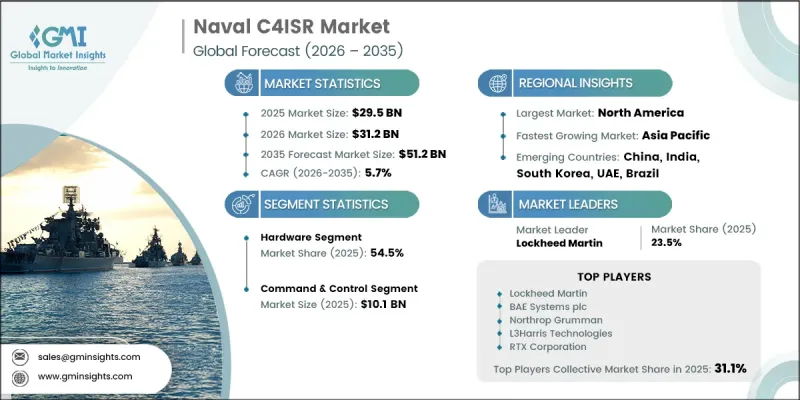
The market growth is being driven by the rising deployment of integrated combat management platforms across naval fleets, expansion of maritime surveillance and coastal monitoring systems, and ongoing modernization of legacy naval communication infrastructure into IP-based and software-defined networks. Increasing integration of multi-sensor fusion technologies to support anti-submarine and surface warfare operations is further strengthening demand, along with the rising adoption of unmanned maritime systems within naval command architectures. Growing geopolitical focus on maritime security is accelerating investments in advanced naval situational awareness capabilities, enabling real-time decision-making and enhanced operational coordination across multi-domain environments. Continuous technological advancements in secure communications, data fusion, and battlefield networking are further improving interoperability among naval assets. Rising emphasis on maritime domain awareness across strategic sea lanes, exclusive economic zones, and offshore infrastructure protection is also contributing to sustained market expansion globally.
| Market Scope | |
|---|---|
| Start Year | 2025 |
| Forecast Year | 2026-2035 |
| Start Value | $29.5 Billion |
| Forecast Value | $51.2 Billion |
| CAGR | 5.7% |
The hardware segment accounted for a 54.5% share in 2025, supported by its essential role as the physical foundation of all naval C4ISR operations. Core hardware components such as advanced sensor arrays, communication and networking systems, and ruggedized visualization units form the backbone of deployed systems across submarines, surface vessels, and maritime patrol platforms. Despite increasing software integration, hardware retains strong value contribution due to continuous fleet modernization cycles and large-scale defense procurement programs, ensuring steady demand across naval upgrade and replacement initiatives.
The command and control segment reached USD 10.1 billion in 2025, driven by its central function in managing naval mission planning, coordination, and execution. The increasing complexity of multi-domain naval operations involving synchronized activities across ships, submarines, aircraft, and shore-based centers is significantly elevating reliance on advanced command infrastructure. The need for resilient systems capable of operating under electronic warfare conditions while processing large volumes of real-time sensor and operational data continues to push investments in next-generation command and control capabilities.
North America Naval C4ISR Market held a 44.1% share in 2025, supported by extensive naval modernization initiatives and sustained investments in advanced communication, intelligence, and command systems across maritime platforms. The region benefits from a strong defense industrial ecosystem that includes highly specialized firms engaged in secure communications, systems integration, and advanced electronics development. This well-established industrial base enables rapid deployment of next-generation naval C4ISR solutions across surface, subsurface, and airborne assets, strengthening regional dominance in the global market.
Key players operating in the Global Naval C4ISR Market include BAE Systems plc, Northrop Grumman Corporation, Lockheed Martin Corporation, RTX Corporation, Thales Group, L3Harris Technologies, General Dynamics Mission Systems, Leonardo S.p.A., Saab AB, Elbit Systems Ltd., Kongsberg Gruppen, Rafael Advanced Defense Systems, HENSOLDT AG, Systematic A/S, and Atlas Elektronik. Companies in the naval C4ISR market are adopting a range of strategic initiatives to strengthen their competitive positioning and expand operational reach. Major players are heavily investing in research and development to advance sensor fusion, secure communications, and AI-enabled decision-support systems for enhanced battlefield awareness. Strategic collaborations with naval forces and defense agencies are supporting the co-development of mission-specific solutions tailored to evolving maritime threats. Firms are also focusing on modular and interoperable system architectures to improve integration across multi-domain platforms. Expansion of software-defined and cloud-enabled command systems is enabling greater scalability and operational flexibility. In addition, companies are strengthening global supply chains, pursuing long-term defense contracts, and enhancing lifecycle support services to improve customer retention and ensure sustained revenue generation in highly competitive defense procurement environments.
Table of Contents
Chapter 1 Methodology and Scope
- 1.1 Market scope and definition
- 1.2 Research design
- 1.2.1 Research approach
- 1.2.2 Data collection methods
- 1.3 Data mining sources
- 1.3.1 Global
- 1.3.2 Regional/Country
- 1.4 Base estimates and calculations
- 1.4.1 Base year calculation
- 1.4.2 Key trends for market estimation
- 1.5 Primary research and validation
- 1.5.1 Primary sources
- 1.6 Forecast model
- 1.7 Research assumptions and limitations
Chapter 2 Executive Summary
- 2.1 Industry 360° synopsis, 2022 - 2035
- 2.2 Key market trends
- 2.2.1 Solution type trends
- 2.2.2 Application trends
- 2.2.3 Platform type trends
- 2.2.4 End-user type trends
- 2.2.5 Regional trends
- 2.3 TAM Analysis, 2026-2035
- 2.4 CXO perspectives: Strategic imperatives
Chapter 3 Industry Insights
- 3.1 Industry ecosystem analysis
- 3.1.1 Supplier Landscape
- 3.1.2 Profit Margin
- 3.1.3 Cost structure
- 3.1.4 Value addition at each stage
- 3.1.5 Factor affecting the value chain
- 3.1.6 Disruptions
- 3.2 Industry impact forces
- 3.2.1 Growth drivers
- 3.2.1.1 Increasing deployment of integrated combat management systems (CMS) on naval vessels
- 3.2.1.2 Rising investments in maritime surveillance networks and coastal monitoring systems
- 3.2.1.3 Upgradation of legacy naval communication systems to IP-based and software-defined networks
- 3.2.1.4 Integration of multi-sensor fusion systems for anti-submarine and surface warfare operations
- 3.2.1.5 Increasing deployment of unmanned maritime systems integrated with naval command networks
- 3.2.2 Industry pitfalls and challenges
- 3.2.2.1 High integration complexity across heterogeneous naval platforms
- 3.2.2.2 Vulnerability of naval communication networks to electronic warfare and cyber threats
- 3.2.3 Market opportunities
- 3.2.3.1 Expansion of naval satellite communication and space-based maritime connectivity
- 3.2.3.2 Development of digital twin and simulation-based naval command systems
- 3.2.1 Growth drivers
- 3.3 Growth potential analysis
- 3.4 Regulatory landscape
- 3.4.1 North America
- 3.4.2 Europe
- 3.4.3 Asia Pacific
- 3.4.4 Latin America
- 3.4.5 Middle East & Africa
- 3.5 Porter's analysis
- 3.6 PESTEL analysis
- 3.7 Technology and Innovation landscape
- 3.7.1 Current technological trends
- 3.7.2 Emerging technologies
- 3.8 Price trends
- 3.8.1 By region
- 3.8.2 By product
- 3.9 Pricing Strategies
- 3.10 Emerging Business Models
- 3.11 Compliance Requirements
- 3.12 Patent and IP analysis
Chapter 4 Competitive Landscape, 2025
- 4.1 Introduction
- 4.2 Company market share analysis
- 4.2.1 By region
- 4.2.1.1 North America
- 4.2.1.2 Europe
- 4.2.1.3 Asia Pacific
- 4.2.1.4 Latin America
- 4.2.1.5 Middle East & Africa
- 4.2.2 Market concentration analysis
- 4.2.1 By region
- 4.3 Competitive benchmarking of key players
- 4.3.1 Financial performance comparison
- 4.3.1.1 Revenue
- 4.3.1.2 Profit margin
- 4.3.1.3 R&D
- 4.3.2 Product portfolio comparison
- 4.3.2.1 Product range breadth
- 4.3.2.2 Technology
- 4.3.2.3 Innovation
- 4.3.3 Geographic presence comparison
- 4.3.3.1 Global footprint analysis
- 4.3.3.2 Service network coverage
- 4.3.3.3 Market penetration by region
- 4.3.4 Competitive positioning matrix
- 4.3.4.1 Leaders
- 4.3.4.2 Challengers
- 4.3.4.3 Followers
- 4.3.4.4 Niche players
- 4.3.5 Strategic outlook matrix
- 4.3.1 Financial performance comparison
- 4.4 Key developments
- 4.4.1 Mergers and acquisitions
- 4.4.2 Partnerships and collaborations
- 4.4.3 Technological advancements
- 4.4.4 Expansion and investment strategies
- 4.4.5 Digital transformation initiatives
- 4.5 Emerging/ startup competitors landscape
Chapter 5 Market Estimates and Forecast, By Solution Type, 2022 - 2035 (USD Million)
- 5.1 Key trends
- 5.2 Discrete naval C4ISR devices
- 5.3 Hardware
- 5.3.1 Sensor systems
- 5.3.2 Communication & network technologies
- 5.3.3 Displays & control peripherals
- 5.3.4 Computing hardware & signal processing units
- 5.4 Software
- 5.4.1 Command & control software
- 5.4.2 Situational awareness & data fusion software
- 5.4.3 Network security & cryptography software
- 5.4.4 Mission planning & target tracking software
- 5.5 Services
- 5.5.1 System integration & engineering
- 5.5.2 Training & simulation
- 5.5.3 Maintenance & support services
- 5.5.4 Managed services
Chapter 6 Market Estimates and Forecast, By Application, 2022 - 2035 (USD Million)
- 6.1 Key trends
- 6.2 Command & control
- 6.3 Communications
- 6.4 Intelligence, surveillance & reconnaissance (ISR)
- 6.5 Electronic warfare
Chapter 7 Market Estimates and Forecast, By Platform Type, 2022 - 2035 (USD Million)
- 7.1 Key trends
- 7.2 Surface vessels
- 7.3 Submarines
- 7.4 Maritime aircraft
- 7.5 Autonomous maritime platforms
- 7.6 Shore-based facilities
Chapter 8 Market Estimates and Forecast, By End-User Type, 2022 - 2035 (USD Million)
- 8.1 Key trends
- 8.2 Naval forces
- 8.3 Coast guards & maritime security agencies
Chapter 9 Market Estimates and Forecast, By Region, 2022 - 2035 (USD Million)
- 9.1 Key trends
- 9.2 North America
- 9.2.1 U.S.
- 9.2.2 Canada
- 9.3 Europe
- 9.3.1 Germany
- 9.3.2 UK
- 9.3.3 France
- 9.3.4 Spain
- 9.3.5 Italy
- 9.3.6 Russia
- 9.4 Asia Pacific
- 9.4.1 China
- 9.4.2 India
- 9.4.3 Japan
- 9.4.4 Australia
- 9.4.5 South Korea
- 9.5 Latin America
- 9.5.1 Brazil
- 9.5.2 Mexico
- 9.5.3 Argentina
- 9.6 Middle East and Africa
- 9.6.1 South Africa
- 9.6.2 Saudi Arabia
- 9.6.3 UAE
Chapter 10 Company Profiles
- 10.1 Global Key Players
- 10.1.1 Lockheed Martin
- 10.1.2 BAE Systems plc
- 10.1.3 Northrop Grumman
- 10.1.4 L3Harris Technologies
- 10.1.5 RTX Corporation
- 10.2 Regional key players
- 10.2.1 North America
- 10.2.1.1 General Dynamics Mission Systems
- 10.2.2 Middle East & Africa
- 10.2.2.1 Elbit Systems Ltd.
- 10.2.2.2 Rafael Advanced Defense Systems
- 10.2.3 Europe
- 10.2.3.1 Thales Group
- 10.2.3.2 Leonardo S.p.A.
- 10.2.3.3 Saab AB
- 10.2.3.4 Systematic A/S
- 10.2.3.5 Kongsberg Gruppen
- 10.2.3.6 HENSOLDT AG
- 10.2.3.7 Atlas Elektronik
- 10.2.1 North America

