PUBLISHER: Global Market Insights Inc. | PRODUCT CODE: 2061362

PUBLISHER: Global Market Insights Inc. | PRODUCT CODE: 2061362
Milling machines Market Opportunity, Growth Drivers, Industry Trend Analysis, and Forecast 2026 - 2035
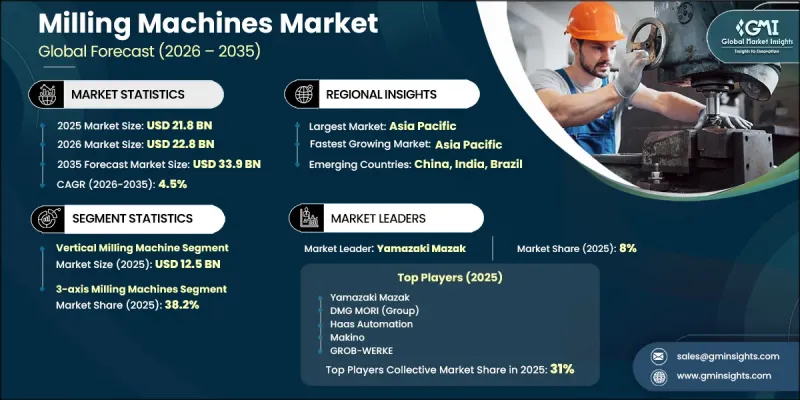
The Global Milling Machines Market was valued at USD 21.8 billion in 2025 and is estimated to grow at a CAGR of 4.5% to reach USD 33.9 billion by 2035.
The milling machines industry is evolving steadily as modern manufacturing environments increasingly demand high precision, operational flexibility, and reliable machining performance. Milling machines remain a critical part of industrial production processes across sectors, including automotive, aerospace, electronics, construction, and general engineering. The market has experienced a significant transformation with the shift from traditional manually operated equipment to advanced automated and digitally controlled systems that improve consistency, reduce production errors, and minimize dependency on highly skilled labor. Growing adoption of smart manufacturing technologies and digitally connected production facilities is further accelerating the deployment of intelligent milling systems capable of handling complex machining tasks with greater efficiency. Manufacturers are also prioritizing equipment that offers enhanced safety features, simplified machine operation, and long-term service reliability to improve productivity and reduce operational downtime. Rising investment in factory automation and precision manufacturing technologies continues to support market expansion globally. In addition, demand for efficient machining solutions that can deliver repeatable accuracy and improved workflow integration is strengthening the long-term outlook for the global milling machines market.
| Market Scope | |
|---|---|
| Start Year | 2025 |
| Forecast Year | 2026-2035 |
| Start Value | $21.8 Billion |
| Forecast Value | $33.9 Billion |
| CAGR | 4.5% |
The vertical milling machines generated USD 12.5 billion in 2025. Their strong market position is supported by compatibility with modern manufacturing requirements and ease of operation in industrial environments. Vertical milling systems provide improved operator visibility during machine setup, adjustment, and production monitoring, helping reduce operational errors and training time for machine operators. These advantages improve overall production efficiency and make vertical milling machines highly preferred among small and medium-sized manufacturing facilities seeking reliable and user-friendly machining solutions.
The 3-axis milling machines segment accounted for 38.2% share in 2025. These machines continue to maintain strong demand because they provide an effective balance between operational versatility and cost efficiency. Most standard machining applications, including drilling, contouring, slotting, and surface cutting, can be performed efficiently using 3-axis systems. Their ability to support consistent and repeatable production processes makes them a preferred choice for commercial machine shops focused on routine component manufacturing and general industrial applications.
U.S. Milling Machines Market held an 80% share, generating USD 4.5 billion in 2025. The country's mature industrial manufacturing base continues to drive demand for advanced machining technologies that emphasize precision, automation, and long-term operational performance. Industries including aerospace, defense, automotive, and industrial equipment manufacturing are increasingly investing in digitally integrated machining systems capable of improving productivity and reducing downtime. Buyers across the U.S. market are also placing strong emphasis on equipment safety, technical support services, machine reliability, and operator training solutions to enhance manufacturing efficiency and maintain competitive production standards.
Key companies operating in the Global Milling Machines Market include Haas Automation, Inc., Yamazaki Mazak Corporation, DMG MORI Co., Ltd., Okuma Corporation, Makino Milling Machine Co., Ltd., FANUC Corporation, Doosan Machine Tools / DN Solutions, Hyundai WIA Corporation, GROB-WERKE GmbH & Co. KG, CHIRON Group, Jier Machine Tool Group Co., Ltd., Qiqihar Heavy CNC Equipment Co., Ltd., Zhejiang Rifa Precision Machinery Co., Ltd., Beijing Jingdiao Group Co., Ltd., Ningbo Haitian Precision Machinery Co., Ltd., Jinan First Machine Tool Co., Ltd., Wuhan Heavy Duty Machine Tool Group Co., Ltd., Baoji Machine Tool Group Co., Ltd., Kede CNC Co., Ltd., and Shandong Weida Precision Intelligent Machinery Co., Ltd. Companies operating in the milling machines market are implementing a range of strategic initiatives to strengthen their market position and expand their global customer base. Major manufacturers are investing heavily in automation technologies, artificial intelligence integration, and digital monitoring systems to improve machine efficiency and precision. Businesses are also focusing on developing smart CNC milling solutions capable of supporting connected factory environments and predictive maintenance capabilities. Strategic partnerships with industrial manufacturers and technology providers are helping companies expand their product portfolios and improve technological capabilities. In addition, manufacturers are strengthening after-sales service networks, technical training programs, and maintenance support to improve customer retention and operational reliability.
Table of Contents
Chapter 1 Methodology & Scope
- 1.1 Research approach
- 1.2 Quality Commitments
- 1.2.1 GMI AI policy & data integrity commitment
- 1.2.1.1 Source consistency protocol
- 1.2.1 GMI AI policy & data integrity commitment
- 1.3 Research Trail & Confidence Scoring
- 1.3.1 Research Trail Components
- 1.3.2 Scoring Components
- 1.4 Data Collection
- 1.4.1 Partial list of primary sources
- 1.5 Data mining sources
- 1.5.1 Paid sources
- 1.5.1.1 Sources, by region
- 1.5.1 Paid sources
- 1.6 Base estimates and calculations
- 1.6.1 Base year calculation for any one approach
- 1.7 Forecast model
- 1.7.1 Quantified market impact analysis
- 1.7.1.1 Mathematical impact of growth parameters on forecast
- 1.7.1 Quantified market impact analysis
- 1.8 Research transparency addendum
- 1.8.1 Source attribution framework
- 1.8.2 Quality assurance metrics
- 1.8.3 Our commitment to trust
Chapter 2 Executive summary
- 2.1 Industry 360° synopsis
- 2.2 Key market trends
- 2.2.1 Country
- 2.2.2 Type
- 2.2.3 Operating Technology
- 2.2.4 Axis Configuration
- 2.2.5 End Use
- 2.2.6 Distribution Channel
Chapter 3 Industry insights
- 3.1 Industry ecosystem analysis
- 3.1.1 Raw material suppliers
- 3.1.2 Equipment manufacturers
- 3.1.3 Value addition at each stage
- 3.1.4 Factor affecting the value chain
- 3.2 Industry impact forces
- 3.2.1 Growth drivers
- 3.2.2 Industry pitfalls and challenges
- 3.2.3 Market opportunities
- 3.3 Growth potential analysis
- 3.4 Regulatory framework
- 3.4.1 North America regulatory standards
- 3.4.2 European CE marking and safety directives
- 3.4.3 Asia Pacific manufacturing standards
- 3.4.4 Environmental and sustainability regulations
- 3.5 Major market trends and disruptions
- 3.6 Technological and innovation landscape
- 3.6.1 Current technological trends
- 3.6.2 Emerging technologies
- 3.7 Pricing analysis (driven by primary research)
- 3.7.1 Historical price trend analysis (driven by primary research)
- 3.7.2 Pricing strategy by player type
- 3.7.3 Price comparison between CNC and conventional equipment
- 3.7.4 Regional price variations
- 3.8 Porter’s analysis
- 3.9 Pestle analysis
- 3.10 Trade data analysis (driven by paid database) ( HS Code 8459)
- 3.10.1 Import and export volume and value trends
- 3.10.2 Key trade corridors and tariff impact
- 3.10.3 China’s export dominance analysis
- 3.10.4 Reshoring and nearshoring trends
- 3.11 Impact of AI and generative AI on the market
- 3.11.1 AI-driven disruption of existing business models
- 3.11.2 GenAI use cases and adoption roadmap by segment
- 3.11.3 Predictive maintenance and digital twin integration
- 3.12 Risks, limitations, and regulatory considerations
- 3.12.1 Capacity and production landscape (driven by primary research)
- 3.12.2 Installed capacity by region and key producer (driven by primary research)
- 3.12.3 Capacity utilization rates and expansion pipelines (driven by primary research)
Chapter 4 Competitive landscape, 2025
- 4.1 Introduction
- 4.2 Company market share analysis
- 4.3 Company matrix analysis
- 4.4 Competitive analysis of major market players
- 4.5 Competitive positioning matrix
- 4.6 Key developments
- 4.6.1 Mergers & acquisitions
- 4.6.2 Partnerships & collaborations
- 4.6.3 New product launches
- 4.7 Expansion plans
Chapter 5 Market Estimates & Forecast, By Type 2022 - 2035, (USD Billion; Thousand Units)
- 5.1 Key trends
- 5.2 Vertical milling machine
- 5.3 Horizontal milling machine
Chapter 6 Market Estimates & Forecast, By Operating Technology 2022 - 2035, (USD Billion; Thousand Units)
- 6.1 Key trends
- 6.2 Computer numerical control (CNC)
- 6.3 Conventional
Chapter 7 Market Estimates & Forecast, By Axis Configuration 2022 - 2035, (USD Billion; Thousand Units)
- 7.1 Key trends
- 7.2 2-Axis milling machine
- 7.3 3-Axis milling machine
- 7.4 4-Axis milling machine
- 7.5 5-Axis milling machine
- 7.6 Others (6-axis, 7-axis. etc.)
Chapter 8 Market Estimates & Forecast, By End Use 2022 - 2035, (USD Billion; Thousand Units)
- 8.1 Key trends
- 8.2 Aerospace & defence
- 8.3 Automotive
- 8.4 Electronics
- 8.5 General machinery
- 8.6 Others
Chapter 9 Market Estimates & Forecast, By Distribution Channel 2022 - 2035, (USD Billion; Thousand Units)
- 9.1 Key trends
- 9.2 Direct sales
- 9.3 Indirect sales
Chapter 10 Market Estimates & Forecast, By Country 2022 - 2035, (USD Billion; Thousand Units)
- 10.1 Key trends
- 10.2 North America
- 10.2.1 U.S
- 10.2.2 Canada
- 10.3 Europe
- 10.3.1 U.K
- 10.3.2 Germany
- 10.3.3 France
- 10.3.4 Italy
- 10.3.5 Spain
- 10.4 Asia Pacific
- 10.4.1 India
- 10.4.2 China
- 10.4.3 Japan
- 10.4.4 Australia
- 10.5 Middle East and Africa
- 10.5.1 UAE
- 10.5.2 Saudi Arabia
- 10.5.3 South Africa
- 10.6 Latin America
- 10.6.1 Brazil
- 10.6.2 Mexico
Chapter 11 Company Profiles
- 11.1 Global Companies
- 11.1.1 Haas Automation, Inc.
- 11.1.2 Yamazaki Mazak Corporation
- 11.1.3 DMG MORI Co., Ltd.
- 11.1.4 Okuma Corporation
- 11.1.5 Makino Milling Machine Co., Ltd.
- 11.1.6 FANUC Corporation
- 11.1.7 Doosan Machine Tools / DN Solutions
- 11.1.8 Hyundai WIA Corporation
- 11.1.9 GROB-WERKE GmbH & Co. KG
- 11.1.10 CHIRON Group
- 11.2 China Companies
- 11.2.1 Jier Machine Tool Group Co., Ltd.
- 11.2.2 Qiqihar Heavy CNC Equipment Co., Ltd.
- 11.2.3 Zhejiang Rifa Precision Machinery Co., Ltd.
- 11.2.4 Beijing Jingdiao Group Co., Ltd.
- 11.2.5 Ningbo Haitian Precision Machinery Co., Ltd.
- 11.2.6 Jinan First Machine Tool Co., Ltd.
- 11.2.7 Wuhan Heavy Duty Machine Tool Group Co., Ltd.
- 11.2.8 Baoji Machine Tool Group Co., Ltd.
- 11.2.9 Kede CNC Co., Ltd.
- 11.2.10 Shandong Weida Precision Intelligent Machinery Co., Ltd.

