PUBLISHER: Global Market Insights Inc. | PRODUCT CODE: 2061380

PUBLISHER: Global Market Insights Inc. | PRODUCT CODE: 2061380
North America Fiberglass Doors Market Opportunity, Growth Drivers, Industry Trend Analysis, and Forecast 2026 - 2035
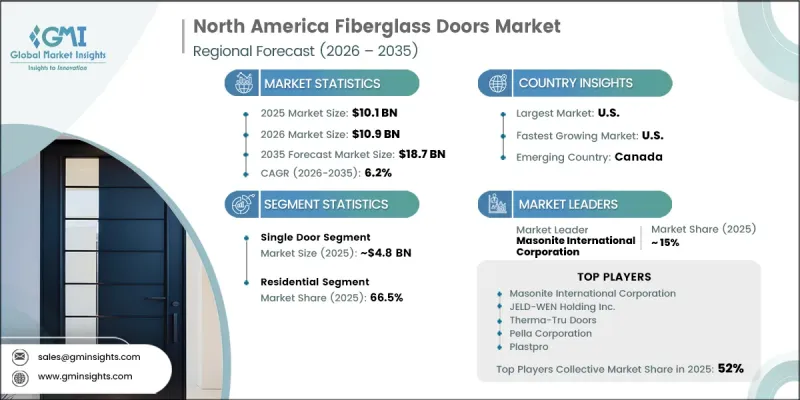
North America Fiberglass Doors Market was valued at USD 10.1 billion in 2025 and is estimated to grow at a CAGR of 6.2% to reach USD 18.7 billion by 2035.
The market across North America continues to witness steady expansion, supported by rising residential construction activity and growing demand for advanced building materials that offer durability and long-term performance. Fiberglass doors are gaining significant attention among homeowners, builders, and property developers because of their ability to withstand harsh weather conditions while maintaining structural integrity and visual appeal. Consumers are increasingly prioritizing products that improve property value, reduce maintenance requirements, and enhance overall building efficiency. The market is also benefiting from the increasing preference for energy-efficient construction materials that align with evolving building standards and sustainability objectives. Modern fiberglass doors combine strength, insulation performance, and design flexibility, making them a preferred solution for both new construction and renovation projects throughout the region. Growing consumer awareness regarding energy conservation and long-lasting home improvement products is further accelerating market growth across residential and commercial applications.
| Market Scope | |
|---|---|
| Start Year | 2025 |
| Forecast Year | 2026-2035 |
| Start Value | $10.1 Billion |
| Forecast Value | $18.7 Billion |
| CAGR | 6.2% |
The increasing focus on remodeling activities and energy-efficient building solutions is expected to continue driving demand for fiberglass door systems throughout North America. Modern fiberglass doors are designed to deliver enhanced thermal insulation, durability, and low maintenance performance, making them highly suitable for contemporary construction requirements. Consumers are increasingly choosing fiberglass doors because they provide a balance of functionality, appearance, and long-term operational value. Advancements in manufacturing technologies have also improved product customization capabilities, enabling a wider range of finishes, styles, and configurations to suit different architectural preferences. Rising adoption of stricter energy-efficiency standards and building regulations is further supporting the use of advanced fiberglass door solutions across the construction industry.
The single door segment generated USD 4.8 billion in 2025 and is projected to grow at a CAGR of 6.7% from 2026 to 2035. This segment continues to account for a major share of the market because single-entry door systems remain widely used across residential and light commercial applications. Single fiberglass doors offer flexible installation options and are available in multiple dimensions, decorative finishes, and design variations that complement a broad range of building styles. These products are increasingly preferred for their energy-saving features, compatibility with advanced security systems, and ability to meet modern construction requirements while preserving traditional design aesthetics.
The residential segment accounted for 66.5% share in 2025 and is expected to grow at a CAGR of 6.5% through 2035. Strong growth in residential construction and renovation projects continues to support demand for fiberglass doors across the housing sector. Homeowners are increasingly investing in property upgrades and entrance system improvements that enhance visual appeal, energy efficiency, and long-term durability. Rising consumer interest in modern home improvement solutions and property value enhancement is contributing significantly to residential market dominance. Buyers are also placing greater emphasis on product reliability, insulation efficiency, and attractive door designs that support both functionality and aesthetics.
U.S. Fiberglass Doors Market accounted for 77.9% share in 2025 and is forecast to grow at a CAGR of 5.8% from 2026 to 2035. The country maintains a leading position in the regional market due to its extensive construction industry, strong residential development pipeline, and highly established building materials distribution network. Demand for fiberglass doors remains strong among homeowners, contractors, and developers seeking durable, energy-efficient, and code-compliant building products. The broad presence of manufacturers and suppliers across the U.S. supports product accessibility, technical assistance, certification services, and after-sales support. In addition, ongoing investments in residential housing projects and replacement door installations continue to create favorable growth opportunities for fiberglass door manufacturers throughout the country.
Key companies operating in the North America Fiberglass Doors Market include Masonite International Corporation, Therma-Tru Doors, Pella Corporation, JELD-WEN Holding, Inc., Plastpro, Inc., ProVia Door, Mastergrain, Feather River Door Company, Neuma Doors, GlassCraft Door Company, Fibertec Window & Door Mfg. Ltd., ODL, Inc., Steves & Sons, Inc., YK Industries, Nova Doors, Inline Fiberglass Ltd., and Lux Doors. Companies operating in the North America fiberglass doors market are focusing on product innovation, energy-efficient technologies, and design customization to strengthen their competitive position. Manufacturers are expanding their product portfolios with advanced fiberglass door systems that offer improved insulation performance, enhanced security compatibility, and modern architectural aesthetics. Strategic partnerships with distributors, contractors, and residential developers are helping companies increase market penetration and strengthen regional presence. Businesses are also investing in advanced manufacturing capabilities to improve production efficiency and support growing demand for customized door solutions. In addition, companies are emphasizing sustainability initiatives by developing environmentally responsible products that comply with evolving energy-efficiency standards and green building regulations.
Table of Contents
Chapter 1 Methodology and Scope
- 1.1 Market scope and definition
- 1.2 Research design
- 1.2.1 Research approach
- 1.2.2 Data collection methods
- 1.3 Data mining sources
- 1.3.1 Global
- 1.3.2 Regional/country
- 1.4 Base estimates and calculations
- 1.4.1 Base year calculation
- 1.4.2 Key trends for market estimation
- 1.5 Primary research and validation
- 1.5.1 Primary sources
- 1.6 Forecast model
- 1.7 Research assumptions and limitations
Chapter 2 Executive Summary
- 2.1 Industry 360° synopsis
- 2.2 Business trends
- 2.2.1 Product type
- 2.2.2 Design
- 2.2.3 Installation
- 2.2.4 Price range
- 2.2.5 Application
- 2.2.6 End use
- 2.2.7 Distribution channel
Chapter 3 Industry Insights
- 3.1 Industry ecosystem analysis
- 3.1.1 Supplier landscape
- 3.1.2 Profit margin
- 3.1.3 Value addition at each stage
- 3.1.4 Factor affecting the value chain
- 3.1.5 Disruptions
- 3.2 Industry impact forces
- 3.2.1 Growth drivers
- 3.2.2 Industry pitfalls & challenges
- 3.2.3 Opportunities
- 3.3 Growth potential analysis
- 3.4 Future market trends
- 3.5 Technology and innovation landscape
- 3.5.1 Smart door integration
- 3.5.2 IoT-enabled access control systems
- 3.6 Price Trends by Door Type (Driven by Primary Research)
- 3.6.1 Historical price trend analysis
- 3.6.2 Pricing strategy by player type (premium / value / cost-plus)
- 3.7 Regulatory framework
- 3.8 Trade statistics
- 3.8.1 Major importing countries
- 3.8.2 Major exporting countries
- 3.9 Porter's five forces analysis
- 3.10 PESTEL analysis
- 3.11 Trade Data Analysis (Driven by Primary Research)
- 3.11.1 Import/Export Volume & Value Trends (Driven by Primary Research)
- 3.11.2 Key Trade Corridors & Tariff Impact (Driven by Primary Research)
- 3.12 Consumer behavior analysis
- 3.13 Impact of AI & Generative AI on the Market
- 3.13.1 AI-Driven Disruption of Existing Business Models
- 3.13.2 GenAI Use Cases & Adoption Roadmap by Segment
- 3.13.3 Risks, Limitations & Regulatory Considerations
- 3.14 Capacity & Production Landscape (Driven by Primary Research)
- 3.14.1 Installed Manufacturing Capacity by Region & Key Producer (Driven by Primary Research)
- 3.14.2 Capacity Utilization Rates & Expansion Pipelines (Driven by Primary Research)
Chapter 4 Competitive Landscape, 2025
- 4.1 Introduction
- 4.2 Company market share analysis
- 4.3 Company matrix analysis
- 4.4 Competitive analysis of major market players
- 4.5 Competitive positioning matrix
- 4.6 Key developments
- 4.6.1 Mergers & acquisitions
- 4.6.2 Partnerships & collaborations
- 4.6.3 New product launches
- 4.6.4 Expansion plans
Chapter 5 Market Estimates & Forecast, By Product Type, 2022-2035 (USD Billion) (Million Units)
- 5.1 Key trends
- 5.2 Single door
- 5.3 Double door
- 5.4 Sliding door
- 5.5 Others
Chapter 6 Market Estimates & Forecast, By Design, 2022-2035 (USD Billion) (Million Units)
- 6.1 Key trends
- 6.2 Interior
- 6.3 Exterior
Chapter 7 Market Estimates & Forecast, By Installation, 2022-2035 (USD Billion) (Million Units)
- 7.1 Key trends
- 7.2 Mobile
- 7.3 Manufactured
Chapter 8 Market Estimates & Forecast, By Price Range 2022-2035 (USD Billion) (Million Units)
- 8.1 Key trends
- 8.2 Low
- 8.3 Medium
- 8.4 High
Chapter 9 Market Estimates & Forecast, By Application 2022-2035 (USD Billion) (Million Units)
- 9.1 Key trends
- 9.2 Residential
- 9.3 Commercial
- 9.4 Industrial
Chapter 10 Market Estimates & Forecast, By End Use 2022-2035 (USD Billion) (Million Units)
- 10.1 Key trends
- 10.2 New construction
- 10.3 Replacement/renovation
Chapter 11 Market Estimates & Forecast, By Distribution Channel, 2022-2035 (USD Billion) (Million Units)
- 11.1 Key trends
- 11.2 Direct
- 11.3 Indirect
Chapter 12 Market Estimates and Forecast, By Country, 2022 - 2035 (USD Billion) (Million Units)
- 12.1 Key trends
- 12.2 North America
- 12.2.1 US
- 12.2.2 Canada
Chapter 13 Company Profiles
- 13.1 Tier 1 Global/Top PLAYERS
- 13.1.1 Masonite International Corporation
- 13.1.2 JELD-WEN Holding, Inc.
- 13.1.3 Therma-Tru Doors
- 13.1.4 Pella Corporation
- 13.1.5 Plastpro, Inc.
- 13.1.6 ProVia Door
- 13.1.7 ODL, Inc.
- 13.2 Tier 2 REGIONAL/NICHE PLAYERS
- 13.2.1 Steves & Sons, Inc.
- 13.2.2 Fibertec Window & Door Mfg. Ltd.
- 13.2.3 Inline Fiberglass Ltd.
- 13.2.4 Mastergrain
- 13.2.5 Nova Doors
- 13.3 Tier 3: Emerging players
- 13.3.1 Feather River Door Company
- 13.3.2 GlassCraft Door Company
- 13.3.3 Neuma Doors
- 13.3.4 Lux Doors
- 13.3.5 YK Industries

