PUBLISHER: Global Market Insights Inc. | PRODUCT CODE: 2061402

PUBLISHER: Global Market Insights Inc. | PRODUCT CODE: 2061402
Critical Care Devices Market Opportunity, Growth Drivers, Industry Trend Analysis, and Forecast 2026 - 2035
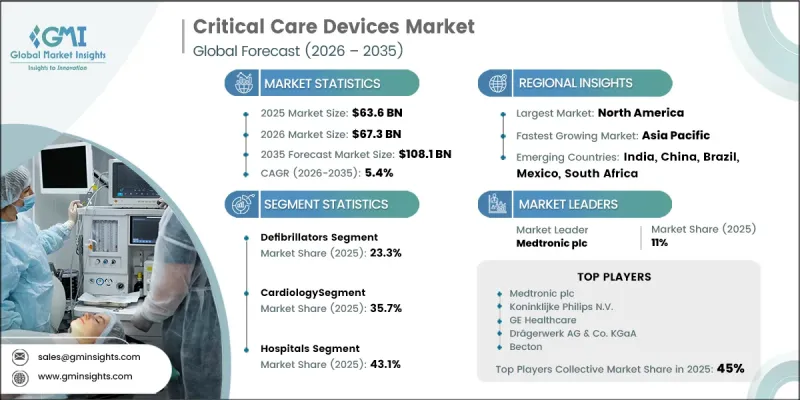
The Global Critical Care Devices Market was valued at USD 63.6 billion in 2025 and is estimated to grow at a CAGR of 5.4% to reach USD 108.1 billion by 2035.
Market expansion is driven by the increasing need for advanced intensive care solutions, the rising prevalence of chronic health conditions, and ongoing technological advancements in critical care technologies. Growing pressure on healthcare systems worldwide to manage critically ill patients more effectively is accelerating the adoption of sophisticated life-support and patient monitoring equipment. Critical care devices are designed to support and maintain vital physiological functions in emergency and intensive care environments, enabling healthcare professionals to deliver continuous monitoring and rapid medical intervention. Rising incidences of chronic disorders associated with aging populations, changing lifestyles, and increasing healthcare demands are contributing significantly to market growth. The growing number of patients requiring intensive medical supervision and long-term critical care support is further increasing the demand for technologically advanced medical devices. In addition, expanding healthcare infrastructure, increasing investments in intensive care facilities, and the integration of digital monitoring technologies are supporting broader adoption of critical care systems across hospitals and specialized healthcare centers worldwide.
| Market Scope | |
|---|---|
| Start Year | 2025 |
| Forecast Year | 2026-2035 |
| Start Value | $63.6 Billion |
| Forecast Value | $108.1 Billion |
| CAGR | 5.4% |
Critical care devices are specialized medical technologies used within intensive care environments to assist in monitoring and stabilizing patients experiencing severe or life-threatening health conditions. These systems are widely utilized to support essential organ functions and improve patient management during emergency treatment procedures. Rising demand for continuous patient observation and advanced therapeutic support is strengthening the adoption of critical care technologies across healthcare facilities. The increasing burden of chronic illnesses and acute medical conditions requiring immediate intervention is further contributing to industry expansion. Growing demand for intensive care units is also supporting the widespread deployment of advanced monitoring and life-support systems throughout the healthcare sector.
The Defibrillators segment accounted for 23.3% share in 2025. Demand for defibrillators continues to rise due to their critical role in restoring normal cardiac rhythm during emergency situations involving severe cardiac complications. Ongoing technological advancements have improved device portability, operational efficiency, and accessibility across emergency care settings. Increasing awareness regarding emergency cardiac response systems and expanding emergency healthcare services are further contributing to the growth of the segment. The availability of technologically advanced defibrillation systems is also supporting wider adoption across hospitals and critical care facilities.
The cardiology segment held a share of 35.7% in 2025. Cardiology remains one of the largest application areas for critical care devices due to the growing global burden of cardiovascular disorders and increasing demand for rapid cardiac intervention technologies. Critical care systems used in cardiology applications enable healthcare professionals to monitor patients continuously and provide immediate therapeutic support during life-threatening cardiac conditions. Rising ICU admissions related to cardiac complications are significantly increasing the demand for advanced cardiac monitoring technologies and support devices. Continuous innovation in real-time monitoring systems and cardiac care technologies is further strengthening the expansion of this segment across healthcare institutions worldwide.
North America Critical Care Devices Market held a 37.5% share in 2025. The region continues to maintain a strong market position due to increasing rates of chronic illnesses and rising demand for intensive healthcare services. The growing prevalence of cardiovascular and respiratory conditions is contributing to higher hospitalization and ICU admission rates, driving the need for advanced critical care technologies across healthcare facilities. North America also benefits from a highly developed healthcare infrastructure, favorable reimbursement systems, and widespread adoption of technologically advanced medical devices. Hospitals throughout the U.S. and Canada continue to invest heavily in advanced intensive care systems, supporting sustained demand for monitoring equipment, infusion systems, and life-support technologies across the region.
Major companies operating in the Global Critical Care Devices Market include Abbott Laboratories, Air Liquide Medical Systems India, Asahi Kasei Corporation, B. Braun Melsungen, Baxter, Becton, Dickinson and Company, Boston Scientific Corporation, Cardinal Health, Dragerwerk, Fresenius Medical Care, GE Healthcare, Getinge, Hamilton Medical, ICU Medical, Koninklijke Philips, and Medtronic. Companies operating in the critical care devices market are adopting several strategic initiatives to strengthen their market presence and expand their competitive positioning globally. Industry participants are investing heavily in research and development activities to introduce technologically advanced monitoring systems, life-support equipment, and integrated digital healthcare solutions. Strategic mergers, acquisitions, and collaborations are helping companies expand product portfolios and improve geographic reach. Market players are also focusing on incorporating artificial intelligence, remote patient monitoring, and data-driven healthcare technologies into critical care systems to improve clinical efficiency and patient outcomes. Expanding manufacturing capabilities, strengthening distribution networks, and increasing investments in healthcare infrastructure partnerships are further supporting business growth.
Table of Contents
Chapter 1 Research Methodology
- 1.1 Research approach
- 1.2 Quality commitments
- 1.2.1 GMI AI policy and data integrity commitment
- 1.2.1.1 Source consistency protocol
- 1.2.1 GMI AI policy and data integrity commitment
- 1.3 Research trail and confidence scoring
- 1.3.1 Research trail components
- 1.3.2 Scoring components
- 1.4 Data collection
- 1.4.1 Partial list of primary sources
- 1.5 Data mining sources
- 1.5.1 Paid sources
- 1.5.1.1 Sources, by region
- 1.5.1 Paid sources
- 1.6 Base estimates and calculations
- 1.6.1 Base year calculation for any one approach
- 1.7 Forecast model
- 1.7.1 Quantified market impact analysis
- 1.7.1.1 Mathematical impact of growth parameters on forecast
- 1.7.1 Quantified market impact analysis
- 1.8 Research transparency addendum
- 1.8.1 Source attribution framework
- 1.8.2 Quality assurance metrics
- 1.8.3 Our commitment to trust
Chapter 2 Executive Summary
- 2.1 Industry 3600 synopsis
- 2.2 Key market trends
- 2.2.1 Product trends
- 2.2.2 Application trends
- 2.2.3 End use trends
- 2.2.4 Regional trends
- 2.3 CXO perspectives: Strategic imperatives
Chapter 3 Industry Insights
- 3.1 Industry ecosystem analysis
- 3.2 Industry impact forces
- 3.2.1 Growth drivers
- 3.2.1.1 Rising demand for intensive care units
- 3.2.1.2 Growing incidence of chronic diseases throughout the globe
- 3.2.1.3 Technological advancements in critical care
- 3.2.1.4 Surging demand for ventilators for better management of diseases
- 3.2.2 Industry pitfalls and challenges
- 3.2.2.1 Lack of skilled professionals
- 3.2.2.2 High cost of critical care devices
- 3.2.3 Market opportunities
- 3.2.3.1 Improvement in emergency medical services (EMS)
- 3.2.1 Growth drivers
- 3.3 Growth potential analysis
- 3.4 Regulatory landscape (Driven by primary research)
- 3.4.1 North America
- 3.4.2 Europe
- 3.4.3 Asia Pacific
- 3.4.4 Latin America
- 3.4.5 Middle East and Africa
- 3.5 Technology landscape (Driven by primary research)
- 3.5.1 Current technological trends
- 3.5.1.1 Multiparameter patient monitoring systems
- 3.5.1.2 Continuous renal replacement therapy (CRRT) Systems
- 3.5.2 Emerging technologies
- 3.5.2.1 Tele-ICU and remote monitoring solutions
- 3.5.2.2 AI-Integrated critical care systems
- 3.5.1 Current technological trends
- 3.6 Future market trends (Driven by primary research)
- 3.7 Impact of AI and Generative AI on the market (Driven by primary research)
- 3.8 Pricing trend analysis (Driven by primary research)
- 3.9 Porter’s analysis
- 3.10 PESTEL analysis
Chapter 4 Competitive Landscape, 2025
- 4.1 Introduction
- 4.2 Company market share analysis
- 4.2.1 Global
- 4.2.2 North America
- 4.2.3 Europe
- 4.2.4 Asia Pacific
- 4.3 Company matrix analysis
- 4.4 Competitive analysis of major market players
- 4.5 Competitive positioning matrix
- 4.6 Key developments
- 4.6.1 Mergers and acquisitions
- 4.6.2 Partnerships and collaborations
- 4.6.3 New product launches
- 4.6.4 Expansion plans
Chapter 5 Market Estimates and Forecast, By Product, 2022 - 2035 ($ Mn and Units)
- 5.1 Key trends
- 5.2 Defibrillators
- 5.3 Multiparameter monitoring devices
- 5.4 ECG devices
- 5.5 Hemodialysis machines
- 5.6 Infusion pumps
- 5.7 Ventilators
- 5.8 Feeding tubes
- 5.9 Anesthesia monitors
- 5.10 CRRT machines
- 5.11 Other products
Chapter 6 Market Estimates and Forecast, By Application, 2022 - 2035 ($ Mn and Units)
- 6.1 Key trends
- 6.2 Renal care
- 6.3 Cardiology
- 6.4 Neurology
- 6.5 Other applications
Chapter 7 Market Estimates and Forecast, By End Use, 2022 - 2035 ($ Mn and Units)
- 7.1 Key trends
- 7.2 Hospitals
- 7.3 Ambulatory surgical centers
- 7.4 Specialty clinics
- 7.5 Other end users
Chapter 8 Market Estimates and Forecast, By Region, 2022 - 2035 ($ Mn and Units)
- 8.1 Key trends
- 8.2 North America
- 8.2.1 U.S.
- 8.2.2 Canada
- 8.3 Europe
- 8.3.1 Germany
- 8.3.2 UK
- 8.3.3 France
- 8.3.4 Spain
- 8.3.5 Italy
- 8.3.6 Netherlands
- 8.4 Asia Pacific
- 8.4.1 China
- 8.4.2 Japan
- 8.4.3 India
- 8.4.4 Australia
- 8.4.5 South Korea
- 8.5 Latin America
- 8.5.1 Brazil
- 8.5.2 Mexico
- 8.5.3 Argentina
- 8.6 Middle East and Africa
- 8.6.1 South Africa
- 8.6.2 Saudi Arabia
- 8.6.3 UAE
Chapter 9 Company Profiles
- 9.1 Abbott Laboratories
- 9.2 Air Liquide Medical Systems India
- 9.3 Asahi Kasei Corporation
- 9.4 B. Braun Melsungen
- 9.5 Baxter
- 9.6 Becton, Dickinson and Company
- 9.7 Boston Scientific Corporation
- 9.8 Cardinal Health
- 9.9 Dragerwerk
- 9.10 Fresenius Medical Care
- 9.11 GE Healthcare
- 9.12 Getinge
- 9.13 Hamilton Medical
- 9.14 ICU Medical
- 9.15 Koninklijke Philips
- 9.16 Medtronic

