PUBLISHER: Global Market Insights Inc. | PRODUCT CODE: 2061429

PUBLISHER: Global Market Insights Inc. | PRODUCT CODE: 2061429
Subscription Billing Management Market Opportunity, Growth Drivers, Industry Trend Analysis, and Forecast 2026 - 2035
The Global Subscription Billing Management Market was valued at USD 7.3 billion in 2025 and is estimated to grow at a CAGR of 13.6% to reach USD 26 billion by 2035.
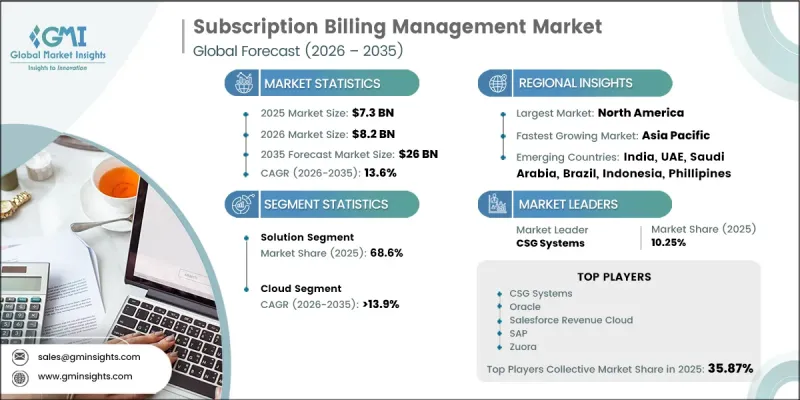
The market is witnessing strong momentum due to the rapid expansion of digital subscription business models and the growing preference for recurring revenue strategies across multiple industries. Organizations operating in SaaS, telecommunications, media, fintech, e-commerce, and digital services are increasingly transitioning away from one-time transaction models toward subscription-based ecosystems to improve revenue visibility and strengthen customer engagement. Rising demand for automated billing workflows, recurring payment processing, invoicing automation, and subscription lifecycle management is accelerating adoption of advanced billing platforms worldwide. Businesses are also investing heavily in cloud-enabled monetization systems to efficiently manage large-scale subscriber bases and recurring revenue streams. The increasing popularity of streaming services, digital applications, embedded payment technologies, and flexible pricing structures is further contributing to market growth. In addition, AI-powered automation, predictive analytics, real-time revenue visibility, and improved billing accuracy are enabling enterprises to optimize operational efficiency while enhancing customer retention and financial performance.
| Market Scope | |
|---|---|
| Start Year | 2025 |
| Forecast Year | 2026-2035 |
| Start Value | $7.3 Billion |
| Forecast Value | $26 Billion |
| CAGR | 13.6% |
The solutions segment held a 68.6% share in 2025 and is anticipated to grow at a CAGR of 13.9% through 2035. Demand for comprehensive subscription billing solutions continues to increase as enterprises seek unified platforms capable of handling invoicing, recurring payment processing, subscription lifecycle management, revenue recognition, and compliance functions within a centralized system. Integrated platforms help organizations minimize operational inefficiencies, reduce manual intervention, and improve billing accuracy across recurring payment cycles. The growing shift toward digital-first business models across industries has further accelerated the need for scalable and customizable subscription billing platforms capable of supporting usage-based, hybrid, and flexible pricing structures.
The cloud segment held a 73% share in 2025 and is projected to grow at a CAGR of 13.9% between 2026 and 2035. Cloud-based subscription billing management platforms continue to gain widespread traction because of their scalability, flexibility, and lower infrastructure requirements. These systems allow organizations to efficiently manage complex recurring billing environments while supporting real-time invoicing, automated payment collection, and high transaction processing volumes. Businesses across SaaS, telecommunications, media, and digital commerce sectors increasingly favor cloud deployment models to support remote accessibility, centralized management, and rapid digital transformation initiatives. The ability to seamlessly scale operations while reducing infrastructure costs continues to strengthen adoption of cloud subscription billing platforms globally.
U.S. Subscription Billing Management Market accounted for 81.6% share, generated USD 2.1 billion in 2025. Market growth in the country is supported by the strong presence of major SaaS providers, digital content companies, cloud technology firms, and subscription-driven enterprises that rely heavily on recurring revenue models. The increasing use of cloud computing technologies and large-scale digital transformation initiatives across industries continues to drive demand for advanced subscription billing systems capable of managing large subscriber networks, complex pricing models, and high-volume transaction environments. Organizations across the U.S. are increasingly adopting automated billing technologies to improve financial operations, strengthen customer retention, and enhance scalability.
Major companies operating in the Global Subscription Billing Management Market include Amdocs, Oracle, Chargebee, Zuora, Stripe Billing, Salesforce Revenue Cloud, SAP, Aria Systems, Recurly, and CSG Systems. Companies operating in the subscription billing management market are focusing on several strategic initiatives to strengthen their competitive positioning and expand market presence. Leading providers are investing heavily in AI-powered automation, advanced analytics, and machine learning capabilities to improve billing accuracy, automate revenue management, and enhance customer experience. Many companies are also prioritizing cloud-native platform development to deliver scalable and flexible subscription management solutions for enterprises of all sizes. Strategic partnerships with payment gateway providers, fintech firms, and SaaS companies are helping market participants broaden their customer reach and improve service integration capabilities. In addition, vendors are introducing customizable pricing models, multi-currency support, and real-time reporting features to address evolving enterprise requirements. Geographic expansion, mergers and acquisitions, and continuous platform innovation remain key strategies supporting long-term market growth and customer acquisition.
Table of Contents
Chapter 1 Methodology
- 1.1 Research approach
- 1.2 Quality Commitments
- 1.2.1 GMI AI policy & data integrity commitment
- 1.2.1.1 Source consistency protocol
- 1.2.1 GMI AI policy & data integrity commitment
- 1.3 Research Trail & Confidence Scoring
- 1.3.1 Research Trail Components
- 1.3.2 Scoring Components
- 1.4 Data Collection
- 1.4.1 Partial list of primary sources
- 1.5 Data mining sources
- 1.5.1 Paid sources
- 1.5.1.1 Sources, by region
- 1.5.1 Paid sources
- 1.6 Base estimates and calculations
- 1.6.1 Base year calculation
- 1.7 Forecast Model
- 1.7.1 Quantified market impact analysis
- 1.7.1.1 Mathematical impact of growth parameters on forecast
- 1.7.1 Quantified market impact analysis
- 1.8 Research transparency addendum
- 1.8.1 Source attribution framework
- 1.8.2 Quality assurance metrics
- 1.8.3 Our commitment to trust
Chapter 2 Executive Summary
- 2.1 Industry 360° synopsis, 2022 - 2035
- 2.2 Key market trends
- 2.2.1 Regional
- 2.2.2 Component
- 2.2.3 Deployment mode
- 2.2.4 Organization Size
- 2.2.5 End use
- 2.3 TAM Analysis, 2026-2035
- 2.4 CXO perspectives: Strategic imperatives
Chapter 3 Industry Insights
- 3.1 Industry ecosystem analysis
- 3.1.1 Supplier landscape
- 3.1.2 Profit margin analysis
- 3.1.3 Cost structure
- 3.1.4 Value addition at each stage
- 3.1.5 Factor affecting the value chain
- 3.1.6 Disruptions
- 3.2 Industry impact forces
- 3.2.1 Growth drivers
- 3.2.1.1 Rising adoption of subscription-based business models across industries
- 3.2.1.2 Rapid expansion of SaaS, fintech, and digital commerce platforms
- 3.2.1.3 Increasing penetration of cloud-based billing and payment solutions
- 3.2.1.4 Growing demand for automated recurring payment and invoicing systems
- 3.2.2 Industry pitfalls and challenges
- 3.2.2.1 Complex regional tax and regulatory compliance requirements
- 3.2.2.2 Integration challenges with legacy enterprise systems
- 3.2.3 Market opportunities
- 3.2.3.1 Increasing adoption of AI-driven analytics and billing automation solutions
- 3.2.3.2 Rising demand for personalized and usage-based subscription pricing models
- 3.2.3.3 Expansion of SMEs adopting cloud-native subscription billing platforms
- 3.2.3.4 Growing cross-border digital commerce and multi-currency billing requirements
- 3.2.1 Growth drivers
- 3.3 Growth potential analysis
- 3.4 Technology and Innovation landscape
- 3.4.1 Current technological trends
- 3.4.2 Emerging technologies
- 3.5 Pricing Analysis (Driven by primary research)
- 3.5.1 Historical Price Trend Analysis
- 3.5.2 Pricing Strategy by Player Type (Premium / Value / Cost-plus)
- 3.6 Regulatory landscape
- 3.6.1 North America
- 3.6.1.1 U.S.: ASC 606 Revenue Recognition Standards & SOX Compliance Requirements
- 3.6.1.2 Canada: PIPEDA Data Privacy & Digital Payment Compliance Frameworks.
- 3.6.2 Europe
- 3.6.2.1 Germany: IFRS 15 Compliance & BaFin Financial Reporting Rules
- 3.6.2.2 UK: FCA Regulations & Open Banking Compliance Standards
- 3.6.2.3 France: CNIL Data Protection & Digital Service Tax Compliance
- 3.6.2.4 Italy: EU VAT Digital Compliance & e-Invoicing Mandates
- 3.6.3 Asia Pacific
- 3.6.3.1 China: Cybersecurity Law & Digital Payment Regulatory Frameworks
- 3.6.3.2 India: GST Compliance & Digital Payment Regulations (UPI Framework)
- 3.6.3.3 Japan: Electronic Transaction Act & Personal Data Protection Law
- 3.6.3.4 South Korea: Electronic Financial Transactions Act & Data Privacy Laws (PIPA)
- 3.6.3.5 Australia: ASIC Regulatory Framework & Digital Economy Compliance Rules
- 3.6.4 Latin America
- 3.6.4.1 Brazil: Central Bank PIX Regulations & Digital Financial Compliance Rules
- 3.6.4.2 Mexico: Tax Authority (SAT) Digital Invoicing Regulations (CFDI System)
- 3.6.4.3 Argentina: AFIP Electronic Billing Regulations for Digital Services
- 3.6.5 MEA
- 3.6.5.1 UAE: UAE VAT Regulations & Digital Government Billing Standards
- 3.6.5.2 Saudi Arabia: ZATCA E-Invoicing & Digital Tax Compliance Rules
- 3.6.5.3 South Africa: SARS Electronic Tax Filing & Digital Transaction Regulations
- 3.6.1 North America
- 3.7 Cost breakdown analysis
- 3.8 Porter's analysis
- 3.9 PESTEL analysis
- 3.10 Patent Landscape (Driven by primary research)
- 3.11 Impact of AI & Generative AI on the Market (Driven by primary research)
- 3.11.1 AI-Driven Disruption of Existing Business Models
- 3.11.2 GenAI Use Cases & Adoption Roadmap by Segment
- 3.11.3 Risks, Limitations & Regulatory Considerations
- 3.12 End-User adoption patterns & demand concentration
- 3.12.1 Adoption rate by industry vertical & organization size, 2022-2025 (%)
- 3.12.2 Willingness-to-pay analysis by buyer segment
- 3.13 Forecast assumptions & scenario analysis (Driven by primary research)
- 3.13.1 Base Case - Key Macro & Industry Variables Driving CAGR
- 3.13.2 Optimistic Scenarios - Favourable macro and industry tailwinds
- 3.13.3 Pessimistic Scenario - Macroeconomic slowdown or industry headwinds
Chapter 4 Competitive Landscape, 2025
- 4.1 Introduction
- 4.2 Company market share analysis
- 4.2.1 North America
- 4.2.2 Europe
- 4.2.3 Asia Pacific
- 4.2.4 Latin America
- 4.2.5 MEA
- 4.3 Competitive analysis of major market players
- 4.4 Competitive positioning matrix
- 4.5 Key developments
- 4.5.1 Mergers & acquisitions
- 4.5.2 Partnerships & collaborations
- 4.5.3 New Product Launches
- 4.5.4 Expansion Plans and funding
- 4.6 Company Tier Benchmarking
- 4.6.1 Tier Classification Criteria & Qualifying Thresholds
- 4.6.2 Tier Positioning Matrix by Revenue, Geography & Innovation
Chapter 5 Market Estimates & Forecast, By Component, 2022 - 2035 ($Bn)
- 5.1 Key trends
- 5.2 Solution
- 5.3 Service
- 5.3.1 Professional services
- 5.3.2 Managed Services
Chapter 6 Market Estimates & Forecast, By Deployment mode, 2022 - 2035 ($Bn)
- 6.1 Key trends
- 6.1.1 On-premises
- 6.1.2 Cloud
Chapter 7 Market Estimates & Forecast, By Propulsion, 2022 - 2035 ($Bn, Units)
- 7.1 Key trends
- 7.2 ICE
- 7.3 Electric vehicles
- 7.3.1 Battery Electric Vehicles (BEV)
- 7.3.2 Plug-in Hybrid Electric Vehicles (PHEV)
- 7.3.3 Hybrid Electric Vehicles (HEV)
Chapter 8 Market Estimates & Forecast, By Organization Size, 2022 - 2035 ($Bn)
- 8.1 Key trends
- 8.2 Small and medium-sized enterprises (SME)
- 8.3 Large enterprises
Chapter 9 Market Estimates & Forecast, By End use, 2022 - 2035 ($Bn)
- 9.1 Key trends
- 9.2 IT & Telecom
- 9.3 Healthcare
- 9.4 Media & entertainment
- 9.5 Retail & e-commerce
- 9.6 BFSI
- 9.7 Others
Chapter 10 Market Estimates & Forecast, By Region, 2022 - 2035 ($Bn)
- 10.1 Key trends
- 10.2 North America
- 10.2.1 US
- 10.2.2 Canada
- 10.3 Europe
- 10.3.1 Germany
- 10.3.2 UK
- 10.3.3 France
- 10.3.4 Italy
- 10.3.5 Spain
- 10.3.6 Russia
- 10.3.7 Netherlands
- 10.3.8 Belgium
- 10.3.9 Norway
- 10.3.10 Sweden
- 10.3.11 Austria
- 10.4 Asia Pacific
- 10.4.1 China
- 10.4.2 India
- 10.4.3 Japan
- 10.4.4 Australia
- 10.4.5 South Korea
- 10.4.6 Philippines
- 10.4.7 Indonesia
- 10.4.8 Singapore
- 10.4.9 Malaysia
- 10.5 Latin America
- 10.5.1 Brazil
- 10.5.2 Mexico
- 10.5.3 Argentina
- 10.5.4 Colombia
- 10.6 MEA
- 10.6.1 South Africa
- 10.6.2 Saudi Arabia
- 10.6.3 UAE
Chapter 11 Company Profiles
- 11.1 Global Players
- 11.1.1 Adyen
- 11.1.2 Aria Systems
- 11.1.3 Chargebee
- 11.1.4 dLocal
- 11.1.5 Oracle
- 11.1.6 Recurly
- 11.1.7 SAP
- 11.1.8 Stripe Billing
- 11.1.9 Vindicia (Amdocs)
- 11.1.10 Zuora
- 11.2 Regional Players
- 11.2.1 Billcentrix
- 11.2.2 Conekta
- 11.2.3 EBANX
- 11.2.4 iugu
- 11.2.5 Kushki
- 11.2.6 PayU
- 11.2.7 Rebill
- 11.2.8 Vindi
- 11.3 Emerging Players
- 11.3.1 Cobranzo
- 11.3.2 Piriod
- 11.3.3 Recurrio
- 11.3.4 Reveniu
- 11.3.5 Treli

