PUBLISHER: Global Market Insights Inc. | PRODUCT CODE: 2061432

PUBLISHER: Global Market Insights Inc. | PRODUCT CODE: 2061432
Automotive Relay Market Opportunity, Growth Drivers, Industry Trend Analysis, and Forecast 2026 - 2035
The Global Automotive Relay Market was valued at USD 11.1 billion in 2025 and is estimated to grow at a CAGR of 6.5% to reach USD 21 billion by 2035.
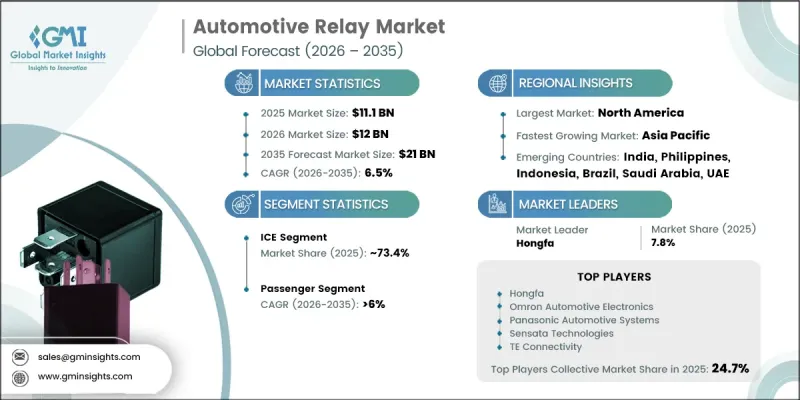
Strong market expansion is supported by rising global vehicle production and the increasing integration of advanced electronic systems across modern automobiles. Automotive relays play a vital role in managing electrical operations within vehicles, supporting functions related to power distribution, lighting systems, infotainment technologies, vehicle safety, and powertrain management. Growing consumer demand for enhanced vehicle comfort, connectivity features, and improved driving performance is accelerating the adoption of technologically advanced relay solutions. The increasing transition toward electric and hybrid mobility is also contributing significantly to market growth, as these vehicles require highly efficient and high-voltage relay systems capable of managing complex electrical architectures. In addition, stringent automotive safety and emission regulations are encouraging manufacturers to integrate more sophisticated electronic components, thereby increasing relay demand worldwide. Continuous advancements in relay design, thermal stability, durability, and environmental resistance are further supporting innovation within the automotive relay industry, ensuring consistent performance under increasingly demanding operating conditions.
| Market Scope | |
|---|---|
| Start Year | 2025 |
| Forecast Year | 2026-2035 |
| Start Value | $11.1 Billion |
| Forecast Value | $21 Billion |
| CAGR | 6.5% |
The automotive relay market is also benefiting from growing emphasis on vehicle electrification and energy efficiency initiatives across the global automotive sector. Relays are increasingly being designed to support advanced battery management systems, charging technologies, and efficient power switching applications in electric mobility platforms. Rising investments in automotive electronics and next-generation vehicle technologies are further strengthening the need for intelligent and reliable relay solutions capable of supporting evolving automotive architectures and higher electronic content in vehicles.
The ICE segment held a share of 73.4% in 2025 and is projected to grow at a CAGR of 6.2% through 2035. Internal combustion engine vehicles continue to account for a substantial portion of global automobile production, creating strong and consistent demand for automotive relays. These vehicles rely heavily on relays to support multiple electrical and electromechanical functions associated with engine operation, ignition management, lighting systems, climate control technologies, and power distribution. Strong manufacturing ecosystems and established supply chain networks for ICE vehicles are also contributing to sustained relay consumption across both developed and emerging automotive markets.
The passenger vehicle segment accounted for 67.4% share in 2025 and is expected to grow at a CAGR of 6% from 2026 to 2035. Passenger vehicles remain the leading application segment due to high production volumes and increasing global ownership rates. Modern passenger automobiles incorporate a growing number of electronic systems designed to improve convenience, safety, comfort, and driving performance, all of which require efficient relay-based switching solutions. Increasing electrification of passenger vehicles and rising integration of advanced electronic control technologies are significantly increasing demand for automotive relays across this segment.
China Automotive Relay Market held a share of 64.2% and generated USD 3.5 billion in 2025. The country continues to maintain a leading market position due to its status as one of the world's largest automotive manufacturing centers, supported by substantial domestic vehicle production and strong consumer demand. Rapid expansion of automotive electronics integration across both passenger and commercial vehicles is driving increased demand for reliable relay technologies throughout the Chinese automotive industry. Growth in electric vehicle manufacturing and continued advancement of vehicle electrification initiatives are also accelerating the adoption of advanced automotive relay systems across multiple automotive platforms.
Major companies operating in the Global Automotive Relay Market include FORVIA HELLA, Hongfa, Littelfuse, Omron Automotive Electronics, Panasonic Automotive Systems, Sensata Technologies, TE Connectivity, Tianbo Electric, and Zettler. Companies operating in the automotive relay market are adopting several strategic initiatives to strengthen their market presence and improve competitive positioning globally. Industry participants are heavily investing in research and development activities to introduce advanced relay technologies with enhanced durability, thermal performance, and energy efficiency. Strategic collaborations, mergers, and partnerships with automotive manufacturers are helping companies expand product portfolios and strengthen long-term supply agreements. Market players are also focusing on developing high-voltage relays specifically designed for electric and hybrid vehicle applications to capitalize on the growing shift toward vehicle electrification. Increasing investments in automation, smart manufacturing technologies, and advanced material development are further improving production efficiency and product reliability. In addition, companies are expanding global distribution networks and strengthening regional manufacturing capabilities to improve customer reach and reinforce their foothold within the global automotive relay industry.
Table of Contents
Chapter 1 Methodology
- 1.1 Research approach
- 1.2 Quality Commitments
- 1.2.1 GMI AI policy & data integrity commitment
- 1.2.1.1 Source consistency protocol
- 1.2.1 GMI AI policy & data integrity commitment
- 1.3 Research Trail & Confidence Scoring
- 1.3.1 Research Trail Components
- 1.3.2 Scoring Components
- 1.4 Data Collection
- 1.4.1 Partial list of primary sources
- 1.5 Data mining sources
- 1.5.1 Paid sources
- 1.5.1.1 Sources, by region
- 1.5.1 Paid sources
- 1.6 Base estimates and calculations
- 1.6.1 Base year calculation
- 1.7 Forecast Model
- 1.7.1 Quantified market impact analysis
- 1.7.1.1 Mathematical impact of growth parameters on forecast
- 1.7.1 Quantified market impact analysis
- 1.8 Research transparency addendum
- 1.8.1 Source attribution framework
- 1.8.2 Quality assurance metrics
- 1.8.3 Our commitment to trust
Chapter 2 Executive Summary
- 2.1 Industry 360° synopsis, 2022 - 2035
- 2.2 Key market trends
- 2.2.1 Regional
- 2.2.2 Relay
- 2.2.3 Propulsion
- 2.2.4 Vehicle
- 2.2.5 Sales Channel
- 2.2.6 Application
- 2.3 TAM Analysis, 2026-2035
- 2.4 CXO perspectives: Strategic imperatives
Chapter 3 Industry Insights
- 3.1 Industry ecosystem analysis
- 3.1.1 Supplier landscape
- 3.1.2 Profit margin analysis
- 3.1.3 Cost structure
- 3.1.4 Value addition at each stage
- 3.1.5 Factor affecting the value chain
- 3.1.6 Disruptions
- 3.2 Industry impact forces
- 3.2.1 Growth drivers
- 3.2.1.1 Increasing vehicle production across the world
- 3.2.1.2 Growing electric vehicle (EV) adoption
- 3.2.1.3 Rising demand for high-performance & miniaturized relays
- 3.2.1.4 Expansion of advanced driver assistance systems (ADAS)
- 3.2.2 Industry pitfalls and challenges
- 3.2.2.1 High maintenance & failure risks
- 3.2.2.2 Increasing complexity in vehicle electronics
- 3.2.3 Market opportunities
- 3.2.3.1 Expansion of Electric Vehicle Charging Infrastructure
- 3.2.3.2 Growth in Connected and Smart Vehicles
- 3.2.3.3 Rising Demand for Energy-Efficient Components
- 3.2.3.4 Increasing Adoption of Autonomous Driving Technologies
- 3.2.1 Growth drivers
- 3.3 Growth potential analysis
- 3.4 Technology and Innovation landscape
- 3.4.1 Current technological trends
- 3.4.2 Emerging technologies
- 3.5 Pricing Analysis (Driven by Primary Research)
- 3.5.1 Historical Price Trend Analysis
- 3.5.2 Pricing Strategy by Player Type (Premium / Value / Cost-plus)
- 3.6 Regulatory guideline
- 3.6.1 North America
- 3.6.1.1 U.S.: Federal Motor Vehicle Safety Standards (FMVSS) & ISO 26262 Functional Safety Compliance
- 3.6.1.2 Canada: Motor Vehicle Safety Regulations (MVSR) for Automotive Electrical Components.
- 3.6.2 Europe
- 3.6.2.1 Germany: VDA Automotive Electronics Reliability Standards
- 3.6.2.2 UK: UNECE Vehicle Electrical Safety & EMC Regulations
- 3.6.2.3 France: Automotive Electrification & EV Component Safety Standards
- 3.6.2.4 Italy: EU RoHS and REACH Compliance for Automotive Electronic Components
- 3.6.3 Asia Pacific
- 3.6.3.1 China: GB/T Standards for Automotive Electrical Relay Systems
- 3.6.3.2 India: AIS Automotive Industry Standards for Vehicle Electrical Systems
- 3.6.3.3 Japan: JASO Standards for Automotive Relays and Electronic Components
- 3.6.3.4 South Korea: KC Certification for Automotive Electronic Devices
- 3.6.3.5 Australia: Australian Design Rules (ADR) for Vehicle Electrical Safety
- 3.6.4 Latin America
- 3.6.4.1 Brazil: INMETRO Certification for Automotive Electrical Components
- 3.6.4.2 Mexico: NOM Standards for Automotive Electronics and Vehicle Safety
- 3.6.4.3 Argentina: National Automotive Component Certification Framework
- 3.6.5 MEA
- 3.6.5.1 UAE: Emirates Authority for Standardization and Metrology (ESMA) Vehicle Electronics Standards
- 3.6.5.2 Saudi Arabia: SASO Automotive Electrical Component Regulations
- 3.6.5.3 South Africa: National Regulator for Compulsory Specifications (NRCS) Vehicle Component
- 3.6.1 North America
- 3.7 Porter’s analysis
- 3.8 PESTEL analysis
- 3.9 Patent Landscape (Driven by Primary Research)
- 3.10 Trade Data Analysis (Based on Paid Database)
- 3.10.1 Import/Export Volume & Value Trends
- 3.10.2 Key Trade Corridors & Tariff Impact
- 3.11 Impact of AI & Generative AI on the Market (Driven by Primary Research)
- 3.11.1 AI-Driven Disruption of Existing Business Models
- 3.11.2 GenAI Use Cases & Adoption Roadmap by Segment
- 3.11.3 Risks, Limitations & Regulatory Considerations
- 3.12 Capacity & Production Landscape (Driven by Primary Research)
- 3.12.1 Production Capacity by Region & Key Producer
- 3.12.2 Capacity Utilization Rates & Expansion Pipelines
- 3.13 Sustainability and environmental aspects
- 3.13.1 Sustainable practices
- 3.13.2 Waste reduction strategies
- 3.13.3 Energy efficiency in production
- 3.13.4 Eco-friendly initiatives
- 3.13.5 Carbon footprint considerations
- 3.14 Forecast assumptions & scenario analysis (Driven by Primary Research)
- 3.14.1 Base Case - Key Macro & Industry Variables Driving CAGR
- 3.14.2 Optimistic Scenarios - Favourable macro and industry tailwinds
- 3.14.3 Pessimistic Scenario - Macroeconomic slowdown or industry headwinds
Chapter 4 Competitive Landscape, 2025
- 4.1 Introduction
- 4.2 Company market share analysis
- 4.2.1 North America
- 4.2.2 Europe
- 4.2.3 Asia Pacific
- 4.2.4 Latin America
- 4.2.5 MEA
- 4.3 Competitive analysis of major market players
- 4.4 Competitive positioning matrix
- 4.5 Key developments
- 4.5.1 Mergers & acquisitions
- 4.5.2 Partnerships & collaborations
- 4.5.3 New Product Launches
- 4.5.4 Expansion Plans and funding
- 4.6 Company Tier Benchmarking
- 4.6.1 Tier Classification Criteria & Qualifying Thresholds
- 4.6.2 Tier Positioning Matrix by Revenue, Geography & Innovation
Chapter 5 Market Estimates & Forecast, By Relay, 2022 - 2035 ($Bn, Units)
- 5.1 Key trends
- 5.2 PCB relay
- 5.3 Plug-in relay
- 5.4 High voltage relay
- 5.5 Electromechanical relay
- 5.6 Time delay relay
- 5.7 Latching relay
- 5.8 Others
Chapter 6 Market Estimates & Forecast, By Vehicle, 2022 - 2035 ($Bn, Units)
- 6.1 Key trends
- 6.2 Passenger cars
- 6.2.1 Sedans
- 6.2.2 Hatchbacks
- 6.2.3 SUV
- 6.3 Commercial vehicles
- 6.3.1 Light duty
- 6.3.2 Medium duty
- 6.3.3 Heavy duty
Chapter 7 Market Estimates & Forecast, By Propulsion, 2022 - 2035 ($Bn, Units)
- 7.1 Key trends
- 7.2 ICE
- 7.3 Electric vehicles
- 7.3.1 Battery Electric Vehicles (BEV)
- 7.3.2 Plug-in Hybrid Electric Vehicles (PHEV)
- 7.3.3 Hybrid Electric Vehicles (HEV)
Chapter 8 Market Estimates & Forecast, By Sales Channel, 2022 - 2035 ($Bn, Units)
- 8.1 Key trends
- 8.2 OEM
- 8.3 Aftermarket
Chapter 9 Market Estimates & Forecast, By Application, 2022 - 2035 ($Bn, Units)
- 9.1 Key trends
- 9.2 Powertrain systems
- 9.3 Body & comfort systems
- 9.4 Safety & security systems
- 9.5 Infotainment & connectivity
- 9.6 Battery management & charging systems
Chapter 10 Market Estimates & Forecast, By Region, 2022 - 2035 ($Bn, Units)
- 10.1 Key trends
- 10.2 North America
- 10.2.1 US
- 10.2.2 Canada
- 10.3 Europe
- 10.3.1 Germany
- 10.3.2 UK
- 10.3.3 France
- 10.3.4 Italy
- 10.3.5 Spain
- 10.3.6 Russia
- 10.3.7 Netherlands
- 10.3.8 Belgium
- 10.4 Asia Pacific
- 10.4.1 China
- 10.4.2 India
- 10.4.3 Japan
- 10.4.4 Australia
- 10.4.5 South Korea
- 10.4.6 Philippines
- 10.4.7 Indonesia
- 10.5 Latin America
- 10.5.1 Brazil
- 10.5.2 Mexico
- 10.5.3 Argentina
- 10.6 MEA
- 10.6.1 South Africa
- 10.6.2 Saudi Arabia
- 10.6.3 UAE
Chapter 11 Company Profiles
- 11.1 Global Players
- 11.1.1 TE Connectivity
- 11.1.2 Panasonic Automotive Systems
- 11.1.3 Omron Automotive Electronics
- 11.1.4 Hongfa (Xiamen Hongfa Electroacoustic)
- 11.1.5 Fujitsu Component
- 11.1.6 Song Chuan
- 11.1.7 American Zettler
- 11.1.8 FORVIA HELLA
- 11.1.9 Sensata Technologies
- 11.1.10 Littelfuse
- 11.2 Regional Players
- 11.2.1 Tianbo Electric
- 11.2.2 Goodsky Electric
- 11.2.3 Gruner
- 11.2.4 Takamisawa Electric
- 11.2.5 Ningbo Forward Relay
- 11.2.6 Zettler
- 11.2.7 Hanchang
- 11.2.8 Ningbo Best
- 11.2.9 Schrack Technik
- 11.2.10 IMO Precision Controls
- 11.3 Emerging Players
- 11.3.1 Sanyou Relays
- 11.3.2 NUCLETRON Technologies
- 11.3.3 Rayex Electronics
- 11.3.4 Churod Electronics
- 11.3.5 Zhejiang Fanhar Electronics

