
PUBLISHER: Global Market Insights Inc. | PRODUCT CODE: 2061455

PUBLISHER: Global Market Insights Inc. | PRODUCT CODE: 2061455
Wealth Management Platform Market Opportunity, Growth Drivers, Industry Trend Analysis, and Forecast 2026 - 2035
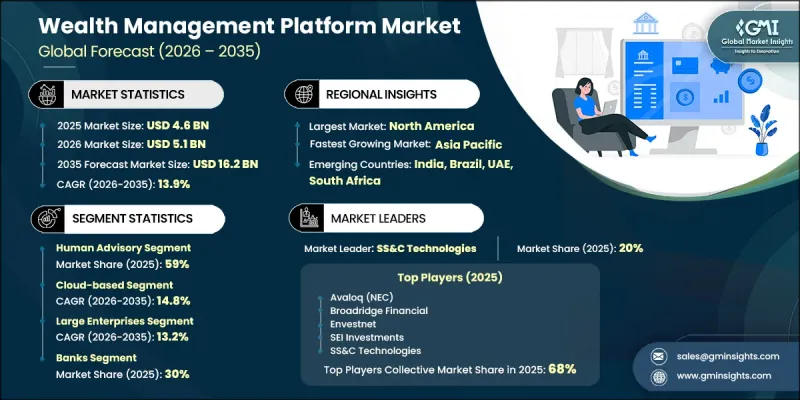
The Global Wealth Management Platform Market was valued at USD 4.6 billion in 2025 and is estimated to grow at a CAGR of 13.9% to reach USD 16.2 billion by 2035.
The wealth management platform industry is witnessing rapid growth as financial institutions increasingly prioritize personalized investment solutions for high-net-worth and mass affluent clients. Rising digital transformation initiatives across the financial services sector are encouraging firms to modernize their infrastructure, improve customer engagement, and enhance operational scalability. Growing interest in alternative investments, including private equity and real assets, is further driving demand for platforms capable of handling complex asset structures and diversified portfolios. In addition, evolving regulatory frameworks are increasing the importance of automated compliance management and advanced reporting capabilities. Financial institutions are steadily replacing traditional legacy systems with cloud-native wealth management platforms to improve flexibility, lower infrastructure expenses, strengthen cybersecurity, and enable real-time access to client data. Artificial intelligence, predictive analytics, and behavioral data are also reshaping advisory services by enabling hyper-personalized portfolio recommendations based on investor objectives, risk profiles, and changing financial priorities. Continuous innovation in digital advisory technologies is expected to accelerate market expansion throughout the forecast period.
| Market Scope | |
|---|---|
| Start Year | 2025 |
| Forecast Year | 2026-2035 |
| Start Value | $4.6 Billion |
| Forecast Value | $16.2 Billion |
| CAGR | 13.9% |
The human advisory segment accounted for 59% share in 2025 and is anticipated to grow at a CAGR of 12.5% from 2026 to 2035. Human-led advisory services continue to maintain a strong position in the industry because investors value customized financial planning and direct interaction with experienced advisors. These professionals analyze market conditions, financial objectives, and risk tolerance levels to create personalized investment strategies tailored to each client. Clients with large or diversified portfolios often prefer human advisory models because they provide trust, personalized communication, and strategic guidance for complex investment decisions. The ability to combine relationship-driven consulting with customized portfolio management continues to strengthen demand for this segment.
The cloud-based segment held a 63% share in 2025 and is projected to grow at a CAGR of 14.8% through 2035. Cloud-enabled wealth management platforms are gaining strong traction due to their scalability, operational flexibility, and lower upfront infrastructure requirements. These systems allow firms to efficiently increase their assets under management and client base while maintaining cost efficiency through subscription-based deployment models. Cloud platforms also provide advisors with real-time access to portfolio data and digital advisory tools from remote locations. Integration with artificial intelligence, robo-advisory technologies, and external financial databases further enhances operational efficiency and supports comprehensive wealth management services.
U.S. Wealth Management Platform Market generated USD 1.5 billion in 2025 and is expected to grow at a CAGR of 12.1% between 2026 and 2035. The country remains a leading hub for innovation in digital wealth management solutions due to its advanced financial ecosystem and large investor base. Financial institutions across the U.S. are increasingly adopting AI-powered advisory tools, predictive analytics platforms, and hybrid advisory models to improve customer engagement and operational efficiency. Robo-advisory and hybrid wealth management services are becoming increasingly popular among firms seeking scalable solutions for mass affluent clients while maintaining personalized financial guidance. Regulatory oversight within the country continues to support investor protection while encouraging innovation in digital financial services and wealth technology platforms.
Key companies operating in the Global Wealth Management Platform Market include Addepar, Temenos, InvestCloud, FIS, Fiserv, Broadridge Financial Solutions, Orion Advisor Solutions, SS&C Technologies, Avaloq, Envestnet, FNZ, iCapital Network, and SEI Investments. Companies operating in the wealth management platform market are adopting several strategic initiatives to strengthen their competitive position and expand their global footprint. Market participants are heavily investing in cloud-native technologies, artificial intelligence, and predictive analytics to improve platform efficiency and deliver highly personalized investment recommendations. Many firms are expanding their hybrid advisory capabilities by combining robo-advisory tools with human expertise to attract both high-net-worth and mass affluent investors. Strategic collaborations with fintech providers and financial institutions are also helping companies broaden service offerings and improve digital integration. In addition, providers are enhancing cybersecurity frameworks, automating compliance management, and integrating real-time portfolio monitoring solutions to improve customer trust and operational transparency. Continuous product innovation and geographic expansion remain central strategies for sustaining long-term growth in the global wealth management platform industry.
Table of Contents
Chapter 1 Methodology
- 1.1 Research approach
- 1.2 Quality Commitments
- 1.2.1 GMI AI policy & data integrity commitment
- 1.2.1.1 Source consistency protocol
- 1.2.1 GMI AI policy & data integrity commitment
- 1.3 Research Trail & Confidence Scoring
- 1.3.1 Research Trail Components
- 1.3.2 Scoring Components
- 1.4 Data Collection
- 1.4.1 Partial list of primary sources
- 1.5 Data mining sources
- 1.5.1 Paid sources
- 1.5.1.1 Sources, by region
- 1.5.1 Paid sources
- 1.6 Base estimates and calculations
- 1.6.1 Base year calculation
- 1.7 Forecast model
- 1.7.1 Quantified market impact analysis
- 1.7.1.1 Mathematical impact of growth parameters on forecast
- 1.7.1 Quantified market impact analysis
- 1.8 Research transparency addendum
- 1.8.1 Source attribution framework
- 1.8.2 Quality assurance metrics
- 1.8.3 Our commitment to trust
Chapter 2 Executive Summary
- 2.1 Industry 360° synopsis
- 2.2 Key market trends
- 2.2.1 Regional
- 2.2.2 Advisory mode
- 2.2.3 Deployment mode
- 2.2.4 Enterprise size
- 2.2.5 Application
- 2.2.6 End use
- 2.3 TAM analysis, 2026-2035
- 2.4 CXO perspectives: Strategic imperatives
Chapter 3 Industry Insights
- 3.1 Industry ecosystem analysis
- 3.1.1 Supplier landscape
- 3.1.2 Profit margin
- 3.1.3 Cost structure
- 3.1.4 Value addition at each stage
- 3.1.5 Factor affecting the value chain
- 3.1.6 Disruptions
- 3.2 Industry impact forces
- 3.2.1 Growth drivers
- 3.2.1.1 Rising demand for personalized financial advisory
- 3.2.1.2 Digital transformation in financial services
- 3.2.1.3 Growth in alternative investments
- 3.2.1.4 Increasing regulatory complexity and compliance requirements
- 3.2.2 Industry pitfalls and challenges
- 3.2.2.1 High implementation and integration costs
- 3.2.2.2 Data security and privacy concerns
- 3.2.3 Market opportunities
- 3.2.3.1 Expansion of robo-advisory and hybrid models
- 3.2.3.2 Growth potential in emerging wealth markets
- 3.2.3.3 Integration of AI and predictive analytics
- 3.2.3.4 Adoption of platform-as-a-service and API ecosystems
- 3.2.1 Growth drivers
- 3.3 Growth potential analysis
- 3.4 Technology and innovation landscape
- 3.4.1 Current technological trends
- 3.4.2 Emerging technologies
- 3.5 Cost breakdown analysis
- 3.6 Regulatory landscape
- 3.6.1 North America
- 3.6.1.1 Securities and Exchange Commission (SEC)
- 3.6.1.2 Financial Industry Regulatory Authority (FINRA)
- 3.6.2 Europe
- 3.6.2.1 European Commission
- 3.6.2.2 European Securities and Markets Authority (ESMA)
- 3.6.3 Asia Pacific
- 3.6.3.1 Ministry of Industry and Information Technology
- 3.6.3.2 Securities and Exchange Board of India (SEBI)
- 3.6.4 Latin America
- 3.6.4.1 Comissao de Valores Mobiliarios (CVM)
- 3.6.4.2 Comision Nacional Bancaria y de Valores (CNBV)
- 3.6.5 Middle East & Africa
- 3.6.5.1 Dubai Financial Services Authority (DFSA)
- 3.6.5.2 Capital Market Authority (CMA)
- 3.6.1 North America
- 3.7 Porter’s analysis
- 3.8 PESTEL analysis
- 3.9 Patent analysis (Driven by Primary Research)
- 3.10 Impact of AI & Generative AI on the Market
- 3.10.1 AI-driven disruption of existing business models
- 3.10.2 Gen AI use cases & adoption roadmap by segment
- 3.10.3 Risks, limitations & regulatory considerations
- 3.11 Sustainability and environmental aspects
- 3.11.1 Sustainable practices
- 3.11.2 Waste reduction strategies
- 3.11.3 Energy efficiency in production
- 3.11.4 Eco-friendly initiatives
- 3.11.5 Carbon footprint considerations
- 3.12 Forecast assumptions & scenario analysis (Driven by primary research)
- 3.12.1 Base Case - key macro & industry variables driving CAGR
- 3.12.2 Optimistic Scenarios - Favorable macro and industry tailwinds
- 3.12.3 Pessimistic Scenario - Macroeconomic slowdown or industry headwinds
Chapter 4 Competitive Landscape, 2025
- 4.1 Introduction
- 4.2 Company market share analysis
- 4.2.1 North America
- 4.2.2 Europe
- 4.2.3 Asia Pacific
- 4.2.4 LATAM
- 4.2.5 MEA
- 4.3 Competitive analysis of major market players
- 4.4 Competitive positioning matrix
- 4.5 Key developments
- 4.5.1 Mergers & acquisitions
- 4.5.2 Partnerships & collaborations
- 4.5.3 New product launches
- 4.5.4 Expansion plans and funding
Chapter 5 Market Estimates & Forecast, By Advisory mode, 2022 - 2035 ($Mn)
- 5.1 Key trends
- 5.2 Human advisory
- 5.3 Robo advisory
- 5.4 Hybrid
Chapter 6 Market Estimates & Forecast, By Deployment mode, 2022 - 2035 ($Mn)
- 6.1 Key trends
- 6.2 Cloud-based
- 6.3 On premises
Chapter 7 Market Estimates & Forecast, By Enterprise size, 2022 - 2035 ($Mn)
- 7.1 Key trends
- 7.2 Large enterprises
- 7.3 SMEs
Chapter 8 Market Estimates & Forecast, By Application, 2022 - 2035 ($Mn)
- 8.1 Key trends
- 8.2 Financial advice & management
- 8.3 Portfolio, accounting, & trading management
- 8.4 Performance management
- 8.5 Risk & compliance management
- 8.6 Reporting
- 8.7 Others
Chapter 9 Market Estimates & Forecast, By End use, 2022 - 2035 ($Mn)
- 9.1 Key trends
- 9.2 Banks
- 9.3 Investment management firms
- 9.4 Brokerage firms
- 9.5 Trading & exchange firms
- 9.6 Others
Chapter 10 Market Estimates & Forecast, By Region, 2022 - 2035 ($Mn)
- 10.1 Key trends
- 10.2 North America
- 10.2.1 U.S.
- 10.2.2 Canada
- 10.3 Europe
- 10.3.1 Germany
- 10.3.2 UK
- 10.3.3 France
- 10.3.4 Italy
- 10.3.5 Spain
- 10.3.6 Russia
- 10.3.7 Netherlands
- 10.4 Asia Pacific
- 10.4.1 China
- 10.4.2 India
- 10.4.3 Japan
- 10.4.4 South Korea
- 10.4.5 Australia
- 10.4.6 Vietnam
- 10.4.7 Indonesia
- 10.5 Latin America
- 10.5.1 Brazil
- 10.5.2 Mexico
- 10.5.3 Argentina
- 10.6 MEA
- 10.6.1 South Africa
- 10.6.2 Saudi Arabia
- 10.6.3 UAE
Chapter 11 Company Profiles
- 11.1 Global players
- 11.1.1 Avaloq
- 11.1.2 Broadridge Financial Solutions
- 11.1.3 Envestnet
- 11.1.4 FIS
- 11.1.5 Fiserv
- 11.1.6 FNZ
- 11.1.7 SS&C Technologies
- 11.1.8 Temenos
- 11.2 Regional players
- 11.2.1 Addepar
- 11.2.2 Backbase
- 11.2.3 Comarch
- 11.2.4 InvestCloud
- 11.2.5 Nutmeg
- 11.2.6 Orion Advisor Solutions
- 11.2.7 Scalable Capital
- 11.2.8 SEI Investments
- 11.3 Emerging players
- 11.3.1 Betterment
- 11.3.2 CAIS
- 11.3.3 iCapital Network
- 11.3.4 StashAway

