PUBLISHER: Global Market Insights Inc. | PRODUCT CODE: 2061465

PUBLISHER: Global Market Insights Inc. | PRODUCT CODE: 2061465
Layered C-UAS Architecture Market Opportunity, Growth Drivers, Industry Trend Analysis, and Forecast 2026 - 2035
The Global Layered C-UAS Architecture Market was valued at USD 2.3 billion in 2025 and is estimated to grow at a CAGR of 27.3% to reach USD 25.4 billion by 2035.
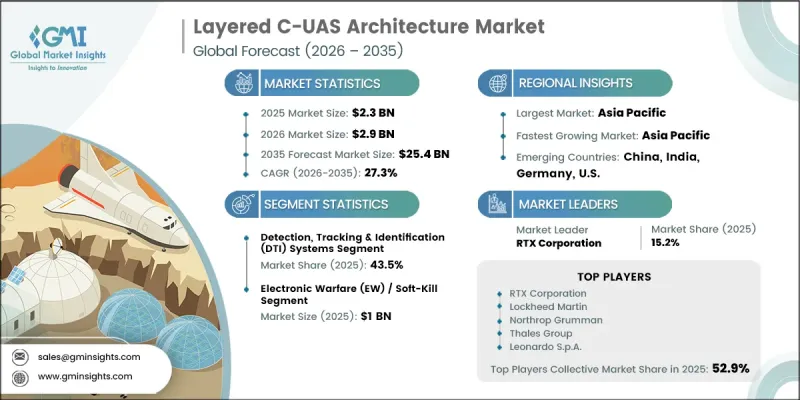
Expansion of the layered C-UAS architecture industry is driven by the growing sophistication, frequency, and diversity of unmanned aerial threats that require comprehensive defense strategies rather than standalone countermeasures. Organizations responsible for protecting sensitive assets are increasingly adopting integrated systems capable of supporting the full spectrum of detection, tracking, identification, and mitigation functions. Rising security requirements across defense establishments, critical infrastructure facilities, and public-sector operations are further accelerating market growth. In addition, continued investments in homeland security programs and defense modernization initiatives are creating strong demand for advanced counter-drone technologies. Technological advancements in sensor networks, command-and-control platforms, and data processing capabilities are also improving the effectiveness and reliability of layered defense architectures. As threat environments become more complex, organizations are prioritizing scalable and interoperable solutions that can respond to multiple threat scenarios while maintaining operational efficiency. These factors are positioning the layered C-UAS architecture market for substantial long-term expansion as governments and security organizations continue strengthening airspace protection capabilities.
| Market Scope | |
|---|---|
| Start Year | 2025 |
| Forecast Year | 2026-2035 |
| Start Value | $2.3 Billion |
| Forecast Value | $25.4 Billion |
| CAGR | 27.3% |
The layered C-UAS architecture market is gaining momentum as evolving unmanned aerial threats create increasing demand for integrated defense frameworks capable of addressing a broad range of operational challenges. The growing use of advanced drone technologies has highlighted the limitations of isolated countermeasure systems, prompting greater adoption of multi-layered architectures designed to provide enhanced situational awareness and coordinated threat response. Increased government focus on national security, rising defense expenditures, and stronger collaboration among security agencies are contributing to the broader implementation of comprehensive counter-UAS solutions. At the same time, advancements in sensor technologies, command-and-control systems, and interoperability capabilities are improving operational performance and strengthening the effectiveness of layered defense networks.
The command, control, and data fusion (C2/DF) platforms segment is projected to grow at a CAGR of 29.3% throughout the forecast period. Growth within this segment is driven by the increasing complexity of modern counter-UAS environments and the growing requirement to integrate information from multiple detection and mitigation systems. As layered defense architectures become more sophisticated, organizations are investing in centralized platforms that support real-time information processing, automated decision support, and coordinated responses across multiple operational layers. These capabilities are becoming essential for improving situational awareness and enhancing overall system performance.
The hybrid and integrated systems segment is anticipated to register a CAGR of 28.1% during 2026-2035. Segment growth is supported by the rising need for flexible and adaptive counter-UAS solutions capable of operating across diverse environments. Increasingly advanced aerial threat scenarios are encouraging adoption of integrated architectures that combine multiple defense layers under a unified operational framework. The ability to coordinate fixed and deployable assets through centralized management systems is improving response effectiveness and supporting wider adoption across defense and security applications.
North America Layered C-UAS Architecture Market accounted for 31.4% share in 2025. Regional growth is driven by heightened priorities surrounding homeland security, airspace protection, border monitoring, and critical infrastructure defense. Growing concerns related to unauthorized aerial activity have increased demand for advanced counter-UAS solutions capable of providing comprehensive protection across a range of operational environments. Significant government investments, large-scale defense modernization programs, and enhanced coordination among federal agencies are further supporting the adoption of layered counter-UAS architectures throughout the region. These factors continue to strengthen North America's position as a key market for advanced airspace security technologies.
Major companies operating in the Global Layered C-UAS Architecture Industry include RTX Corporation, Lockheed Martin, Northrop Grumman, Thales Group, Leonardo S.p.A., Israel Aerospace Industries, Rafael Advanced Defense Systems, BAE Systems, Saab AB, Elbit Systems, Rheinmetall AG, L3Harris Technologies, Anduril Industries, DroneShield, and Dedrone. Companies competing in the layered C-UAS architecture market are implementing a variety of strategies to strengthen their market position and expand their competitive advantage. Significant investments in research and development are enabling organizations to enhance threat detection accuracy, improve sensor integration capabilities, and develop more advanced command-and-control platforms. Strategic collaborations with defense agencies, technology providers, and security organizations are accelerating innovation and expanding deployment opportunities. Market participants are also focusing on developing scalable and interoperable solutions capable of addressing evolving aerial threat environments. Portfolio expansion through acquisitions, technology partnerships, and product diversification remains a key growth strategy. In addition, companies are emphasizing artificial intelligence integration, real-time data analytics, and autonomous response capabilities to improve operational effectiveness, strengthen customer value propositions, and secure a stronger foothold within the rapidly growing layered C-UAS architecture market.
Table of Contents
Chapter 1 Methodology and Scope
- 1.1 Market scope and definition
- 1.2 Research design
- 1.2.1 Research approach
- 1.2.2 Data collection methods
- 1.3 Data mining sources
- 1.3.1 Global
- 1.3.2 Regional/Country
- 1.4 Base estimates and calculations
- 1.4.1 Base year calculation
- 1.4.2 Key trends for market estimation
- 1.5 Primary research and validation
- 1.5.1 Primary sources
- 1.6 Forecast model
- 1.7 Research assumptions and limitations
Chapter 2 Executive Summary
- 2.1 Industry 360° synopsis, 2022 - 2035
- 2.2 Key market trends
- 2.2.1 Component type trends
- 2.2.2 Mitigation technology type trends
- 2.2.3 Deployment architecture trends
- 2.2.4 End-User trends
- 2.2.5 Regional trends
- 2.3 TAM Analysis, 2026-2035
- 2.4 CXO perspectives: Strategic imperatives
Chapter 3 Industry Insights
- 3.1 Industry ecosystem analysis
- 3.1.1 Supplier Landscape
- 3.1.2 Profit Margin
- 3.1.3 Cost structure
- 3.1.4 Value addition at each stage
- 3.1.5 Factor affecting the value chain
- 3.1.6 Disruptions
- 3.2 Industry impact forces
- 3.2.1 Growth drivers
- 3.2.1.1 Rising frequency and complexity of drone threats
- 3.2.1.2 Shift toward integrated and networked defense systems
- 3.2.1.3 Growing protection requirements for critical infrastructure
- 3.2.1.4 Increased defense and homeland security spending
- 3.2.1.5 Advancements in sensor fusion and command-and-control technologies
- 3.2.2 Industry pitfalls and challenges
- 3.2.2.1 Regulatory complexity and operational restrictions
- 3.2.2.2 High system integration cost and technical complexity
- 3.2.3 Market opportunities
- 3.2.3.1 Commercial and civilian airspace security adoption
- 3.2.3.2 Export potential and allied defense collaboration programs
- 3.2.1 Growth drivers
- 3.3 Growth potential analysis
- 3.4 Regulatory landscape
- 3.4.1 North America
- 3.4.2 Europe
- 3.4.3 Asia Pacific
- 3.4.4 Latin America
- 3.4.5 Middle East & Africa
- 3.5 Porter’s analysis
- 3.6 PESTEL analysis
- 3.7 Technology and Innovation landscape
- 3.7.1 Current technological trends
- 3.7.2 Emerging technologies
- 3.8 Price trends
- 3.8.1 By region
- 3.8.2 By product
- 3.9 Pricing Strategies
- 3.10 Emerging Business Models
- 3.11 Compliance Requirements
- 3.12 Patent and IP analysis
Chapter 4 Competitive Landscape, 2025
- 4.1 Introduction
- 4.2 Company market share analysis
- 4.2.1 By region
- 4.2.1.1 North America
- 4.2.1.2 Europe
- 4.2.1.3 Asia Pacific
- 4.2.1.4 Latin America
- 4.2.1.5 Middle East & Africa
- 4.2.2 Market concentration analysis
- 4.2.1 By region
- 4.3 Competitive benchmarking of key players
- 4.3.1 Financial performance comparison
- 4.3.1.1 Revenue
- 4.3.1.2 Profit margin
- 4.3.1.3 R&D
- 4.3.2 Product portfolio comparison
- 4.3.2.1 Product range breadth
- 4.3.2.2 Technology
- 4.3.2.3 Innovation
- 4.3.3 Geographic presence comparison
- 4.3.3.1 Global footprint analysis
- 4.3.3.2 Service network coverage
- 4.3.3.3 Market penetration by region
- 4.3.4 Competitive positioning matrix
- 4.3.4.1 Leaders
- 4.3.4.2 Challengers
- 4.3.4.3 Followers
- 4.3.4.4 Niche players
- 4.3.5 Strategic outlook matrix
- 4.3.1 Financial performance comparison
- 4.4 Key developments
- 4.4.1 Mergers and acquisitions
- 4.4.2 Partnerships and collaborations
- 4.4.3 Technological advancements
- 4.4.4 Expansion and investment strategies
- 4.4.5 Digital transformation initiatives
- 4.5 Emerging/ startup competitors landscape
Chapter 5 Market Estimates and Forecast, By Component Type, 2022 - 2035 (USD Million)
- 5.1 Key trends
- 5.2 Detection, tracking & identification (DTI) systems
- 5.3 Command, control & data fusion (C2/DF) platforms
- 5.4 Mitigation & neutralization systems
Chapter 6 Market Estimates and Forecast, By Mitigation Technology Type, 2022 - 2035 (USD Million)
- 6.1 Key trends
- 6.2 Kinetic/physical neutralization
- 6.3 Electronic warfare (EW) / soft-kill
- 6.4 Directed energy (DE) / hard-kill
Chapter 7 Market Estimates and Forecast, By Deployment Architecture, 2022 - 2035 (USD Million)
- 7.1 Key trends
- 7.2 Fixed / static systems
- 7.3 Mobile / portable systems
- 7.4 Hybrid / integrated systems
Chapter 8 Market Estimates and Forecast, By End-User, 2022 - 2035 (USD Million)
- 8.1 Key trends
- 8.2 Military & defense forces
- 8.3 Government security & border agencies
- 8.4 Critical infrastructure operators
- 8.5 Airport & aviation authorities
- 8.6 Commercial & private sector
Chapter 9 Market Estimates and Forecast, By Region, 2022 - 2035 (USD Million)
- 9.1 Key trends
- 9.2 North America
- 9.2.1 U.S.
- 9.2.2 Canada
- 9.3 Europe
- 9.3.1 Germany
- 9.3.2 UK
- 9.3.3 France
- 9.3.4 Spain
- 9.3.5 Italy
- 9.3.6 Russia
- 9.4 Asia Pacific
- 9.4.1 China
- 9.4.2 India
- 9.4.3 Japan
- 9.4.4 Australia
- 9.4.5 South Korea
- 9.5 Latin America
- 9.5.1 Brazil
- 9.5.2 Mexico
- 9.5.3 Argentina
- 9.6 Middle East and Africa
- 9.6.1 South Africa
- 9.6.2 Saudi Arabia
- 9.6.3 UAE
Chapter 10 Company Profiles
- 10.1 Global Key Players
- 10.1.1 RTX Corporation
- 10.1.2 Lockheed Martin
- 10.1.3 Northrop Grumman
- 10.1.4 Thales Group
- 10.1.5 Leonardo S.p.A.
- 10.2 Regional key players
- 10.2.1 North America
- 10.2.1.1 L3Harris Technologies
- 10.2.1.2 Anduril Industries
- 10.2.2 Europe
- 10.2.2.1 BAE Systems
- 10.2.2.2 Saab AB
- 10.2.2.3 Rheinmetall AG
- 10.2.3 Middle East & Africa
- 10.2.3.1 Israel Aerospace Industries
- 10.2.3.2 Rafael Advanced Defense Systems
- 10.2.3.3 Elbit Systems
- 10.2.1 North America
- 10.3 Niche Players/Disruptors
- 10.3.1 DroneShield
- 10.3.2 Dedrone

