
PUBLISHER: Global Market Insights Inc. | PRODUCT CODE: 2061477

PUBLISHER: Global Market Insights Inc. | PRODUCT CODE: 2061477
PARP Inhibitor Biomarkers Market Opportunity, Growth Drivers, Industry Trend Analysis, and Forecast 2026 - 2035
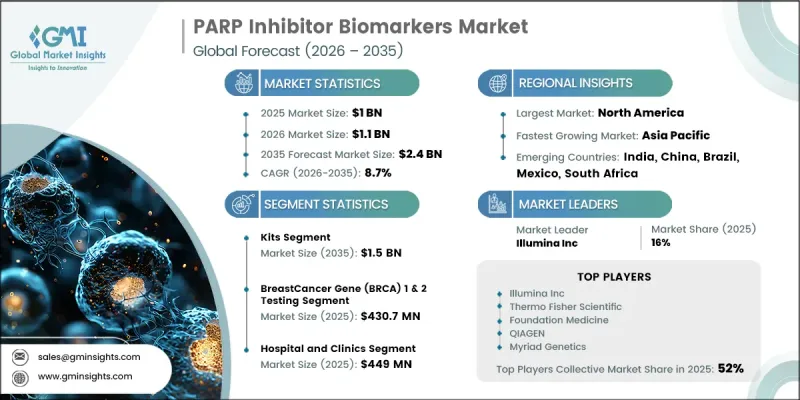
The Global PARP Inhibitor Biomarkers Market was valued at USD 1 billion in 2025 and is estimated to grow at a CAGR of 8.7% to reach USD 2.4 billion by 2035.
The market is witnessing notable momentum due to the growing incidence of breast cancer, rapid progress in genomic research, and increasing investments in oncology treatment worldwide. PARP inhibitor biomarkers have become essential in precision medicine as healthcare providers continue focusing on targeted therapies that improve treatment effectiveness and patient outcomes. The industry is also benefiting from advancements in molecular diagnostics, which enable healthcare professionals to identify suitable patients with greater accuracy. Rising awareness regarding early cancer detection and personalized medicine is further supporting demand for biomarker-based testing solutions. In addition, pharmaceutical and diagnostic companies are strengthening research initiatives to develop advanced testing technologies that improve clinical decision-making. Expanding healthcare infrastructure, growing adoption of companion diagnostics, and increasing demand for precision oncology solutions are collectively accelerating market development. The integration of advanced genetic testing into routine clinical workflows, along with increasing acceptance of biomarker-guided therapies, is expected to continue shaping the long-term outlook of the PARP inhibitor biomarkers industry.
| Market Scope | |
|---|---|
| Start Year | 2025 |
| Forecast Year | 2026-2035 |
| Start Value | $1 Billion |
| Forecast Value | $2.4 Billion |
| CAGR | 8.7% |
PARP inhibitor biomarkers are genetic markers that help identify cancer patients who are more likely to benefit from PARP inhibitor therapies. These biomarkers are widely utilized in precision oncology to support targeted treatment strategies and improve therapeutic outcomes. The increasing burden of breast cancer worldwide continues to create strong demand for advanced biomarker testing solutions. Expanding use of molecular profiling and next-generation diagnostic technologies is further contributing to improved patient selection and treatment planning. In addition, the growing emphasis on personalized cancer care is driving the adoption of biomarker-based diagnostics across healthcare systems. Rising spending on cancer therapies and the growing availability of advanced treatment options are also strengthening market expansion. As healthcare providers increasingly prioritize targeted therapies with higher treatment efficiency, the demand for PARP inhibitor biomarkers is expected to rise steadily over the forecast period.
The kits segment is anticipated to reach USD 1.5 billion by 2035, supported by strong demand across hospitals, research facilities, and diagnostic laboratories. The segment continues to gain traction due to its convenience, standardized workflows, and ability to simplify biomarker testing procedures. Ready-to-use testing kits help reduce operational complexity while improving turnaround time and laboratory efficiency. Their broad adoption across clinical environments is also supporting large-scale screening and precision oncology programs. Furthermore, manufacturers are continuously introducing technologically advanced kits designed to deliver improved accuracy, reliability, and workflow compatibility. The increasing availability of automated and user-friendly solutions is further enhancing the position of the kits segment within the PARP inhibitor biomarkers market.
The breast cancer gene (BRCA) 1 & 2 testing segment generated USD 430.7 million in 2025. BRCA testing maintains a leading position in the market because of its critical role in identifying patients eligible for targeted PARP inhibitor therapies. These tests are widely incorporated into clinical oncology practices, particularly for patients diagnosed with breast and ovarian cancers. The growing acceptance of genetic screening programs and favorable clinical recommendations supporting BRCA testing are accelerating segment growth. In addition, rising awareness regarding hereditary cancer risks and increasing access to genetic counseling services are encouraging more individuals to undergo early-stage testing. The increasing focus on precision diagnostics and early treatment intervention is expected to further strengthen demand for BRCA 1 & 2 testing solutions.
North America PARP Inhibitor Biomarkers Market accounted for 40.7% share in 2025. The regional market is experiencing strong growth due to the rising prevalence of breast cancer and increasing adoption of advanced diagnostic technologies. The region records a substantial number of cancer diagnoses each year, creating significant demand for biomarker-driven treatment strategies. Greater awareness regarding cancer screening and early diagnosis programs is also contributing to higher testing volumes across healthcare institutions. Furthermore, the increasing occurrence of hereditary breast cancer cases linked to BRCA mutations is accelerating the adoption of PARP inhibitor biomarker testing. Strong healthcare infrastructure, high healthcare expenditure, and continued advancements in precision oncology are expected to support sustained market expansion across North America.
Prominent companies operating in the Global PARP Inhibitor Biomarkers Market include Agilent Technologies, Thermo Fisher Scientific, Foundation Medicine, Myriad Genetics, Illumina Inc., QIAGEN, Guardant Health, Invitae, Ambry Genetics, EntroGen, Amoy Diagnostics, BPS Bioscience, and Pillar Biosciences. Companies operating in the PARP inhibitor biomarkers market are implementing several strategic initiatives to strengthen their competitive positioning and expand market presence. Leading players are heavily investing in research and development activities to introduce advanced genomic testing technologies with improved sensitivity and accuracy. Strategic collaborations between pharmaceutical companies, diagnostic developers, and healthcare institutions are helping accelerate biomarker discovery and commercialization. Many organizations are also focusing on regulatory approvals and product launches to broaden their diagnostic portfolios and enhance clinical adoption. Expansion into emerging healthcare markets, increased investment in precision oncology infrastructure, and partnerships for companion diagnostic development are further supporting business growth.
Table of Contents
Chapter 1 Research Methodology
- 1.1 Research approach
- 1.2 Quality commitments
- 1.2.1 GMI AI policy & data integrity commitment
- 1.2.1.1 Source consistency protocol
- 1.2.1 GMI AI policy & data integrity commitment
- 1.3 Research trail & confidence scoring
- 1.3.1 Research trail components
- 1.3.2 Scoring components
- 1.4 Data collection
- 1.4.1 Partial list of primary sources
- 1.5 Data mining sources
- 1.5.1 Paid sources
- 1.5.1.1 Sources, by region
- 1.5.1 Paid sources
- 1.6 Base estimates and calculations
- 1.6.1 Base year calculation for any one approach
- 1.7 Forecast model
- 1.7.1 Quantified market impact analysis
- 1.7.1.1 Mathematical impact of growth parameters on forecast
- 1.7.1 Quantified market impact analysis
- 1.8 Research transparency addendum
- 1.8.1 Source attribution framework
- 1.8.2 Quality assurance metrics
- 1.8.3 Our commitment to trust
Chapter 2 Executive Summary
- 2.1 Industry 3600 synopsis
- 2.2 Key market trends
- 2.2.1 Product trends
- 2.2.2 Service trends
- 2.2.3 Technology trends
- 2.2.4 Application trends
- 2.2.5 End use trends
- 2.2.6 Regional trends
- 2.3 CXO perspectives: Strategic imperatives
Chapter 3 Industry Insights
- 3.1 Industry ecosystem analysis
- 3.2 Industry impact forces
- 3.2.1 Growth drivers
- 3.2.1.1 Increasing prevalence of breast cancer
- 3.2.1.2 Advancements in genomic technologies
- 3.2.1.3 Rising expenditure for cancer treatment
- 3.2.1.4 Growing adoption of personalized medicine and precision therapy
- 3.2.2 Industry pitfalls and challenges
- 3.2.2.1 High cost of PARP inhibitor biomarker test kits and assays
- 3.2.2.2 Limited awareness and understanding of PARP inhibitor biomarkers
- 3.2.3 Market opportunities
- 3.2.3.1 Liquid biopsy & ctDNA-based testing expansion
- 3.2.1 Growth drivers
- 3.3 Growth potential analysis
- 3.4 Regulatory landscape (Driven by primary research)
- 3.4.1 North America
- 3.4.2 Europe
- 3.4.3 Asia Pacific
- 3.4.4 Latin America
- 3.4.5 Middle East and Africa
- 3.5 Technology landscape (Driven by primary research)
- 3.5.1 Current technological trends
- 3.5.1.1 Expansion of companion diagnostics integration
- 3.5.1.2 Improved multiplex biomarker panels
- 3.5.2 Emerging technologies
- 3.5.2.1 Rise of liquid biopsy and ctDNA testing
- 3.5.2.2 Integration of AI and bioinformatics in genomics
- 3.5.1 Current technological trends
- 3.6 Future market trends (Driven by primary research)
- 3.7 Impact of AI and Generative AI on the market (Driven by primary research)
- 3.8 Pricing trend analysis (Driven by primary research)
- 3.9 Porter's analysis
- 3.10 PESTEL analysis
Chapter 4 Competitive Landscape, 2025
- 4.1 Introduction
- 4.2 Company market share analysis
- 4.2.1 Global
- 4.2.2 North America
- 4.2.3 Europe
- 4.2.4 Asia Pacific
- 4.3 Company matrix analysis
- 4.4 Competitive analysis of major market players
- 4.5 Competitive positioning matrix
- 4.6 Key developments
- 4.6.1 Mergers and acquisitions
- 4.6.2 Partnerships and collaborations
- 4.6.3 New product launches
- 4.6.4 Expansion plans
Chapter 5 Market Estimates and Forecast, By Product, 2022 - 2035 ($ Mn)
- 5.1 Key trends
- 5.2 Kits
- 5.3 Assays
Chapter 6 Market Estimates and Forecast, By Service, 2022 - 2035 ($ Mn)
- 6.1 Key trends
- 6.2 Breast cancer gene (BRCA) 1 & 2 testing
- 6.3 Homologous recombination deficiency (HRD) testing
- 6.4 Homologous recombination repair (HRR) testing
- 6.5 Other services
Chapter 7 Market Estimates and Forecast, By Technology, 2022 - 2035 ($ Mn)
- 7.1 Key trends
- 7.2 Next-generation sequencing
- 7.3 Polymerase Chain Reaction
- 7.4 Immunohistochemistry
- 7.5 In situ hybridization
- 7.6 other technologies
Chapter 8 Market Estimates and Forecast, By Application, 2022 - 2035 ($ Mn)
- 8.1 Key trends
- 8.2 Breast cancer
- 8.3 Ovarian cancer
- 8.4 Pancreatic cancer
- 8.5 Prostate cancer
- 8.6 Other applications
Chapter 9 Market Estimates and Forecast, By End Use, 2022 - 2035 ($ Mn)
- 9.1 Key trends
- 9.2 Hospitals and fertility clinics
- 9.3 Home care
- 9.4 Other end users
Chapter 10 Market Estimates and Forecast, By Region, 2022 - 2035 ($ Mn)
- 10.1 Key trends
- 10.2 North America
- 10.2.1 U.S.
- 10.2.2 Canada
- 10.3 Europe
- 10.3.1 Germany
- 10.3.2 UK
- 10.3.3 France
- 10.3.4 Spain
- 10.3.5 Italy
- 10.3.6 Netherlands
- 10.4 Asia Pacific
- 10.4.1 China
- 10.4.2 Japan
- 10.4.3 India
- 10.4.4 Australia
- 10.4.5 South Korea
- 10.5 Latin America
- 10.5.1 Brazil
- 10.5.2 Mexico
- 10.5.3 Argentina
- 10.6 Middle East and Africa
- 10.6.1 South Africa
- 10.6.2 Saudi Arabia
- 10.6.3 UAE
Chapter 11 Company Profiles
- 11.1 Agilent Technologies
- 11.2 Ambry Genetics
- 11.3 Amoy Diagnostics
- 11.4 BPS Bioscience
- 11.5 EntroGen
- 11.6 Foundation Medicine
- 11.7 Guardant Health
- 11.8 Illumina Inc.
- 11.9 Invitae
- 11.10 Myriad Genetics
- 11.11 Pillar Biosciences
- 11.12 QIAGEN
- 11.13 Thermo Fisher Scientific

