PUBLISHER: Global Market Insights Inc. | PRODUCT CODE: 2061490

PUBLISHER: Global Market Insights Inc. | PRODUCT CODE: 2061490
North America Residential HVAC Market Opportunity, Growth Drivers, Industry Trend Analysis, and Forecast 2026 - 2035
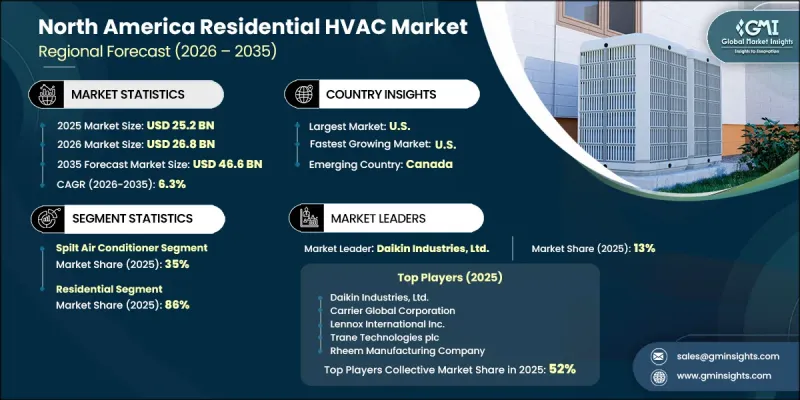
North America Residential HVAC Market was valued at USD 25.2 billion in 2025 and is estimated to grow at a CAGR of 6.3% to reach USD 46.6 billion by 2035.
The market continues to evolve steadily as homeowners increasingly prioritize indoor comfort, energy efficiency, and long-term operational savings when selecting heating and cooling systems. Growing demand for connected living environments is encouraging wider adoption of HVAC systems integrated with smart technologies that improve convenience, system control, and energy management. Consumers are also showing stronger interest in environmentally responsible products as regulatory standards continue to encourage the transition toward lower-impact refrigerants and energy-efficient technologies. Across North America, many households are replacing aging HVAC systems with modern alternatives that offer quieter operation, improved indoor air quality, and enhanced performance. Demand for advanced climate-control systems is also being supported by rising awareness regarding sustainability and home energy optimization. Heat pump adoption continues to increase as homeowners recognize the long-term environmental and financial advantages associated with energy-efficient heating and cooling technologies. In addition, supportive incentive programs and the growing preference for modern residential infrastructure are contributing to sustained expansion within the North America residential HVAC industry.
| Market Scope | |
|---|---|
| Start Year | 2025 |
| Forecast Year | 2026-2035 |
| Start Value | $25.2 Billion |
| Forecast Value | $46.6 Billion |
| CAGR | 6.3% |
The split air conditioner segment accounted for 35% share in 2025. Split air conditioning systems continue to maintain strong popularity across North America due to their straightforward installation process, widespread product familiarity, and strong service network support. Homeowners continue to favor these systems because they provide reliable cooling performance while allowing easier upgrades to existing residential properties. Their established market presence and broad product availability continue to support strong consumer demand. The continued preference for unitary air conditioning systems further reinforces the dominant position of split air conditioners within the North America residential HVAC market.
In 2025, the residential segment held a share of 86%, generating USD 21.6 billion. The residential sector remains the primary driver of HVAC demand across North America as many households continue to operate aging heating and cooling systems that require replacement. Growing consumer awareness regarding indoor air quality, energy conservation, and long-term cost savings is encouraging homeowners to invest in advanced HVAC technologies. Demand for modern air conditioning systems, energy-efficient heat pumps, and intelligent climate-control solutions continues to increase as consumers seek improved comfort and reduced energy consumption. Ongoing home renovation and system upgrade activities are expected to maintain strong momentum for the residential HVAC segment throughout the forecast period.
U.S. Residential HVAC Market held an 89% share, generating USD 22.4 billion in 2025. The country continues to lead the regional market due to widespread reliance on residential air conditioning systems and strong demand for replacement and retrofit solutions. A substantial number of older residential properties across the U.S. continue to require modern, energy-efficient HVAC upgrades, supporting consistent product demand. The country also benefits from a highly developed construction industry, strong distribution networks, and increasing consumer preference for advanced heating and cooling technologies. Rising focus on energy efficiency standards and smart home integration continues to strengthen the U.S. position within the North America residential HVAC market.
Major companies operating in the North America Residential HVAC Market include Trane Technologies plc, Carrier Global Corporation, Daikin Industries, Ltd., Lennox International Inc., Rheem Manufacturing Company, Mitsubishi Electric Corporation, LG Electronics Inc., Panasonic Corporation, Fujitsu General Limited, Gree Electric Appliances Inc., Samsung Electronics Co., Ltd., Nortek Global HVAC, Friedrich Air Conditioning Co., Hisense Group, and Johnson Controls. Companies operating in the North America Residential HVAC Market are implementing several strategies to strengthen their market presence and improve competitive positioning. Leading manufacturers are investing heavily in energy-efficient technologies, smart HVAC systems, and environmentally sustainable refrigerants to align with changing regulatory standards and consumer preferences. Businesses are also focusing on connected home integration by developing advanced systems with remote monitoring, automation, and intelligent climate-control capabilities. Strategic partnerships with contractors, distributors, and home builders are helping companies expand market reach and improve customer accessibility. In addition, manufacturers are increasing investments in research and development to improve system performance, indoor air quality, and energy savings.
Table of Contents
Chapter 1 Methodology and Scope
- 1.1 Research approach
- 1.2 Quality Commitments
- 1.2.1 GMI AI policy & data integrity commitment
- 1.2.1.1 Source consistency protocol
- 1.2.1 GMI AI policy & data integrity commitment
- 1.3 Research Trail & Confidence Scoring
- 1.3.1 Research Trail Components
- 1.3.2 Scoring Components
- 1.4 Data Collection
- 1.4.1 Partial list of primary sources
- 1.5 Data mining sources
- 1.5.1 Paid sources
- 1.5.1.1 Sources, by region
- 1.5.1 Paid sources
- 1.6 Base estimates and calculations
- 1.6.1 Base year calculation for any one approach
- 1.7 Forecast model
- 1.7.1 Quantified market impact analysis
- 1.7.1.1 Mathematical impact of growth parameters on forecast
- 1.7.1 Quantified market impact analysis
- 1.8 Research transparency addendum
- 1.8.1 Source attribution framework
- 1.8.2 Quality assurance metrics
- 1.8.3 Our commitment to trust
Chapter 2 Executive Summary
- 2.1 Industry 360° synopsis
- 2.2 Key market trends
- 2.2.1 Product type trends
- 2.2.2 Application trends
- 2.2.3 Installation trends
- 2.2.4 Distribution channel trends
Chapter 3 Industry Insights
- 3.1 Residential HVAC industry ecosystem analysis
- 3.1.1 Raw material suppliers
- 3.1.2 Component manufacturers
- 3.1.3 HVAC system manufacturers
- 3.1.4 Distributors and wholesalers
- 3.1.5 Contractors and installers
- 3.1.6 End users
- 3.1.7 Value addition at each stage
- 3.1.8 Factors affecting the value chain
- 3.2 Industry impact forces
- 3.2.1 Growth drivers
- 3.2.2 Industry pitfalls & challenges
- 3.2.3 Market opportunities
- 3.3 Growth potential analysis
- 3.4 Regulatory landscape
- 3.4.1 Energy efficiency and performance standards (DOE, ENERGY STAR)
- 3.4.2 Refrigerant phase-down regulations (EPA SNAP, AIM Act)
- 3.4.3 Import and trade compliance
- 3.4.4 Sustainability reporting and ESG transparency
- 3.4.5 Cybersecurity and data privacy (for connected devices)
- 3.5 Major market trends and disruptions
- 3.5.1 Intensified competition and speed to market pressure
- 3.5.2 Supply chain disruptions and sourcing volatility
- 3.5.3 Rising costs and margin pressures
- 3.5.4 Technological innovation and digital integration
- 3.5.5 Market consolidation and brand alliances
- 3.5.6 Sustainability and regulatory compliance
- 3.6 Technological and innovation landscape
- 3.6.1 Current technological trends
- 3.6.1.1 Sustainable product innovation
- 3.6.1.2 Modular and ergonomic system design
- 3.6.1.3 Data-driven R&D and customer-centric innovation
- 3.6.1 Current technological trends
- 3.7 Emerging technologies
- 3.8 Pricing analysis (driven by primary research)
- 3.8.1 Historical price trend analysis (2022-2025)
- 3.8.2 Pricing strategy by player type (premium/value/cost-plus)
- 3.8.3 Regional price variation analysis
- 3.9 Future market trends
- 3.9.1 Energy efficiency and electrification
- 3.9.2 Smart connectivity and predictive maintenance
- 3.9.3 Indoor air quality (IAQ) and health-focused solutions
- 3.9.4 direct-to-consumer and omnichannel expansion
- 3.9.5 Climate-resilient and regional customization
- 3.10 Porter’s analysis
- 3.11 PESTEL analysis
- 3.12 Supply chain analysis
- 3.12.1 Supply chain disruptions and sourcing volatility
- 3.12.2 Regional sourcing strategies
- 3.12.3 Supply chain resilience initiatives
- 3.13 Trade data analysis (driven by paid database)
- 3.13.1 Import/export volume and value trends (HS codes 8415, 8418)
- 3.13.2 Key trade corridors and tariff impact
- 3.13.3 Country-of-origin analysis for major components
- 3.14 Impact of AI and generative AI on the market
- 3.14.1 AI-driven disruption of existing business models
- 3.14.2 GenAI use cases and adoption roadmap by segment
- 3.14.2.1 Predictive maintenance and diagnostics
- 3.14.2.2 Energy optimization algorithms
- 3.14.2.3 Customer service and support automation
- 3.14.3 Risks, limitations, and regulatory considerations
- 3.15 Capacity and production landscape (driven by primary research)
- 3.15.1 Installed manufacturing capacity by region and key producers
- 3.15.2 Capacity utilization rates and expansion pipelines
- 3.15.3 Domestic vs. import-reliant supply structure
Chapter 4 Competitive Landscape, 2025
- 4.1 Introduction
- 4.2 Company market share analysis
- 4.3 Company matrix analysis
- 4.4 Competitive analysis of major market players
- 4.5 Competitive positioning matrix
- 4.6 Key developments
- 4.6.1 Mergers & acquisitions
- 4.6.2 Partnerships & collaborations
- 4.6.3 New product launches
- 4.6.4 Expansion plans
Chapter 5 Market Estimates & Forecast, By Product Type, 2022-2035 (USD Billion) (Thousand Units)
- 5.1 Key trends
- 5.2 Heat pumps
- 5.2.1 Ducted
- 5.2.1.1 Vertical discharge
- 5.2.1.2 Side discharge
- 5.2.2 Ductless
- 5.2.1 Ducted
- 5.3 Spilt air conditioner
- 5.3.1 Ducted
- 5.3.1.1 Vertical discharge
- 5.3.1.2 Side discharge
- 5.3.2 Ductless
- 5.3.1 Ducted
- 5.4 Furnace
- 5.4.1 Gas furnaces
- 5.4.2 Oil furnaces
Chapter 6 Market Estimates & Forecast, By Application, 2022-2035 (USD Billion) (Thousand Units)
- 6.1 Key trends
- 6.2 Residential
- 6.2.1 Single family
- 6.2.2 Multi family
- 6.3 Light commercial
Chapter 7 Market Estimates & Forecast, By Installation, 2022-2035 (USD Billion) (Thousand Units)
- 7.1 Key trends
- 7.2 New construction
- 7.3 Replacement/retrofit
Chapter 8 Market Estimates & Forecast, By Distribution Channel, 2022-2035 (USD Billion) (Thousand Units)
- 8.1 Key trends
- 8.2 Direct sales
- 8.3 Indirect sales
Chapter 9 Market Estimates & Forecast, By Country, 2022-2035 (USD Billion) (Thousand Units)
- 9.1 Key trends
- 9.2 U.S.
- 9.3 Canada
Chapter 10 Company Profiles
- 10.1 American Standard
- 10.2 Bosch
- 10.3 Bryant Heating & Cooling Systems
- 10.4 Carrier
- 10.5 Daikin
- 10.6 Goodman Manufacturing
- 10.7 Honeywell
- 10.8 Ingersoll Rand
- 10.9 Johnson Controls
- 10.10 Lennox
- 10.11 LG Electronics USA
- 10.12 Midea
- 10.13 Panasonic
- 10.14 Rheem
- 10.15 Trane Technologies

